
1. Introduction
Bacille Calmette-Guerin (BCG), a live attenuated strain of Mycobacterium bovis vaccine, is routinely given to infants at birth, in endemic regions with tuberculosis(1). Its administration may reduce the incidence of tuberculosis by up to 87.6% with a wide range of reports (2). This is considered safe in general, but there can be several complications, ranging from regional edema and induration (BCG-itis) to disseminated infection (BCG-osis). The most common complication is abscess formation or suppurative lymphadenitis (3). However, BCG-osis, which is reported with incidence is 0.1 to 4.3 per one million vaccinated children tends to be very serious and has a high mortality rate (4), (5). We report a boy with a history of fever and respiratory complaints and hepatosplenomegaly and SCID as immunodeficiency.
2. Case Presentation
A 4-month-old boy was admitted with a one-month history of fever and dry cough. He was administered different kinds of oral and intravenous antibiotics, with no improvement. He was the fourth child of consanguineous parents. The first child of the family was an eight-year-old healthy girl, the second and third children died of severe pulmonary infections in infancy and possible immunodeficiency, though both were fully immunized. His condition and growth parameters were normal based on his mother report. Physical examination proved he had poor growth (height and weight < 3th percentile and head circumference at the 50th percentile) with hepatosplenomegaly (the liver was palpated at 5 - 6 cm below the costal margin) and splenomegaly (the spleen was palpated 5 - 6 cm below the costal margin) and diffuse pink to purple maculopapular rash on his body which did not resolve until his death. His laboratory tests showed anemia, lymphopenia < 3000/ [mm3], normal platelet count, prolonged PT (prothrombin time) and PTT (partial thromboplastin time), high ESR and CRP (C-reactive protein), high LDH and ferritin and progressive increase in cholesterol and triglyceride and low fibrinogen. Bone marrow aspiration did not show any histological figure for malignancy, Hemophagocytosis and complement profile were normal. Flow cytometry and immunoglobulin electrophoresis results are shown in Table 1 and 2.
Table 1.
Flow Cytometry Results of Patient
| Patient Result% | Reference Value% | |
|---|---|---|
| CD3 | 9 | 59 - 85 |
| CD4 | 7 | 30 - 60 |
| CD8 | 1 | 11 - 38 |
| CD19 | 65 | 6.4 - 23 |
| CD56 | 1 | 5.6 - 31 |
Table 2.
Immunoglobulin Electrophoresis of Patient
| Patient Result | Reference Value | |
|---|---|---|
| IgG | 2.1 g/dl | 6.58 - 18.37 g/dl |
| IgA | < 0.3 g/dl | 0.7 - 3.6 g/dl |
| IgM | 2 g/dl | 0.4 - 2.67 g/dl |
| IgE Elisa | 1Iu/ml | Neonate <11 12mo<25 |
| 1 - 10yr < 144 adult<188 |
Chest X-ray and CT scan are shown in Figure 1 and 2.

Figure 1.
Abdominal CT Scan Shows Hypoechoic Lesions With 2 - 2.5 Cm Diameter Which Were Observed in Liver as Scattered Micro-Abscesses and Heterogenic Spleen, Kidneys Shows Hypertrophy
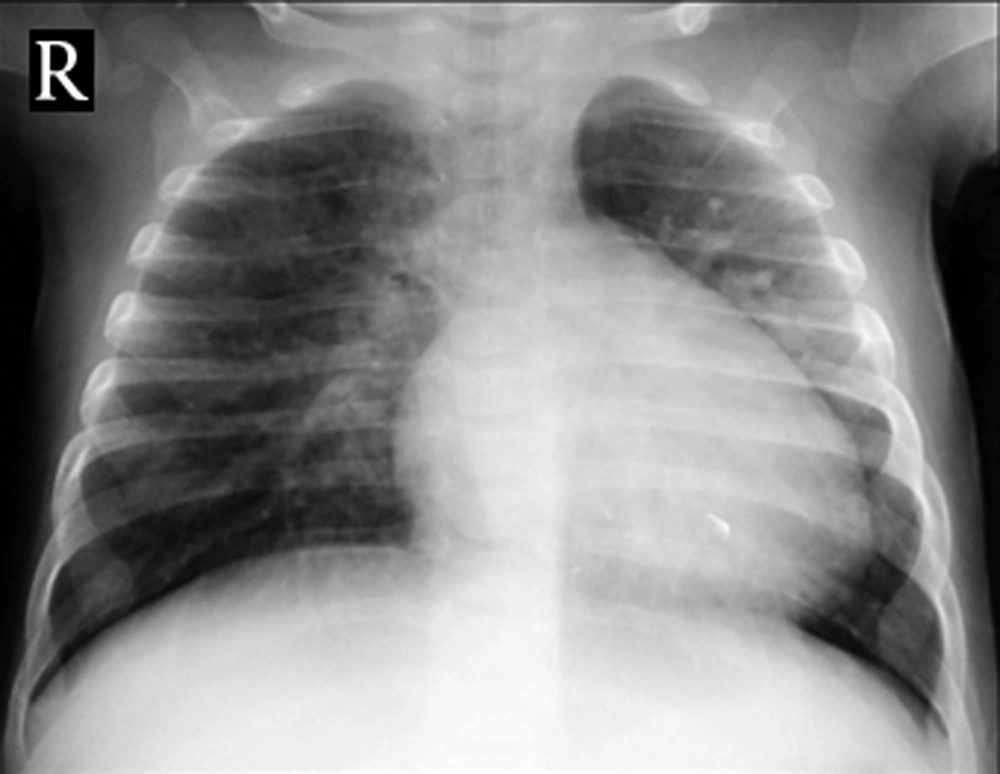
Figure 2.
Chest X-Ray Shows Scattered Interstitial Pulmonary Infiltrations
Anti-tuberculosis (isoniazide, rifampin, ethambutol, clarithromycin, ciprofloxacin), Pneumocystis carinii (co-trimoxazole), cytomegalovirus (ganciclovir, valacyclovir) and fungal infection (amphotericin B) treatment and supplementary intermittent IVIG and gamma-interferon were started for him, and he became candidate for bone marrow transplantation, but after three months of treatment he died because of disseminated infection. He was diagnosed with disseminated BCG (Bacille Calmette-Guerin) infection (BCG-osis) and SCID (severe combined immunodeficiency). The PCR on the bone marrow specimen of the patient was positive for Mycobacterium bovis BCG strain (Masih Daneshvari Hospital Mycobacteriology Laboratory). Primary immunodeficiency is an important risk factor for disseminated infection in children who receive live vaccines especially in the first few months of life. Disseminated BCG-osis is the most common infections in SCID, meanwhile other immunodeficiency syndromes such as chronic granulomatous disease (CGD), and IFN-ȣ receptor 1 or 2 deficiencies, IL-12/β receptor b1 chain deficiency, IL-12p40 deficiency, and STAT1 deficiency can predispose the patients to disseminated BCG infections (5-12). In this patient, T- B+ NK – variant was the responsible immunologic defect.
Based on diagnostic guideline for hemophagocytic lymphohistiocytosis (HLH) syndrome, our patient had five out of eight criteria for diagnosis which are fever, splenomegaly, hypertriglyceridemia (298 mg/ dL; ≥ 265 mg/dL is abnormal) and/or hypofibrinogenemia (39mg/ dL, (≤ 150 mg/dL is abnormal), low or absent NK cell cytotoxicity (as shown by flowcytometry), and finally hyperferritinemia (1244 ng/mL; (> 500 ng/mL is abnormal). IL-2Rɤ common chain (X-linked T-B+ NK- SCID), the probable type of immunodeficiency in this patient, is thought to be associated with HLH (13). There are recent reports of coincidence of HLH and disseminated or complicated tuberculosis infection (14, 15). This patient seems to have disseminated BCG-osis and T-B+ NK- SCID immunodeficiency and HLH syndrome. BCG vaccination does not prevent tuberculosis infection, but disseminated and meningeal tuberculosis is prevented in 50-80% of immune competent cases (16). On the other hand, BCG vaccination at birth can have specific effects on T cell function even in normal infants. It was reported for the first time that BCG suppresses αβ TCR+ T cell counts in healthy infants vaccinated with BCG, but it was not shown that these quantitative changes could lead to functional derangements in T cells’ response However, if it was, this result could be considered important to communities with low income and high malnutrition and/or infectious disease prevalence (17).
3. Conclusions
The incidence of new smear positive tuberculosis cases in Iran is approximately high and reaches to 135/100,000 in eastern Iran’s neighbor Afghanistan (18). BCG vaccination can be effective in reducing the prevalence of mortality and morbidity from tuberculosis in healthy children, but because of extremely low age of vaccination with a live organism in a human being with complete lack of knowledge of his immunologic status, and very low incidence of disseminated BCG-osis in live births (1/250,000) (19), it is wise to recommend postponing the BCG vaccination in families with a history of parental consanguinity and recurrent serious infections or death from infection. Our patient had these two risk factors simultaneously, but in the field of mass vaccination of infants it is hard for health care workers to obtain this information before vaccination. In view of cost effectiveness, policy making strategies in national vaccination programs can consider these important issues. The importance of this case review is demonstration of extreme delay in diagnosis and little attention to family history of death in previous siblings by physicians. Pediatricians are recommended to be aware of possibility of immunodeficiency in infants with positive family history of unusual infections or death, persistent lymphopenia and difficult and/or impossible to treat infections. In suspected neonates of primary immunodeficiency disease, live vaccine is better to be postponed, until appropriate screening tests is developed.