Full Text
Full text is available in PDF
Archives of Clinical Infectious Diseases
Infectious Diseases and Tropical Medicine Research Center, SBUMS
Authors
Nowadays the molecular methods widely use for rapid identification of Mycobacterium other than tuberculosis (MOTT). The Mycobacterium simiae isolates are cause of majority of human pulmonary diseases compared with other atypical mycobacteria. As sensitivity of primers and digestion patterns for diversified fragments is different, this survey evaluated the three various fragments using the PCR- restriction fragment length polymorphism analysis (PRA) for rapid diagnostic of M. simiae isolates.
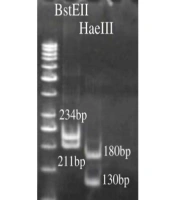
Strains that were identified as M. simiae (17 isolates) by phenotypic (photochromogen and positive niacin) methods were selected for this study. The fragments of the 16S-23S rRNA gene spacer and hsp65 gene were amplified by PCR. Subsequently the amplicons were digested with three restriction enzyme namely AvaII, HphI and HpaII for a 644bp region of hsp65 DNAs, BstEII and HaeIII endonucleases for 439bp region of hsp65 gene (TB11 and TB12 fragment) and HaeIII digestion for 225bp region of 16S-23S rRNA gene spacer.
Of 962 culture positive specimens, 17(1.7%) were identified as M. simiae species; majority of them were multidrug-resistance (12; 70.5%). The overall detection rate by Tb11, Tb12 and SP primers were 82.3% whereas hsp65 primer was 100% (p>0.005). We also found out that the HpaII and HphI enzymes were more specific to distinguish M. simiae species than other restriction enzyme used in this study.
The high discriminative power of hsp65 pattern particularly HpaII digestion, provide an exact and costeffective method for rapid identification of M. simiae strains among registered pulmonary cases.
© 2010, Author(s). This open-access article is available under the Creative Commons Attribution 4.0 (CC BY 4.0) International License (https://creativecommons.org/licenses/by/4.0/), which allows for unrestricted use, distribution, and reproduction in any medium, provided that the original work is properly cited.
Malekshahian D, Tabarsi P, Farnia P, Javanmard P, Seif S, et al. Mycobacterium simiae Isolates Subtypes and Molecular Drug Susceptibility in Iran. Arch Clin Infect Dis. 2022;17(3):e127866. doi: https://doi.org/10.5812/archcid-127866

Sheikholslami MF, Farnia P, Tabarsi P, Aghali Merza M. Comparison of polymerase chain reaction single-strand conformation polymorphism with DNA sequencing to detect drug resistance of mycobacterium tuberculosis isolates. Arch Clin Infect Dis. 2011;6(2):e93411. doi:
Rafiee B, Mosavari N, Ghani S, Sadeghi D, Keshavarz R, et al. Molecular Characterization of Mycobacterium bovis Isolates with High Copy Number of IS6110 by Restriction Fragment Length Polymorphism. Zahedan J Res Med Sci. 2013;16(12):72-74. doi:
Kamali-Kakhki R, Neshani A. Alpha/Beta Hydrolase Gene as a Novel Specific Target for Mycobacterium simiae Using Computational Analyses. Arch Clin Infect Dis. 2026;21(3):e172136. doi: https://doi.org/10.5812/archcid-172136

Ravansalar H, Tadayon K, Mosavari N, Derakhshan M, Ghazvini K. Genetic Diversity of Mycobacterium tuberculosis Complex Isolated from Patients in the Northeast of Iran by MIRU-VNTR and Spoligotyping. Jundishapur J Microbiol. 2017;10(4):e39568. doi: https://doi.org/10.5812/jjm.39568
Last Update: 3 weeks ago
Last Update: 3 weeks ago
Last Update: 3 weeks ago
Last Update: 7 hours ago
Last Update: 1 day ago
Last Update: 4 days ago