
1. Background
Most daily and sports activities require a good performance of hand grip. Grip strength and endurance, the ability of the hand to generate and maintain the muscle force, play a key role in many sports, including rock climbing, wrestling, judo, weight lifting, basketball, baseball, martial arts, and racket sports (1).
Eleven intrinsic and fifteen extrinsic muscles are involved in gripping activities (2). Flexor muscles in the hand and forearm create grip strength while forearm extensors stabilize the wrist during gripping activities (3). Grip strength reduction as a result of overuse of muscles during racket holding may have an effect on athletic performance and predispose players to injury (4).
Kinesio tape (KT), an elastic tape developed by Japanese chiropractor Kenzo Kase, has recently become popular as an integral component of prevention, rehabilitation, and training in competitive sports. Professor Kumbrink has emphasized the positive effect of KT on the improvement of muscle function (5). In the weakened muscle where supporting a full range of motion is desired, the tape is applied from origin to insertion of the muscle. While it is applied from insertion to origin to avoid muscle overuse. Indeed, KT is claimed to support the muscles by improving contraction; reducing fatigue; decreasing over-contracting; reducing cramp; increasing range of motion, and alleviating pain (6). KT application over the skin features a facilitating effect through stimulation of exteroceptors and proprioceptors; increasing sensory feedback from the taped area to transmit more signals to the CNS for integrating information and controlling motor functions (7, 8). It also seems that the cutaneous inputs from KT during muscle fatigue further contribute to the perception of position sense (9). Based on the previous research, KT is clinically effective on sports performance by enhancing muscle strength, stabilizing joints, performing fascial and mechanical corrections, and improving blood and lymphatic circulation (10, 11). However, some studies have shown conflicting results about the KT effects on grip force generation. Lee et al. (12), Lemos et al. (13), and Kouhzad Mohammadi et al. (14) indicated an enormous increase in grip strength following the KT. While Chang et al. (8), Limmer et al. (15), and Zhang et al. (16) declared that KT was not able to change hand grip. There is controversial evidence about the influence of KT on grip power (15, 16). A number of studies are consistent with the positive role of KT (12-14). Conversely, the others have not confirmed it (15, 16). Furthermore, there have been challenging debates on how to apply KT on muscle to enhance power in recent years, from origin to insertion or inversely (17).
Generally, there are a lot of ambiguities about the impact of KT on muscle strength, particularly on hand grip, especially during sports activities. The wide disagreement about KT is related to the duration, location, and tension of the implemented KT. KT seems to have varying effects on muscle performance depending on its location and its tension (1). A meta-analysis of existing evidence by Csapo and Alegre emphasized the need to further explore the effect of KT on muscle strength and prevention of fatigue (17).
Overal, the scientific evidence of the KT effect on grip strength is inconclusive, and further studies are recommended to clarify this issue.
2. Objectives
Considering all the causes mentioned above and also the popularity of KT among elite athletes, the aim of this study was to explore the effect of various methods of forearm KT on hand grip strength and endurance of elite squash players during sporting activities.
3. Methods
3.1. Study Design
The study was conducted as a quasi-experimental trial on thirty-three elite female squash players. The sample size calculation was made using the G*Power statistics software (v.3.1.2, Universität Kiel, Alemanha), considering the Zanchet et al. (18) findings and assuming a power of 80%, effect size of 0.8 and α = 0.05, at least 30 athletes would be necessary to perform the study.
3.2. Ethics Codes
The study has been registered in the Iranian Registry of Clinical Trials by the ID of IRCT201406175486N4. Ethical approval was also received from the Iran University of Medical Sciences Scientific Ethics Committee (No: IR.IUMS.FMD.REC 93-02-30-24467), supporting the newest version of the Declaration of Helsinki.
3.3. Recruitment and Allocation
A total of 49 elite female squash players who were invited to the national squash team of the Iranian Squash Federation were recruited to this study. Considering the inclusion criteria, 33 players were allocated according to the random number generator software. For the purposes of enrolling the athletes, some inclusion criteria were considered. The criteria were age range of between 16-30; BMI between 20 - 25 kg/m2; lack of upper extremity injury during the last 3 months; lack of upper extremity intra-articular injection in the last 3 months; agreement to be included and no history of physical therapy in the last three months. The included athletes were requested to participate study sessions in which both assessment and intervention were performed concurrently. The research session was a regular squash training session that lasted between 60 and 85 minutes for each participant, and the players were clad in sportswear and engaged in their routine sport activities.
3.4. Taping Techniques
The KT was applied to the dominant hand by the researcher’s assistant consistent with the Edinburgh Handedness Inventory (10). The length of the tape on the flexor area was measured from 2 cm distal to the medial epicondyle of the humerus to the anterior line of the wrist, as supported by the previous guidelines. In KT on the extensor area, it was measured from 2 cm distal to the lateral epicondyle to the styloid process of the radius (14). All the athletes were asked to remove their forearm hair by shaving one day before the study, and an alcohol swab was used to clean the area just before taping. During the sport, KT was kept on the players’ skin for a maximum of 60 minutes. There is no specific sequence in which KT modes were employed in the players, and KT techniques were applied at random in each training session for each athlete.
3.4.1. KT on the Flexor Area
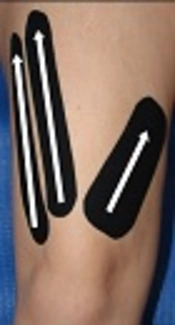
The forearm flexor muscles were placed in a stretched position (the elbow and wrist extended with the forearm supinated) while KT was being applied. Finally, a Y-shaped Temtex KT (Temtex Co., South Korea) was applied over the common wrist flexor muscles from their origin to insertion with 50% stretch tension.
3.4.2. KT on the Extensor Area
The athletes were asked to maintain the elbow extended, and the forearm pronated with the wrist in the neutral position during the taping. After cleaning the skin with an alcohol swab, a reverse Y-shaped Temtex KT was applied over the common wrist extensor muscles with 50% stretch tension.
3.4.3. Placebo KT
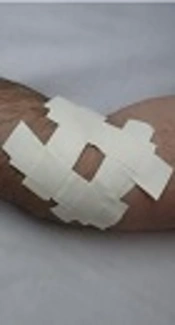
A 10 cm I-strip Temtex KT which was applied transversely without any stretching tension across the belly of the common wrist flexor exactly 5 cm distal to the medial epicondyle of the humerus to the medial side of the forearm, according to Chang et al. (8).
3.5. Study Tool
Hand grip has gained attention as an easy indicator of muscle strength assessment among the functional tests of the upper extremity. It is not only appropriate for clinical application, but it has also been used to determine upper limb impairment and predict possible injuries in athletes (14). In this study, the athletes’ hand grip strength (in Newtons) and endurance (in seconds) were measured using the MIE Digital Pinch/Grip Analyzer (MIE Medical Research Ltd, Leeds, UK) with CAS Software. The test-retest reliability for the MIE hand dynamometer indicated an intra-class correlation coefficient of 0.9085 (0.7174 - 0.9774) for grip strength and 0.9734 (0.9046 - 0.9928) for grip endurance in this study. The assessments were performed in a standardized approach announced by the American society of hand therapists for hand grip strength during which the participant was seated with the shoulder adducted and neutrally rotated, the elbow flexed at 90° and forearm in neutral and the wrist between 0° and 30° extension and between 0° and 15° ulnar deviation (19).
The participants were familiarized with assessment procedures one day before the testing session. Grip strength and endurance were evaluated during the players’ athletic practices. The dynamometer was calibrated prior to all evaluation sessions in compliance with the manufacturer’s instructions. The initial testing started with a warm-up program including ten hand grip repeats with a silicone ring hand gripper (10 lbs.) and upper limb stretching exercises. The assessment and taping both were applied on the dominant hand, and all tests were conducted by an expert examiner.
The athletes were asked to hold the handles of the grip analyzer without any support based on the manufacturer’s guideline and push it with maximum effort for five seconds with no feedback. The gripping was repeated 3 times with a 60-second rest between the trials, and the mean of the three measurements was recorded as the maximal strength grip. The grip strength was evaluated before, immediately, 30, and 60 minutes after taping during sport.
For evaluating the grip endurance, the dynamometer was set for grip endurance test , and 50% of the maximum grip strength was first determined for each player. The athlete was then asked to press the handle of the dynamometer within the range of 50% ± 5 of maximal strength and to hold the force as long as possible within the target range until exhaustion. The CAS Software measured the precise time in seconds during which the load was kept within the range. The grip endurance was evaluated before and 60 minutes after training in the four modes; no tape mode, KT on the flexor area, KT on the extensor area, and placebo KT.
3.6. Statistical Analysis
The Statistical Package for the Social Sciences (SPSS, Version 24, SPSS Inc., Chicago, IL, USA) was used to conduct the analysis. Dropout data were not included for analysis. The Kolmogorov-Smirnov test was used to determine data normality and revealed that the data on grip endurance had a normal distribution. Thus, the sample t-test was applied to determine the differences in grip endurance before and 60 min after training, and the ANOVA test was used for comparison of different modes of KT, and it was followed by the post hoc LSD test to compare the differences between the two groups. Nonparametric Friedman and Kruskal-Wallis tests were used to compare grip strength data immediately, 30, and 60 minutes after KT and the different KT modes, respectively. The level of significance was set at P ≤ 0.05.
4. Results
A total of thirty-three female squash players participated in this study, but statistical analysis was conducted on thirty-one individuals due to the exclusion of two (Figure 1). The age range of participants was 15 to 25 years (mean ± SD: 17.83 ± 3.14) and their BMI and squash experience were 21.71 ± 2.64 (kg/m2) and 6.01 ± 2.65 (years); respectively. The right hand was dominant in 94% of the participants.
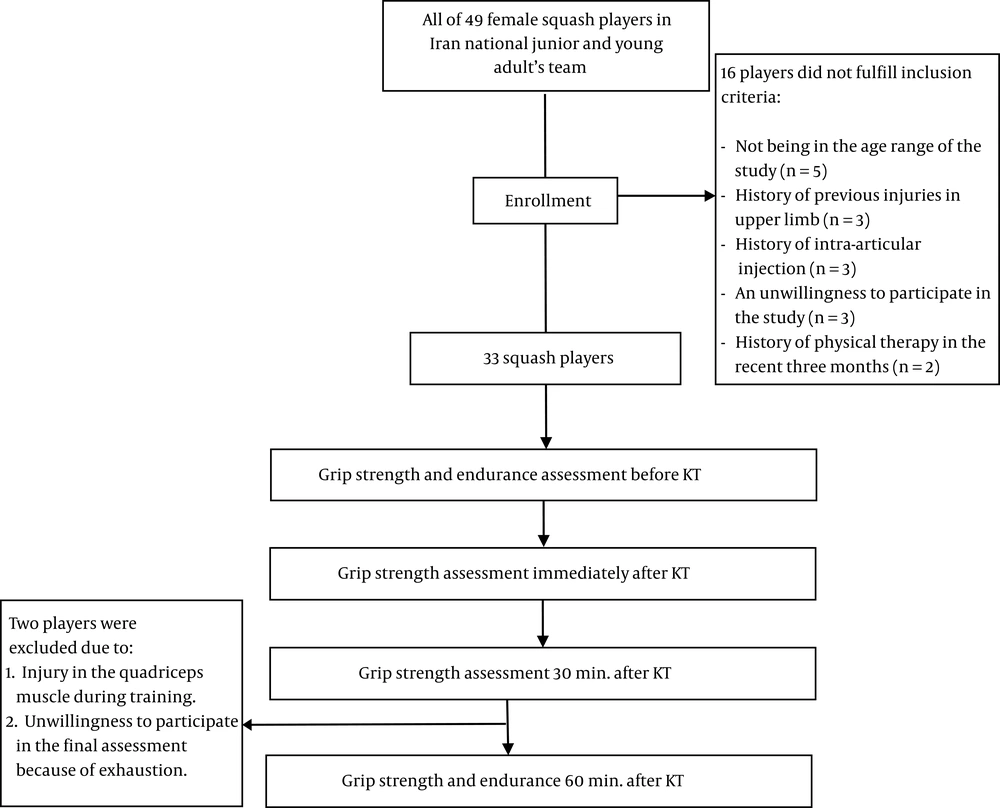
Figure 1.
Flow diagram of the participants.
Statistical analysis revealed no significant differences in grip strength at various times and locations of KT (Table 1). Figure 2 shows that there were no significant differences in flexor and extensor area taping.
Table 1.
Comparison Between Grip Strength at Different Times and Areas of Kinesio-Taping a
| Grip Strength (Newton) | Before KT | Immediately After KT | 30 Min After KT | 60 Min After KT | P Value (P ≤ 0.05) |
|---|---|---|---|---|---|
| Kinesio-taping on flexor area | 334.12 ± 65.89 | 335.19 ± 55.32 | 335.41 ± 46.66 | 334.69 ± 62.24 | 0.563 b |
| Kinesio-taping on extensor area | 332.94 ± 77.14 | 333.48 ± 78.16 | 334.20 ± 56.87 | 333.98 ± 49.25 | 0.832 b |
| Placebo Kinesio-taping | 335.67 ± 50.77 | 335.11 ± 61.27 | 334.71 ± 72.41 | 331.85 ± 71.13 | 0.754 b |
| P Value (P ≤ 0.05) | 0.138 c | 0.331 c | 0.578 c | 0.265 c |
a Values are presented as mean ± SD.
b Non-significant difference (Friedman test).
c Non-significant difference in the baseline (Kruskal-Wallis test).
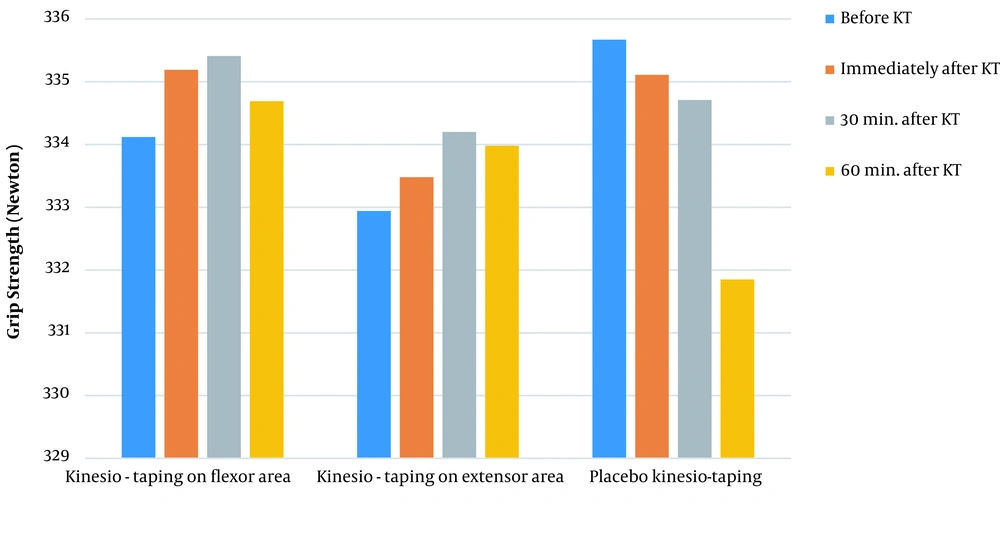
Figure 2.
Comparison between grip strength at different times and areas of Kinesio-taping
However, there have been significant differences in the grip endurance in no KT and placebo KT between before and 60 min after training employing a sample t-test and no significant differences were showed between the KT on flexor and extensor areas in the 60-minute training period (Figure 3).
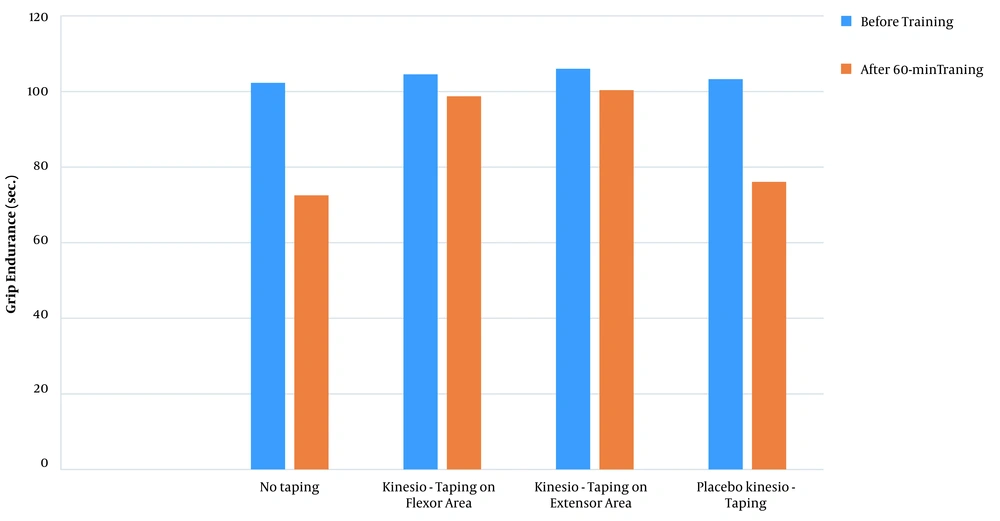
Figure 3.
Comparison between grip endurance before and 60-min after training
One-way ANOVA analysis showed a significant difference among KT groups and the LSD test revealed a significant increase in grip endurance in the mode of KT on extensor area (Table 2). As shown in Table 2, the grip endurance in the no KT mode was much lower than in the others.
Table 2.
Comparison Between Grip Endurance (Sec) Before and 60 Min After Kinesio-Taping a
| Grip Endurance (Seconds) | Before Training | 60 min After Training | P Value (P ≤ 0.05) |
|---|---|---|---|
| No taping | 102.29 ± 9.19 | 72.54 ± 14.88 | 0.001 b |
| Kinesio-taping on flexor area | 104.56 ± 8.92 | 98.74 ± 15.32 | 0.785 c |
| Kinesio-taping on extensor area | 106.01 ± 9.84 | 100.38 ± 8.54 | 0.457 c |
| Placebo Kinesio-taping | 103.29 ± 10.13 | 76.11 ± 8.96 | 0.003 b |
| P Value (P ≤ 0.05) | 0.094 d | 0.002 e |
a Values are presented as mean ± SD.
b Significant difference (sample t-test).
c Non-significant difference (sample t-test).
d Non-significant difference (ANOVA test).
e Significant difference (ANOVA test).
5. Discussion
The main purpose of this research was to study the effect of the various methods of forearm KT on the hand grip strength and endurance among the elite squash players. The findings did not reveal the superiority of the different methods of forearm KT on hand grip at different times. Furthermore, we did not observe significant differences in hand grip endurance between before and after 60 minutes with KT over both areas of the forearm suggesting the great effect of KT on retaining grip endurance and avoiding fatigue. The above findings were consistent with recent observations that there were no major improvements in muscle strength efficiency following KT (15, 20, 21). In accordance with the results of this study, the Zanchet et al. findings did not support the use of “I” shape KT on the ventral forearm in increasing muscle strength in healthy athletes (18). Zhang et al. also showed the incapacity of forearm KT to reinforce hand grip strength immediately in healthy athletes (16). Thus, the impact of KT on muscle contraction because of its sensory inputs might be a placebo effect. The findings of this study were in contrast to the hypothesis of athletes, coaches, sports medicine practitioners, and sports therapists regarding the beneficial effect of KT on increasing grip strength.
There are several reports of positive effects of KT on increasing the grip strength of healthy and non-healthy athletes (10, 12-14). The increased muscle activity of injured athletes could be partially attributed to the pain relief produced by KT and not its benefits in facilitating muscle strength. However, further investigations are required to verify the effects of KT. Our results demonstrated no or little changes in grip strength of the dominant hand immediately, 30 and 60 minutes after KT in the forearm extensor and flexor areas compared to placebo KT, which is compatible with most recent power grip studies (15, 16, 20-22). As well, the findings of several studies on the strength of other muscles, with the exception of hand grip muscles did not suggest beneficial effects for KT (23, 24). The meta-analysis conducted by Csapo and Alegre also announced that KT has no or negligible impact on muscle performance (17).
One plausible explanation for non-significant results in power grip found in this study may be inadequate stimulation of cutaneous receptors by KT to modulate the grip strength of healthy squash players in the immediate and short-term application of KT. Recent findings also suggest that the strength may be muscle-dependent due to the various muscle groups covered by KT (25). The explanation for the negative findings in the present study may be due to different areas of KT coverage or different directions of KT applications that induce different kinds of tactile stimulation. Moreover, the assessment methods of grip strength may vary among the various studies which can create variations in outcomes.
Similar to Zhang et al.’s (16) findings, we found no significant differences in grip endurance between before and 60 min after KT in taping over flexor and extensor areas, that demonstrated the KT had a great impact on retaining grip endurance and decreasing fatigue. There was a significant difference between the placebo and the other two groups that indicated a clear decline in the dominant hand grip endurance in the placebo group. KT seems to have had a major beneficial impact on maintaining static strength and reducing fatigue in the grip muscles. Unfortunately, there are few studies that have investigated the effects of KT on grip endurance. Zhang et al. (16) showed the positive effect of forearm KT on reducing fatigue during repeated concentric action of fingers in the grip, which was in line with our findings. Álvarez-Álvarez et al. observed a significant difference between KT and control group in terms of time to failure of trunk extensor muscular endurance. They demonstrated that the participants with KT were able to maintain the test position longer suggesting that KT helped to retain muscle function and reduced fatigue (26). Our results suggested that forearm KT had a positive effect on fatigue reduction during prolonged grip activity in squash players. Although the precise mechanisms of the effect of KT on muscle endurance are not clear, presumably, the reason for improving endurance in this study can be attributed to enhancing muscular blood flow and oxygen supply, which improves the muscle’s resistance to fatigue. On the other hand, the psychological effects of KT on the athletes’ behaviors can result in more productive results with less muscle exhaustion (27).
Contrary to the results of this study, Soylu et al., who studied the immediate effect of KT on endurance and fatigue of the masseter muscle, found no statistically significant difference within the outcomes before and after KT (27). Moreover, Zanca et al. did not endorse the KT influence applied over the deltoid on preventing shoulder abductor’s fatigue (28).
One of the strengths of the present study was the attendance of professional squash players in the research with an excessive need for grip strength and endurance in their athletic performance. One of the most significant limitations of this research is that it was an experimental study, and it was not feasible to blind the players of the Kinesio-taping type, thus all participants were aware of their own and other players’ taping. The low sample size, was another limitation of this study. Hence, more studies with larger sample sizes as well as other racket sports are advocated for the future.
5.1. Conclusions
The findings of the study demonstrated that KT would be an efficient method for preserving grip endurance in squash players. However, no improvements in grip strength of the dominant hand were observed immediately, after 30 and 60 minutes KT on the forearm extensor and flexor areas compared to placebo KT.