1. Background
Hypohydration can have significant implications on normal physiological functions of the body (1, 2). The most substantial effects can occur on the thermoregulatory and cardiovascular systems, diminishing the ability of the body to dissipate heat efficiently (3, 4). This decreased ability to dissipate heat can increase susceptibility to life-threatening conditions such as exertional heat stroke (3). In addition, current research suggests hypohydration has the potential to increase fatigue and decrease race times, ultimately compromising performance (1, 2). Several methods for determining hydration status have been discussed in literature including plasma and urine osmolality, urine specific gravity, urine color, thirst scale, 24-hour urine volume, and monitoring changes in body mass (5). Urine osmolality is suggested to be the most accurate indicator of total solute concentration, which is influenced by hydration. In a hypohydrated state, the volume of body water is decreased meaning a reduction of water in the urine as well. As a result, the concentration of particles and solutes in the urine increases. Unfortunately osmolality is not always practical in a clinical setting due to high costs and technical knowledge required for operation (5, 6). Although urine specific gravity is not regarded as the gold standard, current literature suggests a clinical refractometer is a valid, reliable, and practical method for determining hydration status in clinical settings (5). Current literature on urine specimen collection and storage procedures requires updating, as most lack empirical evidence to support their recommendations (7-10). The limited research available has primarily included instrumentation recommendations, but has not yet looked at the impact of agitation or storage temperature of samples prior to hydration status measurement. Clinicians often obtain urine specimen samples to assess athlete hydration status for weight checks and monitoring body mass losses. Unfortunately, immediate examination of samples is not always possible. Sedimentation may develop as the urine sample sits and current literature does not address sedimentation or the appropriate storage procedures clinicians should follow to ensure an accurate hydration assessment. Likewise, limited research is available investigating the effect storage temperature has on urine specimen, none of which concentrates on hydration status. Studies that focused on the impact of storage temperature on albumin determination and urine enzyme values have suggested urine samples should not be frozen and can be stored for 24 hours at room temperature or 4°C without impacting results (11-14).
2. Objectives
The purpose of this study was to determine the impact of agitation and storage temperature on urine osmolality compared to the criterion control, urine osmolality measured within two hours of collection.
3. Patients and Methods
3.1. Design
We used a descriptive diagnostic validity test design to investigate the effects that agitation and storage temperature of urine samples have on the measurement of hydration status. In this two-part study, we compared hydration status across three levels of agitation (vortex mixed (AV), hand shaken (AHS), and no agitation (ANS)) and three storage temperatures (refrigerator (TpR), freezer (TpF), room temperature (TpN)). Osmolality measurements were analyzed twice, once within two hours of collection (T1) and again after 48 hours of storage (T2). The dependent variable was osmolality, determined by a freezing point depression osmometer.
3.2. Participants
In an effort to investigate the effects of agitation, we recruited seventy-five (41 males, 34 females) healthy individuals (mean age = 22 ± 5 years; mean self-reported height = 172 ± 23 cm and mass = 77 ± 17 kg) to participate in this study, providing one or more samples (total samples = 81). Each participant, recruited from the campus community, completed a short health questionnaire to self-report demographics and rule out any exclusion criteria such as kidney disease, diabetes, etc. The university’s Institutional Review Board approved this study and all participants completed the written informed consent process.
3.3. Measurements and Instrumentation
We used a freezing point depression osmometer (Model 3320, Advanced Instruments Inc., Norwood, MA) to determine urine osmolality. The freezing point depression technique measures the total solute concentration by comparing the specimen to the freezing point of water (1.86°C) (5, 15). We calibrated the osmometer using known calibration standards prior to each data collection session, according to manufacturer’s instructions. We measured each sample in duplicate. In the event two samples were greater than 5 milliosmoles (mOsm) apart, we analyzed the sample in triplicate and used the mean of the three measurements for statistical analysis (16). We used a Thermo Scientific Vortex Maxi Mixer (Model M16715) on all AV samples. AV samples were on the vortex mixer for 10 seconds at 3,000 revolutions per minute. To investigate storage temperature, we placed samples in a Frigidaire Gallery 18.28 cubic-foot top freezer refrigerator. Refrigerator and freezer temperatures were 2.4°C and -18°C respectively.
3.4. Procedures
We provided each participant with a clean specimen cup and directed him or her to use the restroom to provide a urine sample. We encouraged participants to provide large samples as we split each evenly into three cups labeled according to participant number and condition. Each sample was designated to only one of the variables, to ensure an adequate amount of urine was available for testing of each condition. Our first osmolality measurements were analyzed within two hours of collection (T1), based on recommendations by current literature (7, 17). T1 served as the criterion control for both agitation (AC) and storage temperature (TpC) and is illustrated in Figure 1. After analysis at T1, we stored agitation samples in the biochemical research laboratory in a thermoneutral environment. After forty-eight hours (T2), we disturbed each sample in the appropriate manner before measuring osmolality. We inverted AHS samples 10 times and performed agitation on AV samples by placing them on a vortex mixer for 10 seconds. ANS samples were not disturbed. We placed TpR and TpF samples in the refrigerator (2.4°C) and freezer (-18°C) respectively following completion of the analysis at T1. TpN samples were stored at room temperature (21.8°C). At T2, we removed the samples from the refrigerator and freezer. TpR samples were analyzed immediately following removal. TpF samples were thawed at room temperature for approximately two hours before analysis was performed.
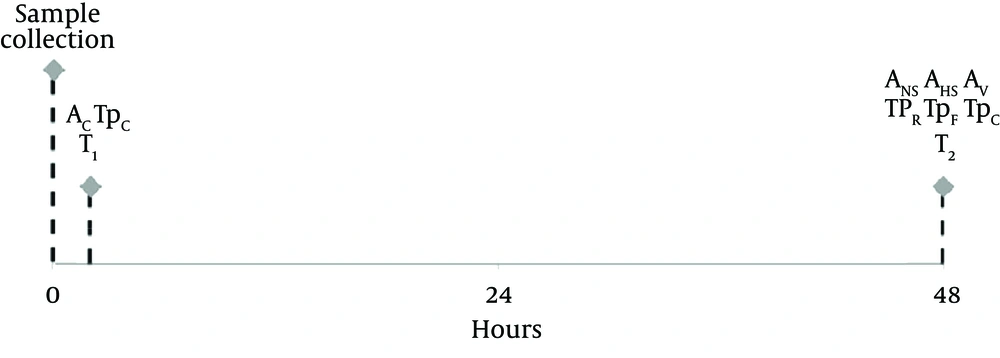
Figure 1.
Timeline of Procedures
3.5. Statistical Analysis
We used t-tests to determine the actual difference between conditions for both agitation and storage temperature variables. We calculated percent error for each condition and demonstrated the difference with Bland-Altman plots. The control sample and criterion for validity was the original specimen analyzed within two hours of collection. Due to the increased number of analyses, we set significance at P < 0.0001 a-priori.
4. Results
We identified no significant differences for ANS (t79 = -0.079, P = 0.937), AHS (t79 = 1.395, P = 0.167) or AV (t79 = -0.753, P = 0.453) when compared to the criterion control (AC). Percent error for ANS (0.00008%), AHS (0.0009%) and AV (0.0007%) demonstrated no clinically relevant differences (Figure 2). We identified no significant differences for TpN (t82 = -0.720, P = 0.474), TpR (t82 = -2.697, P = 0.008) or TpF (t82 = 2.576, P = 0.012) when compared to the criterion control (TpC). Percent error for TpN (0.003%), TpR (0.009%) and TpF (0.022%) demonstrated no clinically relevant differences (Figure 3).
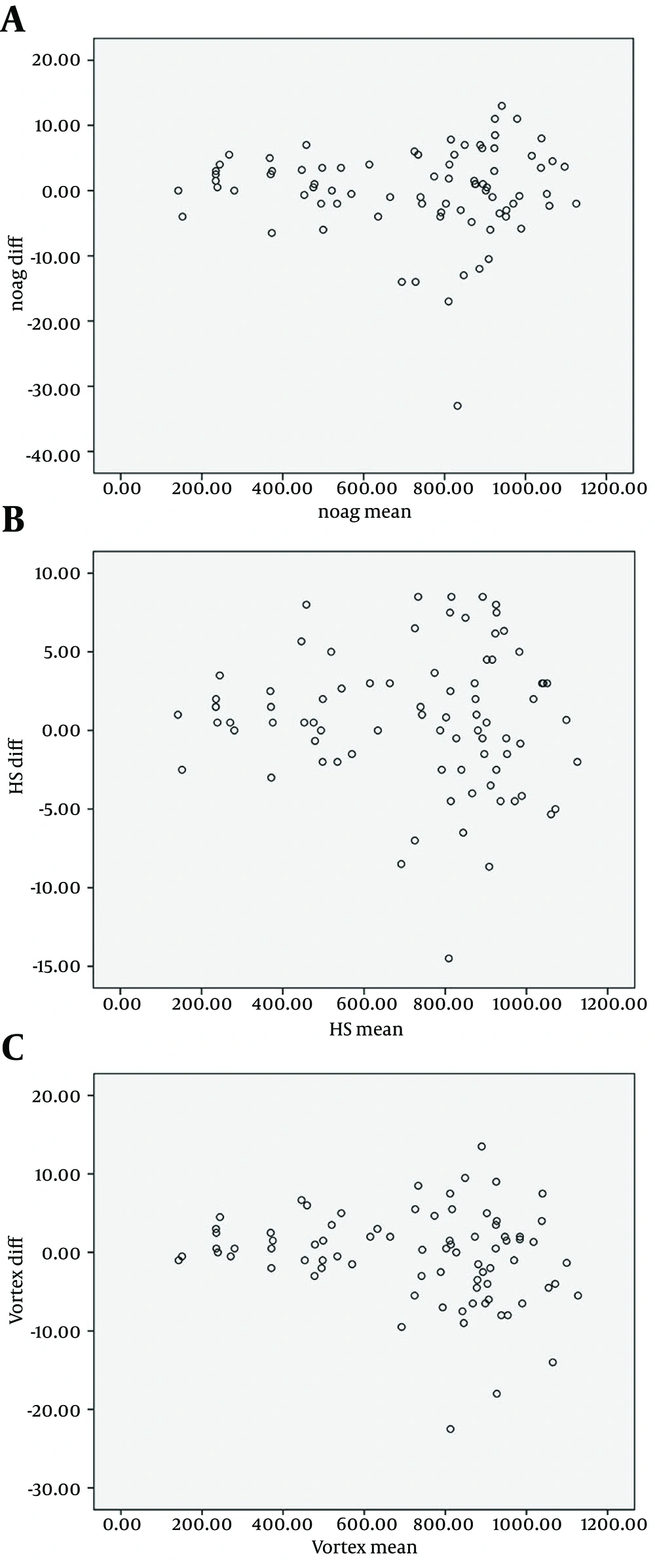
Figure 2.
A, Non shaken; B, hand shaken; and C, vortex mixed compared to the criterion control (AC).
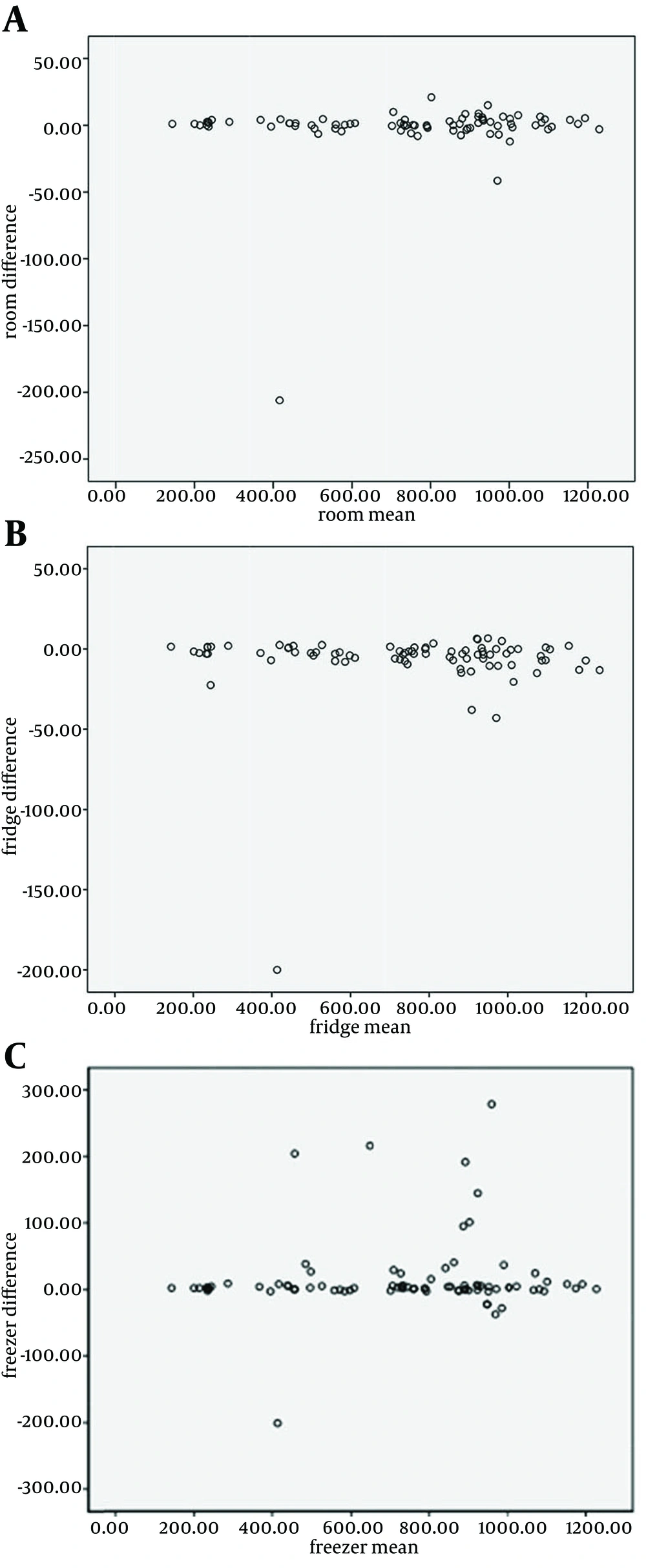
Figure 3.
A, Room temperature; B, Refrigerator; and C, Freezer compared to the criterion control (TpC).
5. Discussion
While instrumentation has been the focus of previous studies (5, 6, 15), this study was the first to investigate the effects of agitation and storage temperature on the osmolality measurement of urine samples. The aim of this study was to determine the impact of agitation and storage temperature on urine osmolality compared to the criterion control, urine osmolality measured within two hours of collection. Urine collection procedure manuals have suggested that urine samples should be analyzed within two hours of collection (7, 17). In contrast, the results of this study demonstrate no differences between AC samples analyzed within two hours and ANS samples that were stored for forty-eight hours before analysis. From a clinical perspective, these findings suggest immediate analysis of urine samples is not necessary to obtain a valid measurement of hydration status. Instead, a sample can be stored for up to 48 hours without impacting urine osmolality measurements. Additionally, we observed no differences between agitation methods. A possible explanation for the lack of differences between the three agitation methods and the control is the time frame in which samples were stored. We did not observe visible sedimentation after 48 hours in most samples. While analysis within 48 hours seems practical for most clinicians, additional storage time or an alternative space (non-air conditioned locker room) may have resulted in further sedimentation that could affect the osmolality measurement. Current institutional guidelines provide inconsistent recommendations on storage temperature of urine samples and none directly address their effects on hydration testing. The World Anti-Doping Agency recommends storing samples in a cold environment and avoiding warm conditions (18) Likewise, the 2010 Urine Preservation Chart suggests that refrigeration of samples alone is adequate if tested within 14 days of collection (19). Other institutions, such as the NCAA Drug Testing and Federal Workplace Drug Testing, currently provide no recommendations on storage temperature (20, 21). With such inconsistent guidelines, minimal research, and a lack of literature concentrating on hydration testing, it is difficult to guide clinicians in best practice, when urine storage is necessary. Limited research has investigated the impact of urine storage temperature on urinary analysis and none has looked directly at the effect on hydration status measurement. Research has suggested urine samples should not be frozen for albumin determination and refrigeration does not appear to be necessary (11, 13). When samples are stored for 24 hours, storage at room temperature or 4°C does not appear to effect urine enzyme values (14). Similar to the literature, our findings suggested samples do not need to be refrigerated or frozen if assessed within 48 hours of voiding. From a clinical perspective, these findings suggest samples can be stored at room temperature for up to 48 hours without compromising the integrity of the urine sample for osmolality measurements. Clinicians today turn to manuals for proper urine collection and handling procedures. These manuals currently have no gold standard for storage procedures prior to urinary concentration analysis. Although manuals suggest utilizing the first voiding of the day, we did not require the first voiding from participants due to timing and availability of sample collection, both in this study and the clinical setting (7). Practice times change daily and are often not held early in the morning when health care providers can obtain first voidings. Clinicians are encouraged in the literature to analyze samples within two hours of collection to avoid excessive bacteria growth (7, 17). We used similar methods in this study, ensuring all samples were analyzed within two hours of collection. We were unable to immediately analyze samples due to location of collection, quantity of specimen and speed of the osmometer. Current urine collection manuals do not mention the use of agitation or any other technique clinicians should utilize once a sample has been stored or sedimentation has developed. We investigated agitation via hand shaking and vortex mixer, methods we believed to be practical for both laboratory analysis as well as clinical settings where equipment may not be available. Based on the findings of this study, none of these factors impact the assessment of hydration status if measured within 48 hours of collection. To our knowledge, there have been no previous studies investigating the effects of agitation or storage temperature on osmolality measurements. The results of the present study indicate agitation and storage temperature do not have an effect on urine osmolality. From a clinical perspective, these results provide clinicians with guidance on the handling and storage of urine specimen for up to 48 hours. Agitation of the urine specimen is not necessary for clinicians who are unable to immediately analyze measurements of hydration. Additionally, samples may be stored at room temperature for up to 48 hours after collection. The purpose of this study was to determine if agitation of urine samples is comparable to the criterion measure, urine osmolality measured within two hours of collection. The findings of this study demonstrated no differences in osmolality measurements between the three agitation methods and the criterion control. Additionally, our findings suggest that samples do not need to be refrigerated or frozen if assessed within 48 hours of void. For practitioners who are unable to immediately measure the hydration status of urine samples, agitation of the urine specimen is not necessary when no visible sedimentation is observed in order to obtain a valid measure of hydration status using an osmometer. Additionally, immediate analysis within two hours of collection is not necessary and samples do not need to be stored in any specific manner. Clinicians should continue to evaluate urine for hydration status during pre-participation exams and preseason practices to monitor athletes for increased risk of exertional heat illness.