1. Background
During walking, running or jumping, external forces eccentrically lengthen the muscle, then a concentric shortening action follows (1). This interaction of eccentric and concentric contraction forms is called a stretch-shortening cycle (SSC) (2). In order to determine the components of the SSC, jump tests are applied. Drop jumps (DJ) are used for fast SSC (F-SSC) (3), and counter movement jumps (CMJ) for slow SSC (S-SSC) (4). For the measurement of parameters in jump diagnostics, such as vertical jump height (VJH) and total ground contact time (GCT) during DJ, typically force plates are used (4) and are judged to be the reference (gold) standard. However, force plates are very expensive and their acquisition is often not possible for sports clubs to measure the DJ in field conditions or physical therapy institutions. As an alternative to force plates, jump mats can be used (5). Jump mats are less expensive than force plates.
Independent of economic factors, measurement devices and methods must meet certain quality criteria such as validity and reliability (6). According to Kenny et al. (4) the FLS Jump Mat (JumpMat, Tyrone, Ireland) is especially suitable for jumps with S-SSC. They mention needing a jump mat that measures valid results for F-SSC. Therefore, the goal of this study was to examine the concurrent validity of the Haynl-Elektronik jump mat (HE jump mat) using a DJ regarding GCT and VHJ.
2. Objectives
Given the explanations above, the following questions arise. (1) Is there a consistency between the results of jump mat and standard force plate with regard to GCT and VJH? (2) Is there a strong agreement between the two measurements? (3) Is this jump mat applicable in clinical practice?
3. Materials and Methods
3.1. Participants
Ten healthy students volunteered in this cross-sectional study (mean age: 24.7 ± 1.95 years, mean height: 1.74 ± 0.08 m, mean weight: 64.8 ± 9.09 kg, mean BMI: 21.42 ± 1.62, female: 8, male: 2). This study was conducted in accordance with the Declaration of Helsinki, and all participants gave written informed consent.
3.2. Procedures
For the present study, each participant completed 3 × 5 jumps with 30 - 60 seconds rest between repetitions of jumps. According to Schlumberger and Schmidtbleicher (7), 8 - 10 jumps should be carried out per series. For the DJ, the participants stood on a 40 cm box (5) placed 20 cm from the force plate. One side of the box had a slope, so that the box could be climbed on with minimal fatigue (8). The participants dropped from the box with extended knees and as vertically as possible. On landing, the knee should be bent as little as possible. After landing, the participants immediately jumped as high as possible straight up in the air, and landed back on the marked cross. The hands had to be held on the hip. In order to obtain the output value GCT (ms) and VJH (mm) for the F-SSC, the values for GCT and VJH (mm) for the F-SSC were averaged from two DJs.
The Haynl-Elektronik jump mat (HEJM) was placed on the Kistler force plate and fixed to it (4) to enable simultaneous measurements of the data required to calculate GCT and VJH. In addition, a cross was marked in the middle of the jump mat so that the participants knew where they should jump up and reload. In addition, the boundaries of the jump mat were marked with tape.
The Haynl-Elektronik jump mat (Niedersprungtestgerät, Haynl-Elektronik, Schönebeck, Germany) is a large 72 × 56 cm mat. The jump mat can measure and calculate GCT, flight time, VJH, and efficiency during DJ. The VHJ is calculated based on the flight time, and the efficiency based on the flight time and GCT (9). The raw data of the HE jump mat were transferred to the PC via a USB connection cable. The jump mat software has the GCT and flight time (ms), the VJH in centimeters (cm) and efficiency automatically displayed in a chart.
The Kistler force plate (Type 9286BA, Kistler, Winterthur, Switzerland) can determine various parameters, such as ground reaction forces and displacements of the center of mass that are important in the field of balance and gait analysis. This force plate can be used to determine F-SSC. The data of the force plate were collected as follows: the GCT during the first foot contact until the foot breaks contact again (in milliseconds: ms) was measured and the VJH (in millimeters: mm) was calculated. The analog force-time signal was collected at a rate of 1 kHz using a 12-bit A/D converter (Meilhaus ME-2600i; SisNova Engineering, Zug, Switzerland) and the software package “ADS” version 1.12 (UK labs, Kempen, Germany) (10). Both devices calculated VJH on the basis of flight time using the formula below. Jump height in cm = 1/8 × acceleration due to gravity (9.81 m/s2) × flight time in s2 (11).
3.3. Statistical Analyses
Pearson correlations with 95% confidence intervals and limits of agreement (LoA) were calculated according to Bland-Altman (12). Both methods were adapted to take into account the inter-correlation of the repeated-measurement nature of the data (e.g. one person contributed ten jumps to the analyses). The Pearson correlation coefficient (r) was calculated for the association between the values VJH and GCT of the force plate and the jump mat. The linear correlations were interpreted as follows: very strong |r| = 0.9 - 1.0; strong |r| = 0.7 - 0.9; moderate |r| = 0.4 - 0.7; weak |r| = 0.2 - 0.4; very weak |r| = 0.0 - 0.2 (13).
A Bland-Altman plot was used for visual representation of heteroscedasticity and to assess the agreement between the measurements by plotting the individual difference between the two systems against the individual mean of the two systems. We used a method proposed by Carstensen (14), because the difference between the two methods and the standard deviation of the differences was associated with the mean of both measurements. The r-package MethComp was used for the calculations and the plots (15). In addition, a logarithmic transformation was conducted and a linear regression equation was created. Pearson correlations corrected for repeated measurements were calculated with the software package Stata version 13.1 (Stata Corp, College Station, Texas).
4. Results
There is a high consistency (linear relationship) between the two measurement methods. The Pearson correlation coefficient for the jump height was 0.99 (95% CI: 0.99 - 0.995) and for the ground contact time between the force plate and the jump mat (HE jump mat) the correlation was 0.98 (95% CI: 0.97 - 0.99).
Figure 1 showed no heteroscedasticity. The VJH on the jump mat represent larger values for heights compared to the force plate, and this difference increases slightly with larger jump heights. It represents negative zero bias (-1.55 ± 0.02 cm) around the zero line for VJH.
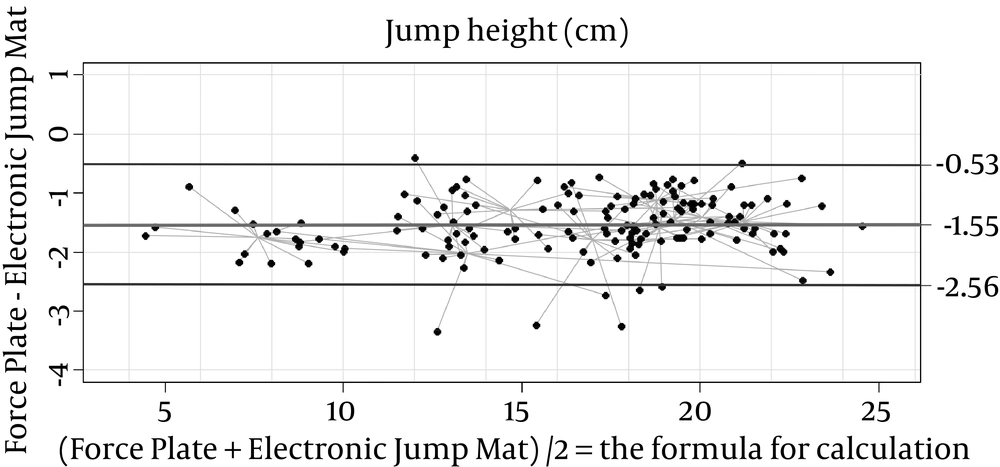
Figure 1.
Normal Data Jump Height in cm
The Bland-Altman Plot of the log-transformed values showed no heteroscedasticity and dependence on the difference on the average values. The Bland-Altman Plot in Figure 2, with values back-transformed and differences (vertical axis) expressed as percentages, shows that on average the Haynl-Elektronik jump mat underestimated the ground contact time with a positive zero bias by 10.5% and that 95% of the measurements with the Haynl-Elektronik jump mat are between 4.1% and 17.4% lower than the values from the force plate.
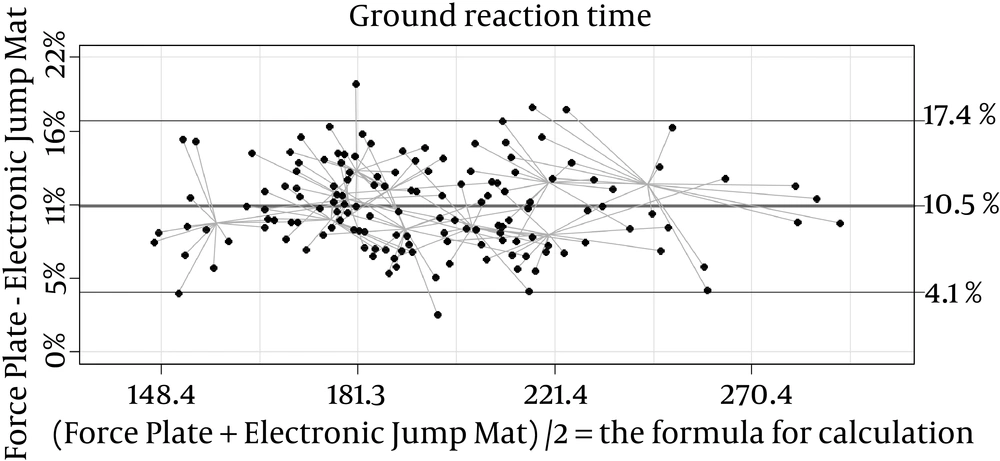
Figure 2.
Ground Reaction Time After Re-Log in %
To minimize the systematic bias between the HE jump mat and the force plate a regression equation was calculated for VHJ and GCT. Regression equation GCT (ms) force plate = 5.920385 + 1.072293 × [value HE jump mat]. Regression equation JH (cm) force plate = -1.73777 + 1.011156 × [value HE jump mat].
5. Discussion
The aim of this study was to examine the concurrent validity of the HE jump mat compared with the reference standard force plate using a DJ regarding GCT and VHJ. The main findings were that (a) there is a strong correlation between the two measurement methods, and that (b) there are some systematic differences between the two methods: mainly that the jump mat method results in slightly shorter contact times and in higher jump heights.
A very strong correlation was determined between the two devices (HE jump mat and force plate) for VJH and GCT. This study investigated different possible persons with various activity conditions (anthropometry, sport and experience with jump training) so that the HE jump mat can be applied to a wide range of persons. The different activity conditions and physical performance levels lead to increased variability, and this again to a greater spread (16). Grouven et al. (17) described that larger spans of the values result in higher correlation.
The Bland-Altman plot shows that the HE jump mat records generally underestimated VJH and overestimated GCT. The differences between HE jump mat and force plate can be explained as follows: one possible explanation is that the sensors are not sensitive enough to react to the HE jump mat. The contact system, which closes the circuit when there is electrical contact between the two interlayers, does not appear to connect fast enough. The results of the present study are similar to the study from Garcia et al. (18) which compared a jump mat with a force plate. In contrast to the current study, they found overestimated values for VJH by 17 cm and for GCT by 7 ms. Garcia et al. (18) used the rebound jump to evaluate the VJH. Rebound jump is different to DJ. The starting position was upright and the knee flexion was freely chosen so that the participants were able to jump as high as possible. The rebound jump can be classified as an S-SSC.
However, some limitations need to be discussed: first, this study considers ten participants completing 15 jumps (3 series with 5 jumps). Thus a total of 150 measurements were recorded. However, these jumps are not from 150 different people and are therefore less representative of the population. In addition, the weighting of each test subject is higher with a small sample size. For further studies, the recruitment of a larger number of participants is recommended to prevent distortion of the results. Secondly, the present study evaluated only a part of the quality criteria. For the final recommendation, it is advised to examine the HE jump mat according to other quality criteria, such as test-retest reliability and sensitivity change. Thirdly, this study includes participants with different characteristics in regard to anthropometry, participation in different sports, and experience with jump training in order to allow the generalizability of our results to a broad range of population. The heterogeneity of our participants resulted in an increased variability (wider spread of the results). This large variability increases correlations compared to more homogenous groups (17). However, the variability in this study corresponds to the range of application in practice. This study did not include athletes with very high jump abilities (note the relatively low jump heights). Therefore extrapolation of our results to high performance athletes must be done with caution.
Finally, it should be mentioned that the interpretation of the relevance of the differences in mean difference and confidence limits at the GCT and the VJH is dependent on the situation, and the aim of the measurement. In principle, we may consider this model of a jump mat as valid, but it must be decided based on the aim of its use whether the observed difference between the force plate and the HE jump mat is acceptable.
5.1. Practical Application
The practicability of the HE jump mat is an important criterion and there are some important points in its favor: the jump mat is less expensive than a force plate, it is considerably lighter than the force plate and can be easily transported and used in- and outdoor (if a flat and solid surface is available). Furthermore, the time to obtain the results was lower for the HE jump mat; however, this is a property of the software and not of the measurement method. To compensate for systematic bias, the following regression equation should be used. GCT: force plate = 5.920385 + 1.072293 × [value HE jump mat]. VJH: force plate = -1.73777 + 1.011156 × [value HE jump mat].