1. Background
Physical demand in a soccer match is characterized by high-intensity actions with recovery periods differing in nature and duration, which results in an average game intensity ranging from 80 to 90% of maximal heart rate (HRmax) (1, 2). Top-level players are required to develop specific physical capacities such as an elevated aerobic power and the ability to perform repeated high-intensity actions with relatively short-time recovery periods, to be able to cope with the game demands (3-5). In order to develop these different skills, coaches need different tools to monitor their player’s physiological and physical training responses.
Nowadays, there are three main techniques to measure the external training load, including manual monitoring systems (6), semi-automatic monitoring systems (5) and GPS technology (7). In this context, the analysis of the time-motion variables does not supply reliable estimations of the internal energy expentidure. On the other hand, several methods have been used for evaluating the physiological demands of elite soccer players in competitive situations using blood lactate sampling (8), core and muscle temperatures (9), and depletion of muscle glycogen stores (10). Because of the limitations of the methods previously reported,1 heart rate (HR) appears to be more suitable for an indirect estimation of the metabolic demand and specific exercise in soccer (11). In this context, the evaluation of the parasympathetic function with the use of HR as an indicator of workload during different soccer exercises has been previously validated (12, 13); both for dissociated training such as intermittent exercises, and for training including the ball such as small-sided games (1, 14). The heart rate recovery is characterized by parasympathetic reactivation and sympathetic withdrawal (15), according to the exercise and metabolic demand. As Daanen et al. explained (15), it is adjusted by the cardiac pumping autoregulation (Frank-Starling law of the heart) both sympathetic activation and parasymapathetic deactivation inducing the HR contraction force especially in the left ventricle (15). At the end of the exercise, the sympathetic system is inhibited whereas the parasymapathetic nervous system is reactived. For precision, the autonomic nervous system includes the parasympathetic and sympathetic nervous system, which control and regulate the body’s unconscious actions (salivation, digestion). Especially, the parasympathetic nervous system is commonly referred to as having “craniosacral outflow” whereas the sympathetic nervous system has “thoracolumbar outflow”. Cardiac parasympathetic reactivation function immediately after exercise corresponds to the heart rate decline (number of beats lost per minute) also called heart rate recovery (HRR) and this tool is considered as a good marker of physical fitness level in intermittent sports such as soccer (1, 14), in a better proportion than heart-rate variability (16). However, different factors such as age, ambient conditions, the training status, the duration and the exercise intensity affect the HR and the HRR responses .e.g. (15). Although some studies have tried to examine the HRR changes and responses after different types of exercises such as in young soccer players (15) or in non-specific soccer conditions (14, 15, 17-), to the best of the author’s knowledge, no study has analyzed the HRR after different training exercise modes (in the same team) in elite professional soccer players. Shetler et al. (20) showed that HRR (at 2 minutes post-exercise) was heterogeneous when the recovery is passive compared to active recovery mode. However, the use of HRR during the 2 minutes following a cardio-respiratory test has been validated (9) whereas the kinetics of HRR between maximal and sub-maximal exercise are different (21) probably due to the activation and deactivation of the sympathetic nervous system during exercise. Furthermore, different factors such as the level of physical fitness, age, the training timing during the day, the period of the season, or gender could affect the HR vagal modulation (22).
2. Objectives
In this context, it appears that there is a lack of practical knowledge in elite soccer players about interest and limits of the HRR following traditional high-intensity training exercise such as small-sided games or intermittent exercises. Therefore, the aim of the present study was to examine the cardiac parasympathetic reactivation function by HRR (at 1, 2, and 3 minutes of recovery) after different types of high-intensity exercise (small-sided games, repeated sprint ability, and intermittent exercises in-line or with change of direction), and two specific running tests (continuous vs. intermittent) in professional soccer players. It was hypothesized that 1- the HRR differs across the different types of exercises; 2- the modification of the intensity induced different HRR for similar types of exercise (for example: INT in line vs. INT with directional changes); and 3- HR decline is higher after the intermittent test (Yo-Yo IE2) as compared to the continuous test (Vameval). Thus, the players’ recovery profile (HRR) according to the type of task could provide information for the training monitoring, with the aim of facilitating a more efficient planning and manipulation of recovery strategies according to their fitness markers.
3. Materials and Methods
3.1. Experimental Approach to the Problem
HR in soccer has been widely studied but there still exists a lack of knowledge concerning the use of HR recovery data (HRR) in elite soccer after traditional training exercise. Therefore, the present study aimed to state, the practical interests, and limits of this method as a tool of evaluation of the recovery capacity across different traditional training situations commonly used in elite soccer. Elite male soccer players belonging to the same top-level team performed different training situations (independent variables) in order to examine their HR decline (HRR, the dependant variable) during the 3 minutes following the end of the different exercise modes, when the player was in passive recovery (standing-up and walking without drinking or stretching actions). Every week the coach used different types of exercises and therefore there is interest to examine how these different methods (duration, solicitation, player’s motivation) should differently impact the dependent variables (HRR) mainly due to the different physiological, muscular and cardio-vascular solicitation. The player’s postures after each exercise were the same in order to have the same energy expenditures during recovery (23).
The experiment took part during the 2010 - 2011 season with the team involved in a congested competitive period (September-October). The training situations included: fitness tests (Vameval and Yo-Yo IE2), short duration intermittent exercises running (INT) in-line or with COD (10 - 10 seconds, 15 - 15 seconds, 30 - 30 seconds), INT including agility and technical skills (8 - 24 seconds), small-sided games (SSGs) with and without goalkeepers (2 vs. 2, 3 vs. 3, 4 vs. 4), and repeated sprint ability (RSA) (10 × 20 m, 10 × 30m, 15 × 20 m). These were traditionally used by the team and technical staff and therefore, the players were accustomed with these types of exercises. All sessions were performed at the same time of the day to avoid any effect of circadian rhythms, (24) and separated by at least 48-hours to minimize the effects of fatigue on each other. During the weeks prior to the experiment, players were familiarized with both the different formats of tests, INT, SSGs, RSA, and the devices used in this study. An appropriate and specific standardized warm-up was performed before each test and exercise session. The coaches provided consistent verbal encouragement during all the testing/exercise sessions to ensure the maintenance of a consistently high work-rate.
3.2. Subjects
Twenty-two international soccer players took part in this study (age: 24.3 ± 4.2 years; height: 178.1 ± 6.2 cm; body mass: 80.3 ± 5.7 kg, fat mass: 8.3 ± 2.1%). The players played both in UEFA Champion’s League and French league-1 and trained between ~4 - 10 hours plus 1 - 2 competitive matches per week. All the players gave their consent after a detailed explanation about the study procedure and risks involved with the investigation. The study conforms to the code of ethics of the World Medical Association and the standards for research’s recommendation of the 1975 Declaration of Helsinki.
3.3. Heart Rate Monitoring
HR was recorded in beat-by-beat mode (R-R) during all training sessions and tests performed, using HR monitors (Polar RS800, Polar Electro, Finland) and analyzed with Polar Pro Trainer 5 software (Polar Electro, Finland). HR data were expressed as percentage of HR reserve (%HR reserve) (25) according to the formula of Drust et al. (24) recommended by Dellal et al. (1). Resting HR was determined as the lowest HR measured during a 10-minutes supine position at 10:00 a.m. in a calm indoor area whereas maximal HR was determined as the highest average values over 5 seconds during the Vameval or Yo-Yo IE2 tests (1). HR was measured during exercise and the three minutes immediately thereafter with all the players doing the same posture and actions (walking or standing still but no drinking or stretching was allowed) to ensure similar energy expenditure. HRR was obtained by the following formulas suggested by Bosquet et al. (19) and Shetler et al. (20).
3.4. Fitness Test
The Vameval test is a continuous aerobic test, which has been largely used with a high degree of validity and reliability (r = 0.97) (26). The test starts at a running speed of 8 km.h-1 and increases by 0.5 km.h-1 each minute until exhaustion. The players adjusted their running speed to the auditory signals that had to be synchronized with marks placed at 20 m intervals along a 200 m oval drawn track on an artificial turf soccer field. The test ended when a player could no longer maintain the imposed running speed at the moment of the audio signal for 2 consecutive times. The end velocity corresponded to the reference value in order to apply the different INT (i.e. MAS).
The Yo-Yo Intermittent Endurance test level 2 (YYIE2) consists of repeated 20 m shuttle runs at progressively increasing speeds dictated by an audio bleep emitted from a calibrated CD player on an artificial turf soccer field (27). Between each shuttle the players had a 5 seconds period of jogging around a mark placed 2.5 m behind the finishing line and had to come back to the starting line to be ready for the next start. Failure to achieve the shuttle run in time on two occasions resulted in termination of the test. The test was also stopped if the player abandoned the trial because he felt impossible to successively perform the next shuttle run.
3.5. Training Exercise Situations
3.5.1. Intermittent Exercises (INT)
High-intensity INT running in-line or with 180° COD was performed (Table 1) including 30 - 30-seconds (30-s of effort interspersed with 30-s of recovery, with 3 COD if COD is included), 15 - 15-seconds (with 2 COD if COD is included), 10 - 10-seconds (with 2 COD if COD is included), and 8 - 24-seconds using the individual intensity of the runs selected according to the Vameval performance as previously shown (28). More specifically, the 8 - 24 seconds differentiating the playing positions (external and central playing positions) consisted in an INT including agility section, sprints, and ended with technical actions (passes or shoot) as it is illustrated in the Figure 1.
Table 1.
Characteristics of the High-Intensity Intermittent Runs Training Sessionsa
| Type and Intensity, %vVameval | Number of Block | Number of Work Periods | Recovery Inter-Series, min | Nature of Recovery | Type of Effort |
|---|---|---|---|---|---|
| 30 – 30 s | |||||
| 100% | 2 | 2 × 10 | 4 | Active | With 40 m and 3 COD |
| 105% | 2 | 2 ×10 | 4 | Active | In-line |
| 110% | 2 | 2 ×10 | 4 | Active | In-line |
| 15 – 15 s | |||||
| 110% | 2 | 2 × 8 | 5 | Passive | In-line |
| 115% | 2 | 2 × 8 | 5 | Passive | In-line |
| 115% | 2 | 2 × 8 | 5 | Passive | With 40 m and 2 COD |
| 10 – 10 s | |||||
| 120% | 2 | 2 × 6 | 5 | Passive | In-line |
| 8 – 24 s | |||||
| 115% | 2 | 2 × 8 | 5 | Active | Specific with ball |
aAbbreviations: v Vameval, maximal speed reached at the end of the Vameval Test; COD, Changes of direction.
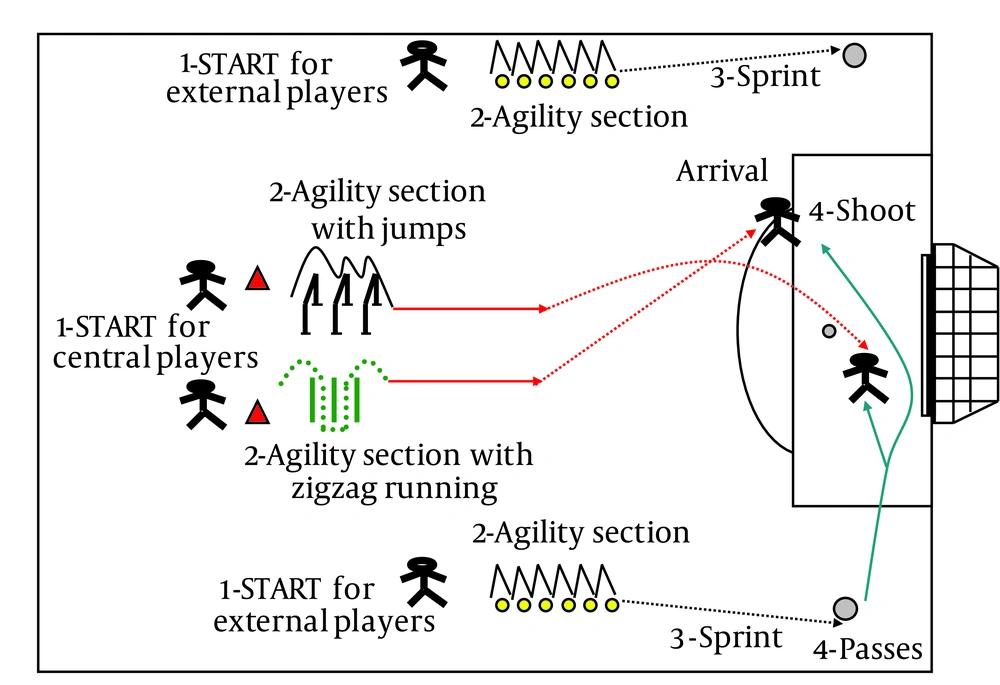
Figure 1.
Description of the 8 - 24-Seconds Intermittent Exercises Differentiating the Playing Positions (External and Central Playing Positions) and Including Agility Section, Sprints, and Technical Actions (Passes or Shoot)
3.5.2. Small-Sided Games (SSGs)
Players performed different SSGs (2 vs. 2: 4 × 2 minutes on a 20 × 15 m size area; 3 vs. 3: 4 × 3 min on 25 × 18 m; 4 vs. 4: 4 × 4 min on 30 × 20 m); played with and without goalkeepers (the objective of the latest form was therefore to collectively maintain the ball possession). Moreover, players had a maximum of two ball-contacts authorized per individual possession, a similar area ratio per player (1:75 m2), and 3-minutes of passive recovery between each bout composing the SSG. Each SSG was performed on a synthetic grass field with 4 coaches around the pitch in order to encourage the players and to provide new balls when necessary to allow continuity of the play during the playing sessions (29, 30). The different teams of the SSG were balanced according to the different playing positions. The different characteristics of SSGs (pitch size, duration, number of periods) were implemented as previously described (29-33).
3.5.3. Repeated-Sprint Ability (RSA)
All players performed three different RSA exercises applied in straight-line runs (10 × 20 m; 10 × 30 m; 15 × 20 m) according to Girard et al (34). and Bishop et al. (35). Each sprint was interspersed by 30-seconds of active recovery consisting to jogging slowly back to the starting line and then waiting for the next sprint start provided by an auditory signal.
3.6. Statistical Analysis
The data are presented as mean and standard deviation (mean ± SD). The homogeneity of variances was examined by means of Levene’s test. The presence of significant differences was determined by means of a one-tailed repeated measures analysis of variance (ANOVA), applied to each of the dependent variables in relation to the post-exercise heart rate decline (for 1, 2, and 3 minutes of recovery, HRR1, HRR2, HRR3) after different types of exercise modes. Whenever a significant difference was found, post-hoc Bonferroni test was used. Fisher’s exact test was used to compare HRR following exercises. The effect Size (ES) was calculated to assess the meaningfulness of differences (36). For each exercise and test used, the coefficient of variation (CV) of the HRR was calculated. All the statistical analyses were performed using SPSS 16.0 for Windows, with significance being set at P < 0.05.
4. Results
4.1. HRR Between the Different Training Methods
Figure 2 shows the HR decline at 1, 2, and 3 minutes of recovery for all the different types of exercise modes (SSG, RSA, and INT). HRR1 and HRR3 were significantly greater during the RSA exercises in comparison with INT (F (2.371) = 42.41, P < 0.01) and SSG exercises (P < 0.001). In contrast, INT and RSA induced significantly greater (F (2.371) = 7.81, P < 0.01) HRR2 as compared to SSG, while at the third minute, there was a greater HR decline (F (2.371) = 20.02, P < 0.01) in INT compared to RSA and SSG exercises (P < 0.01). The intersubjects CV of the HRR are very high for the HRR3 for all exercises reaching 59.2% whereas the CV for the same subject is low for all HRR during all exercises tested (< 7%).
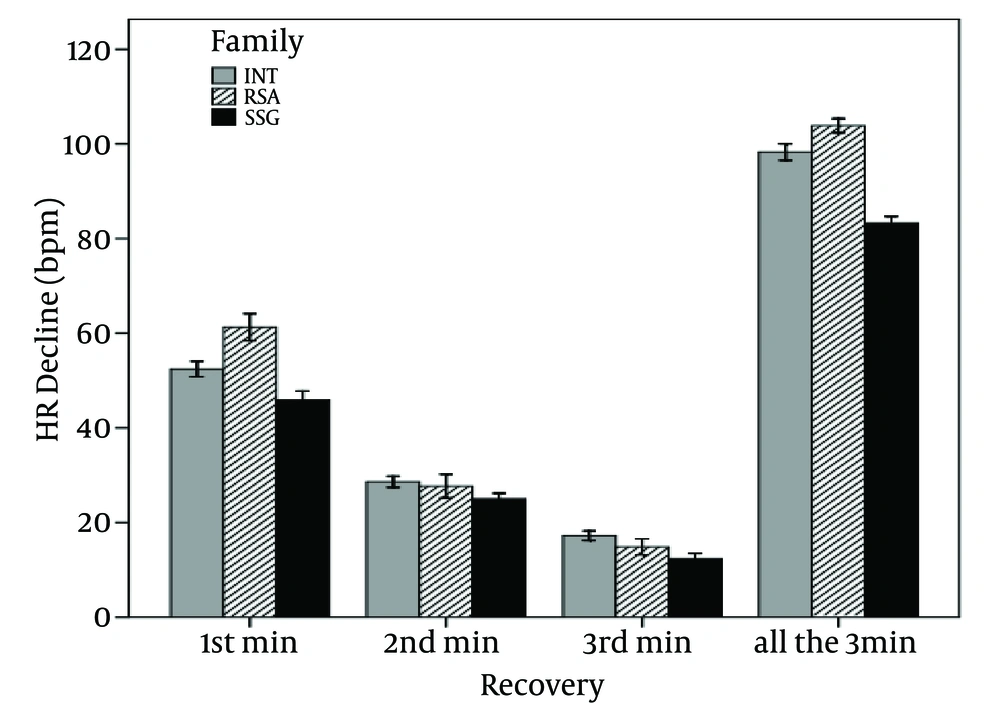
Figure 2.
Heart Rate Decline (bpm) for All the Different Type of Exercise After 1, 2 and 3 Minutes of Recovery
4.2. HRR According the Different Small-Sided Games (SSG)
Specific to the SSG mode of exercise, a significantly greater HR decline has been observed (F (5.126) = 6.264, P < 0.01) after the 4 vs. 4 with GK, 3 vs. 3 with GK and 4 vs. 4 with respect to the 2 vs. 2 at the first minute of recovery (HRR1) (Figure 3). Significantly higher HRR2 were observed (F (5.126) = 4.507, P < 0.01) during the 2 vs. 2 with GK, 2 vs. 2 and 3 vs. 3 than the 4 vs. 4 SSG whereas HRR3 were lower during the 3 vs. 3 with GK than the others SSGs (2 vs. 2 with GK, 4 vs. 4, 3 vs. 3 and 2 vs. 2, F (5.126) = 7.088, P < 0.01). No significant difference among SSGs was noted for overall recovery (for the set of three minutes). The intersubjects CV of the HRR are very high for the HRR3 for all exercises both with and without goalkeepers whereas the CV for the same subjects are low for all HRR during all SSG tested (< 11%).
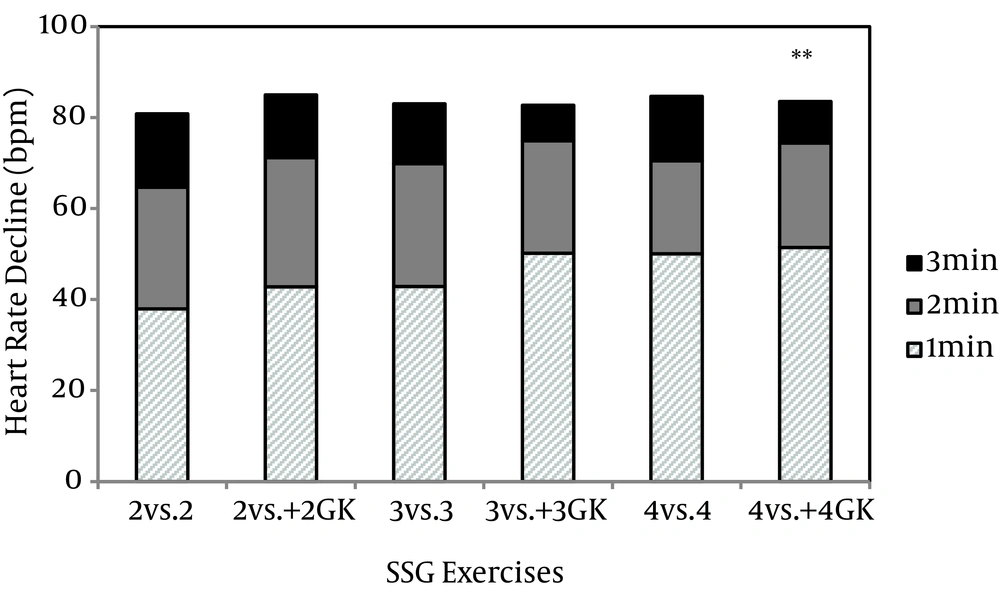
Figure 3.
Heart Rate Decline (bpm) During Different Small Sided Games (SSG) After 1, 2 and 3 Minutes of a Recovery Period
4.3. HRR According the Different Repeated Sprint Ability (RSA)
Regarding the RSA mode of exercise, the 10 × 30 m induced lower HR decline at the first minute of recovery (HRR1) than those after the 10 × 20 m and 15 × 20 m RSA (F (2.63) = 28.863, P < 0.01, Figure 4), whereas the HRR2 was greater during the 10 × 30 m (F( 2.63) = 12.627, P < 0.01). The 10 × 20 m presented lower HRR3 than the 10 × 30 m and 15 × 20 m RSA (F (2.63) = 6.473, P < 0.01). However, the overall HR decline over 3 min was greater after the 15 × 20 m than the other RSA forms (F (2.63) = 6.737, P < 0.01). The CV are low for all HRR during all RSA tested (< 6%).
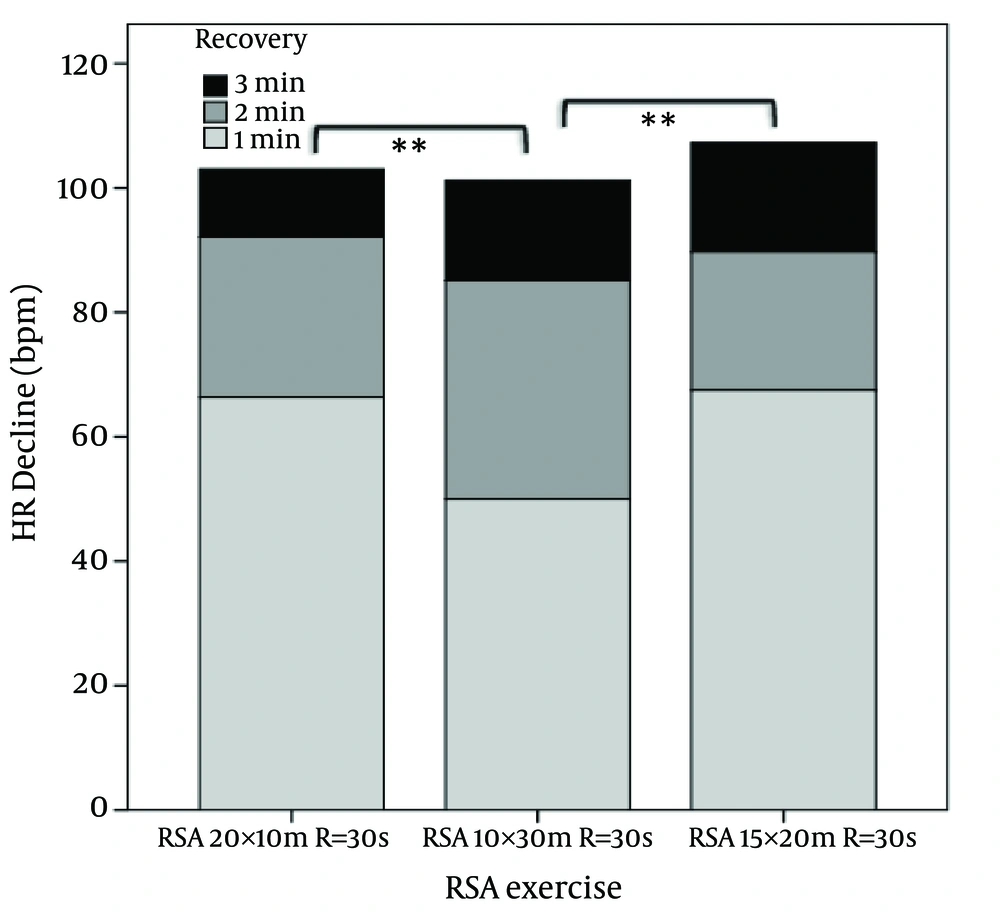
Figure 4.
Heart Rate Decline (bpm) During Different RSA Exercises After 1, 2 and 3 Minutes of a Recovery Period
4.4. HRR According the Different Intermittent Exercises (INT)
Less contrasting results were found concerning the different INT. Indeed, the 15 - 15 seconds including COD induced greater HRR1 as compared to the other in-line INT (F (7.168) = 4.975, p < 0.01, Figure 5), except for the 30 - 30 seconds at 110%. The 30 - 30 seconds including COD presented a significantly higher HRR2 than those after the 15 - 15-seconds at 115%, and the 30 - 30-seconds at 100% and 110% (F (7.168) = 5.788, P < 0.01), while for the HRR3, the 30 - 30-seconds including COD induced only greater HR decline compared to 15 - 15-seconds at 110%, and the 30 - 30-seconds at 110% (F (7.168) = 2.830, P < 0.01). Overall HR decline was greater (F (7.168) = 19.689, P < 0.01) during the 30 - 30 seconds at 100% including 3 direction changes and 15-15 sec at 115% including 2 COD in comparison with all the other INT (P < 0.001). Moreover, there was a difference during the overall HR decline of 30 - 30-seconds at 110% than during 30 - 30-seconds at 100%.
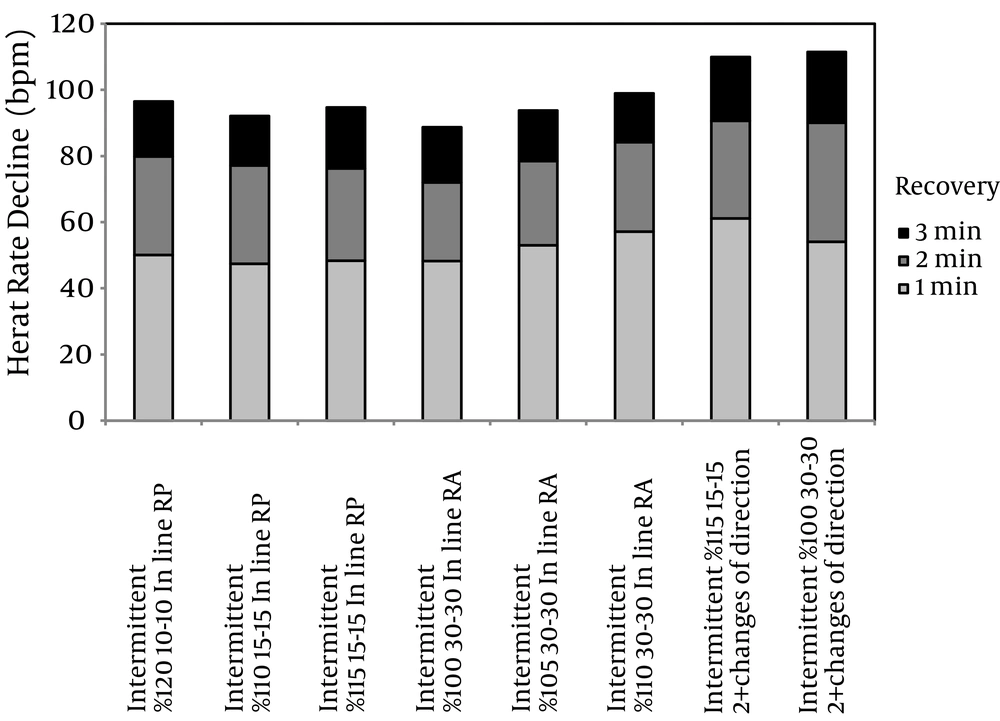
Figure 5.
Heart Rate Decline (bpm) During Different Format Intermittent Excises After 1, 2 and 3 Minutes of a Recovery Period
The HR reached at the end of the INT including COD was significantly higher (P < 0.001) than those of all the other exercises (Table 2). Moreover, the inclusion of goalkeepers in an SSG did not significantly alter the HR reached at the end of the SSG, whereas the increase of the running intensity during INT induced a higher HR reached at the end of the INT.
Table 2.
HR Reached at the End of Each Exercise From All the Types of Exercisesa
| Type and Format of Exercise | HR Reached at the end of the Exercise (bpm) | % of HRmax Reach at the end of the Exercise | % of HRres Reach at the end of the Exercise |
|---|---|---|---|
| RSA | |||
| 10 × 20 m | 190.9 b | 91.1 b | 88.5 b |
| 10 × 30 m | 198.2 | 94.6 | 93.0 |
| 15 × 20 m | 197.7 | 94.4 | 92.7 |
| SSG | |||
| 2 vs. 2 | 186.4 | 89.0 | 85.8 |
| 2 vs. 2 + GK | 183.7 | 87.7 | 84.1 |
| 3 vs. 3 | 183.4 | 87.5 | 83.9 |
| 3 vs. 3 + GK | 180.2 | 86.0 | 82.0 |
| 4 vs. 4 | 178.3 | 85.1 | 80.8 |
| 4 vs. 4 + GK | 173.6 b | 82.9 b | 77.9 b |
| INT | |||
| 10 - 10 at 120% | 194.3 | 92.7 | 90.6 |
| 15 - 15 at 110% | 187.4 | 89.5 | 86.4 |
| 15 - 15 at 115% | 195.2 | 93.2 | 91.2 |
| 30 - 30 at 100% | 185.2 b | 88.4 b | 85.0 b |
| 30 - 30 at 105% | 190.4 | 90.9 | 88.2 |
| 30 - 30 at 110% | 197.6 | 94.3 | 92.7 |
| 15 - 15 at 115% + 2 COD c | 204.6 | 97.7 | 97.0 |
| 30 - 30 at 100% + 3 COD c | 205.6 | 98.1 | 97.6 |
| 8 - 24 sec with ball | 185.8 b | 88.7 b | 85.4 b |
aAbbreviations: COD, change of direction; GK, goalkeepers; INT, intermittent exercises; RSA, repeat sprint ability; SSG, small-sided games.
bSignificantly lower HR reached than those obtained during the other exercise of the same family; P < 0.05.
cSignificantly higher HR reached than those obtained during all type of exercises; P < 0.001.
The intersubjects CV of the HRR during intermittent exercises are lower than those observed during SSG excepted for the 8 - 24 seconds including the ball. The CV for the same subject are the lowest for all HRR during all intermittent exercises tested (< 5%).
4.5. HRR According the Different Fitness Tests
Although the continuous test (Vameval) and the intermittent test (Yo-Yo IE2) induce similar maximal HR, differences were observed for HHR1, HRR2 and HRR3 (P < 0.001). Moreover, players presenting the highest performance in Vameval and especially Yo-Yo IE2 tests displayed better HRR, i.e. HR decrease was higher, than the player’s ranked in the bottom tests performance (P < 0.001).
Although the continuous test (Vameval) and the intermittent test (Yo-Yo IE2) induce similar maximal HR (207.7 vs. 209.5 bpm), higher HR decline were observed in the Yo-Yo IE2 test concerning HHR1 (50.3 vs. 64.6 bpm beat loss, P < 0.001) and HRR2 (29.6 vs. 32.5 bpm beat loss, P < 0.05). However, HRR3 were higher for the Vameval test (18.3 vs. 14.8 bpm beat loss, P < 0.05) (Figure 6).
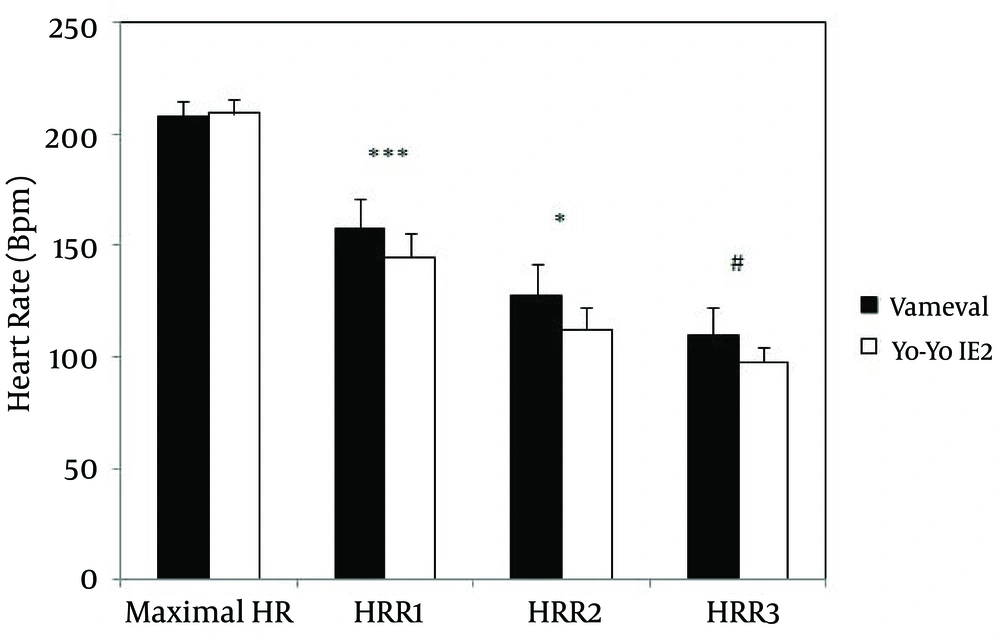
Figure 6.
Heart Rate Decline (bpm) After a Specific Continuous and Intermittent Soccer Test
5. Discussion
The interest and limits of HR decline as an indicator of workload and fitness level in elite soccer players appears clearer with regards to the present study’s results. This is the first study that analysed the cardiac parasympathetic reactivation function according to different traditional training exercises in elite soccer. The main findings showed that the HR decline (HRR) differs after the different types of exercises with SSGs and INT inducing lower HR decline than RSA at 1 and 3 minutes post-exercise. In addition, greater HR declines at the first minute (HRR1) were observed when goalkeepers were included in SSGs, when the sprint distance or the number of repetitions increased in RSA, and when there was an increase in intensity (% of MAS) or when COD were included in INT. Thus, the elite players’ recovery profile (HRR) according to the type of task could provide information for the training monitoring, with the aim of facilitating a more efficient planning and manipulation of recovery strategies according to their fitness markers in elite soccer.
5.1. HRR According to the Intensity of Exercise in Elite Soccer Players
As previously observed, the HR decline after a specific training soccer exercise appears to be dependant on the intensity and duration of the exercise in young and amateur players (18-21). The present study confirms the same tendency in adult elite soccer players. RSA is known to be as one of the more intense exercises in soccer training. Previous studies have shown that RSA training improved similarly the mean and best sprint time than those obtained after a SSG or INT training period (23). The HR responses during these 3 types of exercises were analyzed by Dellal et al. (28) who showed that RSA (5 to 20 seconds sprints) induced similar HR responses than different SSGs (2 vs. 2, 4 vs. 4, 8 vs. 8 with GK) and INT (30 - 30 seconds at 100% and 15 - 15 seconds at 100% of MAS). However, although RSA presented a longer intra-exercise recovery period than INT and SSG, the HRR was faster, especially at the first minute post-exercise which is considered as the best method of assessing HR recovery (19, 20). This difference is probably due to the HR reached at the end of the exercise as it was suggested by Bosquet et al. (19). Indeed, higher HR values were observed at the end of the RSA exercise (195.6 bpm, 93.4% of HRmax and 91.4% of HRres) with a great difference with those found at the end of SSGs (180.9 bpm, 86.4% of HRmax and 82.4% of HRres) and a lower difference with respect to the in-line intermittent training (191.7 bpm, 91.5% of HRmax and 89.0% of HRres). SSGs is a method of exercise requiring simultaneous tactical, physical, and technical activity and as it was previously demonstrated (29, 30), the players’ activities are more heterogeneous as illustrated by a greater coefficient of variation than during RSA (28, 29). During the SSG, each player could control his implication and the tactical component inducing a lower HR solicitation1 (29-33), probably explaining the great difference between the HR reached at the end of SSGs and, RSA and INT. An important question to elucidate is whether the HR reached at the end of the exercise affects the capacity of HR decline at the first minute post-exercise? Complementarily, Buchheit et al. (22) have suggested that the intensity of training, the lean muscle mass, blood acidosis, subject’s VO2max and the intrinsic parasympathetic function are likely related to the post-exercise HR decline. In the present study, the age-span and the physical fitness were relatively homogeneous and therefore they could not have highly affected the HR decline (19). In this context, it appears that the variation of the exercise characteristics may induce different HR decline.
5.2. HRR According to the Characteristics of Exercise in Elite Soccer Players
In a specific point of view, the HRR appears dependant of the characteristics of the exercises. To illustrate it, the manipulation of the rules during SSGs is known to alter the physical activity and the physiological responses during these exercises and the present study showed that the number of players and the presence of the goalkeepers could alter the HRR, especially at the 2 minutes post SSG. Concerning the impact of the number of players, the HR reached at the end of the SSG is in agreement with previous studies mentioning that the lower the number of players, the higher the exercise intensity (28, 29, 37). The manipulation of the presence of goalkeepers during the SSG of the present study induced a similar decrease in the exercise intensity than those presented by Mallo and Navarro (38) for a 3 vs. 3 whereas Dellal et al. (29) have showed an increase of 12% of the HR response during an 8 vs. 8 when goal keepers were included. This contrasted result may be justified by the greater number of players which could allow lower exercise intensity without the presence of the goalkeepers whereas when the 8 vs. 8 includes goalkeepers, they should have greater high-intensity actions in order to attack and defend the goal. However, although the HR reached at the end of the 2 vs. 2, 3 vs. 3 and 4 vs. 4 without goalkeepers was higher compared to the HR reached with the presence of goalkeepers, the HR declines were lower at the 2nd minute of recovery after the SSG while no differences were found for the overall recovery period. It is suggested that the HR responses and the HR decline post-exercise are not the best indicators of the intensity and the capacity of recovery during an SSG due to the presence of the ball, the heterogeneous activity of the players, the opposition, and the tactical and technical implications (19, 32, 33, 39).
Similarly, although the increase of the intensity of work (expressed in % of MAS) in high-intensity INT (i.e. 30 - 30 seconds and 15 - 15 seconds) induced systematically higher HR reached at the end of the exercises, no greater HR decline was observed for the 15 - 15 seconds whereas it was found for the 30 - 30 seconds. Indeed, the 30 - 30 seconds in-line protocol at 100% of the MAS was described as slightly anaerobic whereas at 110% of the MAS was highly anaerobic in nature, contrasting with the 15 - 15 seconds in which the aerobic contribution is lower. Furthermore, the inclusion of the COD during high-intensity INT (i.e. 15 - 15-seconds and 30 - 30-seconds) modifies both the HR reached at the end of the exercises and the post-exercise HR decline. The results confirmed those of Dellal et al. (28) but they showed a greater increase of HR responses during the 30 - 30 seconds compared to the 15 - 15 seconds when the COD were included (with similar number of COD). Moreover, the inclusion of COD induced also higher HR decline during the overall 3 minutes of recovery than during all the other forms of INT probably due to greater anaerobic and peripheral solicitation which could provide a faster recovery capacity.28 However, the HR decline increased differently between INT when the COD was included, with the 15 - 15seconds inducing greater difference at 1, 2, and 3 minutes of recovery whereas no difference was found during the first minute after the 30 - 30 seconds. This may be due to the fact that the global intensity of the 15 - 15 seconds and the fatigue that occurred were greater in accordance with the data of Dellal et al. (28) who found a greater blood lactate accumulation and rating of perceived exercise (RPE) values when COD was included in comparison with the 30 - 30 seconds performed in-line. The intensity of a 15 - 15 seconds is greater than a 30 - 30 seconds and the inclusion of COD increases this magnitude of difference of intensity.
Additionally, when the INT included balls (i.e. specific 8 - 24-seconds according to the playing positions), the HR responses were lower during the excises whereas the HR decline were greater than the intermittent in-line exercises and lower than those including COD. The time of recovery (1/3, i.e. threefold recovery compared to work) is quite long and therefore it could explain this difference of HR response during the intermittent work. Moreover, the superior HR decline during INT including the ball could be due to the specificity of the exercises which represent the players’ activities performed during a game and thus, they are accustomed to this form of exercise and recover quickly.
Although it was suggested that HR is not considered as a good indicator28 in order to evaluate the workload during high intensity exercises, and especially during RSA exercise, the present study revealed consistent results; the increase of the number of the repetition of sprints (from 10 × 20 m to 15 × 20 m) or the increase of the sprint distance covered (10 × 20 m vs. 10 × 30 m) induced greater HR responses during the RSA exercises especially in elite soccer players. In this context, the HR decline appears also to be an interesting tool to analyze the recovery capacity after RSA exercise. Indeed, the increase of the sprint distances or the number of sprint repetitions appears to fatigue the players more and therefore, their capacities to recover could be lower. The results of the present study have demonstrated a lower HR decline, especially at the first and the second minutes of recovery after RSA. The HR decline requires a special attention after RSA in order to analyze the players’ recovery capacity. Whatever the type of training (INT, SSG, RSA), the HRR is considered as a good indicator but only in intra-individual analysis and during the two minutes post- exercises as is was previously showed (12).
5.3. Practical Applications
This study demonstrated that the HR decline is a useful tool in order to detect the shape and fatigue of the players after specific soccer training (SSG, RSA and high-intensity training), but it appears that it is only interesting for the two first minutes after these soccer specific exercises. The HR decline is dependant of the intensity on the exercise and the rules/instructions (inclusion of goalkeepers in SSG, or the COD in RSA and INT). Thus, the players’ recovery profile (HRR) according to the type of task could provide information for the training monitoring, with the aim of facilitating a more efficient planning and manipulation of recovery strategies according to their fitness markers. Furthermore, the HR decline may provide useful information to coaches, fitness coaches and sport scientists for predicting changes in physical performances and therefore, with the interaction of several other methods of fitness training, it could bring important information to establish goals and strategic projections considering recovery. Finally, it is also suggested to experiment the analysis of HRR by periods of 15 or 30 seconds.