
1. Background
The vertical jump is part of many sports techniques and has been investigated in various studies (1). The performance of this skill is measured by calculating the vertical displacement of the center of mass or the tips of the fingers between the time when the subject is standing on the ground and when the subject is at the maximum jump height (2, 3). The vertical jump height depends on many factors, such as the coordinated transfer of energy from the proximal to the distal joints (4). Therefore, the force applied from the muscles and joints of the lower limbs to the ground is considered a predictor of jump height (2). In addition, the force generated in each muscle is related to the muscle physiology considering the volume of the muscles, the ratio of slow and fast muscle fibers, and the activation pattern of the muscles. The anthropometric parameters of a subject, including height, weight, body circumferences, limb length, and body composition, can be used as indicators of muscle volume. Therefore, the anthropometric characteristics of an athlete affect the vertical jump performance. The vertical jump test is used to evaluate the athlete's ability to apply force to the ground and maximize the vertical component of the velocity of the center of mass at the take-off instant (5-9).
The countermovement vertical jump is the common technique of vertical jump to reach the highest distance. The stretch-shortening cycle is used in this jump in which muscles undergo an initial tension when the knee and hip joints are flexed; then, in the second phase of this jump, the explosive force is produced by the muscles, and the rapid extension of the knee and hip joints leads to applying force to the ground for take-off (10-13). Therefore, the athlete's performance in the countermovement vertical jump is closely related to the force and momentum applied to the ground (14-16).
In addition to mechanical principles, previous studies have also examined the effect of individual factors on vertical jump performance that may be correlated with jump height. Anthropometric and body composition parameters are essential in an athlete's vertical jump performance (6, 17-22). Reeves et al. investigated the relationship between upper limb anthropometric parameters and countermovement vertical jump height and indicated that forearm length was the only parameter with a significant but weak correlation with jump height (17). Also, according to Mohammadi Mirzaie et al., anthropometric parameters had no significant relationship with vertical jump height (23). Nikolaidis et al. investigated the relationship between jump height and body composition in young volleyball players and showed that athletes with a lower body fat percentage had a higher jump height (20). Zorba et al. investigated the relationship between anthropometric characteristics and vertical jump performance of elite wrestlers and found no significant correlation (21). In other studies, it has been shown that low body fat percentage had a significant relationship with vertical jump performance (22, 24-26). Ishida et al. indicated a strong relationship between body composition and power output in jumping (27).
Similarly, it has been shown that there is a significant relationship between body composition and quadriceps isokinetic and isometric strength (28, 29). Salehi et al. found a significant correlation between vertical jump height and body fat (30). Omidali et al. also showed the significance of the correlation between jump height and body fat percentage, shank length, and body mass index (31). In the study of Mohammadi Mirzaie et al., a significant positive relationship was found between lean body weight and anaerobic power according to 5-second Ergojump based on the Bosco test method (23). Akdogan et al. indicated a negative relationship between CMJ height and body fat and arm fat percentage (22).
The approach of previous studies investigating the vertical jump was focused on anthropometric parameters or biomechanical variables such as ground reaction force characteristics. In this context, the correlations of these parameters with the jump height are not comprehensively assessed and compared in a group of athletes. Therefore, it is impossible to compare these correlations, and it seems valuable to investigate and compare the contribution of body composition, anthropometric parameters, and ground reaction force characteristics to the vertical jump performance of athletes.
2. Objectives
This study investigated the relationship between body composition, anthropometric parameters, and ground reaction force characteristics with the countermovement vertical jump height in professional male athletes.
3. Methods
In this study, the descriptive method (correlation assessment) was used to investigate the relationship of countermovement vertical jump height with ground reaction force and anthropometric parameters of 18 male professional athletes.
3.1. Subjects
The participants of this study were 18 professional and healthy male athletes who competed in Iranian sports leagues and were experienced in the vertical jump. The athletes participating in this study were free of sports injuries and were allowed to perform the countermovement vertical jump, according to the opinion of the coach and the team physician. Participants were professional volleyball (n = 6), basketball (n = 6), and wrestling (n = 6) players. After explaining the purpose of the study, data acquisition procedure, and possible risks, written consent was obtained from each participant. The Ethics Committee of the Sport Sciences Research Institute of Iran has approved this study with the ethics code of SSRI.REC-2111-1375.
3.2. Data Acquisition and Processing
After the voluntary presence of the participants in the laboratory for data acquisition, we measured the demographic characteristics, including gender, age, and health status, and anthropometric parameters, including height, sitting height, arm span, upper limb length, thigh length, shank length, maximum thigh circumference, and the maximum shank circumference. Height was measured while standing with the heels and shoulders touching the wall. Sitting height was recorded as the vertical distance from the seat surface to the top of the head while sitting on a chair. To measure the arm span, we asked the subject to separate his fingertips of left and right hands as far as possible in the coronal plane, and the distance between the fingertips was recorded. The length of the upper limb was recorded from the shoulder head (AcroMine) to the tip of the third finger. Thigh length was measured from the iliac crest to the external epicondyle of the knee. Shank length was measured from the external epicondyle of the knee to the head of the fibula or the ankle. After anthropometric measurements using the Inbody 770 device, we assessed the body composition parameters of the participants, including body mass, body fat mass, skeletal muscle mass, upper limb mass, trunk mass, lower limb mass, intracellular water volume, and extracellular water volume. Then, each participant performed four maximum-effort vertical jumps, and the ground reaction force (GRF) was measured using a force plate; then, the vertical component of force was extracted. The rate of force development (RFD), negative impulse, and positive impulse were calculated according to the vertical component of GRF. In order to calculate the RFD, the increase rate of the vertical component of GRF in the intervals of 0.08 seconds between the knee extension instance and the instance of achieving the maximum force was calculated. The negative and positive impulses were obtained by calculating the area between the force and the timeline from the force-time curve. All the tests for data acquisition were performed in one day.
3.3. Statistical Analysis
After calculating the mean and standard deviation of the measured parameters, the normal distribution of the data was confirmed using the Shapiro-Wilk test. Independent t-test with a significance level of P < 0.05 was used to examine the difference between the characteristics of the participants. Finally, Pearson's Correlation Coefficient was calculated to assess the correlation of anthropometric parameters and GRF characteristics with the countermovement jump height, while P < 0.05 was considered the significance level. The entire procedure of statistical analysis was carried out in SPSS software.
4. Results
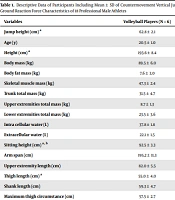
The mean and standard deviation of countermovement jump height, body composition parameters, anthropometric parameters, and ground reaction force characteristics of 18 young male athletes for each professional sports experience are presented in Table 1. The jump height of wrestlers was significantly lower than that of volleyball players; however, no significant difference was observed between wrestlers and basketball players. In addition, since no significant difference was observed between most of the anthropometric parameters measured for the three groups of athletes, including volleyball players, basketball players, and wrestlers, the anthropometric characteristics of participants in this study were homogenous to some extent.
Table 1.
Descriptive Data of Participants Including Mean ± SD of Countermovement Vertical Jump Height, Body Composition Features, Anthropometric Parameters, and Ground Reaction Force Characteristics of 18 Professional Male Athletes
| Variables | Volleyball Players (N = 6) | Basketball Players (N = 6) | Wrestlers (N = 6) | Total (N = 18) |
|---|---|---|---|---|
| Jump height (cm) a | 62.8 ± 2.1 | 59.3 ± 7.7 | 51.1 ± 7.9 | 57.7 ± 7.9 |
| Age (y) | 20.5 ± 1.0 | 22.2 ± 3.4 | 18.3 ± 2.9 | 20.3 ± 3.0 |
| Height (cm) a | 193.6 ± 8.4 | 186.8 ± 7.7 | 179.4 ± 7.7 | 186.6 ± 9.5 |
| Body mass (kg) | 89.5 ± 6.0 | 85.4 ± 12.6 | 88.5 ± 17.5 | 87.8 ± 12.3 |
| Body fat mass (kg) | 7.6 ± 3.0 | 11.9 ± 5.4 | 13.3 ± 7.3 | 11.0 ± 5.8 |
| Skeletal muscle mass (kg) | 47.3 ± 2.4 | 42.2 ± 5.2 | 42.8 ± 6.5 | 44.1 ± 5.2 |
| Trunk total mass (kg) | 31.5 ± 4.7 | 31.6 ± 2.7 | 29.9 ± 7.1 | 31.0 ± 4.9 |
| Upper extremities total mass (kg) | 8.7 ± 1.3 | 8.4 ± 0.9 | 8.3 ± 2.1 | 8.5 ± 1.4 |
| Lower extremities total mass (kg) | 23.5 ± 3.6 | 22.8 ± 3.9 | 19.2 ± 4.4 | 21.8 ± 4.2 |
| Intra cellular water (L) | 37.8 ± 1.8 | 33.9 ± 4.0 | 34.4 ± 4.9 | 35.3 ± 4.0 |
| Extracellular water (L) | 22.1 ± 1.5 | 19.7 ± 2.4 | 20.6 ± 2.9 | 20.8 ± 2.4 |
| Sitting height (cm) a, b | 92.5 ± 3.3 | 90.2 ± 3.6 | 85.7 ± 11.9 | 89.4 ± 4.0 |
| Arm span (cm) | 195.2 ± 11.3 | 199.4 ± 6.3 | 188.5 ± 10.6 | 194.3 ± 10.6 |
| Upper extremity length (cm) | 82.0 ± 5.5 | 80.6 ± 4.8 | 80.3 ± 7.1 | 81.0 ± 5.6 |
| Thigh length (cm) a | 55.0 ± 4.0 | 52.1 ± 7.6 | 49.0 ± 3.6 | 52.0 ± 5.7 |
| Shank length (cm) | 59.3 ± 4.7 | 56.6 ± 3.2 | 53.8 ± 4.3 | 56.6 ± 4.5 |
| Maximum thigh circumstance (cm) | 57.5 ± 2.7 | 55.7 ± 2.9 | 59.8 ± 6.8 | 57.7 ± 4.6 |
| Maximum shank circumstance (cm) | 41.0 ± 1.8 | 38.5 ± 3.6 | 40.3 ± 3.4 | 39.9 ± 3.1 |
| Vertical component of ground reaction force (N) a, b, c | 1451 ± 217 | 1265 ± 176 | 1062 ± 258 | 1258 ± 271 |
| Maximum rate of force development (N/s) a, b | 7513 ± 1971 | 8230 ± 2174 | 4431 ± 1668 | 6689 ± 2545 |
| Negative impulse (N.s) a, c | -0.09 ± 0.03 | -0.13 ± 0.04 | -0.11 ± 0.05 | -0.11 ± 0.05 |
| Positive impulse (N.s) b, c | 0.40 ± 0.03 | 0.43 ± 0.04 | 0.38 ± 0.04 | 0.41 ± 0.04 |
a Significant difference between volleyball players and wrestlers.
b Significant difference between basketball players and wrestlers.
c Significant difference between volleyball players and basketball players.
The results of the correlation assessment of jump height with the measured, calculated, and normalized parameters are shown in Table 2. The results indicated that only the sitting height had a significant positive correlation with the jump height (Pearson correlation coefficient = 0.499). In addition, although the correlations of other anthropometric parameters with the jump height were not significant (P > 0.05), the correlation coefficients for the parameters related to body fat mass and the mass of upper and lower limbs were greater than those of the length of the limbs and the maximum circumference of the thigh and shank. In addition, the normalized anthropometric parameters were more correlated with the jump height than the raw anthropometric parameters in this study. In this regard, the ratio of fat mass to body mass, the ratio of skeletal muscle mass to body mass, the ratio of upper limb mass to body mass, and the ratio of lower limb mass to body mass had a significant correlation with jump height (P < 0.05).
Table 2.
Countermovement Vertical Jump Height Correlation with Body Composition Features, Anthropometric Parameters, Ground Reaction Force Characteristics, and Normalized Data
| Parameter | Pearson Correlation Coefficient | P-Value |
|---|---|---|
| Height (cm) | 0.282 | 0.26 |
| Body mass (kg) | 0.005 | 0.98 |
| Body fat mass (kg) | -0.354 | 0.15 |
| Skeletal muscle mass (kg) | 0.273 | 0.27 |
| Trunk total mass (kg) | 0.310 | 0.21 |
| Upper extremities total mass (kg) | 0.304 | 0.22 |
| Lower extremities total mass (kg) | 0.361 | 0.14 |
| Intra cellular water (L) | 0.274 | 0.27 |
| Extracellular water (L) | 0.190 | 0.45 |
| Sitting height (cm) a | 0.499 | 0.03 |
| Arm span (cm) | 0.298 | 0.23 |
| Upper extremity length (cm) | -0.032 | 0.90 |
| Thigh length (cm) | -0.142 | 0.57 |
| Shank length (cm) | 0.204 | 0.42 |
| Maximum thigh circumstance (cm) | -0.012 | 0.96 |
| Maximum shank circumstance (cm) | -0.090 | 0.72 |
| Body fat mass/body mass a | 0.491 | 0.04 |
| Skeletal muscle mass/body mass a | 0.484 | 0.04 |
| Trunk total mass/body mass | 0.452 | 0.06 |
| Upper extremities total mass/body mass a | 0.496 | 0.04 |
| Lower extremities total mass/body mass a | 0.514 | 0.03 |
| Arm span/height | 0.068 | 0.079 |
| Upper extremity length/height | 0.335 | 0.17 |
| Thigh length/height | 0.324 | 0.19 |
| Shank length/height | 0.056 | 0.83 |
| Vertical component of ground reaction force (N) a | 0.658 | < 0.01 |
| Maximum rate of force development (N/s) a | 0.399 | < 0.01 |
| Negative impulse (N.s) a | 0.192 | 0.03 |
| Positive impulse (N.s) a | 0.381 | < 0.01 |
a Significant correlation with the jump height.
5. Discussion
This study showed a significant correlation between normalized body composition parameters (dimensionless parameters) and vertical jump performance. In addition, the parameters related to the ground reaction force, including the maximum value of the vertical component of the GRF, the maximum RFD, and negative and positive impulse, significantly correlated with the jump height. The findings of this study regarding the negative and significant correlation between body fat percentage and jump height are consistent with the results of previous studies (19, 20, 24-26, 30, 31). In this study, the correlation coefficient between body fat percentage and jump height was found to be -0.491, which is in agreement with the coefficient of -0.39 in the research of Legg et al. and the coefficient of -0.35 indicated by Pérez-López et al. (18, 19). On the contrary, the study by Ishida et al. showed no significant relationship between vertical jump height and body fat percentage in male soccer players on a university team (27). One of the reasons for the higher correlation coefficient between body fat percentage and jump height in this study than in other studies is that the subjects of this study were professional athletes. Therefore, their proficiency in vertical jump increases anthropometric characteristics' effectiveness for jump height. According to this study's findings, reducing body fat is beneficial to implementing muscle force and performing an explosive movement that improves the countermovement vertical jump performance.
In this study, anthropometric parameters related to limb lengths, such as upper limb length, arm span, thigh length, and shank length, were not significantly correlated with vertical jump height, which is consistent with the results of other studies (17, 23, 30). Reeves et al. found no significant correlation between the anthropometric parameters of the upper limb, including the length and mass of the upper limb, and the vertical jump height (17). Salehi et al. also indicated that the correlation between the anthropometric parameters of the upper limb and vertical jump height was not significant (30). Omidali et al. indicated that shank length had a significant correlation with the jump performance of female volleyball players (correlation coefficient = 0.23) (31), while in the present study, the correlation coefficient of 0.204 between shank length and jump height was not significant (P = 0.416).
This study showed that among the investigated parameters, the maximum vertical component of GRF was the main contributor to jump height. Besides, the RFD significantly affects the jump height and is commonly considered an indicator of the athletes' explosive power. However, the correlation coefficient of the maximum vertical component of GRF was more significant than the RFD. The results of this study are consistent with other studies that have shown a strong correlation between power and vertical jump performance (27, 28). In the study of Ishida et al., the correlation coefficient between power and countermovement vertical jump height was obtained as 0.91 (27).
Considering the purpose of this study, the vertical jump technique was controlled to prevent bias in the results. In this regard, the performance of vertical jumps in different techniques, such as squat jump or drop jump, was investigated. For future research, it is suggested to assess the correlation of anthropometric parameters of athletes and GRF characteristics of different techniques with jump performance. In addition, the entire participants performed countermovement vertical jumps with an arm swing, and different jumping conditions, such as jumping without arm swinging, were not regarded as research variables. Therefore, it is suggested to investigate the role of anthropometric parameters such as the length of the upper limb in different conditions of vertical jump in future research. In this study, the subjects were selected from male athletes; however, according to the literature, the relationship between anthropometric parameters and vertical jump performance may differ between male and female groups. Therefore, conducting similar research on the statistical population of female athletes is valuable and will complete the results.
5.1. Conclusions
Correlation assessment of athletes' anthropometric parameters with countermovement vertical jump height indicated that the normalized parameters of body composition (i.e., fat and muscle ratio to body mass) had a significant relationship with vertical jump performance. In addition, the parameters related to the ground reaction force also had a significant correlation with the jump height. In this regard, coaches interested in improving vertical jump performance can design a training program to enhance these parameters. Since reducing the body fat percentage and increasing the ratio of muscle mass to body mass can increase jump height, it is essential to pay attention to these features in the training program. Besides, focusing on enhancing GRF characteristics, i.e., the maximum GRF vertical component, the rate of force development, and the negative and positive impulse, could be considered a valuable part of a training program.