
1. Introduction
Chronic obstructive pulmonary disease (COPD) is a general term for conditions, including chronic bronchitis and emphysema that impede the flow of air in the bronchi and trachea. COPD is a common chronic disease and currently the fifth-leading cause of death worldwide (1).COPD is also increasingly associated with musculoskeletal and gait disordersthat affect patient’s quality of life (2). WHO defines quality of life (QoL) as “individuals’ perception of their position in life in the context of the culture and value systems in which they live and in relation to their goals, expectations, standards and concerns” (3). Airflow limitation,skeletal muscle weakness along with fatigue and activity intolerance leads to decreased performance of daily activities, reduced functional capacity, impairments in patient’s mobility (4), abnormal gait (5), reductions in balance control, increased healthcare utilization, impaired QoL and even mortality (6-8).
Numerous pieces of evidence suggest beneficial effects of exercise therapy for COPD patients in improving their function and decreasing musculoskeletal complications (9-13).
A meta-analysis has shown statistically significant improvements in health-related QoL and exercise capacity following exercise therapy in patients with moderate to severe COPD compared with those patients receiving only conventional treatments (14).
Exercise that includes eccentric contraction has recently attracted attention, as it may be more suitable for patients with chronic health conditions such as COPD (15-17). Prentice stated “In an eccentric contraction, the resistance is greater than the muscular force being produced, and the muscle lengthens while producing tension.” (18) Eccentric training (also known as negative work) is an exercise in which the muscles lengthen during contraction and provide braking and control mechanisms for limb movement. Eccentric training, which requires minimal energy, may be ideally suited for pulmonary rehabilitation as well as increasing both muscle strength and power. When the muscles perform negative work during movement, the oxygen cost is lower than that of concentric exercise at similar work-loads. Also, the increase of muscle mass and strength has been greater in eccentric contractions, compared with concentric contractions (15). Downhill walking is a sample of a whole-body exercise involving eccentric exercise of lower limb muscles specially quadriceps,which can lead to fatigue in quadriceps due to the greater eccentric loading that occurs when going downhill (19, 20). It is physiologically less stressful for poor condition adults. Pivarnik and Sherman reported significantly lower heart rate (HR) responses at grades of -5 and -10 % than at 0, +5 and +10 % in aerobically trained young men and women during both walking and jogging (21). In downhill walking, the quadriceps muscles work in eccentric mode when exerting a braking force to maintain or slow down the pace.It makes the quadriceps mass and strength increase (22).
This case study assessed the impact of a downhill treadmill walking program in QoL, functional ability and thigh muscle size of a disabled patient with COPD.
2. Case Presentation
The patient was a 71-year-old housewife (Weight = 50 kg, Height = 150 cm, BMI = 22.2 kg/m2) who was suffering from chronic bronchitis in middle and lower lobes of her lungs for 30 years with 2-3 acute exacerbations per year. Her HR and SpO2% at restwere85beats/min and 86.6%, respectively. The patient complained of dyspnea, difficulty in walking and inability to perform daily activities. Her main symptoms include shortness of breath, cough, sputum production and periodic acute exacerbations of chronic bronchitis. The patient had no history of smoking, diabetes, hyperlipidemia andischemic heart disease. There was no sign of heart disease in her cardiac examination (ecchocardiography and radionuclide scan) which hadbeen performedseveral times. The patient was frequently referred to Rasool-e-Akram Hospital’s Respiratory Clinic to control her symptoms (shortness of breath, increased cough and sputum) in the two lastyears and received the necessary medications.
Six months ago, she was referred to Rasool-e-Akram Hospital’s Sports Medicine Clinic because of her musculoskeletal disorders such as general muscle weakness and inability to do activities of daily living (ADL); especially walking and difficulties in sitting, standing, praying etc. She reported leg fatigue and a moderate pain in her low back in the first visit [Visual Analog Scale = 5]. Also, after a careful examination a marked weakness of the quadriceps muscles [grade three in manual muscle testing] was revealed. Since the patient lived alone, she was very concerned about the loss of her independence to do ADL. In the initial assessment, she was able to walk 320 m in six minute walk tests but desaturated to 75.6% on room air and felt severely breathless. In pre-intervention spirometry, her forced expiratory volume in one second (FEV1) was 56.8 % and the ratio of FEV1 to FVC (FEV1/FVC) was 70.0% which suggested a moderate degree of COPD.
After consulting with her physician and a number of sports medicine professors, it was decided fora general exercise program to beapplied to improve her physical condition; obviously, this protocol should be designed in a way which does not exacerbate her COPD symptoms. A downhill treadmill walking as an eccentric exercise therapy protocol was designed which was done under the physician’s supervision three days per week for four months with the aim of improving her functional ability and QoL. The case gave a written consent to participate in a 16-week eccentric exercise therapy program. The initial assessment was done in April 2014 and the post intervention assessmentwas done four months later after completion of the training. The outcome measures considered in this study were functional tests including “The Timed up & go test” (TUG), “six-minute walk test” (6 MWT) and “stair climbing test”(SCT), thigh Girth measurement (both of the patient’s thigh areas at 10, 15 and 20 cm above upper pole of the patella),and St. george’s respiratory questionnaire (SGRQ) for evaluation QoL. SGRQ is an originally designed and validated 50-item COPD-specific questionnaire with subscale scores in three parts: symptoms, activity, and impact of disease on daily life. The questions were scored from zero to 100 and expressed as a percentage, the higher the percentage of scores, the lower the quality of patients’ life. The questionnaire was translated into Persian and Tafti et al. (23) assessed its validity and reliability and demonstrated its suitability for culture and society of Iran.
The eccentric exercise therapy protocol was a downhill treadmill walking with the speed of one Km/hour and the negative slope of 5 degrees in the early stages of exercise therapy to enhance the patient compliance with the training process and also prevent muscle fatigue and possible reduction of O2 saturation level. Training wasgiven for less than 10 minutes in the initial stages which progressed to 45 minutes/day in the final session, three days a week for a period of 16 weeks.
Before starting downhill walking on treadmill, a 5-minute slow walking was done for the patient warm up. Table 1 shows the details of progressive eccentric exercise program during treatment session along with the patient’s initial pulse rate and O2 saturation level and the average of these parameters during exercise therapy.
Table 1.
The Details of Progressive Eccentric Exercise Program During Treatment Sessionsa
| Exercise Sessions | Exercise Time (Min) | Rest Time (Sec) | Treadmill Slope (Degrees) | Treadmill Speed (Km/h) | Heart Rate Before Exercise Therapy (Pulse/Min) | O2 Saturation Before Exercise Therapy (%) | Heart Rate During Exercise Therapy (Pulse/Min) | O2 Saturation During Exercise Therapy (%) |
|---|---|---|---|---|---|---|---|---|
| 1 - 5 | < 10 | 120 | -5 | 1 | 85.4 | 86.6 | 89.4 | 87 |
| 6 - 10 | < 10 | 90 | -5 | 1 | 86.6 | 89.4 | 89.8 | 87.4 |
| 11 - 15 | 10 | 0 | -5 | 1.1 - 1.3 | 80.4 | 92.4 | 86.8 | 91.8 |
| 16 - 20 | 20 | 0 | -5 | 1.3 - 1.6 | 83.6 | 92.2 | 89.9 | 92 |
| 21 - 25 | 30 | 0 | -7.5 | 1.7 - 2 | 84.0 | 92.0 | 89.2 | 92.2 |
| 26 - 30 | 30 - 35 | 0 | -7.5 | 2 - 2.2 | 81.0 | 93.2 | 87.2 | 93.4 |
| 31 - 35 | 35 | 0 | -7.5 | 2.3 - 2.5 | 81.2 | 93.2 | 87.9 | 93.4 |
| 36 - 40 | 35 - 40 | 0 | -7.5 | 2.5 - 3.5 | 82 | 93.2 | 87.4 | 93.6 |
| 41 - 45 | 40 | 0 | -7.5 | 3.5 - 4 | 80 | 93.2 | 86.6 | 93.6 |
| 46 - 50 | 40 - 45 | 0 | -7.5 | 4 - 4.5 | 83 | 93.5 | 85.5 | 93.9 |
aValues are presented as mean.
The exercise program was under the sports medicine’s supervision. It should be noted that the necessary emergency equipment such as oxygen and CPR system was available in exercise therapy room. During exercise therapy, HR and O2 saturation werecontrolled by a digital pulse oximeter device (Acare, Oxismarter I, Acare Technology Co., Taiwan) at regular intervals (every 3 minutes). Patient’s cooperation during exercise therapy was excellent. In the initial days of training, the patient was afraid of dyspnea occurring during exercise.
In the first ten sessions, the duration of the exercise was less than 10 minutes and exercise therapy was in three sets with a 90 - 120 second rest between them. The negative slope of the treadmill facilitated the patient’s walking and increased her confidence (Figure 1). In addition, the patient’s oxygen saturation and HR did not differ much compared to rest as seen in the Table 1. After the 10th session, the speed of walking slightly increased to 1.3 without any change in the treadmill gradient. Also, the exercise therapy was performed in a continuous mode in 10 minutes without any complaints of fatigue and fear of dyspnea. This encouraged the patient to continue the training seriously. After the 20th session, the negative slope of the treadmill changed to -7.5 and the duration of walking increased to 30 minutes.
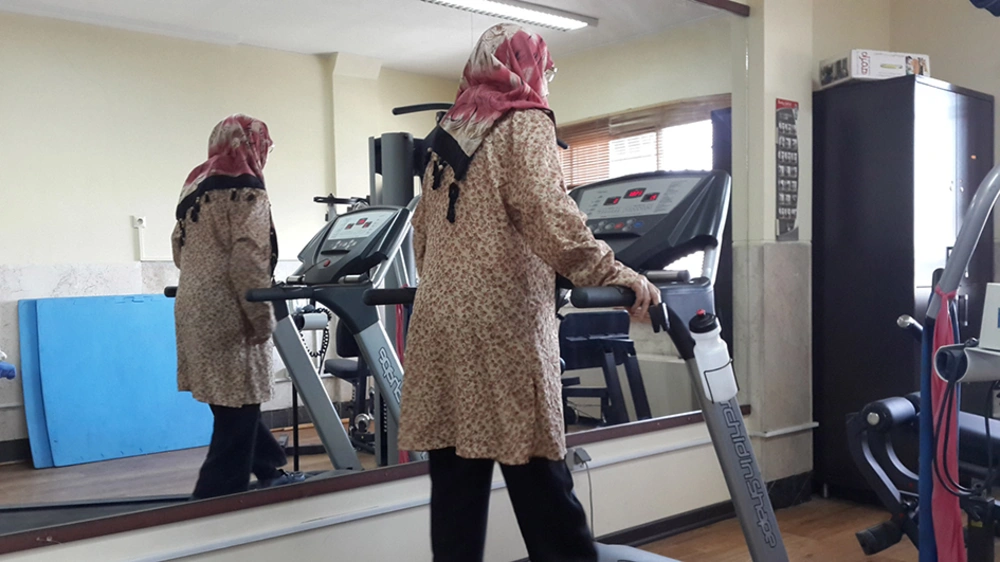
Figure 1.
The patient During Downhill Walking (With Permission of the Patient).
During exercise therapy sessions, the patient had no complaints of shortness of breath but had fatigue in her legs in the early 10 sessions; in the later stage of exercise therapy, the patient could easily go more than 30 minutes on the treadmill. She felt a sense of lightness in her walking due to increasing muscle strength in her lower extremities.
After 20 sessions, the patient found a significant difference in her physical abilities, the patient stated that she could easily walk and do her ADL alone without any help. Above all, she hadnever experienced shortness of breath in walking and doing physical activities. This improvement was incredible and inconceivable for the patient herself. As seen in Table 1, there were no significant differences between HR and O2 saturation before and the mean of mentioned parameters during exercise therapy.
The medications, the patient was taking during training, including Seretide diskus , Amlodipine, Levofloxacine, Montelukast and Omeprazole. At the end of the exercise program, the patient had no low back pain (0 according to VAS), no weakness and fatigue in her legs and her QoL hadimproved considerably. The improvement of measured outcomes was observed in the Table 2.
Table 2.
Outcome Measures Pre and Post Intervention
| Outcome Measures | Pre Intervention | Post Intervention |
|---|---|---|
| Functional Tests | ||
| The timed “up & go” test | 7.97 sec | 5.84 sec |
| Six-minute walk test | ||
| Distance | 320 m | 440 m |
| Speed | 0.88 m/sec | 1.22 m/sec |
| Stair climbing test | 10 steps (With great difficulty) | 36 steps |
| Thigh Circumference | ||
| At 10 cm above the patella | 36 (Right), 35.5 (Left) | 40.5 (Right), 39.5 (Left) |
| At 15 cm above the patella | 43 (Right), 42.5 (Left) | 45.5 (Right), 44.5 (Left) |
| At 20 cm above the patella | 46 (Right), 46 (Left) | 48.5 (Right), 48.5 (Left) |
| Quality of Life (St. George’s Questionnaire Score) | ||
| Part 1 scores (Symptoms) | 28.46 | 25.83 |
| Part 2 scores (Activity) | 53.53 | 12.95 |
| Part 3 scores (Impact) | 28.87 | 6.08 |
| Total scores | 36.63 | 12.07 |
3. Discussion
The findings of this experiment provide evidence that, the eccentric exercise training in the form of downhill walking has improved the QoL and the function of the studied case. The results of the present case study are interesting in several aspects. Firstly, the patient easily accepted this exercise program to improve her performance and with full consent, and regularly participated in the training program. Also, no complaint of shortness of breath and no O2 de-saturation were observed during exercise therapy. In fact, O2 saturation during training was more or less the same as the rest time, it is due to the physiologic properties of eccentric exercise which needs a low energy cost and does not impose additional workload on the heart and respiratory system. Navalta et al. (24) stated the older adults have a 3 mL.kg.min-1 reduction in O2 walking on a -10% gradient in comparison to 0% gradient.Similar findings in the elderly were also reported by Gault et al. (25).
Our case enjoyed this type of exercise because she could have a conversation while walking and appreciated the work performed on her leg muscles. She did not experience muscle soreness during training because of the proper intensity of the exercise protocol. However, she complained of fatigue during the first weeks of exercise therapy, but over time this problem was resolved.
One of the mostnotable findings in our study was significant improvement of thigh muscle circumference which is the sign of the increasing muscle size. After the training, the patient’s thigh circumference increased from 2 to 4 cm in different measured areas. This finding is similar to results of others that have examined the effects of eccentric exercise on muscle size in healthy subjects and patients with various diseases (14, 24).
Another important finding of this case study was the patient’s significant improvement in her functions. The results of functional tests were substantially improved compared to pre-intervention. According to the patient, after two months of training, her physical ability to perform ADL had increased and her lower extremity muscle strength was improved to the extent that she could walk on the way back from hospital to home. This finding was consistent with the results of Roig et al. (16) who stated in a systematic review that eccentric training may be safely used to restore muscles function in patients with chronic conditions such as pulmonary disease, chronic heart failure and stroke.
There is no study that evaluates the effect of eccentric training on QoL of COPD patients. But there issome evidence which hasshown the effectiveness of different exercise trainings in increasing exercise tolerance, improving the ADL and QoL of COPD patients (25).
Our finding in this case study revealed an improvement in the SGRQ’s scores. Although scores on the symptom part of SGRQ’s questionnaire did not show much progress, but the scores of the other two parts of the questionnaire have showed significant improvements in QoL of our case. Therefore, the downhill walking does not seem to have a great role in the improvement of COPD symptoms in this case, but leads to a better quality of life QoL of the patient, by increasing her ability to perform ADL and decreasing her muscle weakness and general tiredness.
In our case, three months after the initiation of exercise therapy, the patient was evaluated again and her improvement was sustained.
The above findings suggest the effectiveness of eccentric exercise in patients with COPD as stated in a few studies that had used the ergo-meter bike for eccentric exercise therapy in chronic pulmonary and cardiac patients (15-17, 26-28). Our findings suggest that the eccentric exercise therapy in the form of downhill walking had positive effects on our case’s functions and QoL, and especially had an augmenting effect on the thigh muscles size.
It is the first case report that studied the impact of downhill walking on the improvement of functional ability and QoL of a COPD patient but some limitations in this study should be mentioned; that this was a pilot trial done on a single case and its results cannot be generalized; therefore further studies should be carried out on a number of subjects with different exercise therapy protocols to acquire more accurate findings. Secondly, blinding can be considered in future.
It seems the downhill walking on treadmill as an eccentric training was a safe training modality for the COPD reported case and could be performed without the patient becoming out of breath or needing supplemental oxygen. However, further study with larger sample size isrecommended to achieve more accurate results.