
1. Background
Chronic obstructive pulmonary disease (COPD) is a progressive, debilitating disease characterized by complete, irreversible airway restriction (1). Globally, over 65 million people develop moderate or severe COPD, and it accounts for about 6% of all deaths worldwide (2). This critical health problem demands appropriate preventative and therapeutic measures (3). On average, 10% of the Iranian population is affected by the disease, ranging from 1% to 40% in different societies with different climatic conditions (4). Environmental and genetic factors, such as smoking, air pollution, aging, occupation, and antitrypsin deficiency of the enzyme alpha-A, are involved in the incidence of this illness (5). Patients with COPD typically experience symptoms, such as productive coughing, decreased exercise tolerance, wheezing, shortness of breath, prolonged exhaustion, and fatigue (6). Fatigue is the second most common complaint in these patients (7) that is experienced in approximately 50% of people with COPD (8). It is an unpleasant mental state that affects the entire body (9). This self-diagnosed state is perceived both subjectively and objectively; however, psychological symptoms are more considered in health care (10). Paddison et al. (11) found that patients with COPD complained about fatigue, which is helpful in predicting the risk of hospitalization. Vardar-Yagli (12) suggested that patients with COPD experience more fatigue in both physical and psychological dimensions. Goertz et al. (13) proposed that fatigue in patients with COPD deeply influences their daily functioning and is considered as one of the most debilitating symptoms in these people (13, 14); it can diminish tolerance and muscle strength and cause weakness (15). Furthermore, it impedes the ability of individuals to do their tasks and fulfill their personal and social roles, reduces people’s ability to maintain a normal life and pursue pleasurable activities, and has many negative effects on the economic status and quality of life (QoL) of those involved (6). Peters et al. (8) reported that 50% of patients with COPD suffer from fatigue, and also these individuals have a lot of limitations in many aspects of their health, QoL, and [role] functioning. Shavro et al. (16) confirmed that patients with COPD undergo a decrease in the quality of their lives. Fadaeeaghdam et al. (17) reported that 51.7% of patients with COPD experience a poor QoL.
QoL is a broad concept and refers to people’s perception of their physical and mental status, level of independence, social connection, and interaction with the environment, as well as beliefs and personal values. QoL is closely associated with health status (18). It includes an overall sense of mental, emotional, social, and physical well-being and reflects patients’ mental perception and response to illness (19). Low QoL causes depression, social isolation, reduced fulfillment of daily activities, and increased economic burden (20). Enduring impaired pulmonary function, and exacerbation of respiratory symptoms, COPD patients experience a gradual decline in health over time. In short, social life, physical function, and daily activities of these patients, including communicating with family members, health care workers, and other people, being engaged in the community, and doing exercises, and various pleasurable activities are often disrupted (21). Hence, it is necessary to consider the benefits of an active life and improved QoL as a priority in the treatment plan of these patients (22).
Meanwhile, regarding the clinical symptoms of COPD patients, health care providers underestimate fatigue and the extent to which it can affect QoL (23). Because COPD is a chronic and debilitating condition, its treatment costs impose a huge social and economic burden on societies (24). No cure is available for COPD, and the common prescriptions aimed at controlling symptoms and avoiding harmful complications (25). In this regard, besides pharmaceutical treatments, several interventions, such as pulmonary rehabilitation, exercise programs, and smoking cessation counseling that can be considered to promote the health status of patients (26). Pulmonary rehabilitation is a non-pharmaceutical treatment designed to improve and control symptoms in patients with COPD. This multilayered combination of training and exercise addresses activity levels, symptoms, and complaints of COPD patients (27). Pulmonary rehabilitation reduces complaints and increases activity tolerance in these patients (28, 29). Jokar et al. (6) observed that pulmonary rehabilitation mitigates fatigue in COPD patients. Since chronic diseases do not have a definitive cure and affect the QoL, yet it is possible to raise the QoL of the patients by deploying specific and tailored solutions (30). Because in a non-pharmaceutical approach patient’s and his family’s needs are considered (31), pulmonary rehabilitation is effective to reduce symptoms, improve QoL, encourage patients’ participation in treatment, promote treatment plan, reduce hospitalization costs, and it allows patients to achieve the highest level of ability and independence (32). Moreover, this cost-effective, non-invasive, and simple approach can be easily implemented at home.
2. Objectives
Thus, this research was undertaken to investigate the impact of the pulmonary rehabilitation program on fatigue and QoL in patients with COPD.
3. Methods
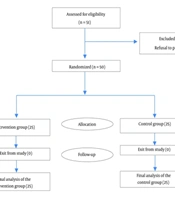
This quasi-experimental study was carried out on 40 patients with COPD who had been admitted to the internal ward of Ali Ibn Abitalib Hospital and Khatam Al-Anbia Hospital in Zahedan, Southeast Iran in 2018 - 2019. The patients were chosen through convenience sampling and then randomized into the experimental (n = 20) and control (n = 20) groups. To determine the group of patients, forty envelopes containing the name of one of the two groups were prepared and randomly arranged. When the patients referred to the ward, they were provided with one of the cards in succession. Sampling continued for six months. The inclusion criteria included the age of over 40 years, stage 2 or 3 of the disease (based on the GOLD criteria), willingness to participate in the study, no heart disease (such as unstable angina, anemia, or uncontrolled hypertension), and no known mental disorder. On the other hand, failing to follow the educational program, exacerbation of the disease, incidence of related complications, and discharge before completion of training sessions comprised the exclusion criteria. According to Jokar et al. (6) study, (X1 = 27.11, s1 = 8.4, X2 = 14.50, and s2 = 7.13), 95% confidence interval, and statistical power of 95%, we estimated 10 subjects for each group. However, due to possible attrition, we finally assigned 20 individuals to each group (n = 40).
Data collection was done after receiving the approval code by the Ethics Committee of Zahedan University of Medical Sciences (code: IR.ZAUMS. REC.1397). Data was collected through a questionnaire consisting of three parts. The first part gathered demographic information, including age, gender, marital status, duration of illness, education, ethnicity, economic status, occupation, history of illness, and medications used. The second part included St George’s Respiratory questionnaire (SGRQ), designed by Jones et al. (33). The SGRQ has been successfully used for COPD patients both in Iran (17) and in other countries (34). It consists of 50 questions divided into three subscales: “symptoms”, “activity”, and “impacts”. In the first part, symptoms, such as cough, sputum, shortness of breath, and wheezing are assessed; the second part deals with activities that can lead to motor limitation and shortness of breath, and the third part concerns the effects of social function and psychosocial disorders caused by chronic respiratory disease. Each subscale of this questionnaire is scored between 0 and 100, expressing as a percentage. A score of zero indicates the best QoL, and higher scores suggest lower levels of QoL. Using Cronbach’s alpha, Aggarwal et al. (35) reported the overall reliability of the SGRQ (α = 0.865), as well as its symptoms (α = 0.685), activity (α = 0.865), and impacts (α = 0.788) subscales (36). In another study by Fallah Tafti et al. (36), Cronbach’s alpha confirmed the reliability of the whole instrument (α = 0.91), as well as its symptoms (α = 0.71), activity (α = 0.82), and impacts (α = 0.88) subscales. In our study, the overall reliability of this instrument (α = 0.923) and its subscales of symptoms (α = 0.725), activity (α = 0.834), and impacts (α = 0.845) were obtained, as well.
In the next stage, we used the Multidimensional Fatigue Inventory (MFI), designed by Smets (1996). It comprises five dimensions of general fatigue, physical fatigue, mental fatigue, reduced motivation, and reduced activity. The MFI measures fatigue based on the statements of the respondent. General fatigue is related to one's overall day-to-day functioning; physical fatigue is associated with a physical sensation that is directly linked to fatigue; mental fatigue is expressed through one’s cognitive symptoms; reduced activity follows mental fatigue, and reduced motivation refers to a low interest or lack of incentive to do any activity. The instrument consists of 20 items that are scored on a 5-point Likert scale ranging from 1 (yes, completely true) to 5 (no, completely false). Each dimension has four questions. The total score of each domain is 4 - 20, and the total fatigue score, determined by summing the scores of the five domains, can vary from 20 to 100; thus, higher scores indicate the more severe degrees of fatigue (23). Hinz et al. (37) and Ghanbari et al. (38) confirmed the reliability of this tool based on Cronbach’s alpha coefficients of 0.94 and 0.756, respectively. In the present study, the reliability of MFI was obtained by the Cronbach’s alpha of 0.79.
After obtaining the written informed consent from the patients, we explained the aims of the study and emphasized that they would be able to withdraw at any stage. Within the first 24 to 48 h of hospitalization, and when the patients’ conditions were stabilized, we filled out the demographic questionnaire, MFI, and SGRQ for patients in both groups. Then, between 4 PM. and 6 PM. for three consecutive days (each lasting 45 to 30 min), patients in the experimental group received face-to-face and individual instructions on their bedside in the presence of a family member. This theoretical and practical program covered COPD and its causes, adhering to dietary and medication principles related to COPD, smoking cessation, and exercise training, which included walking, pursed-lip breathing, diaphragmatic breathing, as well as effective coughing and practicing it. The educational illustrated booklet, containing the content of the program, was provided to the patients at the end of the third session. In the fourth week, a training session was arranged at patients’ homes as a reminder. After discharge, in addition to being advised to follow other instructions, patients (in the experimental group) were asked to perform the walking exercises three days a week (every other day) and pursed-lip breathing four times a day for eight weeks. The subjects were called once a week to ensure the exercises and other recommendations were practiced. At the end of the eighth week, after making coordination using over the phone, we interviewed the patients in both groups at their homes to re-evaluate fatigue and QoL of the cases. The control group received no training, except for routine care. In the end, to observe ethical considerations, we presented the control group with the educational booklet that had been taught to the experimental group. Data were analyzed using SPSS 22 and the independent t-test, paired t-test, and chi-squared test at the significance level of less than 0.05.
4. Results
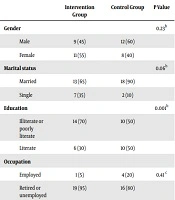
Forty participants completed the study. The mean age of participants in the experimental and control groups was 56.80 ± 7.38 and 50.80 ± 5.83, respectively. Moreover, the mean body mass index (BMI) in the experimental and control groups was 23 ± 3 and 23 ± 2, respectively. There was no significant difference between the two groups in terms of age, BMI, and duration of disease. Similarly, the two groups did not differ significantly in terms of other demographic and clinical factors (Table 1).
Table 1.
Comparing the Demographic and Clinical Characteristics of the Control and Experimental Groupsa
| Intervention Group | Control Group | P Value | |
|---|---|---|---|
| Gender | 0.23b | ||
| Male | 9 (45) | 12 (60) | |
| Female | 11 (55) | 8 (40) | |
| Marital status | 0.06b | ||
| Married | 13 (65) | 18 (90) | |
| Single | 7 (35) | 2 (10) | |
| Education | 0.001b | ||
| Illiterate or poorly literate | 14 (70) | 10 (50) | |
| Literate | 6 (30) | 10 (50) | |
| Occupation | |||
| Employed | 1 (5) | 4 (20) | 0.41 c |
| Retired or unemployed | 19 (95) | 16 (80) | |
| Ethnicity | 0.44b | ||
| Fars | 5 (25) | 3 (15) | |
| Balouch | 15 (75) | 17 (85) | |
| Smoking history | 0.23b | ||
| Yes | 17 (85) | 16 (80) | |
| No | 3 (15) | 4 (20) | |
| Previous hospitalization | 0.65b | ||
| Yes | 20 (100) | 20 (100) | |
| No | - | - | |
| History of other [chronic] diseases | 0.44b | ||
| Diabetes | 9 (45) | 10 (50) | |
| Hypertension | 5 (25) | 5 (25) | |
| Heart disease | 6 (30) | 5 (25) | |
| Disease stage | 0.35b | ||
| Stage two | 15 (75) | 17 (85) | |
| Stage three | 5 (25) | 3 (15) |
aValues are expressed as No. (%).
bChi-squared test.
cFisher’s exact test.
Comparing the QoL scores indicated no significant variation between the two groups before the intervention. However, this difference was significant after the intervention, such that the experimental group expressed a more favorable QoL than did the control group. Moreover, pre- and post-intervention scores were significantly different in the experimental group; thus, patients in this group enjoyed an improvement in QoL at the end of the study. Conversely, this within-group variation was not significant in the control group, and patients in this group even experienced a decline in QoL at the end of the study (Table 2).
Table 2.
Comparing the Mean and Standard Deviation of Quality of Life and Fatigue in Patients with the Chronic Obstructive Pulmonary Disease Before and After Pulmonary Rehabilitation in the Two Groupsa
| Variable | Stage | Statistical Results | ||
|---|---|---|---|---|
| Before Intervention | After Intervention | Changes | ||
| Fatigue | ||||
| Intervention | 72.35 ± 3.93 | 36.70 ± 5.79 | 35.65 ± 7.12 | P = 0.001b |
| Control | 0.60 ± 4.79 | 63.35 ± 4.47 | 14 ± 3.25 | P = 0.21b |
| Independent t-test | P = 0.59c | P = 0.001c | P = 0.001c | |
| Quality of life | ||||
| Intervention | 70.87 ± 11.63 | 49.12 ± 8.83 | 21.75 ± 7.06 | P = 0.001b |
| Control | 71.65 ± 09.74 | 73.59 ± 7.600 | -1.93 ± 4.70 | P = 0.081b |
| Independent t-test | P = 0.081c | P = 0.001c | P = 0.001c | |
aValues are expressed as mean ± SD.
bPaired t-test.
cIndependent t-test.
On the other hand, the results revealed no significant difference between the mean scores of fatigue in the two groups before the pulmonary rehabilitation; meanwhile, this difference between the two groups was significant after the intervention, with the experimental group reporting less severe fatigue. In other words, the intervention was effective in reducing fatigue significantly in the experimental group. The control group, experienced less fatigue at the end of the study than baseline, however, the difference was not significant (Table 2).
5. Discussion
The results of this study corroborated that the pulmonary rehabilitation program could improve the QoL of patients with COPD. In this regard, the results of a study by Cilekar et al. (39) in Turkey showed that low-intensity pulmonary rehabilitation was effective on exercise capacity, shortness of breath, walking distance, and QoL in patients with stable COPD. Zhang et al. (40) noted that deploying rehabilitation training to treat stable COPD improves pulmonary function, motor function, and QoL; hence, it should be considered in clinical practice. Alexescu et al. (41) also concluded that patients with COPD, besides medication and medical treatment, might benefit from pulmonary rehabilitation as a contributor to relieving symptoms. The improvement of COPD symptoms is associated with an increase in QoL (21). Jokar et al. (6) reported that the home-based pulmonary rehabilitation program could enhance the QoL of patients with COPD. Mir Bagheri et al. (21) found that the overall QoL of COPD patients in the experimental group was significantly different from the control group; they suggested that pulmonary rehabilitation should be integrated into the care programs intended for these patients. The results of these studies are in line with our findings, and it could be inferred that disease management strategies should focus on signs and symptoms that are mostly associated with QoL (17). It seems that the continuity and proper implementation of pulmonary rehabilitation programs by patients can be effective in promoting the QoL of patients with COPD.
The results of our study indicated that pulmonary rehabilitation was effective in reducing fatigue in patients with COPD. Van Herck et al. (42) claimed that fatigue is a major symptom in COPD patients, which can be alleviated by pulmonary rehabilitation programs. Paddison et al. (11) also demonstrated that pulmonary rehabilitation leads to a decrease in COPD symptoms, including fatigue, and consequently enhances the patients’ QoL. Ghanbari et al. (38) concluded that breathing exercises, as a non-pharmacological, cost-effective, and safe method of care and treatment, relieve many aspects of fatigue in patients with COPD; nevertheless, the impact of this method on mental fatigue is an important aspect, which should be considered. Jokar et al. (6) reported that pulmonary rehabilitation brings about positive effects that could lead to a reduction in patients’ fatigue. The results of the study by Zakerimoghadam et al. (5) showed that fatigue severity decreased in the intervention group and there was a significant inverse relationship between using respiratory exercises and fatigue severity such that the more these exercises are performed, the less fatigue one will experience, which is consistent with our findings. Fatigue in patients with COPD is an inevitable symptom, and when left uncontrolled, it can affect patients’ health and QoL (9). Therefore, it should be highly considered by nurses and healthcare providers. In addition to routine care provided in the ward, it is necessary to consider (pulmonary) rehabilitation programs training for patients. Finally, to achieve the best health outcomes, patients have to be motivated to practice such programs at home as one of the self-care methods.
5.1. Conclusions
According to the results of this study, pulmonary rehabilitation can lower fatigue and improve the clinical status, and consequently, QoL in patients with COPD. Therefore, it is recommended that health care providers adopt it as part of the care plan for these individuals and monitor its implementation as a treatment priority. The two main limitations of this study were its small sample size and short duration, which restrict the generalizability of the results. Hence, it is suggested that future studies be conducted on larger populations and for longer periods.