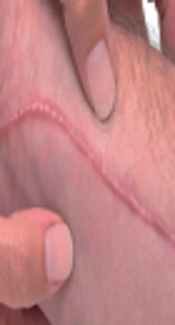
Cover image of the article: Management of Hypertrophic Burn Scar: A Comparison between the Efficacy of Exercise-Physiotherapy and Pressure Garment-Silicone on Hypertrophic Scar

Image Credit:Asian J Sports Med

Management of Hypertrophic Burn Scar: A Comparison between the Efficacy of Exercise-Physiotherapy and Pressure Garment-Silicone on Hypertrophic Scar

Authors

Hamid Karimi1, Mohammadreza MobayenMohammadreza Mobayen ORCID2,*, Aboulhasan Alijanpour1
1Department of Plastic and Reconstructive Surgery, Motahari Burn Hospital, Tehran University of Medical Sciences, Tehran, Iran
2Burn Research Center, Tehran University of Medical Sciences, Tehran, Iran
*Corresponding Author: Burn Research Center of Tehran, Motahri Burn Hospital, Shahid Yasami Street, Vali e asr street, Tehran, Iran., maziar.mobayen@gmail.com. Email: maziar.mobayen@gmail.com

Asian Journal of Sports Medicine:Vol. 4, issue 1; 70-75
Published online:Sep 29, 2012
Article type:Research Article
Received:May 11, 2012
Accepted:Aug 04, 2012
How to Cite:Karimi H, Mobayen M, Alijanpour A. Management of Hypertrophic Burn Scar: A Comparison between the Efficacy of Exercise-Physiotherapy and Pressure Garment-Silicone on Hypertrophic Scar. Asian J Sports Med. 2012;4(1):34536. doi: https://doi.org/10.5812/asjsm.34536

Abstract

Purpose:

Our study aims to investigate the effectiveness of other treatment methods for burn related scarring and to determine the possibility of their routine administration in similar clinical settings.

Methods:

Through a prospective study, 66 patients were enrolled to receive either the conventional pressure garment therapy (PGT) and Silicone (control group) or exercise and physiotherapy (case group). Patients were visited regularly to be examined for the status of their scars regression, limbs dysfunction, and joint motion. Then, these two groups were compared to determine the efficacy of exercise and physiotherapy as an alternative to the conventional treatment with PGT.

Results:

After about 20 months follow-up, decreased articular range of motion (ROM) was: 16 (51.5%) cases compared to 5 (15%) of controls had mild, 11 (35.5%) of the cases compared to 13 (39.5%) of the controls had moderate; and 4 (13%) of the cases compared to 15 (45.5%) of the controls had severe decreased ROM which revealed statistically significant difference (P<0.01). At the same time, Vancouver Scar Scale score was: 15 (48%) of the cases and 6 (18%) of the controls had mild Scar Scale, 12 (39%) of the cases and 14 (42.5%) of the controls had moderate score and 4 (3%) of the cases and 13 (39.5%) of the controls had severe score which revealed a statistically significant difference (P<0.05).

Conclusion:

Our study showed that physical therapy andexercise are more effective than PGT, in management of burn hypertrophic scar, hence could be an alternative in cases that conventional therapy cannot be used for any reason.

Highlights

Full Text

Full text is available in PDF

Copyright

© 2012, Author(s). This open-access article is available under the Creative Commons Attribution 4.0 (CC BY 4.0) International License (https://creativecommons.org/licenses/by/4.0/), which allows for unrestricted use, distribution, and reproduction in any medium, provided that the original work is properly cited.
Similar Articles

1
Sep
2018
Comparative Effect of Ablative Fractional CO2 Laser Plus Triamcinolone Acetonide Cream Versus Intralesional Injection of Triamcinolone Acetonide in Keloid and Hypertrophic Scars: A Randomized Clinical Trial

Comparative Effect of Ablative Fractional CO2 Laser Plus Triamcinolone Acetonide Cream Versus Intralesional Injection of Triamcinolone Acetonide in Keloid and Hypertrophic Scars: A Randomized Clinical Trial

Elham Behrangi,
Maryam Jalilifar,
Vahide Lajevardi,
Saeed Razavi,
Zahra Azizian

Behrangi E, Jalilifar M, Lajevardi V, Razavi S, Azizian Z. Comparative Effect of Ablative Fractional CO2 Laser Plus Triamcinolone Acetonide Cream Versus Intralesional Injection of Triamcinolone Acetonide in Keloid and Hypertrophic Scars: A Randomized Clinical Trial. J Skin Stem Cell. 2018;5(1-2):e69394. doi: https://doi.org/10.5812/jssc.69394
23
Mar
2024
Evaluating the Efficacy of Bromelain and Curcumin in Treating Acne Scars: A Randomized Clinical Trial

Evaluating the Efficacy of Bromelain and Curcumin in Treating Acne Scars: A Randomized Clinical Trial

Saba Shojaan,
Kamyab Andarzbakhsh,
Hanieh Jalalian Targhi,
Shaghayegh Namvar,
Maryam Shiehmorteza,
Hoda Ghoreishi Rad
,et al.

Shojaan S, Andarzbakhsh K, Jalalian Targhi H, Namvar S, Shiehmorteza M, et al. Evaluating the Efficacy of Bromelain and Curcumin in Treating Acne Scars: A Randomized Clinical Trial. Jundishapur J Nat Pharm Prod. 2024;19(2):e144048. doi: https://doi.org/10.5812/jjnpp-144048
9
Sep
2026
Effect of a Structured Exercise Program on Pain Intensity in Patients with Shoulder-Joint Burns: A Secondary Analysis of a Randomized Study

Effect of a Structured Exercise Program on Pain Intensity in Patients with Shoulder-Joint Burns: A Secondary Analysis of a Randomized Study

Alireza Salar,
Fariba Yaghoubinia,
Mehdi Rezvaniamin

Salar A, Yaghoubinia F, Rezvaniamin M. Effect of a Structured Exercise Program on Pain Intensity in Patients with Shoulder-Joint Burns: A Secondary Analysis of a Randomized Study. Med Surg Nurs J. 2026;15(1):e169444. doi: https://doi.org/10.5812/msnj-169444
30
Sep
2017
Comparing Efficacy and Tolerability of Triamcinolone and Verapamil in Treatment of Hypertrophic Scars and Keloids

Comparing Efficacy and Tolerability of Triamcinolone and Verapamil in Treatment of Hypertrophic Scars and Keloids

Abbas Zamanian,
Maryam Nokandeh,
Elham Behrangi,
Zeynab Fazel,
Zahra Azizian

Zamanian A, Nokandeh M, Behrangi E, Fazel Z, Azizian Z. Comparing Efficacy and Tolerability of Triamcinolone and Verapamil in Treatment of Hypertrophic Scars and Keloids. J Skin Stem Cell. 2017;4(3-4):e69390. doi: https://doi.org/10.5812/jssc.69390
10
Apr
2019
Comparative Study of Pain Relief in Two Non-Pharmacological Treatments in Patients with Partial Rotator Cuff Tears: A Randomized Trial

Comparative Study of Pain Relief in Two Non-Pharmacological Treatments in Patients with Partial Rotator Cuff Tears: A Randomized Trial

Sotiria Vrouva,
Chrysanthi Batistaki,
Efterpi Paraskevaidou,
Konstantinos Chanopoulos,
Dimitrios Kostopoulos,
Efthimios Stamoulis
,et al.

Vrouva S, Batistaki C, Paraskevaidou E, Chanopoulos K, Kostopoulos D, et al. Comparative Study of Pain Relief in Two Non-Pharmacological Treatments in Patients with Partial Rotator Cuff Tears: A Randomized Trial. Anesth Pain Med. 2019;9(2):e88327. doi: https://doi.org/10.5812/aapm.88327

More by these authors

Hamid KarimiPubMedScholar
Mohammadreza MobayenPubMedScholar
Aboulhasan AlijanpourPubMedScholar
Share
Cited by
Metrics