
1. Background
Burn injuries remain a substantial public health concern and contribute markedly to disability and the global healthcare burden (1). Beyond survival, many patients experience prolonged physical and psychological sequelae that can impede recovery and reintegration. Among these sequelae, pain is a central and highly consequential symptom. In burn care, pain is not limited to the initial tissue injury; it is often exacerbated by routine clinical procedures such as dressing changes, debridement, physiotherapy sessions, and, when indicated, surgical interventions. When inadequately controlled, pain can restrict movement, reduce participation in self-care, and interfere with adherence to rehabilitation programs. These downstream effects may contribute to functional limitations, prolonged hospitalization, and poorer quality of recovery (1, 2).
Contemporary burn rehabilitation emphasizes early initiation and continuity of therapeutic activities aimed at preserving function and preventing long-term complications such as joint stiffness and contracture (3). The shoulder joint is particularly vulnerable to functional impairment after burns involving the upper limb and periarticular tissues because pain and protective guarding can substantially limit range of motion. In this context, maintaining mobility is clinically important; however, pain during movement is also among the strongest barriers to consistent participation in rehabilitative exercises. This creates a clinical dilemma: exercise and movement are essential for functional recovery, yet pain can undermine the feasibility and tolerability of these interventions (3, 4).
Clinical guidance for burn pain management highlights the need for systematic assessment and multimodal approaches to support patient participation in necessary care, including rehabilitation activities (2). Multimodal care typically integrates pharmacologic analgesia with adjunctive nonpharmacologic strategies, such as education, graded activity, and supportive rehabilitation techniques, to reduce pain-related avoidance and improve function. Within this framework, structured exercise programs may reduce pain through several pathways, including improved joint mobility, reduced stiffness and edema, enhanced local circulation, improved neuromuscular control, and gradual reduction of movement-related fear and guarding (3, 5-7). Education and supervised practice may further support self-efficacy and adherence, potentially improving symptom outcomes over time (2, 3, 5-7).
Existing evidence supports the broader value of rehabilitation and exercise-based interventions after burn injury, particularly for physical and functional outcomes. An overview of systematic reviews and other evidence summaries indicates that rehabilitation is integral across the continuum of burn care and may improve a range of outcomes (5). Meta-analytic findings also suggest that exercise interventions can improve physiological and functional measures after burns, although intervention components, timing, and patient populations vary considerably (6, 7). However, the effect of exercise-based rehabilitation on pain remains less clear. In prior burn studies, pain has often been assessed as a nonprimary outcome, and findings have been heterogeneous. Differences in burn severity, exposure to procedure-related pain, analgesic regimens, timing of exercise initiation, and adherence monitoring can obscure intervention-specific effects. Moreover, in real-world settings, usual care may include basic mobility guidance or therapy input that overlaps with structured programs, potentially reducing between-group differences (5-7).
Evidence regarding the effect of structured post-discharge exercise programs on pain intensity in patients with shoulder-joint burns remains limited, and available reviews emphasize substantial variation in intervention content, timing, populations, and patient-reported outcomes (7). Recent local evidence from the same clinical setting and shoulder-joint burn population showed that a 12-week structured exercise program improved quality of life at 3 months, supporting the evaluation of pain as a complementary patient-reported outcome in this cohort (8).
In addition to heterogeneity in the international literature, context-specific evidence remains limited in many settings. Differences in clinical routines, staffing models, patient-education resources, and post-discharge follow-up may influence both the feasibility and effectiveness of structured rehabilitation approaches. Therefore, locally derived evidence using pragmatic designs that reflect typical care pathways may help guide implementation decisions and rehabilitation planning (3, 5, 8).
2. Objectives
The objective of this study was to evaluate whether, compared with usual care, a structured post-discharge exercise program reduces pain intensity over 3 months among patients with shoulder-joint burns.
3. Methods
3.1. Study Design and Setting
This study was a secondary analysis of a randomized parent study (8) conducted in 2021 at the burn unit of Ali Ibn Abi Talib Hospital, Zahedan, Iran. The study was conducted after approval by the Ethics Committee of Zahedan University of Medical Sciences (IR.ZAUMS.REC.1400 [No. 276]). Written informed consent was obtained from all participants before enrollment.
3.2. Participants and Eligibility Criteria
The study population comprised adult patients with third-degree burns involving the shoulder joint. Participants were recruited by convenience sampling from patients scheduled for discharge from the burn unit and were then randomly allocated to the intervention or control group. Eligibility criteria were defined by combining clinical, functional, and safety considerations.
Patients were included if they were aged 18 - 50 years, weighed less than 100 kg, had third-degree burns involving the shoulder joint with a burn extent of 15% - 45%, had stable vital signs, were able to read and write, and had no history of malignancy or psychiatric illness. In addition, patients were required to have no known pre-existing joint problems or neuromuscular disorders that could interfere with exercise performance or outcome assessment. To ensure adequate recovery for participation in the exercise program, patients were enrolled only after the acute phase of treatment, when at least 14 days had elapsed since skin grafting and they were clinically ready for follow-up after discharge.
Exclusion criteria included hospital readmission during the study period, graft-site infection or graft rejection, participation in other physiotherapy or rehabilitation programs, inability to continue the prescribed exercise program, and death. Participants were also excluded if they failed to perform the prescribed exercises more than twice per day for 2 consecutive days.
3.3. Sample Size
The sample size was originally determined for the quality-of-life outcome of the parent study, based on the study by Najafi et al. (9), using the formula for comparing 2 independent means:
The values used were α = 0.05 (Z1-α/2 = 1.96), statistical power = 90% (Z1-β = 1.64), X̄1 = 169.55, X̄2 = 132.76, S1 = 4.61, and S2 = 12.56. The calculated minimum was 1.7 participants per group. To account for potential attrition and obtain a practicable analytic sample, the enrollment target was increased to 15 participants per group (total N = 30). Pain was assessed in the same study cohort; no separate a priori sample-size calculation was performed for the visual analogue scale (VAS) outcome.
3.4. Randomization and Allocation Concealment
After recruitment and baseline assessment, participants were randomly assigned to the intervention or control group in a 1:1 ratio using permuted-block randomization with a block size of 4. The allocation sequence was generated using a random-number table based on all possible balanced block permutations. To ensure allocation concealment, the sequence was placed in sequentially numbered, opaque, sealed envelopes prepared by a researcher who was not involved in participant recruitment or outcome assessment. Eligible participants were enrolled by the research team, and group assignment was revealed only after enrollment.
3.5. Intervention and Control Conditions
The control group received routine burn care, including standard wound care, dressing changes, analgesic management, and usual discharge and follow-up instructions. In addition to routine care, the intervention group received a structured exercise-training program delivered individually in 4 sessions. The intervention was delivered by one of the researchers (FZG). Session content included education about the disease process and potential complications, range-of-motion exercises, strengthening and stretching exercises, and self-care activities. Training was provided when patients were physically and psychologically ready, and understanding of the instructions was verified through a question-and-answer assessment.
After discharge, participants in the intervention group were provided with an exercise booklet and exercise-registration forms. They were instructed to perform the prescribed exercises 3 times daily for 12 weeks, with each movement repeated 10 times per session. Each session included warm-up, stretching, range-of-motion, and strengthening exercises. Participants were followed during the post-discharge period, and adherence to the exercise program was monitored through follow-up contacts and review of exercise records. All participants were given the researcher's telephone number for questions, if needed. The complete 12-week exercise protocol and its quality-of-life outcome in the parent cohort have been reported previously (8).
3.6. Pain Measurement
Pain intensity was measured using a 10-cm VAS, with scores ranging from 0 (no pain) to 10 (worst imaginable pain). The VAS is an established measure of pain intensity with documented measurement properties and reliability. Assessments were performed at baseline and at 1 and 3 months after the intervention. Demographic and clinical characteristics were also recorded using a researcher-designed form. The selection and interpretation of the VAS were based on established measurement literature (10-13).
3.7. Statistical Analysis
Data were analyzed using SPSS version 21. Descriptive statistics were used to summarize participant characteristics. The Shapiro-Wilk test was used to assess the normality of continuous variables. Baseline group comparisons were performed using the independent-samples t-test for continuous variables and the chi-square test or Fisher exact test for categorical variables, as appropriate. Changes in pain intensity over time and between groups were analyzed using repeated-measures analysis of variance (ANOVA). When the assumption of sphericity was violated, the Greenhouse-Geisser correction was applied. Bonferroni-adjusted pairwise comparisons were used for post hoc analyses. A P value of less than 0.05 was considered statistically significant.
No participants were lost to follow-up or excluded after allocation, and no VAS data were missing at any assessment point. Accordingly, all randomized participants were included in the final analysis, and the per-protocol analysis was identical to the complete-case analysis.
3.8. Ethical Considerations
The study was approved by the Ethics Committee of Zahedan University of Medical Sciences (IR.ZAUMS.REC.1400 [No. 276]), and written informed consent was obtained from all participants before enrollment.
4. Results
4.1. Participant Flow and Baseline Characteristics
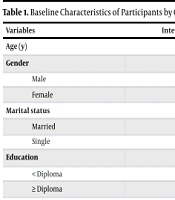
A total of 30 participants were randomly assigned to the intervention group (n = 15) or the control group (n = 15). All randomized participants completed the 3-month follow-up, with no losses to follow-up and no missing data at any assessment point; therefore, a complete-case analysis was performed. Baseline demographic and clinical characteristics are presented in Table 1. The 2 groups were comparable at baseline, with no statistically significant differences in age, sex, marital status, or education level.
Table 1.
Baseline Characteristics of Participants by Group a
| Variables | Intervention (n = 15) | Control (n = 15) | Total (n = 30) | P-Value |
|---|---|---|---|---|
| Age (y) | 34.60 ± 9.51 | 30.93 ± 9.15 | 32.77 ± 9.40 | 0.292 b |
| Gender | 0.999 c | |||
| Male | 7 (46.7) | 7 (46.7) | 14 (46.7) | |
| Female | 8 (53.3) | 8 (53.3) | 16 (53.3) | |
| Marital status | 0.999 c | |||
| Married | 11 (73.3) | 11 (73.3) | 22 (73.3) | |
| Single | 4 (26.7) | 4 (26.7) | 8 (26.7) | |
| Education | 0.999 c | |||
| < Diploma | 9 (60.0) | 10 (66.7) | 19 (63.3) | |
| ≥ Diploma | 6 (40.0) | 5 (33.3) | 11 (36.7) |
a Values are expressed as mean ± SD or No. (%).
b Independent-samples t test.
c Fisher exact test.
4.2. Pain Intensity Over Time
Mean pain intensity decreased over time in both groups, as shown in Table 2.
Table 2.
Pain Intensity Scores (VAS 0 - 10) at Baseline, 1 Month, and 3 Months in the Intervention and Control Groups a
| Group | Baseline | 1-Month | 3-Month | 1 mo – baseline b | 3 mo – baseline b |
|---|---|---|---|---|---|
| Intervention (n = 15) | 7.40 ± 0.63 | 4.60 ± 0.63 | 3.60 ± 0.63 | -2.80 | -3.80 |
| Control (n = 15) | 7.53 ± 0.74 | 4.90 ± 0.63 | 3.60 ± 0.63 | -2.63 | -3.93 |
a Values are expressed as mean ± SD. Negative values denote a reduction in pain intensity. Between-group differences over time were evaluated using the repeated-measures ANOVA model.
b indicates the within-group mean change from baseline.
Between-group comparisons showed small differences in pain intensity at all assessment points. The mean differences (MDs; intervention minus control) were -0.13 (95% CI, -0.64 to 0.38; Cohen d = -0.19) at baseline, -0.30 (95% CI, -0.77 to 0.17; Cohen d = -0.48) at 1 month, and 0.00 (95% CI, -0.47 to 0.47; Cohen d = 0.00) at 3 months. None of these between-group differences was statistically significant.
4.3. Repeated-Measures Analysis of Variance
Repeated-measures ANOVA showed a significant main effect of time on pain intensity (F(2, 56) = 2751.52, P < 0.001, partial η2 = 0.99), whereas the main effect of group (F(1, 28) = 0.598, P = 0.446, partial η2 = 0.02) and the group × time interaction (F(2, 56) = 0.872, P = 0.424, partial η2 = 0.03) were not statistically significant. These inferential results are presented in Table 3.
Table 3.
Results of Repeated-Measures Analysis of Variance for Pain Intensity (VAS 0 - 10) a
| Effect | SS | df | MS | F | P-Value | Partial η2 | Test Power |
|---|---|---|---|---|---|---|---|
| Group | 0.544 | 1 | 0.544 | 0.598 | 0.446 | 0.02 | 0.05 |
| Time | 2506.944 | 2 | 1253.472 | 2751.52 | < 0.001 | 0.99 | 1.00 |
| Group × Time | 0.422 | 2 | 0.211 | 0.872 | 0.424 | 0.03 | 0.108 |
a Results are from repeated-measures analysis of variance. The Greenhouse-Geisser correction was applied when the assumption of sphericity was violated. Abbreviations: SS, sum of squares; df, degrees of freedom; MS, mean square.
Post hoc pairwise comparisons with Bonferroni adjustment indicated significant reductions in pain intensity from baseline to 1 month and from baseline to 3 months within both groups (all P < 0.01). No adverse events or unintended harms related to the exercise program or study participation were reported in either group during the study period.
5. Discussion
5.1. Principal Findings
In this secondary analysis of a randomized study of patients with shoulder-joint burns, pain intensity measured by the VAS decreased over the 3-month follow-up in both the intervention and control groups. Repeated-measures ANOVA demonstrated a significant main effect of time (F(2, 56) = 2751.52, P < 0.001, partial η2 = 0.99), whereas neither the main effect of group (F(1, 28) = 0.598, P = 0.446, partial η2 = 0.02) nor the group × time interaction (F(2, 56) = 0.872, P = 0.424, partial η2 = 0.03) was statistically significant. These results indicate that, although pain improved over time in both groups, the structured exercise program did not provide an additional statistically significant benefit beyond usual care. This pattern is consistent with the heterogeneity of patient-reported outcomes identified across burn-rehabilitation evidence syntheses (5-7).
A plausible explanation is that the observed improvement primarily reflects the natural recovery process, including wound healing, stabilization of inflammation, and gradual resumption of movement, together with routine inpatient care provided to both groups (2, 3). In burn settings, pain is usually managed through multimodal strategies that combine pharmacologic analgesia with nonpharmacologic and supportive measures to facilitate procedures and participation in rehabilitation activities (2). Therefore, even without a distinct exercise-related analgesic effect, a substantial reduction in pain over time is clinically plausible when standard care is consistent and effective (2, 3).
5.2. Relation to Previous Evidence
From a rehabilitation perspective, early and continuous therapy is widely recommended to prevent stiffness, contracture, and functional decline after burns (3). However, the relationship between exercise and pain is complex. Exercise may theoretically reduce pain by improving circulation, decreasing edema, reducing joint stiffness, and normalizing movement patterns. At the same time, movement can temporarily increase pain, especially in the early healing stages or during dressing changes and debridement. If usual care already includes encouragement of movement and basic mobilization advice, a structured program may not produce a clear additional benefit for a symptom such as pain, particularly when pain is influenced by multiple concurrent clinical factors (2, 3).
The present pattern is broadly consistent with previous literature suggesting that exercise-based burn rehabilitation tends to show clearer benefits for physical and functional outcomes than for pain alone. An overview of systematic reviews has emphasized the central role of rehabilitation across the burn-care continuum while also noting variability in intervention content, timing, and outcome strengths (5). Similarly, systematic reviews of exercise interventions in burn populations have reported improvements in several physiological and functional domains, whereas patient-reported outcomes such as pain have been more heterogeneous and are not always primary endpoints (6, 7). More recent trials have explored earlier exercise training and broader recovery outcomes, supporting feasibility and potential benefits in selected domains, but the extent to which pain improves beyond usual care remains inconsistent (4).
5.3. Possible Explanations for the Lack of an Additional Pain Effect
Several factors may explain why no additional pain reduction was detected in this study. First, there may have been overlap with usual care. If routine burn-unit management already included movement advice, basic physiotherapy, or encouragement of mobilization, the control group may have received elements similar to the intervention, thereby reducing observable between-group differences (2, 3). Second, the study may have been underpowered to detect small effects because 15 participants per group may be insufficient to detect modest between-group differences in pain, particularly in the presence of a large within-subject time effect. Third, burn pain is strongly influenced by analgesic dosing, the timing of dressing changes, debridement, grafting, infections, sleep disruption, and psychological distress (2). If these factors were not measured and controlled analytically, they could have masked a true intervention effect. Fourth, although no major protocol deviations were documented, adherence to the home-based exercise program was assessed primarily through self-reported logs and follow-up contacts rather than objective monitoring. Therefore, variation in the actual dose of exercise performed cannot be completely excluded. Finally, pain was measured using the VAS, a widely accepted tool with strong psychometric support (10-13), but pain remains highly variable and context-dependent; differences in timing relative to analgesic administration or wound care can increase measurement noise and weaken between-group contrasts (2, 3, 10-13).
5.4. Clinical Implications
Despite these limitations, the findings remain clinically useful. Improvement in both groups suggests that pain management and recovery processes were sufficient to support gradual pain reduction over time. However, the absence of a significant group × time interaction indicates that, under routine conditions, adding a brief structured exercise-education and supervision program may not automatically lead to measurable additional pain relief. This does not rule out functional benefits of exercise; rather, it suggests that, if pain reduction is a primary goal, rehabilitation may need to be more explicitly integrated with pain-focused strategies, such as timing exercise sessions with analgesic peaks, using graded exposure for movement-related fear, or combining exercise with other nonpharmacologic pain-management approaches (2, 3).
In practice, burn units should continue emphasizing multimodal pain management and early rehabilitation. Structured exercise education and supervised initiation remain valuable for functional recovery, but if pain reduction is the main target, programs may require explicit pain-focused tailoring, including coordination with analgesic timing, symptom-triggered modification rules, and standardized documentation of concurrent pain care. Future studies should use larger samples, improve measurement of analgesic exposure and procedure-related pain, monitor adherence objectively, and apply analytic methods that can adjust for baseline pain and other key confounders, such as mixed-effects models. Trials should also define clinically meaningful pain improvement a priori and report both statistical and clinical interpretations.
5.5. Strengths and Limitations
The study has several strengths, including repeated measurements, a clearly defined pain outcome with standardized assessment points, and a structured intervention that can be replicated or refined. However, several limitations should be considered when interpreting the results. Convenience sampling, the single-center setting, likely lack of blinding, limited monitoring of adherence, and limited reporting of concurrent analgesic use or procedural pain may all reduce the ability to detect modest between-group effects. In addition, the findings should be generalized cautiously, particularly to patients with more extensive burns, different burn locations, or different rehabilitation settings. Small samples and methodological heterogeneity are also recurring limitations in the burn-exercise evidence base.
5.6. Conclusions
Pain intensity decreased significantly over the 3-month follow-up in both intervention and control groups among patients with shoulder-joint burns. However, the structured exercise program did not demonstrate an additional statistically significant advantage over usual care for pain reduction. Further adequately powered studies with rigorous methodology and standardized pain-management strategies are warranted.