Full Text
Full text is available in PDF
Asian Journal of Sports Medicine
Sports Medicine Research Center, TUMS
Authors
To assess the anthropometric characteristics and dietary intake of the Greek national cross-country skiing team.
Thirty-three athletes (10 females aged 20 5 years; 23 males aged 20 6 years old) participated in the study. All athletes were members of the Greek national ski team, and they had been selected to take part in the Winter Olympics, World Ski Championships, European Ski Championships or other international events, according to their performance. Body composition was estimated by bioelectrical impedance (BIA) and skinfold thickness. The athletes recorded their physical activity and dietary intake for 3 training days, and on a competition day.
The female skiers had 14.21.9% body fat, the men 11.01.5% body fat. Female athletes consumed a diet of 1988319 Kcal during training days and 2011330 Kcal during competition days. Male athletes consumed 2255790 Kcal and 2125639 Kcal respectively. These values are below those recommended for highly active people. During the training period, carbohydrate, fat and protein contributed to 44.57.1%, 39.25.3% and 16.13.7% of the total energy intake (EI) respectively for the males, and to 52.85.6%, 33.03.7% and 14.32.5% of the EI of the women. Between training and competition days, men demonstrated an increased carbohydrate and reduced fat consumption when competing (
The inadequate energy and nutrient intake in the Greek national cross-country ski team could put the athletes at risk of nutritional deficiencies, and possibly compromise their athletic performance.
© 2012, Author(s). This open-access article is available under the Creative Commons Attribution 4.0 (CC BY 4.0) International License (https://creativecommons.org/licenses/by/4.0/), which allows for unrestricted use, distribution, and reproduction in any medium, provided that the original work is properly cited.
Theodoros Nikolaidis P, Knechtle B. Do Skiers with Similar Race Time but Different Age Pace Similarly in a Cross-Country Ski Marathon?. Asian J Sports Med. 2018;9(2):e14474. doi: https://doi.org/10.5812/asjsm.14474
Angoorani H, Haratian Z, Mazaherinezhad A, Younespour S. Injuries in Iran Futsal National Teams: A Comparative Study of Incidence and Characteristics. Asian J Sports Med. 2014;5(3):e23070. doi: https://doi.org/10.5812/asjsm.23070
Noormohammadpour P, Mazaheri R, Abarashi M, Halabchi F, Seif-Barghi T, et al. Body Composition and Dietary Pattern of Iranian Male Soccer Players, a Large National Study. Asian J Sports Med. 2019;10(1):e83684. doi: https://doi.org/10.5812/asjsm.83684
Nourian R. Percentage of Body Fat and Weight Gain in Participants in the Tehran High School Wrestling Championship. Asian J Sports Med. 2012;3(2):34711. doi: https://doi.org/10.5812/asjsm.34711
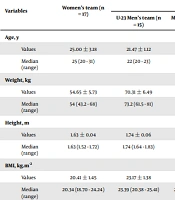
Angoorani H, Haratian Z, Farmanara H, Jahani P. Lower Physical Fitness Is Associated with Injuries in Iranian National Futsal Teams: A Prospective Study. Asian J Sports Med. 2021;12(3):e110778. doi: https://doi.org/10.5812/asjsm.110778
More by these authors
Last Update: 1 week ago
Last Update: 1 week ago
Last Update: 1 week ago
Last Update: 6 days ago
Last Update: 6 hours ago
Last Update: 5 days ago