1. Background
Weightlifting is a physically demanding sport which makes athletes vulnerable to different musculoskeletal injuries (1, 2). Injuries to muscles and tendons are common among weightlifters where 60% of injuries lead to chronicity, 20% of all injuries are acute muscle injuries and 25% are overuse injuries of tendon (3). The high intensity training regime and intensive physical performance contribute to injury risk among the weightlifters especially in the load bearing joints such as the knee joint which may cause pain and discomfort (1, 2). Acute knee injuries are reported to occur during the deep squat position of the knee joint with high loads (4).
In Olympic weightlifting, snatch lifting is a technique where by the barbell with the weights is lifted from the floor to an overhead position in a single motion (2). During snatch lifting, carrying enormous weights can produce high joint moments, compressive loads and shearing forces over the knee joint in the deep squat position (5, 6). The compressive force and mechanical loading of the knee joint during a 110 kg lift ranges from 6,000 to 7,000 Newtons and exceeds approximately 24 times of the body weight (7). Thus, the mechanical stress can contribute to high local peak forces, microscopic trauma and stiffness in the knee joint which may cause knee pain (7). Among the weightlifters who missed the training, approximately 95% reported knee pain lasting for more than a week (8). Therefore, it is important to provide a good care and management plan for addressing knee problems among weightlifters.
However to date, there is no published literature on how to manage knee pain among the weightlifters. A recent systematic review suggests that the treatment of knee conditions should include approaches to support self-care and exercise-based interventions (9). The effective self-treatment components include training self-management skills, information delivery, goal setting and prescription of therapeutic exercise (9). Experts in the field of musculoskeletal rehabilitation argue that the multiple dimensions of the patients’ presentation from a biopsychosocial perspective of illness model may respond well to a multimodal rather than a single treatment approach (10). Also in clinical practice, the clinicians use a multimodal approach rather than a single modal or standalone treatment (11). Therefore in the current study, a multimodal knee care intervention (MKCI) was developed incorporating self-care and exercise based interventions and the effect of MKCI was tested among elite weightlifters with knee pain.
2. Objectives
The main objective of the study was to investigate the effects of MKCI on the intensity of knee pain, knee functional ability and knee strength among the elite weightlifting athletes with knee pain. Thus, the primary hypothesis was that the weightlifting athletes who had MKCI would show improvements in intensity of knee pain (IKP), knee functional ability (KFA), pain free knee extension strength (P-KES), pain free double leg functional strength (P-DLS) and pain free single leg functional strength (P-SLS). The outcome of the study may provide evidence on a new scientific approach based on MKCI for management of knee pain among weightlifting athletes.
3. Methods
3.1. Study Design
A within subject, repeated measures, single blinded, self-controlled comparative study was conducted for a total period of 16 weeks with the measurements taken repeatedly at the first, fourth, eighth and 16th weeks, respectively. The investigator was blinded to the allocation of the group and the intervention. The period between first until fourth week was set as self-controlled study period where the course of knee symptoms were monitored with the athletes availing the usual care services provided at the training camp. The MKCI was provided for eight weeks starting from the fourth week until 12th week. A four-week duration of short term follow up period was set to monitor the symptoms at the 16th week. Thus, the study design was set to be a self-controlled comparative design with repeated measures.
3.2. Participant Characteristics
A total of 11 elite weightlifters from the national weightlifting team who were training for the international and Olympic level weightlifting competition participated in the study. The mean age, height, and weight of the participants were 21.55 ± 3.91 years, 161.09 ± 11.14 cm, and 69.18 ± 15.99 kg, respectively. The study details for recruitment were advertised in a national weightlifting training facility and all the participants were recruited from a national weightlifting training camp at Northern Thailand. All of the study participants reported consistent knee pain over the past one month with a pain intensity greater than 30 mm in a 100 mm visual analogue scale (12, 13). The participants who could not continue the training program as a result of the knee pain, who sought for medical advice in hospital-based care and those who could not hold an 80% percentage of attendance in the MKCI sessions were set as withdrawal criteria in the study. All the participants gave written informed consent prior to their participation in the study. The ethical approval for the project was obtained from the Human Research Ethics Committee, Faculty of Associated Medical Sciences, Chiang Mai University, Thailand.
3.3. Outcome Measurements
3.3.1. Pain Intensity
3.3.2. Knee Functional Ability
The knee functional ability was measured using Victorian Institute of Sport Assessment scale (VISA) (14). The VISA evaluates the functional ability to play a sport and it has a maximum score of 100 where a lower scores indicates greater functional impairments, and a high score indicates improved functional ability to play sport.
3.3.3. Knee Strength
The knee strength was evaluated using three different strength measures which includes single leg pain free knee extension strength (P-KES), pain free double leg functional strength (P-DLS) and pain free single leg functional strength (P-SLS). The P-KES was measured in kilogram unit using a dynamometer (model Push-Pull 100, 0.1 N accuracy, Global Medical Device, India) in a sitting position with knee in 60 degrees of terminal extension angle as confirmed with a handheld goniometer (model HiRes12-1000HR, 1º accuracy, Baseline Enterprise, USA). The P-DLS and P-SLS were measured in functional standing position using a back and leg digital pull dynamometer (units in kilogram). For the P-DLS and P-SLS measurements, the starting position of the participants were set at 50 degrees of terminal knee extension angle and the participants were advised to perform the test smoothly and firmly to the point of onset of pain for a total period of 5 seconds. All of the measurements were taken 3 times with 30 seconds of rest as a standardized procedure between each measurement. The average of the 3 values were used for further analysis.
In addition, the order of the strength measurements were randomized and an independent physiotherapist who was blinded of the study objectives carried out the measurements. Prior to the tools to be used in the study, an intra-rater reliability analysis of the measurement tools were carried out using intra class correlation coefficient (ICC2) and standard error of measures (SEMs) in a population of ten healthy athletes (4 men and 6 women) with 24 hours of interval between the measures. The mean age, height and weight of the participants were 26.10 ± 2.61 years, 166.00 ± 8.63 cm, and 55.63 ± 13.35 kg, respectively. An excellent reliability was established for P-KES (ICC2-0.92, SEMs-0.50), P-DLS (ICC2-0.96, SEMs-1.34) and P-SLS (ICC2-0.89, SEMs-1.91) respectively.
3.3.4. Quality of Professional Lifting (QOPL) and Knowledge on Self-Knee-Care (KSC)
The QOPL and KSC were evaluated as secondary measures. An Olympic snatch lifting activity involves three phases of lifting namely snatch, clean and jerk (15). The QOPL was evaluated by measuring pain during these three different phases of the snatch lift (15). The knowledge on knee care was measured using a KSC pro forma. The pro forma was delivered to the participants to evaluate the KSC at pre-intervention, post-intervention and follow up phases of the study. In addition, the attendance of the weightlifters was monitored all over the 8 weeks of intervention period for a total period of 16 interventions (2 interventions per week) as any athletes with non-attendance for more than 3 weeks was dropped from final analysis.
3.4. Multimodal Knee Care Intervention
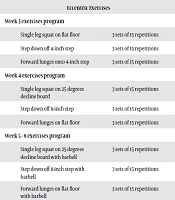
The MKCI was an eight-week interventional program which was co-developed by a multidisciplinary team of physiotherapists, sports psychologists, sports physiatrists, coaches and the athletes. The MKCI consisted of two parts, namely the self-care component and the exercise intervention component. The purpose of self-care component was to enhance knowledge and empower athletes to self-manage their conditions effectively by teaching them to cope up and handling their knee symptoms, including the physical and psychosocial consequences of living with their knee conditions. The exercise intervention programs consisted of sets of exercises based on the Curwin-Stanish protocol (16, 17). Table 1 indicates the self-care educational program and Table 2 shows the exercise interventions used in the MKCI.
Table 1.
Phases and Contents of the Multimodal Knee Intervention Program
| Phases of the MKCI | Topics of Program |
|---|---|
| Phase I (wk1) - Knowledge of knee pain (45 minutes per session X 2 times per week) | Lecture and discussion |
| -Individual knee problems | |
| -Anatomy and functions of knee | |
| -Common pathologies of anterior knee pain research findings on the weight lifting sports and associated musculoskeletal changes | |
| -Risk factors/predisposing factors of knee injuries | |
| -Healing process of knee injuries | |
| Phase II (wk2) - Pain management (45 minutes per session X 2 times per week) | Lecture and discussion |
| -Etiology, pathology and pain mechanism of knee pain | |
| -Effects of knee pain on mental, physical and social status | |
| -Various treatment methods | |
| *Physical therapy (i.e., exercises, positioning and ADL adjustment, treatment modalities, taping and bandaging) | |
| *Psychological therapy (i.e., stress management and imagination) | |
| *Acupuncture therapy, traditional massage, and surgery | |
| -Advantages and disadvantages of each treatment method | |
| Phase III (wk3 - wk6) - Practical application (45 minutes per session X 2 times per week) | Practice |
| -Taping and bandaging | |
| -Postural correction in lifting | |
| -Stretching programs | |
| -Eccentric exercise programs (various positions to promote strength, power and endurance) - squats, forward lunges and Step downs | |
| -Ice bag over the affected area of knee for 20 minutes after session | |
| Phase IV (wk7 - wk8) - Sports specific training (45 minutes per session X 2 times per week) | Practice |
| -Individual problems (e.g., excessive foot pronation and supination foot; tactics) | |
| -Proprioception exercises | |
| -Plyometric exercises | |
| -Ice bag over the affected area of knee for 20 minutes after session |
Table 2.
Types of Exercises Used in the Exercise Intervention Programa
| Exercises | Duration |
|---|---|
| Stretching exercises (performed all exercises sessions); hip flexors, iliotibial band, piriformis, quadriceps, hamstrings and calf | 5 repetitions with 20 seconds hold |
| Eccentric Exercises | |
| Week 3 exercises program | |
| Single leg squat on flat floor | 3 sets of 15 repetitions |
| Step down off 4-inch step | 3 sets of 15 repetitions |
| Forward lunges onto 4-inch step | 3 sets of 15 repetitions |
| Week 4 exercises program | |
| Single leg squat on 25 degrees decline board | 3 sets of 15 repetitions |
| Step down off 8-inch step | 3 sets of 15 repetitions |
| Forward lunges on flat floor | 3 sets of 15 repetitions |
| Week 5 - 8 exercises program | |
| Single leg squat on 25 degrees decline board with barbell | 3 sets of 15 repetitions |
| Step down off 8-inch step with barbell | 3 sets of 15 repetitions |
| Forward lunges on flat floor with barbell | 3 sets of 15 repetitions |
| Plyometric Exercises | |
| Week 7 exercises program | |
| Squat jump | 2 sets of 20 repetitions |
| Double-leg hop | 2 sets of 20 repetitions |
| Week 8 exercises program | |
| Jump to box (4 inches) | 2 sets of 20 repetitions |
| Skipping | 2 sets of 10 repetitions per leg |
| Single leg hop | 2 sets of 10 repetitions per leg |
aWeight of barbell was adjusted depending on the symptoms of each subject. Participants used the maximum weight that allowed them to perform the exercises with minimum pain or discomfort.
3.5. Statistical Analysis
Data were analyzed using the statistical software package for social sciences (SPSS for Windows version 22.0, IBM Corp, Armonk, New York, United States of America). The changes in variables in the self-controlled study period between the first and fourth week were analyzed using the non-parametric Wilcoxon signed-ranks test. The Friedman test was used to evaluate the changes in all outcome measures between three periods of study i.e. fourth week (control period of study), 12th week (post-intervention) and 16th week (follow-up period). The level of significance was set to be P < 0.05.
4. Results
Among the total of 11 athletes (4 men and 7 women), 7 had bilateral knee pain and 4 had unilateral knee pain accounting for a total of 18 knees with symptoms with a mean symptom duration of 69.6 weeks. The mean age, height, and weight of the participants were (21.55 ± 3.91) years, (161.09 ± 11.14) cm, and (69.18 ± 15.99) kg, respectively. All the athletes completed eight weeks of intervention and twelve weeks follow up period without any adverse events. During the eight weeks of MKCI program, 7 participants attended 100% of sessions, 3 athletes attended 93.7% (15 sessions) and one athlete attended 87.5% (14 intervention sessions) with an overall adherence rate of 93.7%. The average attendance for the sixteen weeks intervention sessions was 15.5 ± 0.69 session.
The result from the self-controlled phase showed that only P-KES significantly decreased (P < 0.05) from 31.76 ± 12.01 kg at control period to 28.68 ± 10.72 kg at pre-intervention (week 4). There were no significant changes in other measures during the 4-weeks interval before starting the knee educational program. The results from the Friedman test showed that there were significant improvements observed in the IKP, KFA, P-KES, P-DLS and P-SLS with the trend of improvements at 12th week of intervention and reached significance at the follow-up period by the 16th week with (P < 0.05) as shown in Table 3. Also, the KSC scores significantly improved by end of the intervention and follow-up period at the 12th and 16th week, respectively. However, there were no significant differences in QOPL (P > 0.05).
Table 3.
Mean Values (± SD) of the Outcome Measures at Pre-Baseline, Pre-Intervention, Post-Intervention and Follow Up Period
| Outcome Measures | Control Period (1 to 4 Weeks) | Pre-Intervention (4th Week) | Post-Intervention (12th Week) | Follow Up (16th Week) |
|---|---|---|---|---|
| VAS score (100 mm) | 52.50 ± 33.79 | 59.17 ± 31.54 | 42.78 ± 38.17 | 27.78 ± 30.98a |
| P-KES (kgs) | 31.76 ± 12.01 | 28.68 ± 10.72b | 33.01 ± 11.39 | 36.93 ± 16.78a |
| P-SLS (kgs) | 51.04 ± 29.64 | 49.55 ± 27.15 | 54.81 ± 25.88 | 63.62 ± 33.56a |
| P-DLS (kgs) | 129.68 ± 60.90 | 125.97 ± 63.08 | 146.26 ± 65.90 | 153.64 ± 71.61a |
| VISA score (100 mm) | 74.50 ± 14.90 | 73.33 ± 11.64 | 79.50 ± 14.65 | 86.33 ± 9.51a |
| QOPL | ||||
| During snatch | 40.05 ± 22.67 | 47.81 ± 35.55 | 33.75 ± 36.25 | 29.38 ± 35.30 |
| During clean | 37.97 ± 26.38 | 50.01 ± 30.22 | 34.90 ± 33.52 | 30.63 ± 32.35 |
| During jerk | 38.44 ± 32.95 | 47.19 ± 31.94 | 35.01 ± 33.67 | 24.38 ± 33.46 |
| Knee self-care score (Total score of 20 points) | Not applicable | 13.27 ± 3.00 | 18.64 ± 0.92c | 18.27 ± 1.10a |
aSignificant difference between pre-intervention and follow up period
bSignificant difference between control period and pre-intervention period as per Wilcoxon signed rank test.
cSignificant difference between pre-intervention and post-intervention period
5. Discussion
The introduction of MKCI comprising self-care and exercise intervention improved IKP, KFA, P-KES, P-DLS and P-SLS among elite weightlifters for up to four weeks after the completion of the program. As there was no previous evidence available in managing the knee pain among the weightlifters, the experience and findings gained from the study have opened up several interesting outcomes with practical implications. Firstly, the study helps to understand about the collaborative environment within a multidisciplinary team to develop the intervention and the organizational capacity to administer the intervention. The process of developing a multidisciplinary MKCI program helped the professionals across disciplines to understand each other’s roles and be able to integrate their expertise towards forming an effective intervention which could be transferred towards day to day clinical practice. Secondly, the project yielded a set of reliable and tested outcome measures which were able to identify the interventional effects among an elite population of professional weightlifters. Thirdly, the MKCI was co-developed with the elite weightlifters who were the end users of the research outcomes and as such, their inputs presumably reflected the needs of the athletes and hence, it may be applicable to other different national weightlifting training facilities. Thus, the study provided first-hand practical knowledge and evidence on the effectiveness of MKCI to weightlifters with knee pain, their coaches and other professionals about the management of knee pain among professional elite weightlifting athletes.
Multimodal intervention approach involves different health care professionals working together to form an intervention based on biopsychosocial approach targeting the needs of the patients (18). The MKCI intervention in the current study was developed by a multidisciplinary team of physiotherapists, sports psychologists, sports physiatrists involving the coaches and the athletes. The MKCI program covers a wider scope of topics from anatomy, pathophysiology of healing of knee structures, psychological components, education of exercises and self-care treatment methods such as taping. Patients attain maximum benefits when an intervention is combined with exercises, self-management intervention and patient education (19). In other words, self-management interventions which do not include significant exercise intervention has limited value (20). Therefore, the MKCI intervention program in the current study was designed to have both exercise-based intervention and self-management care complemented with patient education. Psychosocial theories such as theory of planned behavior, theory of reasoned action supports how understanding and knowledge is crucial for positive attitude and healthy behavior (21, 22). Perhaps, the improved KSC scores could suggest that the positive outcomes of the study might be due to the improved knowledge base and successful engagement of the athletes with the MKCI in self-managing their knee pain.
There was no significant differences observed in most of the outcome measures among athletes during the self-controlled phase between the beginning of the first week and the end of the fourth week. This indicated that the symptoms did not recover automatically and it seemed to be getting worse as the knee extension strength deteriorated significantly between the first and fourth week. Therefore, the self-controlled phase was crucial for this study to rule out any natural effects of recovery which may confound the effects of MKCI. A systematic review on self-care interventions to manage knee conditions suggests that inadequate adherence causes poor outcomes of the intervention (9). In the current study, the participants had 93.7% adherence for the MKCI program. Perhaps, the high adherence rate could be due to the participant characteristics as the participants were highly motivated and disciplined young athletes who were training for a higher level competition. The nature of the exercises such as strengthening exercises, flexibility exercises and plyometric exercises chosen for the exercise intervention care in the MKCI program falls within the recommended scope of exercise prescription for self-management of patients with knee pain (9). A recent systematic review suggests that the length of the multimodal health intervention program for knee pain program and the duration of follow up ranges between 2 weeks to 12 months and the duration of MKCI program used in current study lies within the clinical practice norms (9). All of the study measures showed significant improvements at the end of 16th week while there were no statistical differences in QOPL. Perhaps, this could be due to short time frame when the measurements were taken at 16th week as the desired interventional effect was reported to occur after 6 months of adherence to the intervention program (22). In future studies, a long-term evaluation of the measures at the 3rd and 6th months may be necessary.
The findings from this study should be interpreted in light of a few limitations. The MKCI program was delivered by a multidisciplinary team in a national level training camp for elite weightlifters and hence, it might enhance the internal validity of the program delivered. However, some athletes who participate in the weightlifting sport works alone with their coaches and may not have access to a multidisciplinary team. Thus, the external validity of the MKCI program might have its limitations to be applied to a general population of weightlifters with knee symptoms. As the population of elite weightlifting athletes are unique and limited, it was not possible to have a controlled group as a parallel arm and thus, self-control group served as an effective alternative approach of study design. As the population of national level elite professional weightlifting athletes are very small, the current study accessed a unique population with limited sample size. Although it was a pilot study with a small sample size, the study findings were still relevant to practitioners, coaches and athletes involved in weightlifting sport, especially as it was the first interventional study to be conducted in the sport of professional weightlifting. While the current study findings were not comparable due to lack of similar previous studies, the current study adds unique knowledge and evidence to scientific literature on weightlifting. Furthermore, the findings of the current study support and justify the planning for a larger study which is currently under development for the weightlifting athletes who are training in different multiple training centers. The exercises used in the MKCI program were simple exercises and did not required specialized training facility or sophisticated equipment which was one of the strengths of the study. Thus, the other weightlifting athletes might find it easy to practice on their own in a non-clinical environment.
5.1. Conclusion
The MKCI program reduced pain intensity, improved knee functional ability, knee strength and knowledge of knee care among elite athletes involved in weightlifting. Also, the exercises used in the MKCI program were simple and easily reproducible in any training facility. The MKCI program used in the current study added scientific evidence to the literature of the weightlifting sport on the efficacy of a multidisciplinary intervention to manage elite weightlifters with knee pain. Further studies with larger samples across multiple centers are recommended to strengthen the scientific evidence behind the efficacy of MKCI program among elite weightlifters with knee pain.