
1. Background
Soccer is one of the most favored sports all over the world. The risk of injury in this sport is reported higher than other ones (1) It is estimated that 10 to 35 injuries occur in 1000 hours of match among the male football players, meaning the high probability of a limiting injury (2).
An injury is defined as any physical complaint sustained by a player resulting from a football match or football training, irrespective of the need for medical attention or time loss from football activities. An injury that results in a player receiving medical attention is referred to as a “medical attention” injury and an injury that results in a player being unable to take a full part in future football training or match play as a “time loss” injury.
A high number of these injuries (65 to 95%) happens in the lower extremity (1). Thus, these injuries should be controlled to increase the safety and health of football players. In order to prevent sports injuries, the variables affecting the occurrence of injury and risk factors should first be identified.
In general, the risk factors of soccer injury are divided into two different groups including internal (personal factors) and external (environmental) ones. External risk factors are environment-related factors (3). Internal risk factors are associated with biological and physiological characteristics of the individual. One of the intrinsic, modifiable risk factors previously referred to, is psychological aspects especially personality traits that seem to be undoubtedly even superior (4). Emotion is an inherent part of a competitive experience (5). Perception, cognition, neurophysiology, motivation, behavior, motor expression, subject feeling and decisions all are influenced by emotion. These factors are effective on either facilitating or debilitating sport performance (6). In fact, confronting stressful and exciting conditions within competition along with inability to control emotions and anger may lead to numerous sport errors and finally being penalized. Therefore, applying effective psychological factors such as coping can achieve sport success and also minimize sport errors and injuries (7). One of the most important items that help the athletes to perform well in stressful situations is emotional intelligence (EI). Emotional intelligence is the capacity of individuals to recognize their own, and other people’s emotions, to discriminate between different feelings and label them appropriately (8). The five components of EI; self-awareness, self-regulation, social skills, empathy and motivation help using emotional information correctly and also guide the people how to think, behave, and manage the emotions to adapt environments or achieve their goal (8, 9).
It has been widely accepted that people with high EI have greater mental health, higher successful job performance, and also higher leadership skills (10, 11). In fact, having high EI seems to be the main tool in controlling emotions in stressful situations. Motivational processes and mental aspects such as anxiety and EI have been studied through sport psychology science in order to understand how they relate to sport performance and most of them have been framed according to the achievement goal theory (12, 13). In a competitive climate, athletes will adopt a motivational climate associated with either intrinsic or extrinsic motivations (14). High level of anxiety as a negative psycho-emotional state results from fear of events, which are not always identifiable, can manifest as an exaggerated response resulting in receiving penalty cards. The results of a meta-analysis showed that EI is a weak determinant of sports performance (15). However, some studies have demonstrated that emotions have an important impact on athletic performance (16, 17). Despite the aforementioned, it is now hypothesized that high EI may effectively prevent unconventional sports behavior within competitions, there are very few studies supporting the role of EI on prevention of sport injuries and also minimization of unconventional behaviors among professional athletes. It has also been emphasized to consider future EI research on selecting clear, objective, and comparable measures of sports performance among different sports and levels of sports performance (15).
2. Objectives
Practitioners, sport psychologists, coaching staff, athletes, and sport administrators, therefore, need appropriate knowledge of the role of EI and its relevance for successful performance in major competitions. The present study was conducted to examine this relationship among Iranian Premier League of soccer players.
3. Methods
3.1. Study Population
This prospective study was performed on Iranian footballers participating in Premier League in 2014 - 2015 season. Among 14 teams participating, 6 teams were willing to record the sports injury.
3.2. Codes of Ethics
All the players were asked to sign an informed consent before the study and they were also reassured that the data would be kept strictly confidential. All athletes were given information about the aim of the study. Participants’ names were not recorded to assure confidentiality. This study was conducted based on “Ethical Principles for Medical Research” and has been approved by the Ethics Committee of Iran University of Medical Sciences (no.: 93-02-30-24761).
3.3. Study Tool
To assess emotional intelligence among athletes, the Schutte Self-Report Emotional Intelligence test (SSEIT) was employed. This tool has been structured to measure general emotional Intelligence, using four sub-scales of emotion perception, utilizing emotions, managing self- relevant emotions, and managing others’ emotions. The SSEIT includes a 33-item self-report using a 1 (strongly agree) to 5 (strongly disagree) scale for responses. Each sub-test score is graded and then added together to give the total score for the participant (18, 19).
According to the Austin et al. (20) survey in 2004, the reliability of the modified 41-item scale form of the questionnaire was tested showing acceptable reliability (internal consistency) with the coefficient of 0.85. The content validity of the questionnaire was also revealed to be good with a correlation coefficient of 0.67 as compared with the Bar-On model of emotional-social intelligence (20). In Iran, the reliability of SSEIT was examined on 677 university students leading high reliability with a Cronbach’s alpha of 0.84 (21).
3.4. Study Protocol
At the same time of the pre-participation evaluation (PPE) of athletes in pre-season, we gave the Emotional Intelligence questionnaire to all footballers and they completed the forms in the mental health assessment station during the PPE where one of the authors were present there to answer any question about the form. The time of questionnaire completion was considered to be about 15 minutes. Among 16 physicians of Premier League teams finally 6 physicians accepted to cooperate in this research.
At the end of each month, we collected the sport injuries log books which were daily fulfilled by the team physicians. Also, we recorded the reports of the number of yellow and red cards for each athlete as well as for all teams in two phases (middle and end of each season) based on Football League Organization report.
3.5. Statistical Analysis
The results were presented as mean ± standard deviation (SD) for quantitative variables and were summarized by absolute frequencies and percentages for categorical variables. Normality of data was analyzed using the Kolmogorov-Smirnoff test. Categorical variables were compared using chi-square test or Fisher’s exact test when more than 20% of cells with expected count of less than 5 were observed. Quantitative variables were also compared with t test or Mann-Whitney U test. The multivariable regression model was also used to assess the causality relationship with the presence of confounders (such as age, education level, and marital status). For the statistical analysis, the statistical software SPSS version 16.0 for windows (SPSS Inc., Chicago, IL) was used. P values of 0.05 or less were considered statistically significant.
4. Results
In total, 327 athletes were assessed. The mean age of athletes was 24.81 ± 4.16 ranging from 17 to 36 years. Regarding educational level, 5.2% had undergraduate level, 56.8% had diploma, and others had an academic degree. Regarding marital status, 67.8% were single and others were married.
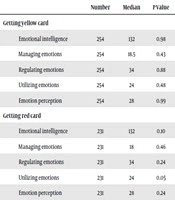
The mean total scale of emotional intelligence was 132.92 ± 10.75. Among different sub-scales of emotional intelligence, the mean scale for managing self-relevant emotions and other emotions was 18.91 ± 3.52, for regulating emotions was 34.43 ± 3.69, for utilizing emotions was 24.06 ± 3.00, and for emotion perception was 27.77 ± 3.70. According to the reports of the Football League Organization, in total, 202 out of 254 registered athletes (79.5%) received yellow cards and 28 out of 231 athletes (12.1%) received red cards. Of all studied athletes, report of injury was recorded only for 135 which of those, 77 (57.0%) were exposed to various types of sport injuries.
As shown in Table 1, among different subscales of emotional intelligence, only regulation of emotions was significantly different between injured and non-injured athletes (P = 0.04). Using multivariable logistic regression analysis with the presence of confounders (Table 2), lower ability to regulate emotions was associated with higher risk for sport injuries (OR = 0.88, 95% CI: 0.79 - 0.98, P = 0.02). None of the subscales of emotional intelligence was related to receiving yellow card, but utilizing emotions was adversely related to receiving red card (Table 1). However, as shown in Table 3, by applying the multivariable regression model, the association between utilizing emotions and receiving red card changed to insignificant.
Table 1.
The Association Between Sub-Scales of Emotional Intelligence and Getting Yellow and Red Cards and Also Sports Injuriesa
| Number | Median | P Value | |
|---|---|---|---|
| Getting yellow card | |||
| Emotional intelligence | 254 | 132 | 0.98 |
| Managing emotions | 254 | 18.5 | 0.43 |
| Regulating emotions | 254 | 34 | 0.88 |
| Utilizing emotions | 254 | 24 | 0.48 |
| Emotion perception | 254 | 28 | 0.99 |
| Getting red card | |||
| Emotional intelligence | 231 | 132 | 0.10 |
| Managing emotions | 231 | 18 | 0.46 |
| Regulating emotions | 231 | 34 | 0.24 |
| Utilizing emotions | 231 | 24 | 0.05 |
| Emotion perception | 231 | 28 | 0.24 |
| Sports injury | |||
| Emotional intelligence | 135 | 133 | 0.26 |
| Managing emotions | 135 | 18 | 0.55 |
| Regulating emotions | 135 | 35 | 0.04 |
| Utilizing emotions | 135 | 24 | 0.36 |
| Emotion perception | 135 | 28 | 0.99 |
aDegree of freedom = 1.
Table 2.
Assessing the Relation Between Emotional Intelligence and Sport Injury by the Multivariable Regression Modeling
| Beta | SE | OR | 95% CI | P Value | |
|---|---|---|---|---|---|
| Regulating emotions | -0.11 | 0.05 | 0.88 | 0.79 - 0.98 | 0.02 |
| Age | 0.12 | 0.07 | 1.13 | 0.98 - 1.30 | 0.08 |
| Education level | 0.16 | 0.25 | 1.17 | 0.71 - 1.94 | 0.52 |
| Marital status | -0.49 | 0.57 | 0.61 | 0.20 - 1.87 | 0.38 |
Table 3.
Assessing the Relation Between Emotional Intelligence and Getting Red Card by the Multivariable Regression Modeling
| Beta | SE | OR | 95% CI | P Value | |
|---|---|---|---|---|---|
| Utilizing emotions | 0.10 | 0.07 | 1.10 | 0.96 - 1.27 | 0.13 |
| Age | 0.06 | 0.06 | 1.06 | 0.93 - 1.21 | 0.32 |
| Education level | 0.02 | 0.25 | 1.02 | 0.61 - 1.68 | 0.93 |
| Marital status | 0.52 | 0.54 | 1.68 | 0.58 - 4.86 | 0.33 |
5. Discussion
To the best of our knowledge, this work is one of the first studies investigating association of EI with sport injuries and receiving penalty cards among Iranian Professional Soccer Players. The results showed that among the subscales of EI, regulation of emotions had significant relationship to the sport injuries.
Regulation of emotion helps the people to control their actions. In fact, emotions regulation can allow the individuals to improve mood statement as well as increase empathy and compassion. Regulation of emotion has been identified as a process for controlling emotional reactions especially in stressful situations, so it can effectively reduce adverse consequences of emotional responses. As shown in the present study, the occurrence of injuries in footballers was adversely associated with regulation of emotions that is completely predicable according to the mentioned justifications. More importantly, this relationship was independent to baseline confounders including age, educational level, and marital status. In other words, by following the process of emotion regulation, the risk of occurring sport-related injuries can be effectively minimized. We also univariately showed that utilizing emotion could reduce receiving red cards, however this association was not revealed by considering the study confounders. In fact, it seems that the relation between utilizing emotion and getting red card may potentially be more affected by other athletes’ characteristics such as their educational level, single marital situation, or lower ages. In total, hence emotional intelligence has a significant effect on human adaptability and the efficiency of psychosocial functioning, emotion regulation, as one of the main components of intelligence, can be applied to minimize the risk of sport injuries among the elite soccer players.
The different aspects of emotional intelligence have been previously assessed in different sport fields. As indicated by Rutkowska and Bergier (22), most female soccer players were androgynous and the level of their emotional intelligence was significantly higher than in other participants leading to more adaptability with stressful conditions. As shown in another study by Lane et al. (23), pleasant emotions were associated with optimal performance and unpleasant emotions were associated with dysfunctional performance. A pleasant emotion is obtained by proper regulation of emotions, the association between optimal performance of footballers and regulation of emotions can be explained well. Some of the authors could also connect the occurrence of sport-related injuries and stress and anxiety conditions within playing and thus could show an adverse association between intensity of precompetitive cognitive anxiety and emotional intelligence (24). It has been recently demonstrated that the relationship between EI and injury may be mutual so these two factors have an effect on each other (25). Although it seems that the power of this association is significantly associated with the type of injury and athletes’ personal characteristics. Moreover, success in professional sport depends on self-confidence, emotional focus and control and EI of players (25, 26). In fact, by controlling and regulating emotions, the preparedness of athletes can be improved and consequently the risk for injuries can be notably reduced.
There is a concordance between this study results and the meta analysis conducted by Kopp and Jekauc (15) that the quantitative analyses demonstrated a small positive relation between EI and sports performance. There are some different instruments for evaluating EI and its different components. No correlation between EI and sports injuries in some studies of this meta-analysis (15) can be due to different instruments. As the most important limiting factor in this study, we evaluated the association of EI with sport-related injuries only in six soccer teams of Iran Premier League. If it was possible to record the sport injuries of more soccer teams it might have concluded a different result of association of EI subscales with sports injuries or getting cards. Another limitation is using one questionnaire for EI evaluation. There are some other questionnaires that are reliable for EI.
In conclusion, the results showed that regulation of emotions can effectively reduce the risk of sport-related injuries. Although utilizing emotions seems to be effective in reducing the likelihood of getting a penalty card, but this association may be potentially affected by other athletes’ characteristics as the potential confounders. Moreover, according to the results, EI is concerned as a possible soccer injury predictor. Thereafter, it is recommended to design future studies based on such facts and implementation of EI screening and EI development programs as an integral part of the training process among soccer teams. This, however, requires a more intensive exploration and supply of useable conceptualizations of EI in soccer as well as valid and easily handled instruments of EI and, finally, well-grounded and easily implemented EI-training programs by sports psychologists.