
1. Background
The childhood overweight and obesity epidemic has become a global emergency in public health and a crucial challenge of the 21st century (1). The prevalence of overweight and obesity has increased in children and adolescents in developing countries, from 8.1% to 12.9% for males and from 8.4% to 13.4% for females (2). In a study in Iran, the prevalence of overweight and obesity in children aged 6 - 18 years was 10.1% and 4.79% according to national cut-offs, respectively (3).
Obesity in children increases the risk of chronic diseases, such as hypertension, hyperlipidemia, diabetes, cardiovascular disease, sleep apnea, arthritis, and multiple malignancies in adulthood (4, 5). Obesity in childhood also has long-lasting effects, such as detrimental socioeconomic and cardiovascular effects, and it keeps obesity up to adulthood (6). Factors such as nutrition, genetics, physical activity level, and performance in motor activity can be mentioned as elements related to overweight (7). However, few studies have focused on the efficacy of physical activity as a contributing factor to obesity (8).
According to some studies, obese children and adults have less physical activity and tend to have a more sedentary lifestyle and occupation, gradually a decrease in the physical activity leading to less energy burns and increased risk of obesity (9). Studies have shown that obese or overweight children are less likely to engage in physical activity than their normal-weight friends (10). In a literature review, Zacks et al. observed a relationship between increased weight and developmental motor delay in children, although they demonstrated that physical activity is a staple of healthy weight management (11).
Gross motor skills are the basic movements traditionally associated with human physical activity (12). Gross motor skills are the basis for many activities, including running, skipping, jumping, throwing, hopping, and catching. Higher levels of gross motor skills are associated with better cardiorespiratory fitness, lower body mass index (BMI), higher physical activity, better language skills, higher social development, and enhanced cognitive development, according to previous studies (12, 13). It has previously been observed that poor motor skills have been linked with higher body weight in childhood (14). Gentier et al. showed that overweight and obese children present poorer gross motor skill performance and worse fine motor precision and manual dexterity than their healthy-weight peers (15).
In recent years, the prevalence of obesity in children has been largely dependent on energy imbalances (16). The epidemic of obesity in the past two decades is likely a result of a gradually increasing caloric intake and a decreasing level of physical activity (16). Although some studies have been carried out on the relationship between gross motor skills and different variables, such as social function, academic achievement, physical activity, and BMI in children (17-19), there is yet little conclusive supporting evidence for these associations. Additionally, few studies have investigated the relationship between obesity and gross motor skills in children (20).
2. Objectives
Therefore, the present study aimed to investigate the relationship between gross motor skills scores and BMI in children and identify obesity as one of the factors associated with gross motor skills.
3. Methods
3.1. Subjects and Sampling Method
This study was a cross-sectional study and was conducted in the field method. The population of this study included children 5 - 7 years old living in Bojnourd, Iran. In this study, 100 children were selected through a multi-stage method. Samples were collected from kindergartens in Bojnourd. In the first stage, Bojnourd was divided into three zones according to municipality classification, and then, in each district, each kindergarten was considered one cluster. Among the clusters, a few clusters were chosen by a simple random method relative to the number of kindergartens in that area. In the next stage, in these selected areas, equal numbers of each age group (5, 6, and 7 years) and both genders were selected if they met the inclusion criteria, and after obtaining written consent from the parents of the child and if the child desired. The sample size was calculated to be 100 children.
The inclusion criteria were normal children aged from 5 - 7 years who could follow directions and comply during evaluation. The exclusion criteria were lack of cooperation for research, known developmental disability, mental or other clinically diagnosed impairment, and apparent deformity and orthopedic injury in both upper and lower extremities within 6 months.
3.2. Determination of the Level of Gross Motor Skills and Its Relationship with Body Mass Index
Ulrich’s test of gross motor development (3rd edition) is used to assess gross motor skills in children. The translation steps, standardization, and localization of Ulrich’s test of gross motor development (3rd edition) have already been determined in a previous study (21). This study also evaluated and approved the content validity index (0.8 - 1), internal consistency (≥ 0.85), and reliability (≥ 90) of the test. A single evaluator who had been trained by the authors was involved in assessing gross motor skills among children aged 5 - 7 years.
Each child was then given a total of the Ulrich 2 motor test, and each child’s score was calculated. The total score for each subscale was 48, and the total motor skills score was 96. Then, the relationship between BMI and gross motor skills was investigated using statistical methods. According to the purpose of the study, the BMI of children was considered the independent variable, and gross motor skills score was considered the dependent variable. In the present study, BMI was used to identify overweight and obese children. Height was measured in bare feet and in centimeters. Body mass was measured with digital scales in minimal clothing. By measuring both height and body mass in the present study, children’s BMI was calculated using the following formula:
In this formula, the weight is calculated in kg and height in meters.
The Ulrich 2 scale was used to qualitatively evaluate motor skills, as described previously by Mohammadi et al. (21).
In this study, the performance of basic motor skills in children was assessed by motor skills development test, and their scores were collected. To perform the test, the assessor thoroughly described how to perform each skill and then showed the skill to each child. The child was then asked to perform each skill; after twice observation, the test taker evaluated and scored the desired skill. In the end, the performance of the subjects in different groups was compared based on different levels of BMI. The validity of this test is 96%, and its reliability for each subscale is 87% (12).
3.3. Statistical Analysis
The data were analyzed using SPSS software (version 23). The chi-square test was used to compare qualitative variables between groups. The independent t-test (normal distribution of data) and equivalent non-parametric tests were used to compare quantitative variables between groups. In all calculations, a P-value < 0.05 was considered the level of significance. Before sampling, the importance and necessity of this study were explained to parents, and consent was obtained from their parents voluntarily and consciously. All information obtained from children in the form of a questionnaire without anonymity and only with a questionnaire number was recorded and emphasized the keeping of volunteer secrets.
4. Results
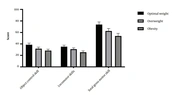
The study included 100 children aged 5 to 7 years. In this study, 51 (51.3%) and 48 (49.7%) cases were female and male, respectively. The participants’ mean BMI was 16.61 ± 1.59 kg/m2 (BMI range: 13 - 20.26). In this study, the Ulrich-2 test was used to assess gross motor skills. The test has a total score and two subsets, including object control skill and locomotor skill, each of which consists of 6 subscales. Additionally, in this study, the mean and SD of total gross motor skills score and each of the subscales for object maintenance and motor skills were assessed in three groups of BMI, including optimal weight, overweight, and obesity. One-way analysis of variance (ANOVA) was used for this purpose (Figure 1).

Figure 1.
Relationship between body mass index and gross motor skills. There are significant differences in object control, locomotor, and total gross motor skills between children with optimal weight and obese children. The data are expressed as mean.
Paired comparisons were made between the optimal, overweight, and obese groups based on the statistical analysis in terms of total gross motor skills score, object control skill, and locomotor skill. A significant correlation was observed in all these comparisons (P < 0.0001). The total gross motor skill scores were significantly lower in the higher-weight groups than in the lower-weight groups.
The study also assessed the total gross motor skill and each of the subscales of object control skill and locomotor skill in the two male and female gender groups (Table 1). As can be seen, the total gross motor skill score was significantly different between the two groups (P < 0.0001). The total score of motor skills and each of its subscales was higher in the female group than in the male group.
Table 1.
Relationship Between Gross Motor Skills and Gender a
| Item (Mean ± SD) | Male | Female | P-Value |
|---|---|---|---|
| Total score of gross motor skill | 63.69 ± 5.38 | 66.05 ± 5.74 | < 0.0001 |
| Moving skill | 29.23 ± 2.63 | 30.61 ± 2.95 | < 0.0001 |
| Object maintenance skill | 34.45 ± 3.16 | 35.44 ± 3.42 | < 0.0001 |
Abbreviation: SD, standard deviation
a The total score of motor skills and each of its subscales were significantly different between female and male subjects (P < 0.0001).
This study also compared motor skills in different age groups using a one-way ANOVA test (Table 2). Significant differences were observed between the three groups (P < 0.0001), although the total score of motor skills and each of its subscales increased in older children.
Table 2.
Relationship Between Motor Skills and Age a
| Item (Mean ± SD) | 7-Year-Old | 6-Year-Old | 5-Year-Old | P-Value |
|---|---|---|---|---|
| Object maintenance skill | 36.33 ± 3.06 | 35.40 ± 2.73 | 32.94 ± 3.27 | < 0.0001 |
| Moving skill | 30.63 ± 1.95 | 30.04 ± 3.05 | 29.05 ± 3.40 | < 0.0001 |
| Total score of motor skill | 66.96 ± 4.14 | 65.45 ± 5.15 | 61.66 ± 6.50 | < 0.0001 |
Abbreviation: SD, standard deviation.
a The total score of motor skills and each of its subscales were significantly different between children of different ages (P < 0.0001).
The relationship between motor skills and BMI was determined according to gender. The results, as shown in Table 3, indicate that there are significant statistical differences between the BMI and motor skills except for the locomotor skill in the female group. In the male group, there was a significant difference between motor skills score and BMI (Table 4).
| Items | Optimal Weight (1) | Overweight (2) | Obesity (3) | P-Value | |
|---|---|---|---|---|---|
| 1 and 3 | 1 and 2 | ||||
| Total score of motor skill | 69.10 ± 4.13 | 64.23 ± 4.00 | 58.55 ± 5.57 | < 0.0001 | 0.005 |
| Moving skill | 31.82 ± 2.71 | 30.00 ± 1.91 | 27.55 ± 3.16 | < 0.0001 | 0.10 |
| Object maintenance skill | 37.27 ± 2.44 | 34.23 ± 2.61 | 31.00 ± 2.78 | < 0.0001 | 0.002 |
a These data show a significant relationship between the total score of motor skills and each of its subscales with body mass index (BMI) in the female group, except for the moving skill.
b The data are expressed as mean ± standard deviation (SD).
| Items | Optimal Weight (1) | Overweight (2) | Obesity (3) | P-Value | |
|---|---|---|---|---|---|
| 1 and 3 | 1 and 2 | ||||
| Total score of motor skill | 66.30 ± 4.87 | 60.92 ± 4.32 | 59.00 ± 3.85 | 0.001 | 0.003 |
| Moving skill | 30.46 ± 2.51 | 27.85 ± 2.21 | 27.25 ± 1.98 | 0.004 | 0.005 |
| Object maintenance skill | 35.84 ± 2.92 | 33.07 ± 2.84 | 31.75 ± 2.18 | 0.002 | 0.012 |
a These data show a significant relationship between the total score of motor skills and each of its subscales with body mass index (BMI) in the male group.
b The data are expressed as mean ± standard deviation (SD).
5. Discussion
The purpose of this study was to investigate the relationship between BMI and gross motor development in 5 - 7-year-old children in Bojnourd. The present study showed that there were significant differences in object control, locomotor, and total gross motor skills between children with optimal weight and obese children (P < 0.05). The results of the present study also indicated that the relationship between motor skill scores and BMI was significantly different between children of different ages and genders (P < 0.05).
Nervik et al., in a study on 3-5-year-old children, showed lower motor skill scores in the group with higher BMI (22), which is similar to the results of the present study. Khalaj and Amri also observed similar results in a study of 160 children aged 4 to 8 years (23). In a study, Dokic and Međedović compared motor development in obese girls to normal-weight girls and showed that obese girls had less motor development than normal-weight girls (24). Truter and Du Toit also examined the relationship between motor skills and BMI in the two groups of 4 - 6 years, compared to the 6 - 8 years; however, contrary to the present study, only a significant difference was observed in some parts of the study (25). In a study using 7- and 8-year-old children, only some parts showed a significant relationship (26).
The present study showed that gross motor skills have a significant relationship with age, as the motor skills score increases with increasing age. Truter and Du Toit also obtained similar results in their studies, with the difference being that the mean of motor skills in the group 6 to 8 years was higher than in the group 4 to 6 years (25). It was also shown in this study that gross motor skill scores had a significant relationship with gender, and girls had higher average motor skill scores than boys. Shams and Vameghi obtained a different result in a study on 3- to 5-year-old children, as the mean score of boys was higher than girls (27). However, in the aforementioned study, a motor assessment scale (OSU-SIGMA qualitative scale) different from the present study (Ulrich’s test of gross motor development) was chosen.
The low sample size due to the non-cooperation of children to participate in the study, concerns about the possibility of harming children during the test, and little cooperation by kindergartens and schools to achieve outcomes were some of the limitations of this study. The problems related to the non-cooperation of children were solved by assistance from kindergarten educators and encouragement through small awards. The safety of children was also increased by conducting all stages of testing in rooms covered with tatami mats. This cross-sectional study was conducted to evaluate the variables of BMI and motor skills, which might lead to a misinterpretation of the dependent and independent variables examined in the present study. Additionally, many underlying factors might affect the relationship between the variables due to the cross-sectional nature of the study design.
5.1. Conclusions
The results showed that there was a significant relationship between BMI and motor skills. This finding might be due to two modes. One is that high BMI in obese children is due to low physical activity (or weaker motor skills); another mode is that their high BMI has reduced their motor skills.