1. Background
The assessment of fundamental movement skills (FMS) is an irreplaceable component of a number of professions. There are several ways to measure children’s FMS, depending on what information is needed. The quantitative assessment method involves measuring performance outcomes, and precise FMS evaluation is not common in contexts in which a qualitative assessment approach is needed. However, researchers have developed several FMS tests that are based on a quantitative approach (1, 2) and can serve as a fairly accurate measure of such skills. FMS-POLYGON (2) is a reliable and valid instrument for FMS assessment in eight-year-old children. The authors discovered a high correlation (0.82) between the new quantitative test and the test of gross motor development, second edition (TGMD-2) (3), which can be classified as a qualitative FMS test and is commonly used in many studies that investigate the effects of specific treatments on FMS (4-7). This shows that quantitative assessment methods can be as good as qualitative methods in measuring the FMS of children. This is especially important in terms of the applicability of the FMS-POLYGON. The need for a quick and easily administrable test for FMS assessment has been noted in primary schools. FMS-POLYGON has proven to be easily administered and allows for the testing of large groups of children in a short period of time. A number of studies have searched for evidence of a relationship between qualitative FMS tests and motor-functional abilities in children (8-11). Significant associations between FMS and endurance among children aged 13 to 15 years have also been noted (8). The results of a study by Overlock and Jun (10). suggests that balance and motor skill performance are moderately associated with each other in five to nine-year-old children. A strong correlation was also found between FMS and motor abilities in children aged nine to 10 years (11). Another investigation (12) confirmed the significant correlation between striking, catching, throwing, and shooting skills with good results in the static and dynamic balance assessment test. The relationship between FMS as measured by TGMD-2 and motor-functional abilities has also been investigated (2), and researchers state that the correlation exists in the male and female sample populations. All of these studies have measured FMS through qualitative assessment, but no studies using quantitative assessment tools were found.
In addition, in examining the above studies, we note a lack of studies investigating the relationship between motor-functional abilities and FMS in children of early school age. Because children are already being selected for some sports by their eighth year of life, it is important to determine whether FMS-POLYGON could serve as a good selection tool. Research also suggests that early sampling can lead to numerous positive growth and developmental opportunities. Several researchers have also demonstrated that the early sampling pathway is beneficial to long-term talent development in sports (13).
2. Objectives
The main aim of this study was to determine the influence of some motor-functional abilities and morphological characteristics on the FMS of eight-year-old boys and girls.
3. Materials and Methods
3.1. Participants
Ninety second graders (45 boys and 45 girls) aged eight (8.1 ± 0.4) years and attending elementary schools in Split, Croatia participated in the investigation, which was carried out during May of 2014. On average, the boys were involved in organized physical activity for 118.63 ± 114.11 minutes per week, whereas the girls had slightly higher results of 125.21 ± 106.79 minutes per week. Weekly sedentary activity was significantly higher (boys: 1284.06 ± 375.81 minutes per week, girls: 1387.97 ± 379.20 minutes per week).
All of the children were chosen randomly. The children gave verbal consent, and their parents gave written informed consent. This study only included children with no health problems or significant motor disorders. The study protocol conforms to the ethical guidelines of the 1975 declaration of Helsinki as reflected in a priori approval by the institution’s (university of Split, faculty of kinesiology) human research committee.
3.2. Measurements
3.2.1. Motor-Functional Abilities
Three variables were used to assess the motor-functional status of the children. The variables were selected according to the results of previous studies (14). The test for flexibility was a simple sit-and-reach test (SIT-REACH, 1 cm), explosive strength was measured using a long jump from a standing position (ST-L-JUMP, 1 cm), and cardiovascular endurance was evaluated by measuring the time that was needed to cover 1/4 of a mile (1/4-MILE, 0.1 s). The first two tests were performed three times, with an appropriate rest in between. The mean of the three scores was used in a later analysis.
3.2.2. Fundamental Movement Skills
The FMS test (FMS-POLYGON) (2) was used to assess the children’s FMS (Figure 1). According to previous studies (15, 16), this test is valid and reliable in school children. The FMS-POLYGON consists of four tests: consecutively tossing and catching a volleyball against a wall (Figure 1A), running across obstacles (Figure 1B), carrying medicine balls (Figure 1C), and straight running (Figure 1D). An area of 10 × 24 meters with 14 cones, three obstacles, two medicine balls, a volleyball, a Swedish vault, and four pairs of photocells are needed for the FMS-POLYGON. The participants stand on a starting line with the volleyball and begin the first task of tossing and catching the ball against a wall six times on the examiner’s signal. They then leave the ball and run across three obstacles, finally passing through the cones. Participants then lift and carry the first and the second medicine ball and put them on the Swedish vault, then run 20 meters until passing through the photocells. It is important to emphasize that the middle obstacle must be moved aside before the run. The result of the test is the time (in seconds) needed to successfully accomplish the above four tasks.
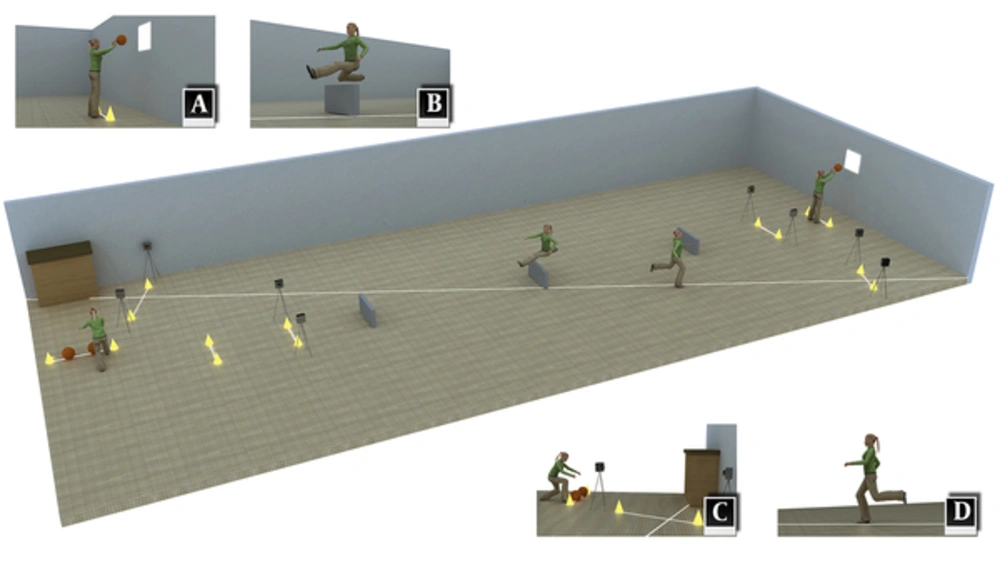
Figure 1.
Fundamental Movement Skills Test
3.3. Data Analysis
Data were analyzed using the Statistica for windows 7.0 package, and the statistical significance was set at P ≤ 0.05. Basic descriptive statistics were calculated: mean value, standard deviation, and minimum and maximum results. Multiple regression analysis was used to determine the influence of the set of anthropometric and motor variables on FMS.
4. Results
The basic statistics for eight-year-old boys and girls are shown in Table 1. Boys averaged 134.0 cm in height and 30.3 kg in weight. Girls averaged 134.1 cm in height and 30.1 kg in weight. When gender differences are observed, it is obvious that the girls were significantly more flexible, whereas the boys scored higher in strength and endurance, although without significant differences. In addition, boys needed less time to complete the FMS-POLYGON tasks. According to the Kolmogorov-Smirnov test, all variables were normally distributed.
Table 1.
Basic Statistics of All Variables for Boys and Girls; the Results of the T-Test Between the Gendersa
| Variables | Boys, n = 45 | Girls, n = 45 | T-Test (P Value) | ||||
|---|---|---|---|---|---|---|---|
| Mean ± SD | MIN | MAX | Mean ± SD | MIN | MAX | ||
| Body height, cm | 134.0 ± 5.5 | 121.3 | 146.6 | 134.1 ± 5.1 | 123.1 | 147.2 | 0.94 |
| Body weight, kg | 30.3 ± 5.9 | 21.0 | 49.1 | 30.1 ± 5.7 | 19.0 | 48.0 | 0.94 |
| SIT-REACH, cm | 27.7 ± 7.1 | 12.0 | 43.0 | 36.9 ± 9.2 | 11.0 | 58.0 | 0.00 |
| ST-L-JUMP, cm | 131.8 ± 18.3 | 89.3 | 176.7 | 126.7 ± 13.6 | 91.0 | 159.3 | 0.08 |
| 1/4-MILE, s | 138.4 ± 18.6 | 101.2 | 173.6 | 145.2 ± 21.6 | 108.6 | 196.5 | 0.10 |
| FMS-POLYGON, s | 23.93 ± 2.82 | 19.96 | 31.47 | 24.46 ± 1.94 | 20.20 | 28.95 | 0.30 |
aMAX, maximum result; Mean, mean value; MIN, minimum result; SD, standard deviation; SIT-REACH, sit and reach test; ST-L-JUMP, standing long jump test; 1/4-MILE, 1/4 mile test.
Multiple regression analyses (Table 2) were used to determine the statistically significant influence of a set of morphological and motor variables on the FMS-POLYGON results in both boys and girls. In boys, the multiple correlation coefficient has a value of 0.81 (P < 0.001), and 69% of the common variance can be explained with the chosen predictive set of variables, which means that only 31% of the total variability of the criterion can be ascribed to other anthropologic characteristics. For girls, the multiple correlation coefficient was 0.65 (P < 0.001), and the predictive set of variables explains 42% of the total variability of the criterion.
Table 2.
Regression Analysis of Morphological Characteristics, Motor-Functional Abilities, and Success in FMS-POLYGONa
| Variables | FMS-POLYGON | |||
|---|---|---|---|---|
| Boys, n = 45 | Girls, n = 45 | |||
| BETA | P-level | BETA | P-level | |
| Body height, cm | -0.32 | 0.02 | -0.22 | 0.19 |
| Body weight, kg | 0.07 | 0.61 | -0.02 | 0.91 |
| SIT-REACH, cm | 0.03 | 0.74 | 0.04 | 0.77 |
| ST-L-JUMP, cm | -0.50 | 0.00 | -0.39 | 0.00 |
| 1/4-MILE, s | 0.43 | 0.00 | 0.49 | 0.00 |
| RQ | 0.81 | 0.65 | ||
| RQ2 | 69% | 42% | ||
| P-level | 0.00 | 0.00 | ||
aRQ, multiple correlations; RQ2, percentage of the explained variance; P-level, importance of the multiple correlation coefficients; SIT-REACH, sit and reach test; ST-L-JUMP, standing long jump test; 1/4-MILE, 1/4 mile test.
Based on the analysis of each predictor, the statistically significant influence on the criterion is recorded for the explosive strength test (boys: B = -.50, P < 0.001; girls: B = -.39, P < 0.001) and the endurance test (boys: B =.43, P < 0.001; girls: B =.49, P < 0.001) for both genders. In addition, body height had a statistically significant influence on the criterion, but only in boys (B =- 0 .32, P < 0.021).
5. Discussion
The main aim of this study was to determine the influence of some motor-functional abilities and morphological characteristics on the FMS of eight-year-old boys and girls. On average, boys perform better in tests for endurance, explosive strength, and fundamental motor skills, whereas girls are better than boys in flexibility. Generally, girls with high endurance and explosive strength accomplish better results in FMS. To achieve greater results in FMS-POLYGON, boys must have greater body height in addition to possessing high endurance and explosive strength.
Gender differences in motor abilities favor boys during prepubertal ages. Factors influencing gender differences may be attributed to the differing degrees of encouragement, practice opportunities, and reinforcement patterns of boys and girls inside and outside the school setting (17). This research confirms earlier findings about boys’ preference for manipulative activities and girls’ for locomotion activities. An overview of the results concerning sexual dimorphism in motor abilities has been presented (18). As a rule, boys score higher in motor tests of strength and endurance (19), which was also the case in the current study. However, girls had better results in the flexibility test, which confirms certain studies (20).
Some studies (21-23) have found certain body compositions to be negatively related to locomotor skill proficiency. Body mass index (BMI) was used as a measure for body composition, and lower motor skill level was found in obese children than in normal-weight peers (24). Because use of BMI may lead to imprecise evaluations, it is not always suitable for body composition assessment (25), and it is not clear whether children in the mentioned study had lower motor skill levels because they had lower body height or higher body weight. For this reason, BMI was not used in the current study.
Starting from the premise that success in almost all kinesiological activities is determined by a combination of various related factors and using multiple regression analysis, we determined the impact of morphological and motor variables on FMS. Given the differences between the genders in motor abilities, we investigated the effect of these variables on FMS according to gender. A significant influence of endurance (1.4 mile run) on FMS is in accordance with other studies (8), which state that performance in tasks involving locomotor (running and jumping) and object control skills (catching, throwing, hitting, and shooting) is significantly correlated with the results of the multistage fitness test. The authors have suggested further research in order to more precisely identify the relationship between endurance and FMS, which was done in the current study.
A significant relationship between explosive strength (standing long jump) and fundamental movement skills is expected. The standing long jump test is an integral part of the TGMD-2, which is used to assess the quality of gross motor skills. Specifically, based on the definition of quantitative approach, the standing long jump is a test of explosive strength. However, the same test is recognized as a test for assessing gross motor skills, and it focuses on estimating the quality of performance. This suggests the need for further research to more clearly define whether the applied test is used for assessing motor skills and/or motor abilities of children. Confirmation of the obtained results was found in recent studies analyzing the relationship between qualitative and quantitative FMS assessments (2). The authors found a significant correlation between average throwing distance and the quality of performance in the overhand throw in children aged seven to 12. Other studies (26) have also reported a significant correlation between qualitative and quantitative assessments in primary school children.
According to these findings, it can be concluded that certain connections between motor-functional abilities and FMS can be quantified and can explain a great percentage of common variance. In addition, these abilities appear to develop in parallel under the influence of genetics, nutrition, and various physical activities. However, the results point to certain gender differences, which are primarily manifested through morphological structure. For example, body height proved to have a positive influence on FMS-POLYGON success only in boys. By reviewing the tasks in FMS-POLYGON, it can be assumed that taller boys had the advantage in the tossing and catching the volleyball against a wall task, which had to be done over a mark that was 150 cm high. It was also probably easier for taller boys to clear the 50 cm high obstacle and run, because running speed is directly related to two factors: frequency of movement and stride length. It is clear that factors other than motor-functional ability and morphological characteristics also influence the rate of adoption and implementation of quality movement skills in children of early school age; these factors include social and economic status and nutrition habits. We have not evaluated these dimensions, and future research into this issue should take them into account.
5.1. Conclusion
According to the results presented and discussed, the following conclusions can be drawn:
1. Predictors of success on the FMS-POLYGON are very similar for boys and girls.
2. Success in explosive strength and endurance tests has a significant impact on success in the FMS-POLYGON in both genders.
3. The greatest predictive value doe FMS-POLYGON results is the explosive strength test results, probably due to the nature of the FMS-POLYGON.
4. Boys with greater body height had the advantage in some FMS-POLYGON tasks.
5. Because contemporary sport requirements generally favor taller, faster athletes with higher degrees of endurance, it can be assumed that FMS-POLYGON can serve as a tool to identify talented athletes.