
1. Background
In the last two decades, policymakers and managers in the health field have played crucial roles in supporting individuals to take care of their own health or their relatives, although the quality and the availability of provided information and materials (depending on the contexts and countries) were not always desirable (1, 2). Health literacy (HL) is known as individuals’ ability to obtain, process, and understand basic health information and services that are necessary for making proper health decisions (3). The concept also includes skills of numeracy, insurance literacy, and the abilities needed to navigate the increasingly complex world of healthcare (4). About a decade ago, Baur (5) argued that literacy knowledge is never static; instead, HL skills change over the lifespan and are affected by experience and environment.
Primarily, in the literature, HL has been defined as the ability of individuals to place, interpret, and apply health information to their decisions, although the role of society in providing accessible and comprehensible information cannot be ignored in this view (6-8). In the Iranian context, this view is adopted by the health system and researchers (9). Following this view, Namazi (10) argues that both the health system and individuals play significant roles in improving HL since different human beings receive different responsibilities in their immediate communities. The roles of both those who communicate information and individuals who seek it are of significant importance. Ancker et al. (6) suggest “health information fluency” and argue that “health information fluency” refers to the universal effective use of health information. They believe HL can embrace a combination of concerns about individual skills. In other words, HL is a multidimensional concept resulting from the interplay between community, family, education, and healthcare systems that empower individuals to take control of their health (7).
Adequate HL can empower individuals so much that they would play an active role in changing their environment, and they would positively affect community health (9, 11). Cudjoe et al. (12) highlight the influential role of HL as a determinant of healthy behavior, although they state pathways through which HL influences health indicators are neither completely clear nor consistent. Likewise, Huang et al. (13) state that HL plays a leading role in the promotion of healthy behaviors and lifestyles, the prevention of diseases, and the improvement of individuals’ health levels through education.
Meanwhile, students, as a group of individuals, who would be part of the future communities and whose HL level can affect societies, have attracted researchers’ attention (11, 14, 15). Investigating the HL of individuals who would be part of healthcare providers and the sources of health information in their future careers might further illuminate some aspects of the HL field. College students are known for their dynamic knowledge development and their interactions with the social environment in order to enhance the capabilities they take forward into future life; they dynamically develop their general and professional knowledge (16). The HL of students majoring in medical sciences is an area that is worth investigating. The evidence from the literature shows that there is still a lack of research on college students’ HL, especially outside the United States (13).
In general, the literature suggests university students have inadequate HL; however, the results of studies vary based on the setting and the measurement tools used (16-19). Even different demographic differences within the same community ended in different results (14, 15). Elsborg, et al. (14) concluded that Danish students’ HL relates to their personal background and educational path and believe such results might be of importance when planning curricula and educational activities, including cross-disciplinary courses. In addition, although Chinese male students revealed higher HL than female students (20), in countries such as Greece (21) and Taiwan (22), females had higher HL than male respondents. Evans et al. (17) observed significant differences in HL among different Ghanaian colleges regarding the self-esteem, health, and financial status of the participants.
Studies comparing the HL of students majoring in medicine and related disciplines to students studying other majors have reported convergent results. Some studies found medical students owned a higher level of HL than their peers in other majors (e.g., Uysal et al.’s study (19) in Turkey). In America Joseph et al. (23) and Taiwan Yang et al. (24), students majoring in health revealed higher HL than respondents who studied other majors. In Australia, medical and allied health students had higher HL than nursing students (1, 25). However, unexpectedly, medical and health students in China had poorer HL than engineering students regarding their performance on multiple dimensions of a questionnaire developed by Mullan et al. (25). Several studies also agree investigating the HL of students majoring in health-related degrees is particularly important, as they will be influencing the health choices of others during their professional careers (20, 26, 27), and there are variables that affect such a literacy.
In the Iranian context, the results of related studies suggest that HL requires more attention. As Momeni et al. (28) reported, Iranian older adults in their study had a relatively low level of HL (45%). In educational settings, Panahi et al. (29) reported of 360 respondents, 9.2% (n = 31) of the students had low HL; about 27.6% (n = 94) of the studied participants had inadequate HL, and 42.6% (n = 145) had adequate HL. Panahi reported that just 19.7% (n = 67) of the respondents majoring in medical sciences had excellent HL. Ramezankhani et al. (30) reported out of 500 students studying at medical universities, 26.4% had inadequate and just 31.2% had adequate HL. Just recently, Namazi (10) observed that the HL mean of non-medicine students was pretty low (36.4% with limited and 63.6% with optimal HL). Naghibi et al. (31) reported that 60% of adult respondents (aged 18 - 65 years) in their study had limited or inadequate HL. The controversial results of recent studies might point to the need to conduct more similar studies among Iranian student communities and consider possible factors that might affect HL. Of several factors that might positively affect the HL of individuals, we can consider students’ extracurricular studies.
Some countries have implemented policies and plans to create reading habits in children before school and arrange strategies to encourage reading habits in school children (32). At the same time, a range of variables have impacts on such habits. Ünlüsoy et al. (33) considered adolescents’ out-of-school literacy practices and reported that they were more involved in habits related to social media than in print-based studies. The researchers observed that of all the four functions of literacy (including entertainment, social, instrumental, and education-related), the entertainment/social aspect was the first, followed by instrumental and educational functions. Jolliffe and Harl (34) also reported that college students spent twice as much time per day on extracurricular reading involving technology. Moyer (35) argues that educators need to update their definition of reading to involve reading in digital aspects. Moyer argues the more individuals increase their no-academic studies, the more they develop their knowledge and understanding. That is, these forms of knowledge can have social realizations.
Likewise, Encheva et al. (36) hypothesized that reading habits have been transformed due to the changes in the information environment; therefore, the need for enhancing proper information literacy of the users might be to some extent connected to the ongoing changes of information. The emergence of digital collections resulted in a rapid transformation in readers’ practices. Readers have replaced traditional reading materials and practices with more easily reached information and methods. This is more conspicuously present in readers’ preference to use databases that are affluent with information resources in academic libraries. The statistical data accurately support the frequency of use and the tendency to go with digital reading.
Iranian students of medicine spend a significant amount of their time in challenging academic settings and are indulged in lessons and projects that they should finish on time. Expectedly, they might ignore skills or activities that require extra time and commitment. Namazi (9) argues that by developing the expected level of HL, medicine students can develop themselves to make proper decisions about the health of their future patients. On the contrary, these students are prone to make inappropriate decisions and develop unhealthy behaviors if they do not acquire the proper amount of HL required for both their personal and career lives.
Different studies performed in Iran have reported some obstacles that affect Iranian university students’ extracurricular reading habits, including high costs of books, non-availability of students’ favorite books, homework, school projects, students’ willingness to fill free time with TV programs, lack of enough time, no encouraging instruction about studying habits, scarcity of public libraries, individuals’ reluctance to value studying, being pessimistic about future, having other hobbies, economic problems, Internet addiction, computer games, and books (37, 38). By looking at the aforementioned hindrances from a general point of view, studies suggest that cultural, religious, social, economic, and political factors have affected Iranian students’ extracurricular habits (38).
The present study investigated the level of HL and extracurricular reading habits of university students majoring in medicine and how they achieve the health information that they need. Extracurricular reading plays an important role in further developing the thinking skills of students. Health information might be available in several formats (e.g., videos, audio files, and health magazines) for different groups who are interested and seek health information; however, in this study, regarding the participants who are university students, the written mode of information is the focus. Ismoilova (39) argues that becoming professionally literate in health-related concerns might not be fully predicted and planned in educational programs. That is, the importance of academic courses in the classrooms and practical training cannot end in fully developed professionals if particular extra activities are not added. Extracurricular reading can encourage students to read independently, to get acquainted with the best materials for their profession and their interests, and to further enrich the knowledge they have acquired in the classroom. Independent reading has been practiced in the education system since ancient times, and since 1959, it has been officially taught as a special subject in the extracurricular reading form in some countries (39).
The present study aimed to investigate the correlation between the extracurricular reading habits of medical students and their HL and to find out if there is a relationship between extracurricular reading habits and each of the five aspects of HL. The five aspects of HL include access, reading, understanding, appraising, decision-making, and applying health information (40). It was hypothesized that (1) the scores of extracurricular reading habits of the participants correlate with their HL level and (2) there is a relationship between extracurricular reading habits of the participants with their health information reading, their access to health information, their understanding of health information, and their use of health information.
The present study included students of medicine in the context of Iran; therefore, the results might not only expand the literature but suggest areas that are worth further studying (e.g., challenges of online reading habits for students of medicine). In general, extracurricular readings not only enrich medicine students’ understanding of independent reading but also deepen their knowledge, skills, and competencies in subjects that are not fully covered in academically taught materials. Many years of experience have shown that when students choose the materials for their readings, they are led to more valuable content that suits their appeal and needs. Therefore, the availability, selection, and recommendation of materials can be considered one of the important issues facing the methodology of reading outside academic settings.
1.1. Extracurricular Studies
Generally, reading is not defined as a “natural thing” but as an academic subject that students acquire through instruction (41). Reading also requires a long time for students to learn how to read (42). Long (43) argues that reading skill is first a precondition of all the things that are central to the educational issues of a nation, including both occupational and technical education. Long found that the causes of the decline in reading are numerous, and they act differently in the complexity of cultural and cognitive conditions. Increases in the number of media forms and devices and some conditions, including the amateur trend of reading instruction, decreasing rate of economic status, and declining completion rates of higher education are among the highlighted factors. Clark and Foster (44) stated that most students read texts other than books once or twice a week and indicated they read more if they find more free time. However, later studies indicate that studying habits and methods have changed.
Some studies have investigated what reading for pleasure might look like and what the impact of such programs might be on promoting different skills (45). Reading beyond academically scheduled activities fosters a critical connection between written texts and the community and can develop communications with books among individuals, teachers, and other related stakeholders, including parents and the wider community. In addition to the beneficial nature of reading, individuals who create more opportunities to merge with literacy-related activities inside and outside of their home have more positive opinions about reading, involve themselves in more leisure reading, and obtain outstanding reading achievement (46), and demonstrate considerable academic achievement. All these achievements might also include developments in HL. Ismoilova (39) concludes that, in addition to equipping students with reading skills, extracurricular reading habits nurture active readers to read independently, understand the message, and choose a particular topic. In other words, extracurricular reading can act as the main education tool, increasing the willingness to learn more.
2. Objectives
Studies that investigated HL in the context of Iran almost unanimously concluded that the HL of their participants was not promising (28-30). Although all these studies were research-provoking and provided the literature with useful results, it seems that most of them have inclusively considered the HL level of their participants. Therefore, investigating extracurricular reading habits as a variable that might correlate with the HL of students can add more to the literature. The aim of the present study was to investigate the possible correlation between extracurricular studies and HL of medical students. It was hypothesized that (1) the scores of extracurricular reading habits of the participants correlate with their HL level and (2) there is a relationship between the extracurricular reading habits of the participants with their health information reading, their access to health information, their understanding of health information, and their use of health information.
3. Methods
The participants of the present study were 220 students of medicine studying at Abadan University of Medical Sciences, Abadan, Iran, who were in the fifth and sixth terms of their studies. The participants were included based on a stratified sampling; that is, approximately 55 participants from each level were included. Half of the participants were male, and half of them were female students; that is, gender was not considered a variable in this study. The participants’ mean age was 21 years. All the respondents had passed similar courses and agreed to participate in the study. The researchers used two types of questionnaires which were used after obtaining respondents’ informed consent. The participants were told that their information would be kept confidential and would be used only for research purposes, and before final analysis, incomplete questionnaires were excluded.
The first questionnaire was the Health Literacy for Iranian Adults (HELIA) questionnaire developed by Montazeri et al. (40). As Namazi (10) points out, this tool can be used for different groups and is not inclusively developed for any specific class, occupation, education, or age group. The HELIA included 33 items, which formed five aspects of access (6 items), reading (4 items), understanding (7 items), appraising (4 items), decision-making, and applying health information (12 items). The items are measured based on a 5-point Likert-type scale (for the reading dimension from 1 = quite hard to 5 = quite easy and for measuring access, understanding, appraising, decision-making, and applying health information from 1 = never to 5 = always. The total score ranges from 33 to 165. Based on the cut-off points of the HELIA questionnaire, after converting to a 0 - 100 score, participants’ HL was divided into four categories: Inadequate (scores 0 - 50), problematic (scores 50.1 - 66), adequate (scores 66.1 - 84), and excellent (scores 84.1 - 100).
The second tool was a questionnaire developed by the researchers of the present study to particularly collect data for the purpose of this study. The questionnaire was primarily aimed to check 4 areas: (1) What subjects, (2) the medium of reading or how they get the materials, (3) how much, and (4) why participants have extracurricular studies. Each area included 5 items. This 20-item questionnaire had a 5-option Likert scale (Never = 1, Rarely = 2, Sometimes = 3, Very often = 4, Always = 5). Researchers’ familiarity with the student’s educational life, characteristics, and the aims of the study work together to form this 20-item questionnaire for withdrawing participants’ answers. The psychometric properties of this questionnaire were checked. Since the estimation of extracurricular reading habits of the participants was one of the focal points of the study, the items of this questionnaire asked how much extracurricular studies participants have, what topics they usually study, for what purposes (why, e.g., for pleasure, to learn something new, and add to my knowledge) they have extracurricular studies, and how they obtain the information they need (e.g., through reading books, magazines, searching the web, and consulting experts).
The reliability and validity of the questionnaire were also considered. For measuring reliability, Cronbach’s alpha was used, and for checking the content validity of the questionnaire, the content validity index (CVI) was used. The form asked for relevance, clarity, and simplicity on a 4-point Likert scale that comprised the options very relevant, relevant, relatively relevant, and not relevant.
First, four health researchers were asked to provide their views about the items and the overall validity of the questionnaire. They suggested some minor changes regarding the clarity and the representativeness of items. Afterward, the questionnaire was piloted on 30 students of medicine at the same university. Cronbach’s alpha was used to measure the internal consistency of the 20 items of the questionnaire. The results indicated the internal consistency of all items was above 89% for extracurricular studying items. At the end of the questionnaire items, the items related to participants’ demographic information, including age, gender, term of study, and occupation, were included. The collected data were analyzed using SPSS software. Moreover, descriptive (i.e., frequency, mean, and standard deviation [SD]) and inferential statistics (i.e., t-test and the Pearson correlation test) were used. The significance level was set at less than 0.05.
4. Results
As the study aimed to investigate the possible correlation between extracurricular studies and the HL of medicine students, participants’ performance on the two questionnaires, the HELIA and the questionnaire, which was developed specifically for measuring the extracurricular study habits of participants of the present study, was estimated (Table 1).
Table 1.
Descriptive Statistics of Extracurricular Reading Habits and Health Literacy Aspects
| Research Variables | Mean ± SD |
|---|---|
| Extracurricular reading | 3.99 ± 0.456 |
| Health literacy | |
| Reading | 2.78 ± 0.809 |
| Access | 2.96 ± 0.701 |
| Understanding | 2.71 ± 0.683 |
| Apprising | 2.65 ± 0.725 |
| Using information/decision-making | 2.77 ± 0.715 |
| Total | 2.77 ± 0.624 |
In Table 1, the mean and SD of the two main variables of the study are presented. According to the scale of the questionnaire, the mean ranged from 1 - 5. The mean of extracurricular reading habits was higher than 3.11 ± 0.456; the mean of each of the aspects of HL was much less than the aforementioned value. The aforementioned results suggest that the participants’ extracurricular studying habits score was better than their HL. The total HL mean was higher than average, and the information access mean was the highest of the five subindices of HL. The aforementioned findings suggest that although participants had access to different sources of HL, appraisal of the information had the lowest mean. The mean of the total extracurricular score was 2.77 ± 0.4, and the mean of all aspects of reading habits was less than 3. Therefore, the studied participants performed better in their HL than they did in reading habits (RH). Table 2 shows the extracurricular reading habits of the medical students who participated in this study based on their answers to the questionnaire, which was designed for the purposes of this study.
Table 2.
Extracurricular Reading Habits of the Participants
| Themes and SN | Items | Mean ± SD | Mean Total |
|---|---|---|---|
| What | 3.99 | ||
| 1 | Novels and storybooks | 4.00 ± 0.120 | |
| 2 | Course materials | 3.98 ± 0.112 | |
| 3 | Non-course materials which are related to health and medicine | 4.01 ± 0.110 | |
| 4 | Materials related to art, history, religion, etc. | 3.98 ± 0.111 | |
| 5 | Reading without paying attention to the subject | 3.99 ± 0.119 | |
| How/medium | 3.95 | ||
| 6 | Reading materials from professional publications related to medicine (non-academic materials) | 3.99 ± 0.119 | |
| 7 | Reading booklets, pamphlets, and commercial and educational brochures | 3.00 ± 0.010 | |
| 8 | Suggestions received from teachers, doctors, friends, etc. | 3.99 ± 0.116 | |
| 9 | Obtaining reading materials from the Internet | 4.50 ± 0.02 | |
| 10 | Getting extra-reading materials from course materials/suggestions/further readings | 4.00 ± 0.119 | |
| How much | 4.00 | ||
| 11 | Having a daily schedule for extracurricular reading | 3.90 ± 0.200 | |
| 12. | No free time to read materials other than my lessons | 4.15 ± 0.090 | |
| 13 | Just read whenever free | 3.99 ± 0.100 | |
| 14 | More than 7-hour weekly reading | 3.99 ± 0.113 | |
| 15 | Doing activities other than reading in free time | 3.98 ± 0.114 | |
| Why | 4.00 | ||
| 16 | Read to learn something new and add to my knowledge and skills as a future doctor/professional | 3.98 ± 0.121 | |
| 17 | Extra reading increases understanding of academic lessons | 4.02 ± 0.122 | |
| 18 | Reading extracurricular materials for pleasure | 4.01 ± 0.119 | |
| 19 | To improve my general knowledge | 4.00 ± 0.112 | |
| 20 | Extra reading exercises the brain | 3.99 ± 0.111 |
The questionnaire asked what participants choose for their extra-reading, how they get the materials, how much they read, and why participants have extracurricular studies. According to the Likert scale of the questionnaire, the value of the mean ranged from 1 - 5. For example, the highest mean in the theme “What” belongs to non-course materials related to health and medicine (4.01) and novels and story books (4.0); however, the lowest mean belongs to materials related to art, history, and religion, in addition to reading without paying attention to the subject. The highest total mean value also equally belongs to these Why and How much (4.00). Furthermore, it seems that these groups of students connect their extra reading to their academic topics as HL is also in line with their academic and professional purposes, including HL materials in their academic courses, and providing extra sources that are within students’ access might be helpful. Moreover, “obtaining reading materials from the Internet” (4.50) also requires attention. Regarding the availability of net-supported materials, individuals seek to find answers to their information needs from the net. Additionally, “no free time to read materials other than my lessons” (4.15) might further point to the academic challenges that participants face. This result might answer the question of why participants do not have extra reading and why their HL mean is around average (2.77). Extra reading increases understanding of academic lessons (4.02). Regarding the aforementioned results, students’ willingness to read non-course materials but not having enough time to read might raise further precautions.
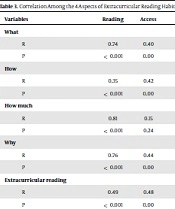
The results of the Pearson correlation, comparing the relationship between each of the four aspects of the extracurricular reading habits questionnaire and the five areas of the HELIA questionnaire, are presented in Table 3.
Table 3.
Correlation Among the 4 Aspects of Extracurricular Reading Habits Questionnaire and 5 Aspects of Health Literacy for Iranian Adults (HELIA) Questionnaire
| Variables | Reading | Access | Understanding | Appraising | Decision-Making/Applying | HL |
|---|---|---|---|---|---|---|
| What | ||||||
| R | 0.74 | 0.40 | 0.83 | 0.58 | 0.36 | 0.81 |
| P | < 0.001 | 0.00 | 0.00 | 0.00 | 0.00 | 0.00 |
| How | ||||||
| R | 0.35 | 0.42 | 0.53 | 0.02 | 0.72 | 0.36 |
| P | < 0.001 | 0.00 | 0.00 | 0.85 | 0.00 | 0.00 |
| How much | ||||||
| R | 0.81 | 0.15 | 0.89 | 0.53 | 0.29 | 0.69 |
| P | < 0.001 | 0.24 | 0.00 | 0.00 | 0.02 | 0.00 |
| Why | ||||||
| R | 0.76 | 0.44 | 0.68 | 0.73 | 0.34 | 0.37 |
| P | < 0.001 | 0.00 | 0.00 | 0.00 | 0.00 | 0.00 |
| Extracurricular reading | ||||||
| R | 0.49 | 0.48 | 0.44 | 0.38 | 0.58 | 0.58 |
| P | < 0.001 | 0.00 | 0.00 | 0.37 | 0.00 | 0.03 |
Abbreviations: HL, health literacy; r, Pearson correlation coefficient.
According to Table 3, in general, there is a significant correlation between HL and the extracurricular reading habits of the participants (r = 0.58, P = 0.03). In particular, HL correlated with all aspects of What, How much, Why, and How-Why. Nonetheless, the highest correlation existed between HL and aspects of What (r = 0.81, P = 0.001) and How much (r = 0.69, P = 0.001), and the lowest correlation existed between HL and aspect of How (r = 0.36, P = 0.0001). That is, as participants’ extracurricular reading increased, participants’ scores of HR and its included aspects also increased. Participants’ performance on both questionnaires is also shown in Table 4.
Table 4.
Comparison of Extracurricular Reading Habits and Health Literacy of Respondents Regarding the Assumed Optimal Mean
| Variables | Df | T | Median (Test Value = 3) | Mean | P-Value |
|---|---|---|---|---|---|
| Extracurricular reading | 94 | 2.55 | 0.119 | 3.99 | 0.012 |
| Health literacy | 94 | -3.55 | -0.225 | 2.77 | 0.0001 |
According to the information and results presented in Table 4 and considering the 5-scale Likert value questionnaire, the Median (MD) was 3. The mean of HL was less than 3 and significant at 0.0001. However, the mean of extracurricular reading habits was 3.99 and significant at 012. This finding suggests that the participants of the present study developed adequate extracurricular reading habits.
5. Discussion
The present study investigated the possible correlation between extracurricular reading habits and HL of students majoring in medicine and whether the extracurricular reading habits of the participants correlate with each of the five aspects of HL. The findings of the study revealed that there was a significantly positive correlation between HL and extracurricular studying of the respondents; in other words, by increasing and improving extracurricular reading habits, medical students enhance their HL. Bann et al. (47) showed that reading habits and comprehension significantly predicted Medicare knowledge of their adult participants, and they added an important point. Bann et al. concluded the fact is not that those who read more materials related to Medicare benefit more; however, extra reading and reading interventions positively correlate with their knowledge. They suggested that extracurricular reading habits affect the knowledge level of individuals, and HL, as one area of required knowledge for medical students, can also be affected through extra-reading. Similarly, Bahrami et al. (48) observed a positive correlation between extracurricular reading habits and their participants’ mental health.
In the present study, the highest mean of HELIA scores was related to the dimensions of understanding and access; the lowest score was related to the dimension of decision-making and applying health information. That is, although participants had access to the information they needed, they seemingly could not evaluate the available materials and consequently apply the information that they had access to. Santos et al. (49) observed that although the Internet is the most popular way for students to have access to information, it is also associated with the worst HL scores. Regarding the quality of information available on the Internet, Santos et al. argued that despite availability, such information is often incorrect and hardly comprehendible.
Ahmadi et al. (11) have also stated that students do not have enough information to evaluate available sources, and this might further point to their insufficient knowledge to read and evaluate the validity of the information. These findings might indirectly highlight that individuals use the immediate sources of information which is within their reach, and Internet-supported materials are the first in this category. In this regard, Raeisi Nafchi et al. (50) observed that public media significantly affects individuals’ HL; they have also identified 6 similar layers in HL.
The results of the present study also suggested that there was a correlation between participants’ HL and what they studied. Budhathoki (26) argues that understanding the HL needs of all students in universities seems necessary; accordingly, required students’ health services can be provided. Budhathoki adds if the students are better supported, they are likely to perform better academically and acquire skills to engage in health promotion in the community during their careers.
Lack of time as a barrier to extra reading, which was also among the top obstacles identified by Watson (51), and the top three study barriers (i.e., lack of time, lack of access to books, and fatigue) to reading identified in Hodgson and Thomson’s (52) were also cited by participants of this study. Watson (51) observed that lack of time, lack of access to books, and fatigue were the main factors that led to decreased reading after starting medical school. Other findings of the present study highlighted that participants have extracurricular reading because extra reading increases their understanding of academic lessons, and they read for pleasure. Watson (51) also reported that his respondents experienced several benefits from leisure reading, such as learning facts and gaining an understanding of themselves. Likewise, in the present study, the highest mean belongs to the way students obtain their reading materials, the Internet. In line with the aforementioned findings, Namazi (9) showed that the majority of students mentioned the Internet as their main source of health information. Parandeh Afshar et al. (53) and Mahmoudi and Taheri (54) also reported their participants mostly received health information via the Internet.
Expectedly, medical universities have to invest in creating electronic materials and transferring information via social networks available (e.g., Instagram, Telegram, and WhatsApp); accordingly, they might fill some part of the available need for required information. Nasser (45) recommends that educational settings create a culture in which all students are encouraged to be enthusiastic readers; these settings should recognize a diverse range of reading materials and encourage students to read professionally, for example, websites, comics, and magazines. The problems associated with extracurricular learning content and organization have long been of interest to methodist scholars and practical teachers (39).
Moradmand (37) reports parents’ role, availability of libraries in schools, family income, and many other factors as factors affecting habits of extracurricular studying among students. As Runk et al. (15) suggest, medical students are our future healthcare providers and key players in health settings; therefore, effort has to be taken to improve medical students’ HL and improve the response of future healthcare providers.
Based on the results of the present study and similar studies, it can be inferred that due to easy access to the Internet and widespread use of technology in universities, the desire to obtain information through the Internet has increased. Studies reported that most college students in their study obtain information through the Internet digital world. This issue might further point to the need for developing Internet-supported sources that are professionally valid and meet the requirements of a wide range of individuals. The professional and social success of individuals depends on their knowledge and understanding of information related to their professional fields. However, researchers also point to possible challenges of the digital world. The importance of information shared on social networks is influenced by celebrities and the number of technicians who might use these platforms to expand their personal priorities. This might have the effect of creating information sections; the person who prepares and sends the message might influence the circulation of information by presenting a specific set of expectations and beliefs and creating a friendly network connection in which even misinformation can circulate without control and evaluation freely (55).
Participants of the present study also suggested that extra reading increased their understanding of academic lessons (mean = 4.02). In this era of information, the more studies individuals have, especially extracurricular studies, the higher their abilities to have access to health information and their understanding become. Ancker et al. (6) argue that society can provide opportunities to create information for individuals; accordingly, everyone fulfills their informational needs and develops their cognitive skills. If it is possible to develop ways to provide types of information widely available and easily accessible, then such information would be accessible to the individuals who need it. As Elsborg et al. (14) argue, students whose major is health and medicine will be involved in the planning and provision of healthcare in their future careers. Therefore, their level of HL must be addressed in the curricula. Educational institutions should, therefore, be aware of students’ needs and take this issue into consideration when they plan activities intended to address students’ HL.
In Iranian universities, students majoring in medicine usually spend about 7 years in university learning their profession. As Budhathoki et al. (26) suggests regarding the years that medicine and health students spend in academic places, it is essential that universities train health-professional students to ensure the future health workforce can understand and respond to the HL needs of the communities which the health providers will be responsible for.
5.1. Limitations of the Study and Suggestions for Further Research
The positive aspect of this study is that it provided information about the relationship between HL and curricular readings of students majoring in medicine. More specifically, the study highlighted 4 areas of students’ studying habits: (1) Subjects the participants choose for their extracurricular study, (2) the medium of reading or how they get the materials, (3) how much, and (4) why they have extracurricular studies. The participants were students of a university who were from all over the country. All state universities in Iran include students who have been selected after a highly competitive entrance exam, and based on their performance on the exam, they are placed in different universities. Medicine is one of the most competitive and lucrative majors in the Iranian universities. Around 70% of all students are from other provinces, and the rest are from Khuzestan province and live in the dormitory of the university; Abadan is one of the cities of this province. However, one of the limitations of the present study is the absence of precise background diversity as a variable. Furthermore, this cross-sectional study highlighted the study demands and indirectly pointed to related challenges. The study is significant as it might lead to similar studies which include medical students from different universities. Students’ interest in reading more than academic courses and their report of limited time for studying might invite policymakers to manage the situation to make proper provisions for improving the degree of HL.
In the present study, gender is not considered a variable, and the participants’ views, regardless of their gender, highlighted tendencies, conditions, and some possible facts about the extracurricular readings of medicine students. However, it is assumed that including gender as a variable in future studies can highlight more information about curricular studying habits and HL across the two genders. As demographic information for the student population was not obtained, it can only be hypothesized that the sample is representative of medicine students of Abadan University of Medical Sciences. However, the participants were likely younger than the overall student population, as the samples were selected from second-year and third-year students. The points that they highlighted about limited time for studying and what they need to develop their professional knowledge might even change positively or negatively and expand respectively in later years of study.
Another limitation of the current study is that there was no information about participants’ reasons for adopting or not adopting certain reading habits. It is possible that some participants had stable habits of reading materials or, conversely, not reading materials due to their course materials challenges. Future studies might explore such factors. Further research in the present study is needed to have more cases to support and a more specific explanation to clarify the relationship between health literacy and extracurricular readings of students majoring in medicine. Overall, to provide more effective suggestions for the development of university students’ reading habits and related variables, it would be beneficial to replicate this study with larger and other samples.
Finally, as the data sample consisted of medicine students in a state-run university, the results could not be generalized to students in other medical schools. It is suggested that future investigations in this regard be conducted to draw comparisons toward making a generalization about this matter. As Runk et al. (15) argue, if researchers consider the context in assessing the HL of a particular population, they will achieve a higher understanding of individuals’ related needs.
5.2. Conclusions
The findings of the present study suggested a significantly positive correlation between HL and extracurricular studying of the respondents, which implies that by investing in extracurricular reading opportunities, it is possible to increase the professional knowledge of medical students. The findings also revealed that the medical students of the present study understand and have access to health information more than other areas of the HELIA. Nevertheless, regarding decision-making and using health information, they were at the lowest rate (according to their views). This finding also implies that participants’ access to the information they needed does not guarantee their ability to evaluate the available sources or use what they have reached. Lack of time might negatively affect extracurricular readings, and by making effective planning and enriching the available sources, it is possible to foster their interest in reading more. Most students refer to the Internet as they encounter a question. Developing professional websites that meet such needs might alleviate the challenge. As Ancker et al. (6) argue, a lack of sufficient HL can affect not only social literacy but also the career quality of future health staff. Medical students are one of the most closely related groups to health issues. Although medical students learn about health issues as part of their studies and develop their knowledge in this field, the medium of receiving HL information for extracurricular studies goes beyond printed materials. The ability to obtain such skills requires proper advice in this modern changing world. Supporting extracurricular studying is a dependable way to enhance the cognitive, social, and professional abilities of individuals. The willingness and interest of the students in extracurricular studies can be a good impetus to invest in supporting these interests. In line with Harnett’s findings (56) and regarding the impacts of the coronavirus disease 2019 (COVID-19) pandemic situation, it is concluded that it might not be enough to provide print resources in a public format; instead, it should be taken into account that how the community has access to information. As has been experienced during the pandemic, access to libraries, even colleges, stores, and traditional sources of print materials, such as pamphlets and newspapers, seems difficult, if not impossible.
Štefková et al. (57) argue that students from public health, medicine, and health informatics will be involved in the planning and provision of healthcare in their future careers; therefore, their level of HL must be addressed in the curricula. Educational institutions should, therefore, be aware of the differences among students and take this into consideration when they plan activities intended to address students’ HL. It might also be important to be aware of future career responsibilities when offering cross-disciplinary activities to students of different educational statuses. Not just students majoring in health-related programs are required to be health-literate, but students of other disciplines would be involved in future careers, and they are in need of a wide range of literacies, including HL.