
1. Background
In recent years, medical student admissions in Iran have risen sharply. Since 2021, the capacity for general medical and specialized residency programs has increased by at least 40% and 30%, respectively (1). This surge has faced opposition, with critics warning that it may lead to the admission of students with insufficient cognitive abilities, potentially hindering their ability to cope with the multifaceted demands of medical education. These concerns highlight the need for criteria to help policymakers distinguish suitable candidates for general medical programs (2). For years, intelligence quotient (IQ) was considered the primary factor in academic performance (3). However, research suggests that cognitive abilities alone cannot fully explain individual differences in achievement. Consequently, scholars have explored non-cognitive factors that influence academic success (4, 5).
Emotions play a vital role in medical students' lives as they navigate intellectual and physical stressors, challenging clinical situations, and the intense emotions of patients and families (6). Throughout their education, they face numerous challenges, including a prolonged program, extensive theoretical and practical tasks, and significant cognitive demands. Additionally, long shifts and sleep deprivation can impact their physical health, exposing them to a wide range of positive and negative emotions.
Negative emotions are prevalent among medical students and residents (6-8). In a study by Kasman et al., third-year medical students reported both positive emotions like gratitude, joy, compassion, pride, and calmness, as well as negative emotions such as anxiety, guilt, sadness, anger, and shame, often linked to uncertainty, inadequacy, responsibility, disrespect, and value conflicts (9). Students may also experience aggression and aversion in patient interactions (10). Pitkala and Mantyranta’s qualitative analysis revealed that third-year students frequently felt helpless and uncertain when encountering their first patients. They found physical examinations anxiety-inducing and confusing and felt guilty about using patients for learning (11).
Medical students often respond to these emotional experiences with detachment, distrust, emotional disconnection, and limiting empathy to a cognitive level (6). Moreover, emotions can impact cognitive functions like learning, decision-making, and information processing, ultimately affecting their academic performance.
Emotional intelligence (EI) is a psychological construct that may influence how students cope with academic and environmental pressures (6, 12, 13). It is defined in various ways: Mayer, Salovey, and Caruso view EI as a cognitive ability to perceive and reason about emotions, while Goleman considers it a personality trait encompassing persistence and optimism (12, 14). Other definitions describe EI as the tendency to make emotion-based decisions or express emotions non-verbally (14).
Research on the relationship between EI and academic performance has yielded mixed results. Some studies confirm a positive correlation (15, 16), while others find no such link. One study showed that higher EI scores predicted better performance in continuous assessments and final exams among first- and final-year medical students (17). Similarly, another study reported a positive correlation between EI and academic success (18). However, Gupta et al. (19), in a study of nearly 200 first-year medical students, found no significant relationship between EI and academic performance.
2. Objectives
Despite extensive discussion of EI in the context of medical education, the evidence regarding its impact on academic performance remains inconclusive. While some studies suggest a positive association, others do not support this claim. This inconsistency underscores the need for further research, particularly in the context of Iran, where rapid changes in medical education policy demand new insights into student selection and support. Therefore, the present study aims to investigate the relationship between EI and academic performance among Iranian medical students.
3. Methods
This cross-sectional descriptive-analytical study included 230 medical students from Zabol University of Medical Sciences during the 2023 - 2024 academic year. Participants were selected using stratified random sampling based on the four phases of the general medical program: Basic sciences, physiopathology, clerkship, and internship. Proportional representation was calculated for each phase, and students were randomly chosen from each stratum. The sample size (n = 266) was determined using G*Power software [effect size (ES) = 0.4, power = 0.90, alpha = 0.05]. Inclusion criteria required active enrollment and completion of at least one academic semester. Exclusion criteria included guest enrollment at another university or incomplete responses exceeding 15% of the questionnaire items (n = 33). Data were collected through an electronic two-part questionnaire administered via Google Forms. After obtaining informed consent, the questionnaire link was shared with participants via online messaging platforms.
A. Part one: Collected demographic data, including age, gender, place of birth, academic phase, and overall GPA.
B. Part two: Utilized the Schering EI Questionnaire, comprising 33 items scored on a 5-point Likert scale (1 - 5). Reverse-scored items included 10, 12, 14, 18, 20, 22, 28, and 33. The questionnaire measured five subscales: Self-motivation (7 items), self-awareness (8 items), self-regulation (7 items), social awareness/empathy (6 items), and social skills (5 items). Total scores ranged from 33 to 165.
The validity and reliability of this instrument in Iranian student populations have been confirmed (20-22). Content and construct validity were verified, and Mansouri reported a Cronbach's alpha of 0.85 (21).
Data were analyzed using SPSS 26. Quantitative variables were reported as means ± standard deviations, and qualitative variables as frequencies (%). Normality was assessed via skewness and kurtosis (-1 to +1) (23). Independent t-tests compared EI components, while Pearson’s correlation examined its link to academic performance. The significance level was set at P < 0.05. Informed consent was obtained from all participants, ensuring confidentiality and exclusive research use. Participants were informed of their right to withdraw anytime without penalty.
4. Results
The study achieved an 89% response rate, with 230 participants (42.2% female, 57.8% male). The majority of students (85.2%) were under 25 years old, while 14.8% were aged 25 or older. Participants were distributed across medical program phases as follows: Basic sciences (55.2%), physiopathology (13.5%), clerkship (17.4%), and internship (13.9%). Additionally, 31.3% were in clinical phases, and 68.7% were in non-clinical phases. Regarding residency, 53.5% were native to the Sistan region, and 46.5% were non-native. Based on GPA, 72.6% had a GPA below 17, and 27.4% had a GPA of 17 or higher. Demographic details are summarized in Table 1.
Table 1.
Absolute and Relative Frequency Distribution of Demographic and Academic Characteristics of Medical Students a
| Characteristics | Values |
|---|---|
| Gender | |
| Female | 97 (42.20) |
| Male | 133 (57.80) |
| Age group (y) | |
| < 25 | 196 (85.20) |
| ≥ 25 | 34 (14.80) |
| Educational phase | |
| Basic sciences | 127 (55.20) |
| Physiopathology | 31 (13.50) |
| Clerkship | 40 (17.40) |
| Internship | 32 (13.90) |
| Clinical/non-clinical | |
| Clinical | 72 (31.30) |
| Non-clinical | 158 (68.70) |
| Residency | |
| Native | 123 (53.50) |
| Non-native | 107 (46.50) |
| GPA | |
| < 17 | 167 (72.60) |
| ≥ 17 | 63 (27.40) |
a Values are expressed as No. (%).
Figure 1 illustrates the mean scores for EI subscales, with the highest score in self-awareness (22.4) and the lowest in social skills (15.0). The overall mean EI score was 96.3 ± 14.6, as detailed in Table 2. GPAs ranged from 12 to 19, with a mean of 15.68 ± 1.46.
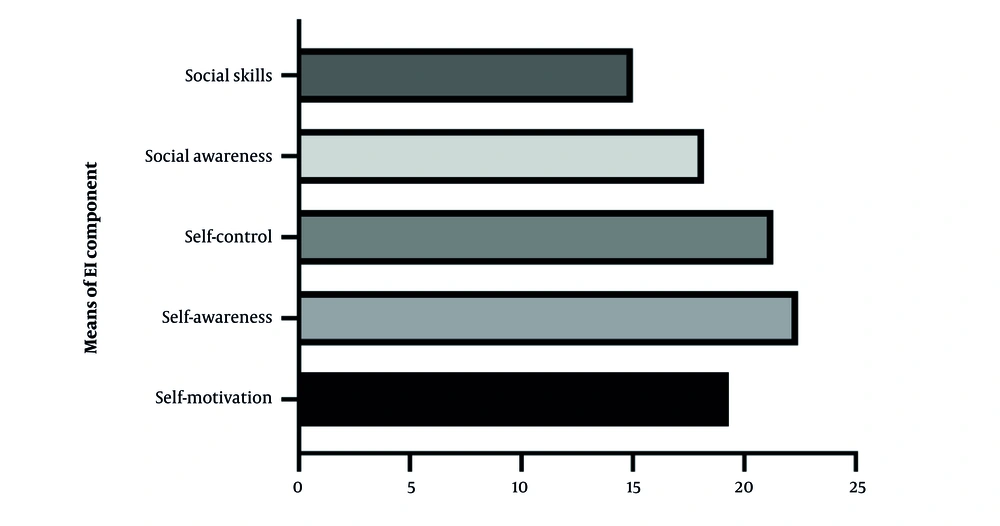
Figure 1.
Mean of emotional intelligence (EI) component scores among medical students
Table 2.
Mean and Standard Deviation of Emotional Intelligence Component Scores in Medical Students a
| EI Components | Min-Max Score | Values |
|---|---|---|
| Total EI | 51 - 132 | 96.3 ± 14.6 |
| Self-motivation | 8 - 31 | 19.3 ± 4.2 |
| Self-awareness | 12 - 32 | 22.4 ± 3.3 |
| Self-control | 10 - 32 | 21.3 ± 4.8 |
| Social awareness | 7 - 26 | 18.2 ± 3.0 |
| Social skills | 6 - 24 | 15.0 ± 3.1 |
| Overall GPA | 12 - 19 | 15.7 ± 1.5 |
Abbreviation: EI, emotional intelligence.
a Values are expressed as mean ± SD.
An independent samples t-test revealed no significant differences in total EI scores based on gender, age, hometown, or educational stage (Table 3). However, significant differences emerged in specific EI subscales and demographic subgroups.
Table 3.
Comparison of Mean Emotional Intelligence Scores and Academic Performance (Overall GPA) by Participant Characteristics a
| Variables | Values | t | P |
|---|---|---|---|
| EI | |||
| Gender | -1.021 | 0.308 | |
| Female | 95.2 ± 13.8 | ||
| Male | 97.1 ± 15.1 | ||
| Age (y) | -1.374 | 0.171 | |
| Under 25 | 15.8 ± 14.7 | ||
| Over 25 | 99.5 ± 13.9 | ||
| Place of origin | -0.394 | 0.694 | |
| Non-native | 95.9 ± 13.9 | ||
| Native | 96.7 ± 15.2 | ||
| Academic stag | -0.634 | 0.527 | |
| Preclinical | 95.9 ± 15.2 | ||
| Clinical | 97.2 ± 13.3 | ||
| Academic performance (overall GPA) | |||
| Gender | 0.477 | 0.634 | |
| Female | 15.7 ± 1.4 | ||
| Male | 15.6 ± 1.5 | ||
| Age (y) | -4.794 | 0.001 | |
| Under 25 | 15.5 ± 1.5 | ||
| Over 25 | 16.5 ± 1.1 | ||
| Place of origin | 0.763 | 0.447 | |
| Non-native | 15.7 ± 1.5 | ||
| Native | 15.6 ± 1.5 | ||
| Academic stag | -9.161 | 0.001 | |
| Preclinical | 15.2 ± 1.4 | ||
| Clinical | 16.7 ± 1.0 |
Abbreviation: EI, emotional intelligence.
a Values are expressed as mean ± SD.
Male students scored significantly higher in social skills (15.36 ± 3.324) than female students (14.54 ± 2.810), t (228) = 1.981, P = 0.049. Students aged 25 and above demonstrated higher social awareness (19.32 ± 3.188) compared to younger students (18.05 ± 2.899), t (228) = -2.337, P = 0.020.
Additionally, academic performance differed significantly by age and educational stage: Students aged 25 and above performed better academically than younger students (P < 0.001). Clinical-phase students outperformed preclinical-phase students academically (Table 3).
Pearson correlation analysis revealed no significant relationship between overall EI and academic performance (Table 4). However, a positive and significant relationship was found between academic performance and the medical course stage, while no such relationship was observed between EI and the medical course stage (Table 3).
Table 4.
Pearson Correlation Analysis of the Relationship Between Emotional Intelligence and Academic Performance
| Variables | EI | Self-motivation | Self-awareness | Self-regulation | Social Awareness | Social Skills |
|---|---|---|---|---|---|---|
| Academic performance | ||||||
| R | 0.014 | -0.033 | 0.012 | 0.010 | 0.080 | 0.003 |
| P | 0.836 | 0.615 | 0.853 | 0.874 | 0.225 | 0.960 |
Abbreviation: EI, emotional intelligence.
5. Discussion
This study explored the relationship between EI and academic performance among medical students in the Sistan region, alongside associations with gender, age, place of birth, and educational stages. A response rate of over 89% strengthened the study’s generalizability by reducing selection bias.
No significant correlation was found between overall EI and academic performance. However, differences emerged in specific EI components based on demographic characteristics. Male students scored higher in social skills, while those aged over 25 demonstrated better social awareness and academic performance compared to younger students. Clinical-phase students outperformed preclinical-phase students academically.
No significant difference was observed in overall EI scores between male and female students, consistent with studies by Vasefi et al. (24), Wijekoon et al. (25), and Fernández-Berrocal et al. (26). However, male students exhibited higher social skills. These findings contrast with research by Austin et al. (27) and El Seifi et al. (28), who reported higher overall EI scores for females. Such discrepancies may stem from cultural and social influences. In collectivist cultures like Iran, norms around emotional expression and regulation likely shape gender differences in EI components (29, 30).
Students aged 25 and older scored higher in social awareness and academic performance, though no link was found between age and overall EI. This aligns with Ehsan et al. (31), who suggested that narrow age ranges in study populations might explain the lack of correlation. Older students may develop better communication skills and stress management abilities, contributing to improved academic outcomes (32).
No significant differences were observed in EI between native and non-native students, consistent with Vasefi et al. (24). However, this contrasts with Coban et al. (33), who found differences between rural and urban students. Similarly, no correlation was found between EI and years of study or between clinical and preclinical students, contrasting with studies reporting declines (24) or increases (34, 35) in EI during medical training.
No significant correlation was found between EI and academic performance, consistent with several studies (24, 36-39). However, other studies reported positive relationships (25, 40, 41). These discrepancies may result from unmeasured factors like personality traits, self-esteem, or stress (2), as well as variations in educational environments. For instance, differences in classroom experiences, clinical training quality, and university type (e.g., type 1 vs. type 3 universities) may influence outcomes (42). Additionally, our broader sample across all years of training may have contributed to differing results compared to studies focusing on specific stages.
This study had several limitations. First, EI was assessed using a self-reported questionnaire, which may introduce bias. Second, students with GPAs below 12 were excluded, potentially limiting generalizability. Third, academic performance was evaluated solely through GPA, which may not fully capture achievement. Finally, only certain socio-demographic variables were examined, excluding potential mediators like personality traits, self-confidence, and stress. Future studies should investigate mediators influencing the EI-academic performance relationship, such as personality traits and stress management. Including samples with diverse cultural and economic backgrounds could enhance understanding of how these factors shape the EI-performance link. Additionally, incorporating objective measures of academic performance and EI could address limitations of self-reported data.
Demographic characteristics significantly influenced the variables under study. For example, gender and age shaped interpersonal abilities and stress management strategies, while no significant differences were found between native and non-native students. These findings underscore the importance of considering sociocultural contexts when interpreting EI and academic performance relationships. Future research should explore these dynamics in diverse settings to provide deeper insights.