
1. Background
Clinical education is considered one of the most crucial components of medical training, often referred to as the heart of professional education (1). Medical education, as a whole, forms a fundamental pillar in developing skilled human resources within the healthcare sector and plays a decisive role in the quality of future healthcare services (2). This education encompasses both theoretical and clinical components, which together prepare students for entry into the medical profession. Clinical education stands out as a particularly vital element in the training of medical students (3), holding a position of special significance. Indeed, clinical education is the most important part of medical training and an indispensable component of it (4). It is during clinical training that acquired knowledge is put into practice, skills are taught, and students are confronted with the realities of the work environment (5). In clinical education, students, through interaction with instructors and the clinical educational environment, apply previously learned theoretical and practical concepts in real-life situations and with actual patients. Consequently, any deficiencies in the clinical education of students will lead to weaknesses and reduced effectiveness in graduates (6).
The complexity of learning in clinical settings has prompted researchers to examine this environment from various perspectives. These dimensions include attention to the individual characteristics of learners, student satisfaction with clinical education, student participation in clinical activities, preservation of student individuality in clinical settings, clear delineation of student responsibilities during the clinical rotation, and the utilization of innovations in clinical education, all of which are of particular importance (4). Various studies have highlighted factors such as insufficient attention to clinical education, a lack of adequate clinical instructors, a lack of coordination and alignment between clinical training and classroom instruction, and a shortage of resources as significant problems in clinical education from the students’ perspective (5-7). A study in Ireland indicated that, according to students, patient examination and the lack of coordination between theoretical and practical courses were the most significant issues in the clinical setting (7). Similarly, a study in Hong Kong revealed that a lack of professional knowledge and skills was the most critical problem in clinical education as perceived by students (8). Based on the study by Mabuda et al., educational and learning support, time allocated for learning, appropriate communication between theoretical and practical courses, and interactions between students and instructors/staff are factors that influence the quality of clinical education (9).
Students, as recipients of educational services, are the best source for identifying educational problems (10). Considering the importance of clinical courses and internships, and because students are directly involved in them, understanding the current situation and its shortcomings from the students’ viewpoint can provide a foundation for improving the existing conditions and rectifying deficiencies. This is crucial because the obstacles and problems in this area not only affect the quality of education but also compromise the quality of healthcare services (8). The complexity of learning in clinical settings has led researchers to examine this environment from various dimensions, including attention to the individual characteristics of learners, student satisfaction with clinical education, student participation in clinical activities, preservation of student individuality in clinical settings, clear delineation of student responsibilities during the clinical rotation, and the utilization of innovations in clinical education, all of which are of particular importance.
The clinical environment, encompassing hospitals and medical centers, plays a vital role in student learning. The richer these environments are in terms of educational resources, medical equipment, and clinical conditions, the more efficient and effective student learning will be. Access to patients with diverse illnesses, interaction with the medical staff, participation in treatment decisions, and performing practical skills under the supervision of specialist physicians are among the factors that contribute to the quality of clinical education (11). Instructors with up-to-date knowledge and appropriate professional skills are factors that influence the quality of clinical education. However, in some educational centers, students may face challenges such as patient overcrowding, equipment shortages, limited opportunities for active participation, poor interaction with faculty, and stress arising from direct contact with patients. These factors can negatively impact the learning process and reduce student motivation and performance. Therefore, it is essential to identify these problems and provide appropriate strategies to improve learning conditions in clinical settings (12).
Students, as recipients of educational services, are the best source for identifying educational problems. Given the importance of clinical courses and internships, and because students are directly involved, understanding the current situation and its shortcomings from their perspective can provide a foundation for improving existing conditions and rectifying deficiencies. The obstacles and problems in this area not only affect the quality of education but also compromise the quality of healthcare services (13). Unfortunately, clinical education in hospitals is not always designed to foster creative and critical thinking in students, thus hindering their ability to apply their knowledge in clinical situations. Furthermore, adequate emotional and psychological support from instructors in clinical settings is sometimes lacking (14). A desirable learning environment is one that supports educational and intellectual activities and collaboration between learners as well as faculty and students. Therefore, if a calm and serious atmosphere, free from tension and stress, is established, it can create good motivation for students to participate more actively in clinical learning (15).
Identifying the status of clinical education helps to address or correct weaknesses and can lead to improved achievement of educational goals, the training of skilled individuals, and the provision of higher quality care services (16). The involvement of nurses, model-based clinical teaching, case method care, the establishment of dynamic communication, and instructor communication with ward staff are factors that enhance the learning environment (17).
2. Objectives
Considering the various studies conducted both in Iran and other countries, and given that infrastructure and human resources (including students and faculty), equipment, facilities, dominant teaching methods and styles, faculty approaches, and management methods differ at the levels of faculties, hospitals, universities, and even the culture of people in different cities and countries, the need to examine and improve clinical education based on these differences becomes more apparent. Therefore, the present study was conducted to investigate the factors affecting the quality of clinical education for medical students at Abadan University of Medical Sciences in the academic year 2023 - 2024.
3. Methods
This descriptive cross-sectional study was conducted in 2023 to determine the status of clinical education quality for medical students at Abadan University of Medical Sciences. The study population consisted of medical students at Abadan University of Medical Sciences who had entered the clinical setting (entry years 2017 - 2020). The sample size was determined based on the main objective: Evaluating the mean clinical education quality score. Using GPower 3.1.9.7 software, a minimum of 90 participants was established, considering an effect size of 0.3, a 0.05 significance level, and 80% power of study. Given that students were present in various departments at the time of the study, convenience sampling was employed. This involved approaching the aforementioned students, providing necessary explanations regarding the study objectives, and ensuring the confidentiality of their information. Individuals who agreed to participate in the study were included. The inclusion criteria were being a medical student, being present in a clinical department, and providing consent to participate in the study. The exclusion criterion was failing to answer more than 10% of the questionnaire questions.
Data collection was performed using the Clinical Education Quality Questionnaire, the reliability and validity of which had been examined and confirmed by Heshmati and Darvishpour (18). This questionnaire comprises two sections: The first section includes demographic information such as age, gender, year of university admission, clinical education department, etc. The second section contains 33 questions and 5 subscales related to the quality of clinical education. The subscales of the questionnaire are: Educational goals and curriculum (11 questions), quality of clinical education instructors (9 questions), approach to students (4 questions), clinical education environment (6 questions), and supervision and evaluation (3 questions). The questions were scored as no (score 1), to some extent (score 2), and yes (score 3). The scores of the responses provided by individuals to the questions were summed, and ultimately, the overall clinical education quality score was determined. Given that the total score for each domain varied, the domain scores were standardized to a 100-point scale for comparability and interpreted as follows: A mean score between 0 and 33.99 was considered a weak domain, 34 to 67.99 as a moderate domain, and 68 to 100 as a desirable domain. The questionnaires were completed through self-administration.
Data analysis was conducted using SPSS version 26. Descriptive statistics for quantitative variables were presented as means and standard deviations, and categorical variables were described using frequencies and percentages. To examine the status of clinical education quality and its domains based on two-level demographic variables, independent samples t-tests were used. For demographic variables with more than two levels, one-way analysis of variance (ANOVA) was employed. The significance level for all tests was set at P < 0.05.
4. Results
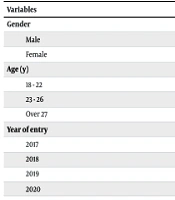
Of the 98 students surveyed, 53 (54.1%) were male, and the majority (73.5%) were in the age group of 23 - 26 years. A total of 66.3% of the students had a grade point average (GPA) between 16 and 18. Additionally, 53.1% of the students were admitted through public admission. Of the students surveyed, 59.2% were in major clinical departments, with the remainder in minor departments (Table 1).
Table 1.
Frequency and Percentage Distribution of Demographic Variables of Participating Medical Students
| Variables | No. (%) |
|---|---|
| Gender | |
| Male | 53 (54.1) |
| Female | 45 (45.9) |
| Age (y) | |
| 18 - 22 | 14 (14.3) |
| 23 - 26 | 72 (73.5) |
| Over 27 | 12 (12.2) |
| Year of entry | |
| 2017 | 24 (24.5) |
| 2018 | 16 (16.3) |
| 2019 | 31 (31.6) |
| 2020 | 27 (27.6) |
| Academic GPA | |
| 14 - 16 | 25 (25.5) |
| 16 - 18 | 65 (66.3) |
| Over 18 | 8 (8.2) |
| Student admission type | |
| Public | 52 (53.1) |
| Obligated | 24 (24.5) |
| Excess capacity | 17 (17.3) |
| Transfer/guest | 5 (5.1) |
| Clinical department attended | |
| Major | 58 (59.2) |
| Minor | 40 (40.8) |
Abbreviation: GPA, grade point average.
The overall mean quality of clinical education from the students’ perspective was 63.45 ± 16.93, which is considered at a moderate level. According to the students, the most influential domain on the quality of clinical education was the quality of instructors, while the domain with the lowest score was the clinical educational environment. The mean scores obtained in all domains were at a moderate level from the students’ viewpoint, with only the quality of instructors domain being at a desirable level (Table 2).
Table 2.
Mean and Standard Deviation of Clinical Education Quality and Its Domains
| Variables | Mean ± SD |
|---|---|
| Educational goals and curriculum | 63.45 ± 16.93 |
| Quality of instructors | 70.07 ± 17.48 |
| Approach to students | 64.83 ± 18.91 |
| Clinical education environment | 54.50 ± 18.55 |
| Supervision and evaluation | 64.88 ± 20.55 |
| Overall clinical education quality | 63.91 ± 14.53 |
The status of clinical education quality and its domains based on the examined variables is reported in Table 3. The results of the independent samples t-test showed that although male students perceived higher importance in the overall quality of clinical education and the subscales of educational goals and planning, instructor quality, and approach to students, these differences were not statistically significant (P > 0.05). Notably, only the domain of instructor quality was perceived at a desirable level by both male and female medical students, while the remaining domains were rated at a moderate level by students of both genders.
Table 3.
Mean and Standard Deviation of Clinical Education Quality and Its Domains Based on Demographic Variables a
| Variables | Clinical Education Quality | Educational Goals and Curriculum | Instructor Quality | Approach to Students | Clinical Education Environment | Supervision and Evaluation |
|---|---|---|---|---|---|---|
| Gender | ||||||
| Male | 63.92 ± 13.98 | 64.03 ± 16.78 | 70.37 ± 17.73 | 65.72 ± 18.60 | 52.83 ± 15.77 | 63.94 ± 20.77 |
| Female | 63.91 ± 15.33 | 62.76 ± 17.30 | 69.71 ± 17.41 | 63.70 ± 19.47 | 56.41 ± 21.42 | 65.92 ± 20.71 |
| P-value b | 0.99 | 0.71 | 0.85 | 0.60 | 0.34 | 0.64 |
| Age | ||||||
| 18 - 22 | 64.79 ± 15.21 | 66.45 ± 14.13 | 67.19 ± 20.94 | 63.69 ± 19.22 | 57.53 ± 22.07 | 67.46 ± 17.68 |
| 23 - 26 | 63.83 ± 14.99 | 63.08 ± 17.21 | 71.03 ± 17.19 | 64.81 ± 19.64 | 53.16 ± 18.09 | 64.96 ± 21.47 |
| Over 27 | 63.38 ± 11.74 | 62.12 ± 19.23 | 67.59 ± 15.80 | 65.97 ± 15.26 | 58.79 ± 10.97 | 61.11 ± 19.81 |
| P-value c | 0.97 | 0.76 | 0.66 | 0.95 | 0.50 | 0.74 |
| Year of entry | ||||||
| 2017 | 67.26 ± 13.06 | 69.94 ± 14.92 | 70.37 ± 15.64 | 67.01 ± 18.63 | 57.17 ± 17.83 | 68.52 ± 19.01 |
| 2018 | 63.07 ± 15.42 | 62.87 ± 21.61 | 70.37 ± 18.40 | 65.10 ± 17.54 | 52.77 ± 15.45 | 59.72 ± 20.64 |
| 2019 | 63.57 ± 12.13 | 64.22 ± 14.79 | 68.69 ± 16.11 | 63.17 ± 17.05 | 53.76 ± 17.88 | 65.95 ± 18.36 |
| 2020 | 61.84 ± 17.77 | 57.12 ± 16.48 | 71.19 ± 20.68 | 64.51 ± 22.60 | 53.91 ± 22.16 | 63.37 ± 24.62 |
| P-value c | 0.60 | 0.06 | 0.96 | 0.91 | 0.87 | 0.59 |
| Department | ||||||
| Major | 62.83 ± 14.24 | 63.01 ± 15.88 | 66.54 ± 17.39 | 65.66 ± 19.38 | 54.60 ± 17.20 | 63.79 ± 20.87 |
| Minor | 65.48 ± 15.00 | 64.09 ± 18.58 | 75.19 ± 16.57 | 63.54 ± 18.46 | 54.31 ± 20.65 | 66.39 ± 20.51 |
| P-value b | 0.38 | 0.76 | 0.01 | 0.59 | 0.94 | 0.54 |
| GPA | ||||||
| 14 - 16 | 65.05 ± 14.06 | 63.64 ± 17.54 | 69.48 ± 16.33 | 69.67 ± 18.46 | 58.44 ± 18.01 | 64.00 ± 20.86 |
| 16 - 18 | 63.17 ± 14.82 | 62.28 ± 17.18 | 70.88 ± 18.04 | 62.82 ± 18.93 | 52.82 ± 17.79 | 64.44 ± 21.26 |
| Over 18 | 66.41 ± 15.12 | 72.35 ± 11.16 | 65.28 ± 17.92 | 65.62 ± 20.14 | 55.55 ± 26.39 | 70.83 ± 15.64 |
| P-value c | 0.76 | 0.29 | 0.68 | 0.31 | 0.43 | 0.70 |
| Admission type | ||||||
| Public | 63.09 ± 14.71 | 63.17 ± 16.89 | 70.01 ± 18.35 | 61.38 ± 18.15 | 53.74 ± 18.95 | 63.03 ± 22.08 |
| Obligated | 58.50 ± 12.93 | 56.69 ± 17.04 | 64.51 ± 15.33 | 61.46 ± 16.63 | 50.93 ± 15.86 | 58.33 ± 14.38 |
| Excess capacity | 69.93 ± 13.13 | 68.27 ± 12.73 | 74.95 ± 17.55 | 75.00 ± 19.76 | 60.13 ± 20.05 | 73.86 ± 19.62 |
| Guest | 77.98 ± 11.50 | 82.42 ± 13.79 | 80.74 ± 10.92 | 81.67 ± 18.07 | 60.00 ± 22.01 | 84.44 ± 16.85 |
| P-value c | 0.009 | 0.008 | 0.13 | 0.008 | 0.40 | 0.01 |
Abbreviation: GPA, grade point average.
a Values are expressed as mean ± SD.
b Independent samples t-test.
c One-way ANOVA.
According to the results of the one-way ANOVA, the domain of instructor quality was perceived at a desirable level by students aged 23 to 26 years. The other domains were of moderate importance, and none of these differences were statistically significant (P > 0.05). The mean overall quality of clinical education and its domains from the perspective of students from different entry years was examined using one-way ANOVA, and no significant difference was observed (P > 0.05).
While the examination of clinical education quality scores and domains based on the clinical department attended by students showed that these scores (except for approach to students and clinical education environment) were higher in minor departments compared to major departments, this difference was statistically significant only in the domain of instructor quality according to the independent samples t-test (P = 0.01). Specifically, the quality of instructors in minor departments was perceived at a desirable level by students, whereas it was perceived at a moderate level in major departments.
The examination of clinical education quality scores and domains based on students’ GPA using one-way ANOVA did not show a significant difference (P > 0.05). From the perspective of students with a GPA above 18, the domains of educational goals and curriculum, and supervision and evaluation were at a desirable level. For students with a GPA between 16 and 18, only the domain of instructor quality was at a desirable level, and for students with a GPA between 14 and 16, the domains of instructor quality and approach to students were at a desirable level.
According to the results of the one-way ANOVA, the overall quality of clinical education and the domains of educational goals and curriculum, approach to students, and supervision and evaluation showed significant differences based on the student admission type (P < 0.05). In all significant cases, the lowest mean scores in clinical education quality were reported by students admitted through obligatory service commitment, and the highest mean scores were reported by guest students. A post-hoc Tukey test revealed a significant difference between the scores reported by students with obligatory service commitment and guest students.
5. Discussion
The findings of this study suggest that certain variables influence the quality of clinical education for medical students. In our study, the overall quality of clinical education was reported as moderate, which aligns with the findings of Heshmati and Darvishpour (18) and Zadi et al. (19) but contrasts with the study by Seidi et al. (20), where the quality of education was reported as desirable. This discrepancy could be attributed to differences in the universities and the study groups, with Seidi et al. (20) focusing on the faculty of nursing and midwifery. In our study, the domain of educational instructors was identified by students as having the most significant impact on the quality of clinical education, consistent with the studies by Heshmati and Darvishpour (18), Zadi et al. (19), and Khedmatizare et al. (21). This contrasts with the study by Seiedi et al. (20), where educational goals and curriculum were considered the most important factor. This suggests that in most studies, educational instructors are perceived as the highest contributor to the quality of education.
Regarding the interaction with students, from their perspective, a suitable learning environment is one where students are respected and provided with appropriate opportunities for learning and achieving goals (1). The involvement of nurses, model-based clinical teaching, case method care, the establishment of dynamic communication, and instructor communication with nurses and ward supervisors are factors that enhance the learning environment (17). In our study, the clinical educational environment was reported by students as having the least impact on the quality of clinical education. Similarly, the study by Khedmatizare et al. (21) found the clinical educational environment to have the lowest score. However, in the studies by Heshmati and Darvishpour (18), Zare et al. (19), and Seiedi et al. (20), supervision and evaluation had the lowest scores among the subscales of clinical education quality.
According to the results of the study by Henderson et al. on 389 nursing students, students’ perceptions of their treatment in the clinical learning environment were mostly moderate (22). Factors affecting the effectiveness of education in the clinical setting include the prevailing atmosphere of the educational space. An educational space and interaction with learners that involve mutual communication and respect promote self-confidence, reduce stress, facilitate learning in the clinical environment, and increase feelings of satisfaction and interest in working with patients and in the clinical setting (21). In the study by Peyman et al., students also identified the unfavorable conditions of the clinical environment and educational facilities as major problems in clinical education (23). This difference could be due to variations in universities and study groups. A large number of students in a ward, a lack of welfare facilities in the ward, the non-use of appropriate educational aids in the ward, and the weak role of the clinical environment in motivating students to pursue this profession in the future are considered weaknesses in this domain.
Educational programs have a significant impact on students’ academic success. The practical application of theoretical content is a major factor in acquiring professional skills and clinical competence. In our study, educational goals and curriculum were reported as moderate. In the studies by Abotalebi et al. (24) and Hadizadeh et al. (25), this subscale was also moderate, with a mean lower than in the present study. In the study by Khedmatizare et al. (21), it was moderate with a higher mean. It seems that the planning and implementation of programs related to clinical education need revision. A crucial point in educational planning is the alignment of goals with available resources and their realism, which can vary for each university depending on its facilities. In fact, planning should be based on the existing situation of each university.
The guidance of internships and practical training by skilled and experienced instructors is a very important factor in improving the quality of education. In the study by Seiedi et al. (20), students believed that clinical instructors were present at the internship site on time and expected students to be present in the clinical environment on time. Instructor support for students in the clinical environment is another factor that improves the quality of clinical education. In the present study, the quality of educational instructors was reported as desirable and excellent. The study by Mortazavi (26) also reported similar results, with this subscale being rated as good. Failure in clinical training can irreparably harm patient safety and ultimately patients’ lives. Sharing successful clinical experiences of students to strengthen interpersonal skills in creating a teamwork approach to increase patient safety and improve the quality of service delivery, ultimately leading to patient satisfaction.
Regarding the interaction with students, from their perspective, a suitable learning environment is one where students are respected and provided with appropriate opportunities for learning and achieving goals. In our study, the interaction with students was reported as moderate, which is consistent with the study by Tolyat et al. (16). The study by Ghorbanian et al. (2) mentioned that in their study, students believed that clinical instructors were present at the internship site on time and expected students to be present in the clinical environment on time. Instructor support for students in the clinical environment is another factor that improves the quality of clinical education. In our study, the approach to students was also reported as appropriate. Learning and acquiring clinical skills are directly related to the characteristics of clinical instructors, and it seems that the implementation of the teaching-learning process through qualified and efficient instructors can enable students to make the best possible use of their abilities. Experts believe that clinical instructors have a significant impact on improving the quality of clinical education and can make clinical experiences enjoyable for students (27). The results of the study by Mirzabeigi et al. showed that students evaluate the learning environment as suitable when there is good communication between personnel and students are accepted as young colleagues. From the students’ perspective, a suitable learning environment is one where students are respected and provided with appropriate opportunities for learning and achieving goals (28). Therefore, it is recommended that more attention be paid to this issue. Among these, the deputies and heads of departments in faculties have a very important role, and one of the solutions is to select experienced, knowledgeable, and well-informed instructors.
In our study, no association was found between age range, gender, year of entry, and student GPA with any of the subscales of clinical education quality. Similarly, in the study by Seiedi et al. (20), the results of the analysis showed no association between age, gender, and place of residence with the evaluated domains. However, an association was observed between students’ GPA and the domains of educational goals and curriculum, interaction with students, learning environment, supervision and evaluation, and self-efficacy. Also, in the research by Fotokian et al. (1), no significant difference was observed between the variables of age, place of residence, and academic program (day and night) with the status of clinical education. However, the results of the present study regarding the academic program domain did not match the study by Alqarni (29), which stated that students in higher academic semesters reported better quality of clinical education. This difference may be related to the difference in the statistical population of the two studies.
The factors that had a significant association in our study included the relationship between the quality of educational instructors and the clinical department, and the relationship between the type of student admission and the domains of educational goals and curriculum, approach to students, supervision and evaluation, and the overall quality of clinical education. In response to questions regarding educational goals and curriculum, "clarity of student responsibilities in the ward" had the highest mean, while "importance given to students’ opinions in internship planning" had the lowest mean. This aligns with the study by Heshmati and Darvishpour (18) but not with Peyman et al. (23). This discrepancy might be due to the different academic disciplines of nursing and medicine, suggesting that authorities should involve students more in the planning processes of internship programs.
Regarding the quality of educational instructors, "clinical instructor’s expectation regarding students’ punctuality in the clinical setting" obtained the highest mean, and "reduction of student stress by the clinical instructor" received the lowest mean. Support from the clinical instructor can reduce student stress and increase their self-confidence. In response to questions about the approach to students, "enhancing student self-confidence in the clinical setting" had the highest mean, and "necessary cooperation of ward personnel with students" had the lowest mean. Ghorbanian et al. (2) and Delaram (10) emphasized the importance of ward personnel’s approach and cooperation with students in their studies. Therefore, increasing the cooperation of ward personnel with students can help improve the quality of clinical education.
In response to questions about the clinical learning environment, "sufficiency of patients in terms of number for learning" had the highest mean, and "sufficiency of welfare facilities in the wards" had the lowest mean. This indicates a need to increase welfare facilities in the wards. Khazaei and Ghavami (30), and Mortazavi et al. (26) highlighted the importance of standard patient numbers and welfare facilities for students regarding the quality of clinical education. Therefore, clinical education standards should always be reviewed, which is consistent with the results of the present study.
In response to questions about supervision and evaluation, "evaluation of instructor activity by students" had the highest mean, and "sufficient supervision of the clinical education process" had the lowest mean. This necessitates increased supervision of the clinical education process. Regarding the evaluation of instructor activity by students, the results of the present study were not consistent with the findings of Sharifi et al.’s study (31), which evaluated the performance of clinical professors in the internship period as unfavorable. This inconsistency might be due to the direct supervision of clinical professors and the absence of resident students at Abadan University of Medical Sciences.
5.1. Conclusions
Students perceived the clinical learning environment as the weakest indicator of clinical education quality at Abadan University of Medical Sciences. Addressing factors such as the sufficiency of student numbers, welfare facilities, and creating motivation among students were identified as crucial determinants. Our recommendations include increasing student participation in the planning of internship and practical training programs and considering their opinions, addressing the faculty shortage and the lack of student-faculty involvement in the teaching process, enhancing the quality of education by motivating both students and faculty and empowering instructors, encouraging increased cooperation between ward personnel and students, providing welfare facilities for students and establishing educational rooms in each department, allowing students to use equipment, and addressing educational and managerial deficiencies.