1. Background
According to the Gardner’s multiple intelligence theory, there are two major kinds of intelligence: first, one’s internal intelligence and awareness that enables identification and differentiation of human’s complicated emotions; and second, the knowledge and awareness in interpersonal relationships which creates ability to recognize and distinguish emotions and intentions of other people (1-4). By definition, Emotional Intelligence (EI) refers to the capability of perceiving and expressing emotions along with their unification and alignment in the mind and also the ability to comprehend and reason with feelings and regulate personal and interpersonal emotions (1, 5).
EI skills will cause improvement of adaptation in addition to the higher likelihood of success even in seriously risky situations (6). Previous studies showed that EI is effective in person’s life accomplishments and the individuals with higher EI have better social skills, more consistent long-term relationships and greater capability of resolving challenges (6). Also, children with better emotional quotient are more able to concentrate on the problems and use certain skills to solve them leading to enhancement of their cognitive capabilities (7). EI can be hardly improved, while instruction and consistency in dealing with certain circumstances could be effective in the improvement of EI (8).
Educational success or achievement of individuals does not solely depend on their intelligence quotient, but is also related to sensational and social skills of EI. Having the needed motive, the ability to remain expectant, obeying commands and controlling stimuli, skill of asking others for help, and expression of emotional and educational needs are among such social skills (9). Therefore, EI is important in terms of educational issues (10). Due to the significance of medical profession and its influence on the healthcare system, it is vital to study the personal and psychological factors pertaining to educational and vocational successes in medical students. In this regard, there is paucity of data concerning relation between EI and educational achievement in medical fields, and the current study is one of the primary researches among Iranian medical students.
2. Objectives
The aim of this study was evaluation of the relation between EI and academic achievement of students working in the medical field.
3. Patients and Methods
This cross-sectional study was conducted on 150 medical students of Baqiyatallah university of medical sciences between February 2010 and July 2011 who had completed at least two academic semesters. Students who were interested to participate and did not have any of the exclusion criteria including recent emotional distress, previous psychological abnormalities and chronic somatic disorders were enrolled. Also, the study was implemented following ratification in Scientific-Moral Committee of medicine faculty of Baqiyatallah university of medical sciences and the participants’ data were assessed in an encrypted and confidential manner.
Initially, the research questionnaires containing checklists of demographic details and standardized Bar-On questionnaires -for evaluation of EI- were distributed among the students. The respective information was extracted and registered after the participants filled up the questionnaires. Criterion of educational achievement was student’s grade point average (GPA) announced by educational deputy of the university. The demographic information checklist was designed and prepared by the researchers based on references in the literature. Bar-on questionnaire contains 90 questions in five dimensions and 15 subsets. The five dimensions include: intra-personal dimension, interpersonal dimension, tension (stress) control, compatibility dimension and public manners dimension (11). Fifteen subsets of Bar-on questionnaire are: problem solving ability, fortunateness, self-actualization, stress tolerance, self-awareness, realism, inter-personal relations, optimism, self-regard, impulse control, flexibility, accountability, empathy and assertiveness. Each of these items includes six questions. Every question in the questionnaire has five answer choices ranging from “I absolutely agree” to “I absolutely disagree” (the Likert 5-grade spectrum). Reliability of the Persian version of EI questionnaire (Bar-On) was assumed 0.94 based on Cronbach’s alpha. The minimal and maximal scores for this questionnaire were 90 and 450, respectively (11, 12). The collected data were analyzed using SPSS-17 software and the final results were interpreted.
In assessment of model variables, values of EI, problem solving ability, stress tolerance, inter-personal relation, impulse control and self-awareness as well as distribution of variables were analyzed using the Kolmogorov-Smirnov (KS) test. P value < 0.05 was considered as the significance level for correlations between variables. Descriptive data were expressed in terms of mean value, median, and percent. Due to normal distribution of data, Pearson’s test was applied to check presence of any correlation between variables. P value < 0.05 was again considered as the significance level between variables.
4. Results
In the current research, 150 medical students in preliminary (basic sciences) and clinical levels from Baqiyatallah university of medical sciences were studied. All of the examinees filled the questionnaires (response rate: 100%). Quantitative variables of the research are described in Table 1. Age average of the participating students was 23.17 ± 2.170 years and 100% of the participants were male. Among the participants, 22 (14.7%) were studying at the preliminary level and the rest 128 students (85.3%) were at clinical level.
Table 1
Demographic Characteristics and Emotional Intelligence Score
| Variable | Mean ± SD | Maximum | Minimum |
|---|---|---|---|
| Age | 23.17 ± 2.150 | 28 | 19 |
| Educational average score | 15.21 ± 1.138 | 17.98 | 11.66 |
| EI a score | 334.69 ± 37.877 | 445 | 253 |
| Problem Solving | 23.69 ± 3.334 | 36 | 15 |
| Emotional Tolerance | 20.72 ± 4.004 | 30 | 6 |
| Interpersonal relationship | 23.31 ± 3.552 | 30 | 14 |
| Impulse control | 19.00 ± 4.807 | 30 | 6 |
| Self awareness | 22.75 ± 3.309 | 30 | 16 |
aAbbreviation: EI, emotional intelligence
Average EI in basic sciences level was 303.14 ± 39.321; while the maximum and minimum values were 402 and 261, respectively. The value in the clinical level was 340.11 ± 35.007 with maximum and minimum of 445 and 253, respectively. Among the medical students, a significant relation was observed between EI and educational achievement level (P < 0.001) with correlation coefficient (CC) of 0.305. A significant correlation was also observed between problem solving ability and educational achievement level (P < 0.001) with CC of 0.271. Significant correlation and linkage was also found between levels of stress tolerance and educational achievement (P < 0.001) with CC of 0.161. But no significant association was discovered
between inter-personal relationship and educational achievement level.
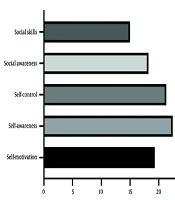
Among the medical students, no significant correlation was found between impulse control and educational achievement level (P > 0.05); but, the relation between self-awareness and educational achievement level was found to be significant (P < 0.05) with correlation coefficient of 0.257. Finally, as observed in Table 2 , 3 and 4 and Figure 1 , average EI was different in terms of educational level (basic sciences, physiopathology, clerkship, and internship levels). The same difference was observed for all other components except for impulse control. Total averages of EI and also other components except for impulse control were different in terms of clinical levels (clerkship and internship) and non-clinical levels (basic sciences, physiopathology).
Table 2
Emotional Intelligence and Educational Degrees
| Variable | Degree | mean | Mean | Standard | Variable | Degree |
|---|---|---|---|---|---|---|
| Average | 0.111 | 2.036 | ||||
| Basic | 22 | 14.68 | 1.340 | |||
| Physiopathology | 25 | 15.33 | 0.913 | |||
| Clerkship | 56 | 15.21 | 1.206 | |||
| Internship | 47 | 15.38 | 1.017 | |||
| Total | 150 | 15.21 | 1.138 | |||
| EI score | 0.000 | 9.641 | ||||
| Basic | 22 | 303.14 | 39.32 | |||
| Physiopathology | 25 | 322.96 | 29.10 | |||
| Clerkship | 56 | 342.16 | 36.08 | |||
| Internship | 47 | 346.79 | 34.26 | |||
| Total | 150 | 334.69 | 37.87 | |||
| Problem Solving | 0.000 | 7.109 | ||||
| Basic | 22 | 21.50 | 3.12 | |||
| Physiopathology | 25 | 22.40 | 2.75 | |||
| Clerkship | 56 | 24.30 | 2.99 | |||
| Internship | 47 | 24.66 | 3.53 | |||
| Total | 150 | 23.69 | 3.34 | |||
| Pressure Tolerance | 0.028 | 3.130 | ||||
| Basic | 22 | 19.50 | 3.39 | |||
| Physiopathology | 25 | 19.36 | 3.58 | |||
| Clerkship | 56 | 20.82 | 4.41 | |||
| Internship | 47 | 21.89 | 3.67 | |||
| Total | 150 | 20.72 | 4.00 | |||
| Self-awareness | 0.000 | 7.524 | ||||
| Basic | 22 | 20.09 | 3.47 | |||
| Physiopathology | 25 | 22.16 | 2.67 | |||
| Clerkship | 56 | 23.34 | 3.15 | |||
| Internship | 47 | 23.60 | 3.09 | |||
| Total | 150 | 22.75 | 3.30 | |||
| Interpersonal Interaction | 0.001 | 6.085 | ||||
| Basic | 22 | 21.00 | 3.67 | |||
| Physiopathology | 25 | 22.28 | 3.18 | |||
| Clerkship | 56 | 24.30 | 3.37 | |||
| Internship | 47 | 23.77 | 3.35 | |||
| Total | 150 | 23.31 | 3.55 | |||
| Impulse control Variable | 0.254 | 1.373 | ||||
| Basic | 22 | 19.14 | 4.22 | |||
| Physiopathology | 25 | 19.04 | 4.24 | |||
| Clerkship | 56 | 18.08 | 5.61 | |||
| Internship | 47 | 20.00 | 4.19 | |||
| Total | 150 | 19.00 | 4.80 |
Table 3
Educational Degrees and EI Subscale
| First | Second | Problem solving | Impulse control | Stress tolerance | Self-awareness | Interpersonal |
|---|---|---|---|---|---|---|
| Basic | ||||||
| Physiopathology | 0.764 | 1 | 0.999 | 0.109 | 0.568 | |
| Clerkship | 0.003 | 0.819 | 0.539 | 0.000 | 0.001 | |
| Internship | 0.001 | 0.898 | 0.089 | 0.000 | 0.010 | |
| physiopathology | ||||||
| Basic | 0.764 | 1 | 0.999 | 0.109 | 0.568 | |
| Clerkship | 0.063 | 0.840 | 0.411 | 0.382 | 0.066 | |
| Internship | 0.023 | 0.850 | 0.048 | 0.248 | 0.290 | |
| Clerkship | ||||||
| Basic | 0.003 | 0.819 | 0.539 | 0.000 | 0.001 | |
| Physiopathology | 0.063 | 0.840 | 0.411 | 0.382 | 0.066 | |
| Internship | 0.941 | 0.184 | 0.512 | 0.980 | 0.853 | |
| Internship | ||||||
| Basic | 0.001 | 0.898 | 0.089 | 0.000 | 0.010 | |
| Physiopathology | 0.023 | 0.850 | 0.048 | 0.248 | 0.290 | |
| Clerkship | 0.941 | 0.184 | 0.512 | 0.980 | 0.853 |
Table 4
Emotional Intelligence in Terms of Clinical or Non-clinical Educational Degrees
| Clinic | Number | Mean | SD | P-value | |
|---|---|---|---|---|---|
| Average of educational score | 0.195 | ||||
| Non-clinical a | 47 | 15.03 | 1.16 | ||
| Clinical b | 103 | 15.29 | 1.12 | ||
| EI c total | 0.000 | ||||
| Non-clinical | 47 | 313.68 | 35.32 | ||
| Clinical | 103 | 344.27 | 35.17 | ||
| Problem Solving | 0.000 | ||||
| Non-clinical | 47 | 21.98 | 2.93 | ||
| Clinical | 103 | 24.47 | 3.23 | ||
| Stress tolerance | 0.007 | ||||
| Non-clinical | 47 | 19.43 | 3.45 | ||
| Clinical | 103 | 21.31 | 4.11 | ||
| Self-awareness | 0.000 | ||||
| Non-clinical | 47 | 21.19 | 3.21 | ||
| Clinical | 103 | 23.47 | 3.11 | ||
| Interpersonal | 0.000 | ||||
| Non-clinical | 47 | 21.68 | 3.44 | ||
| Clinical | 103 | 24.06 | 3.36 | ||
| Impulse control | 0.881 | ||||
| Non-clinical | 47 | 19.09 | 4.19 | ||
| Clinical | 103 | 18.96 | 5.08 |
a Clinical: Internship and clerkship
b Non-clinical: Basic and physiopathology
cAbbreviation: EI, emotional intelligence
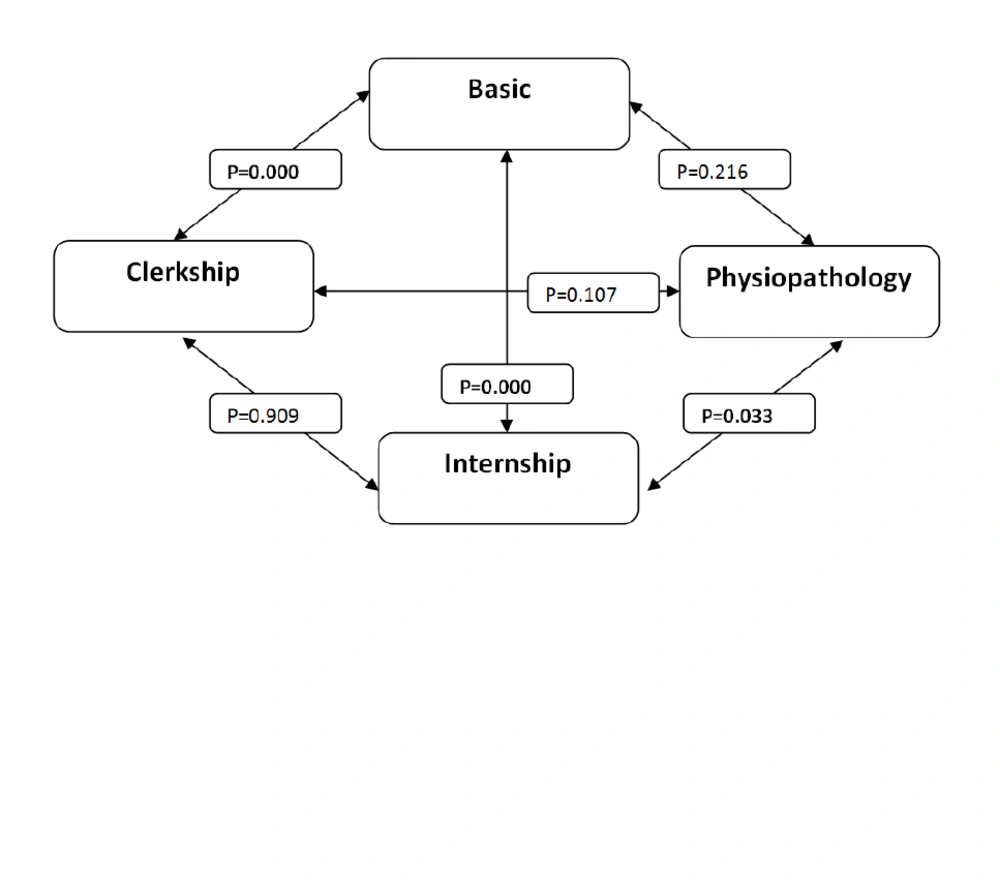
Figure 1
The Correlation between Educational Degrees
5. Discussion
Identification of significant correlation between EI and educational achievement level was one of the most important findings of the current study. Also, significant relations were observed between educational achievement and levels of problem solving ability, stress tolerance, and self-awareness among the EI dimensions. It can be therefore concluded that among the EI components, problem solving ability, stress tolerance, and self-awareness are more significantly related to educational achievement level and may play more remarkable roles in prediction of educational achievement. This finding is in alignment with the assertion that individuals’ achievements in educational aspects in the university are not related solely to their intelligence quotient. Nonetheless educational achievement may depend on emotional and social skills of EI such as having the needed motive, the ability to remain expectant, obeying commands and controlling the stimuli, asking for others’ aid, and expression of emotional and educational requirements (9).
In different studies in academic levels and even lower educational levels such as high-schools, it was demonstrated that a clear correlation exists between educational achievement and psychological and sensational controlling capabilities such as EI (13). Role of EI on educational progress has also been emphasized in studies by Besharat et al. (12), Parker et al. (14), Samari et al. (15), and Pitrides et al. (16) but none of these studies, unlike the current research, investigated the respective correlation among medical students.
Furthermore, certain abilities have been related to the educational and vocational achievement and also EI in former studies. In a research conducted by Wessel et al. in US on health sciences students, a significant correlation was observed between EI and the control, guidance and leadership capabilities (17).
Similar to our study, Zahrakar et al. evaluated EI using Bar-on questionnaire and they observed a significant and positive correlation coefficient at P = 0.01 between components of EI including self-awareness (CC = 0.271), impulse control (CC = 0.228) problem solving (CC = 0.287), interpersonal relationships (CC = 0.276), and stress tolerance and educational performance (CC = 0.311). Among the components of EI, stress tolerance and problem solving ability were the major and significant predictors for educational performance (18). These findings are not in accordance with results of the current research in terms of correlation between the respective dimensions and educational achievement.
The relation between EI and mental health and educational performance of male and female students was analyzed in a study by Bakhshi et al., in Islamic Azad university-Behbahan branch. Similar to the current research, they concluded that there is a positive and significant correlation between variables of EI and educational performance (P < 0.01) with correlation coefficient of 0.68 (19). On the other hand, impact of EI capabilities on educational achievement level has been brought under question in some other studies. For example, no significant correlation was found between any of EI dimensions and efficiency of anesthesia aides (exam scores of anesthesia board) in the research conducted by Talarico et al. in Pittsburg university (21). Also, the study carried out by Haghani et al. in Isfahan on medical students revealed that average EI scores had no significant relation with their GPAs. However, among the sub-scales of EI, only independence was related to students’ GPA, but neither total score of EI nor critical thinking had tangible effect on person’s educational achievement (22). Also, no relation was found between EI and educational achievement in the studies by Tamannaiefar et al. (23) and Keshavarzi et al. (24) both of which have been carried out on non-medical students.
According to the previous studies, educational achievement of medical students may be improved if behavior control abilities and self-confidence are promoted (25). Filcher el al. concluded that average score of EI by the course of time increased for the intervention group, but slightly decreased in the control group (26). In their study, score of initial EI was not significantly different between pre-clinical and clinical groups which is inconsistent with the results of our study. In a study by Pangersic et al. in Croatia on medical students of second to sixth year, it was shown that professors had an essentially effective role in educational motivation of students through orientating their sensational, emotional, and social approaches. Also, they could influence determination of students’ future job plans. Such intellectual and emotional orientation may have resulted from contributing to the improvement of EI as well (27).
A privilege of the current study is the fact that both clinical and non-clinical groups were compared here, and clinical group exhibited higher EI. Taking into account the fact that all participants of the current research were male, one of the reasons for discrepancy of the current results with findings of other studies is inequality of gender proportion. Overall, it seems that although role of EI and its associated dimensions are effective during the course of education, but its impact becomes more tangible during vocational stages especially when the person’s career is much more crucial (30). Thus, paying attention to the improvement of emotional control and EI is specifically critical among physicians. It is noteworthy that some of the abilities affecting EI such as problem solving ability, stress tolerance, interpersonal relationship, impulse control, and self-awareness can be promoted by using certain instructions. Therefore, the results of the current research and other similar studies can be utilized for designing solutions to improve EI level of students in Iran’s academic system in order to promote their social and educational achievements.