
1. Introduction
The curriculum is among the most important elements influencing the success or failure of higher education systems. Curricula reflect universities’ development and responsiveness to evolving societal needs. They provide comprehensive plans for educational activities and establish a framework for learning. The curriculum also plays a fundamental role in achieving university goals and developing human resources. It is a systematic process that defines objectives, content, teaching methods, and needs-based assessment and evaluation. Therefore, high-quality curricula reflect universities’ responsiveness to society’s changing needs. In developing countries such as Iran, higher education has experienced rapid quantitative growth and strong popularity among young people. However, qualitative improvement is equally essential because unchecked expansion may lead to declining standards (1).
Nursing is a cornerstone of healthcare systems and safeguards individual and community health in response to evolving societal needs. Accordingly, nursing education aims to produce graduates with the knowledge, skills, and competence required to fulfill diverse societal roles (2). Nursing programs form the foundation for training specialized personnel, ensuring healthcare quality, and advancing public health (3, 4). Graduate nursing students, who engage in care delivery, education, research, and management, must effectively address dynamic healthcare and societal demands (2).
Aging is a global challenge for healthcare systems in developing countries (5). Despite the growing number of older adults worldwide, the number of specialized geriatric nurses remains insufficient, and academic programs have not fully met community needs (6). Nurses are responsible for providing physical and psychological care and emotional support to older adults in various settings, including hospitals, care centers, and homes (7). The older adult population in Iran is growing rapidly (8). The proportion of older adults increased from 7.22% in 2006 to 12.0% in 2023 (9, 10) and is projected to exceed 30% by 2050 (11). Considerable international and national attention is now being given to training nurses who are familiar with age-related disorders and are able to provide appropriate care in this field (12). Given the growth of the older adult population and the fact that approximately 90% of nursing services are provided directly to this segment of society, the need for skilled, specialized, and motivated nurses in elderly care is increasing (13).
The Master of Science in Nursing (MSN) plays a pivotal role in advancing healthcare quality, as nurses with advanced practice certification improve patient safety and reduce hospital mortality rates (14). Geriatric nursing, a specialized MSN track, focuses on providing comprehensive care and services for older adults.
Curriculum evaluation is a key activity in curriculum improvement and development. One evaluation method for curriculum revision is comparative study, which educational planners in leading countries consider among the most dynamic scientific approaches and reliable research methods. This type of research analyzes similarities and differences between educational systems, identifies strengths and weaknesses, develops approaches to solve educational problems, and determines factors affecting educational progress or stagnation. Continuous reflection and research can strengthen educational programs, improve the quality of nursing education, and enhance students’ professional skills.
Given Iran’s rapidly aging population and the limited number of geriatric nursing specialists, systematic evaluation of the Master of Science in Geriatric Nursing curriculum is necessary. Existing studies have mainly described the program, and comparative evidence regarding its alignment with international models remains limited. This study is therefore novel because it provides structured benchmarking of Iran’s geriatric nursing curriculum against an established Asian model, namely Chiang Mai University in Thailand, to identify both shared features and context-specific gaps. Chiang Mai University was selected because of its recognized nursing faculty, diverse graduate programs, and emphasis on advanced, practice-oriented education in gerontological nursing. By comparing the two curricula in terms of philosophy, goals, structure, and graduate competencies, this study provides evidence to support curriculum refinement, strengthen educational quality, and better prepare graduates to meet the growing demands of elderly care in Iran.
2. Methods
This applied descriptive-comparative study used document analysis to systematically compare the master’s-level geriatric nursing curriculum in Iran with that of the Faculty of Nursing at Chiang Mai University, Thailand. The study was conducted in 2025 at Guilan University of Medical Sciences. Information on the most recent Master of Geriatric Nursing program approved in 2021 in Iran was obtained from the Ministry of Health website, and information on Chiang Mai University’s program in Thailand was obtained from the university’s website. This comparative analysis used the most recent officially approved Master of Geriatric Nursing curricula: Iran’s 2021 program from Guilan University of Medical Sciences, which remained current through 2025 with no revisions according to Ministry of Health records, and Chiang Mai University’s 2024 - 2025 curriculum.
Document analysis was selected because, in both countries, formal, authoritative curriculum documents are publicly available through official university or governmental websites, and these documents reflect the approved structure, content, and program requirements. Therefore, they constitute valid primary sources for comparative curriculum research. The analysis was limited to these official documents to ensure accuracy and consistency between the two programs.
2.1. Data Collection and Research Design
This study used a comparative research design based on George F. Z. Bereday’s four-stage model: description, interpretation, juxtaposition, and comparison. To ensure data reliability, a systematic data collection approach was applied, emphasizing official documentation rather than general web-based articles.
2.2. Documents and Inclusion Criteria
The primary documents analyzed were the official Master of Geriatric Nursing curricula obtained from authorized sources. For Iran, the program was sourced from the official curriculum document published in 2021 by the Ministry of Health and Medical Education, which serves as the mandatory framework for all Iranian universities offering this program. For Chiang Mai University, the most recent curriculum from 2025 was retrieved directly from the official Faculty of Nursing website. To supplement these documents, a targeted literature search was conducted in Scopus, PubMed, Google Scholar, SID, and Magiran using keywords such as “Geriatric Nursing,” “Curriculum,” and “Comparative Study.” The inclusion criteria for secondary sources were peer-reviewed articles published between 2015 and 2025 that focused on educational reforms or geriatric nursing program evaluations.
2.3. Methodological Rigor and Bias Mitigation
To minimize selection bias and enhance validity, data triangulation was performed by cross-referencing official curriculum documents with institutional reports and peer-reviewed educational literature. By focusing on the primary official curricula rather than isolated reports, we ensured the accuracy of the foundational data (15).
2.4. Bereday’s Analytical Framework
1) Description: Evidence on program history, philosophy, mission, vision, admission criteria, and structural components, including credit hours and course titles, was systematically collected and synthesized.
2) Interpretation: Data from both programs were analyzed to elucidate contextual and structural differences, with attention to the underlying educational philosophies, including gerontological nursing and gerontological nurse practitioner models.
3) Juxtaposition: The collected data were organized into comparative matrices and tables to categorize similarities and differences and establish a clear analytical framework.
4) Comparison: The final stage synthesized the findings to address the research questions, identify gaps in the Iranian curriculum, and propose evidence-based recommendations for reform.
3. Results
The results provide a structured comparison of the geriatric nursing MSc curricula in Iran and at Chiang Mai University. The comparison addresses historical development, educational philosophy, mission and vision, graduate competencies and responsibilities, admission criteria, and key program characteristics. The findings are summarized in three tables that highlight the main similarities and differences between the two programs. Although both curricula emphasize gerontological nursing, the Iranian program is based on a traditional gerontological nursing model, whereas Chiang Mai University’s program follows a gerontological nurse practitioner model.
The master’s degree in nursing science is a professional degree that enables students to acquire in-depth knowledge and expertise in their selected area of specialization. Graduates can respond to the changing needs of health and society and are prepared for advances in health science and technology (16). The program places strong emphasis on professional ethical principles and virtues, collaboration, and critical thinking. Master of nursing science programs are thesis-based and focus on the development of nursing knowledge in a specific area of concentration (17).
In Iran, the master’s degree curriculum in geriatric nursing was first approved in 2010; the first cohort of students was admitted to Tarbiat Modares University in 2011, and the latest revision was implemented in 2021. The history of the Master of Science program in gerontological nurse practitioners in Chiang Mai, Thailand, dates to 2018 - 2019, when the Master of Nursing Science program was established at Chiang Mai University. Chiang Mai University is a leading public institution in northern Thailand that was established to serve as a regional academic and professional center in response to government policy and societal needs. The university is committed to knowledge generation, research, and academic excellence, guided by principles of academic freedom, integrity, and service to society.
Although Iran’s geriatric nursing program and Chiang Mai University’s Master of Nursing Science share the goal of preparing graduates for advanced nursing care of older adults, they differ in educational emphasis and scope. In Iran, the curriculum focuses on comprehensive nursing care across acute, chronic, and community settings to promote functional independence among older adults and support families in care delivery. In contrast, Chiang Mai’s program emphasizes advanced clinical competencies aligned with the gerontological nurse practitioner role, including health promotion, disease prevention, primary medical care, rehabilitation, and palliative care for older adults in complex health situations. These differences reflect distinct program frameworks: Iran’s foundation in a traditional gerontological nursing model and Thailand’s practitioner-oriented approach, which integrates broader clinical autonomy and interprofessional collaboration into graduate outcomes. Table 1 presents the definitions of the field in the two systems.
Table 1.
Comparison of the Definitions, Philosophy, Vision, and Mission of Geriatric Nursing in Iran and Chiang Mai University, Thailand
| Components | Iran | Chiang Mai University |
|---|---|---|
| Program definition and scope | A graduate program focused on comprehensive nursing care for older adults at the individual, family, and community levels, with emphasis on preventive, therapeutic, and rehabilitative nursing functions. Graduates are trained to assess and address the physical, psychological, social, and cultural-spiritual needs of older adults and facilitate healthy and active aging. | The Master of Nursing Science program in Gerontological Nurse Practitioner focuses on the relationships between individuals, their environment, and health in the context of an aging society. It integrates nursing and health sciences to equip graduates with the skills needed to care for both healthy and ill older adults and their families across the continuum of care, including health promotion, disease prevention, treatment, rehabilitation, and palliative care. |
| Values | The geriatric nursing program emphasizes education grounded in Islamic philosophy and focuses on human values and moral character. Core values include respect for ethical and human principles, preservation of dignity and rights, justice in care provision, support for independence and self-care, involvement in decision-making, interprofessional collaboration, lifelong learning, professional accountability, transparency, and promotion of healthy and active aging for older adults and their families. | The Faculty of Nursing emphasizes the FONCMU values: focus on quality, organizational leadership, nurturing and care, social commitment, morality and ethics, and unity. |
| Vision | The geriatric nursing program aims to train skilled nurses who improve knowledge and clinical competencies in aging care according to accepted global and regional standards. The program seeks to enhance community-based geriatric nursing, continuously update nurses’ expertise through lifelong learning, improve the quality of care for older adults and their families, and promote international collaboration to address specialized needs. | Chiang Mai University’s Faculty of Nursing aims to become a leading international nursing institution that contributes to sustainable health and global academic excellence. The faculty seeks high international recognition and meaningful socioeconomic outcomes through quality education, research, and professional practice. |
| Mission | The geriatric nursing program aims to reduce mortality and complications associated with aging by expanding specialized care structures and enhancing the nursing care process. It also aims to improve the quality and continuity of geriatric nursing services by developing clinical expertise, promoting updated knowledge and skills, expanding community-based care capacities, and supporting collaboration across health sectors. | In alignment with Chiang Mai University’s mission, the Faculty of Nursing fulfills core roles in education, research, community service, and cultural preservation. It is committed to high-quality nursing education, impactful research, and service to society through evidence-based practice and professional leadership, contributing to the well-being of individuals and communities locally and internationally. |
The values of the geriatric nursing program in Iran emphasize a holistic and ethically grounded approach that prioritizes human dignity, justice, autonomy, lifelong learning, and interprofessional collaboration within its cultural context. In contrast, the Faculty of Nursing at Chiang Mai University emphasizes values such as sound knowledge, best practices, inquiry-based research, moral mindfulness, and the pursuit of world-class standards, reflecting a strong orientation toward academic rigor and research engagement. Regarding vision and mission, the Iranian program focuses on preparing competent nurses to enhance care quality, community health, and specialized services for older adults. Chiang Mai University’s Faculty of Nursing articulates a vision of being a leading international nursing academic and research institution and a mission that integrates education, research, community service, and cultural activities (Table 1).
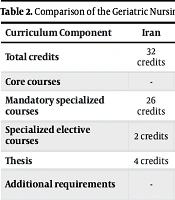
According to the curriculum of the master’s degree in geriatric nursing in Iran, students must complete 32 credits. In contrast, the Chiang Mai University program requires at least 36 credits (Table 2). More complete information is provided in Appendix 1 in the Supplementary File.
Table 2.
Comparison of the Geriatric Nursing Curriculum in Iran and Chiang Mai University, Thailand
| Curriculum Component | Iran | Chiang Mai University |
|---|---|---|
| Total credits | 32 credits | Minimum of 36 credits |
| Core courses | - | 9 credits |
| Mandatory specialized courses | 26 credits | 12 credits |
| Specialized elective courses | 2 credits | 3 credits |
| Thesis | 4 credits | 12 credits |
| Additional requirements | - | Two seminars and at least one publication. Students may select courses in nursing administration, adult and gerontological nursing, or maternal and child nursing. |
The expected professional roles differ in scope and emphasis. Iranian graduates focus on core clinical care, patient education, and research participation, with strong attention to ethics and interprofessional collaboration. In contrast, Chiang Mai University graduates are prepared for broader gerontological nurse practitioner functions, including advanced assessment, prevention, treatment, rehabilitation, palliative care, leadership, research use, and community-based service development.
In Iran, admission to the geriatric nursing master’s program is based on a bachelor’s degree in nursing, success in a national entrance examination, and Ministry of Health regulations. In contrast, Chiang Mai University uses an online registration system, university entrance processes, and an interview. Therefore, Chiang Mai’s admission system includes a broader assessment of candidates beyond academic qualifications alone.
Both programs generally last two years. Chiang Mai University’s Master of Nursing Science program is structured over four regular semesters, with a maximum completion period of four academic years to accommodate part-time study. The Iranian curriculum is also completed within four semesters, but students usually attend the faculty on a part-time basis two to three days a week.
Thailand’s program uses diverse active learning methods, including simulation, clinical education, group learning, project-based learning, technology-enhanced learning, and problem-based learning. Iran’s curriculum includes seminars; intradepartmental, interdisciplinary, and interuniversity conferences; small-group discussions; educational workshops; journal clubs and case reports; outpatient training in elderly centers and other health service settings; distance learning and simulation techniques where possible; participation in lower-level education; self-study; and other educational methods and techniques according to educational needs and goals.
Chiang Mai University assesses students through research-focused activities, including semesterly thesis seminars and mandatory thesis publication for graduation. Iran uses diverse assessment methods, including written tests, oral tests, computer-interactive examinations, direct observation of procedural skills, project-based assessment, portfolios, and logbooks.
In Iran, graduates with a master’s degree in geriatric nursing can work in diverse healthcare and social service settings, including hospitals, medical and geriatric care centers, 24-hour and home care services, comprehensive health centers, counseling centers, day-care centers, welfare organizations, and educational institutions. Chiang Mai University graduates are similarly prepared for clinical, educational, and research roles, with additional emphasis on advanced clinical decision-making and leadership (Table 3).
Table 3.
Comparison of Key Dimensions of the Master’s Degree Program in Geriatric Nursing in Iran and Chiang Mai University, Thailand
| Component | Iran | Chiang Mai University |
|---|---|---|
| Professional duties of graduates | Graduates are expected to apply advanced knowledge of nursing and gerontology to care for older adults across the health and illness spectrum; lead the development, management, and evaluation of elderly care systems; integrate health promotion, disease prevention, primary care, rehabilitation, and palliative care; provide direct care for older adults with complex health needs; use ethical reasoning and evidence-based decision-making; apply innovations and health technology; empower, educate, and coach families and community caregivers; provide consultation at individual, family, and community levels; and demonstrate leadership, critical thinking, teamwork, effective communication, lifelong learning, and research utilization in professional practice. | Graduates are prepared to function in three main professional domains. In the care role, they deliver ethical, patient-centered care to older adults and their families, collaborate with interdisciplinary health teams, assess and prioritize client needs, communicate effectively, make appropriate referrals, and support community-oriented services. In the educational role, they provide education and counseling to older adults, families, and society across prevention levels; apply current evidence and technologies; assist in developing educational materials; and contribute to academic activities, including workshops and short courses on geriatric topics. In the research role, they participate in aging-related research, identify research needs, develop plans, use innovative research tools, disseminate findings, and apply evidence to enhance gerontological nursing services. |
| Admission requirements | Admission is subject to the rules and regulations of the Ministry of Health and Medical Education. In addition to general qualifications, candidates must have a bachelor’s degree in nursing from inside or outside the country approved by the Ministry of Health, Treatment, and Medical Education. | Graduates with a bachelor’s degree register online for their desired major. They are then admitted through the university entrance process and an interview. |
| Study conditions | The course of study is two years, and students graduate after completing a maximum of four semesters. Students attend the faculty on a part-time basis, two to three days per week. | The Master of Nursing Science program of four regular semesters is typically completed in two years. The study period must not exceed four academic years. |
| Educational methods and techniques | The program uses seminars and intradepartmental, interdisciplinary, and interuniversity conferences; small-group discussions; educational workshops; journal clubs and case reports; outpatient training in elderly centers; other areas of health service provision; distance learning and simulation techniques where possible; participation in lower-level education; self-study; and other educational methods and techniques according to needs and educational goals. | The program uses simulation-based learning, clinical education, group learning, project-based learning, technology-enhanced learning, and problem-based learning. |
| Evaluation methods | Assessment methods include written tests, oral tests, computer-interactive examinations, direct observation of procedural skills, project-based assessment, portfolios, and logbooks. | Students are required to present a seminar on a topic related to their thesis once every semester for at least two semesters. Attendance at student seminars is mandatory. The thesis must be developed for publication, and successful publication is a graduation requirement. |
4. Discussion
This study compared the curriculum structure, content, and educational orientation of the Master’s program in Geriatric Nursing in Iran with that of the Faculty of Nursing at Chiang Mai University in Thailand. The comparison examined how each program addresses the educational requirements of geriatric nursing within the context of its national health system and the challenges posed by population aging. Identifying similarities and differences between the curricula improves understanding of how contextual factors, such as healthcare priorities, workforce needs, and available resources, shape curriculum design. The results also provide practical insights for curriculum developers and policymakers by identifying areas for curriculum optimization, adaptation of best practices, and alignment with international standards, ultimately supporting improvements in the quality and effectiveness of geriatric nursing education.
Both programs share the goal of promoting older adult health and specialized care. However, Chiang Mai University’s definition is more coherent and internationally aligned, with an emphasis on the practitioner role and end-of-life care. Iran focuses on prevention, rehabilitation, and culturally tailored needs within local contexts. This pattern reflects global trends in geriatric nursing education and suggests that Iran could broaden its scope by integrating practitioner training and palliative elements to address underserved older adult populations.
Both programs aim to enhance nurses’ knowledge and skills in meeting the needs of older adults. Iran emphasizes clinical care quality, continuing education, and family empowerment in local contexts. Chiang Mai University adopts a global and development-oriented approach to strengthen international standing and sustainable health. Iran’s regional focus contrasts with Thailand’s comprehensive vision, but both programs advance specialized geriatric care and regional or global collaboration. These findings suggest that Iran could incorporate forward-looking elements, such as international partnerships, to increase the program’s impact.
Iran’s curriculum mission focuses on reducing aging-related morbidity and mortality through specialized nursing care, whereas Chiang Mai University places broader emphasis on scientific ethics, knowledge advancement, and leadership. Both programs train responsive professionals, but Iran prioritizes clinical interventions and direct services, whereas Thailand adopts a more holistic and organization-oriented approach. These differences reflect cultural and social needs. Iran addresses urgent population aging, while Chiang Mai University offers a complementary model that may help refine Iran’s specialized focus.
Common geriatric nursing challenges, including cultural differences that affect health attitudes and care (18), are addressed similarly in both programs through shared principles of dignity, ethics, accountability, and care quality. Iran’s philosophy, rooted in Islamic teachings and social justice, views nurses as ethically committed caregivers. Chiang Mai University emphasizes care quality, leadership, lifelong learning, and teamwork through the FONCMU model, which refers to a focus on quality, organizational leadership, nurturing and care, social commitment, morality and ethics, and unity. These differences shape program structure, content, and teaching methods and highlight opportunities for Iran to integrate teamwork and leadership more explicitly into geriatric nursing training.
In general, the Iranian program’s holistic, ethical, and community focus equips graduates for context-specific roles, whereas Chiang Mai University’s academic rigor, research orientation, and alignment with global standards foster evidence-based practice. Integrating these orientations may enable balanced reforms in Iran by strengthening research without undermining patient-centered care.
Chiang Mai University’s program structure is more comprehensive, offering more specialized credits, rigorous thesis requirements, diverse content areas such as health assessment, primary care, and evidence-based education, flexibility through at least three elective credits, and the integration of seminars with mandatory publication. In contrast, Iran’s traditional framework prioritizes core medical care, professional ethics, cultural adaptation, mandatory nonspecialized courses such as home care, palliative care, and telehealth (19), regular semester workshops targeting practical skills such as communication, patient safety, and evidence-based nursing, and focused attention to elder abuse. These elements are closely aligned with local realities, including increasing home care needs amid shorter hospitalizations.
Although Iran’s strengths lie in practical and localized training for community-specific challenges, Thailand excels in fostering research depth and self-directed learning. A blended approach, such as Iran adopting research mandates and elective courses or Thailand incorporating targeted workshops, would allow Iran to modernize its curriculum and improve global competitiveness without weakening its culturally grounded and patient-centered core.
Chiang Mai University’s educational structure centers on specialized courses and theses, whereas Iran’s curriculum includes diverse low-credit courses addressing the multifaceted health needs of older adults (20). A core challenge in nursing education is bridging the theory-practice gap, which is exacerbated by misaligned curricula (21). Both programs could strengthen this area through mandatory real-world clinical exposure and interactions with older adults. Iran could leverage its workshops, and Thailand could leverage its simulations, to improve alignment with health system demands.
Thailand’s emphasis on active methods, including simulation-based, problem-based, project-based, and technology-enhanced learning, strengthens students’ practical skills, confidence, decision-making, and competence compared with traditional instruction, as evidence confirms the gains of simulation in knowledge, skills, and self-efficacy (22). Iran could strengthen its curriculum by expanding these methods in clinical and classroom settings to bridge the theory-practice gap and improve geriatric competencies.
The student admission process also differs fundamentally between Iran and Chiang Mai University. In Iran, admission is mainly based on written examination scores, and criteria such as clinical background, communication skills, and professional competencies are not directly considered. In contrast, Chiang Mai University uses a structured interview to assess candidates’ professional attitudes, clinical experience, communication skills, and academic goals. Although this method is qualitative and subjective, it enables more accurate identification of talent and selection of capable candidates. Clinical experience at Chiang Mai University, as a main pillar of student admission, plays an important role in promoting clinical judgment and critical thinking (23, 24). However, neglecting this element in the Iranian admission process may hinder the training of nurses with effective practical skills (25). In addition, proficiency in English is a key requirement for admission at Chiang Mai University, whereas in Iran this issue is often postponed until after admission. Various studies have shown that focusing only on written examination scores cannot accurately identify talented candidates. Therefore, revising student admission criteria by considering professional background, communication skills, motivation, and clinical competencies could improve educational quality and help train committed and capable nurses (26-28).
Another strength of Iran’s geriatric nursing curriculum is the definition of specific graduate roles across health levels, from prevention to rehabilitation, which can enhance motivation, job satisfaction, and alignment between education and the labor market (29). Ghaffari et al. showed that reforming employment and career pathways can prevent superficial certification and promote deeper learning (29). Potential solutions include strengthening infrastructure, creating skill-matched positions, developing dedicated geriatric clinical credits, and establishing retention policies to optimize curriculum implementation and career outlook.
This comparison of MSc geriatric nursing programs in Iran and Chiang Mai University in Thailand identified shared goals for improving care for older adults despite structural differences. Iran’s localized and treatment-oriented design strengthens clinical skills with cultural sensitivity, whereas Chiang Mai University’s global focus emphasizes competencies, self-learning, and leadership. Differences in admission, content, research requirements, and philosophy produce distinct outcomes, while a shared emphasis on ethics, dignity, and empowerment provides a foundation for scientific exchange between the two countries.
The differences between the two programs reflect the globalization of nursing education theory, which emphasizes that successful curriculum reform requires a strategic blend of international best practices and context-specific adaptations. The findings suggest that adopting a globalized framework, such as the nurse practitioner model, must be balanced with Iran’s unique sociocultural health requirements to ensure sustainable educational outcomes.
4.1. Conclusions
This comparative analysis highlights complementary strengths in the Iranian and Thai geriatric nursing curricula. The Iranian program benefits from culturally grounded practical components, such as workshops, home care, and palliative care, whereas the Thai curriculum emphasizes research skills, simulation-based learning, leadership, and elective courses. The comparison indicates that the Iranian curriculum would benefit from better alignment of competencies with labor market needs, greater transparency regarding the relevance of courses to community needs, revision of admission criteria beyond written examinations, and stronger specialization. Selective adoption of Thai practices, such as thesis publication requirements, elective clinical units, and simulation technologies, could strengthen the program.
To move toward meaningful reform, Iranian educational policymakers should consider piloting targeted improvements, including incorporating clinical experience into the admission process, strengthening leadership and self-directed learning components, and establishing collaborative initiatives such as joint workshops and faculty exchange programs with Chiang Mai University. These measures could enhance educational quality and better prepare geriatric nursing specialists to meet the evolving demands of an aging population at both national and regional levels.
4.2. Limitations and Future Research
Future research should validate this comparison using mixed methods, including interviews with faculty and graduates, stakeholder surveys, and field visits. This study has several limitations. First, the analysis relied exclusively on official curriculum documents and university websites and did not incorporate primary data such as interviews, Delphi panels, or expert consultations. Although document analysis is an established method in comparative curriculum research, the absence of stakeholder perspectives may limit the depth of interpretation. Second, access to Thai-language academic sources was restricted, which may have reduced the breadth of contextual information available for comparison. Third, the limited number of international studies on comparative gerontological nursing curricula constrained broader benchmarking of the findings. Future research would benefit from qualitative methods and expert input to provide a more comprehensive and multidimensional comparison.