1. Background
Pregnancy and motherhood are considered joyful and important developmental milestones in a woman's life. Accordingly, many experts view pregnancy as a period of profound emotional transformation, accompanied by substantial changes in couples’ emotions and cognitions (1). Pregnancy is also one of the most stressful periods in a couple’s life, as couples experience various physical, psychological, financial, and social changes, along with disruptions to normal routines (2, 3). Although many couples adapt to these challenges with support from family members, healthcare teams, and friends, others may be vulnerable to psychological disorders and mental health challenges (4, 5).
Postpartum mental disorders are categorized into maternity blues, PPD, and postpartum psychosis. PPD can burden mothers with unfamiliar and distressing symptoms, including anxiety, worry, feelings of weakness and helplessness, anhedonia, sleep and appetite disturbances, lack of self-confidence, and a sense of parental inadequacy. Among psychiatric disorders, depression has the highest lifetime prevalence, at approximately 17%, with an annual incidence rate of 1.59% (6). In Asian countries, the prevalence ranges from 3.5% to 63.3% (7), with the highest rates reported in Pakistan and the lowest in Malaysia. In Iran, the lowest reported prevalence of this disorder has been 10% to 13% between 2 and 8 weeks postpartum, whereas the highest has reached 41% within 10 days after delivery.
Epidemiological studies have identified stressful life events as strong predictors of depression, increasing the risk of mental disorders and even mortality (8). These events are also associated with higher relapse rates among individuals with mood disorders. Accordingly, antenatal depression, life events, social support, marital status, and socioeconomic status (e.g., low educational level, low income, and unemployment) may play subtle but important roles in the development of this disorder (9). Social support functions as a protective factor against adverse life events, and its emotional quality is associated with a sense of belonging. Previous research has shown that a lack of social support is an important risk factor for PPD (10). In addition, the quality of the marital relationship and marital satisfaction are variables associated with PPD (11, 12). Research indicates that no single factor can explain the occurrence of PPD; rather, it results from the interaction of multiple factors (13). Another psychosocial factor involved in the onset of PPD is self-efficacy, defined as an individual’s personal belief in their own capabilities.
2. Objectives
Given the COVID-19 crisis, the prevalence of PPD reported in previous studies, and the critical importance of promoting women’s mental health, this study aimed to identify factors influencing PPD during the pandemic. This investigation sought to synthesize the published evidence on this topic and increase awareness among maternity healthcare providers regarding PPD and the need to refer mothers with depression to counseling or psychiatric centers. Therefore, the primary objective of this study was to determine the predictors of PPD during the COVID-19 pandemic.
3. Methods
The present study was a descriptive, cross-sectional epidemiological investigation conducted in 2020 - 2021 to identify predictors of PPD during the COVID-19 pandemic. The study population comprised 230 women who gave birth at Kowsar Teaching Hospital in Qazvin, Iran. The inclusion criteria were age 20 - 30 years, pregnancy during the COVID-19 pandemic, having a healthy infant, and follow-up for at least 12 weeks. The exclusion criteria were incomplete questionnaires, unwillingness to continue participation, preexisting physical or psychological illness based on self-report, stressful life events within the previous 3 months (eg, loss of loved ones), and current use of psychiatric medications.
This study was approved by the Ethics Committee of Qazvin University of Medical Sciences (IR.QUMS.REC.1399.227). All eligible women were recruited after providing informed consent. Participants were informed about the study objectives, the confidentiality and anonymity of their data, and their right to withdraw from the study at any time without penalty. Convenience sampling was used. Initially, eligible women were identified and selected from the postpartum ward at Kowsar Center. Subsequently, the researcher compiled a list of selected participants to facilitate the formation of a study group on a virtual platform for further coordination.
Data were collected using several instruments. A sociodemographic and obstetric questionnaire was used to record age, educational level, occupation, family income, and obstetric history, including menstrual history, gravidity, parity, and previous children. Marital satisfaction was assessed using the short form of the ENRICH Marital Satisfaction Scale, a 47-item tool measuring 12 subscales: idealistic distortion, marital satisfaction, personality issues, communication, conflict resolution, financial management, leisure activities, sexual relationship, children and parenting, family and friends, equalitarian roles, and religious orientation. Social support was measured using the Medical Outcomes Study Social Support Survey, a 19-item functional support scale covering 4 dimensions. Self-efficacy was evaluated using the General Self-Efficacy Scale and the Social Self-Efficacy Scale. In addition, the Fear of COVID-19 Scale was administered to all participants.
The researcher maintained communication with participants through a virtual group. The link to the Edinburgh Postnatal Depression Scale was distributed online to mothers who were at least 6 weeks postpartum. Participants were followed for at least 6 weeks after completing the Edinburgh Postnatal Depression Scale. During this period, individuals who screened positive for PPD were referred to relevant healthcare centers for treatment.
After data collection and coding, statistical analyses were performed using SPSS software version 24. The normality of the data distribution was assessed using the Anderson-Darling test. Participant characteristics were described using frequency tables, charts, and descriptive statistics, including mean and SD. When the normality assumption was met, linear regression analysis was used to identify predictors of PPD. When the normality assumption was violated, data transformation or the generalized estimating equation method was used. The statistical significance level was set at P < 0.05.
4. Results
The present study, titled “Predictors of Postpartum Depression During the COVID-19 Pandemic,” was conducted among 230 mothers who delivered at Kowsar Teaching Hospital in Qazvin, Iran. Descriptive statistics, including the mean, SD, frequency, and percentage, were used to summarize the data. To identify predictors of PPD, univariate and multivariate linear regression models were used, with the level of statistical significance set at P < 0.05.
Analysis of demographic characteristics showed that most participants were married (n = 223, 97.0%) and housewives (n = 213, 92.6%). Regarding spouses’ occupation, 174 (75.6%) were self-employed. In terms of education, 128 mothers (55.7%) had a secondary or high school diploma, whereas the most common educational level among spouses was primary or middle school (n = 96, 41.7%). Most participants resided in urban areas (n = 144, 62.6%). Regarding family income, the most frequent bracket was 10 - 20 million Rials (n = 102, 44.6%), and 100 mothers (43.5%) reported low financial satisfaction. The mean age of the mothers was 28.22 ± 4.78 years (Table 1).
Table 1.
Demographic Characteristics of the Participants (N = 230) a
| Variables | Values |
|---|---|
| Marital status | |
| Married | 223 (97.0) |
| Divorced | 6 (2.6) |
| Widowed | 7 (3.0) |
| Employment status | |
| Housewife | 213 (92.6) |
| Employed | 17 (7.4) |
| Maternal education | |
| Secondary/high school diploma | 161 (70.0) |
| University/academic | 69 (30.0) |
| Spousal education | |
| Primary/middle school | 106 (46.1) |
| Secondary/high school diploma | 80 (34.8) |
| University/academic | 44 (19.1) |
| Place of residence | |
| Rural | 73 (31.7) |
| Urban | 144 (62.6) |
| Suburban | 13 (5.7) |
| Financial satisfaction | |
| Low | 154 (67.0) |
| Moderate | 65 (28.3) |
| High | 11 (4.8) |
| Health insurance | |
| Yes | 174 (75.7) |
| No | 56 (24.3) |
| Total | 230 (100.0) |
| Age | 28.55 ± 5.42 |
a Values are expressed as No. (%) or mean ± SD.
Regarding psychological and social variables, the mean PPD score was 16.56 ± 5.66. Given the clinical threshold of 12, this score indicates the presence of PPD in the study population. The mean fear of COVID-19 score was 25.59 ± 6.06, with a range of 7 to 35, indicating a relatively high level of fear. The total social support and marital satisfaction scores were 47.05 ± 17.18 and 134.54 ± 24.15, respectively. Based on weighted means used to adjust for the unequal number of items across subscales, the highest scores were observed for “positive social interaction” and “affectionate support” in the social support domain and for “leisure activities,” “conventionality,” and “equalitarian roles” in the marital satisfaction domain. The mean self-efficacy score was 45 ± 6.49, with a range of 17 to 85, indicating a moderate level (Table 2).
Table 2.
Mean Scores of Postpartum Depression Among the Study Population (N = 230)
| Variables | Mean ± SD | Minimum-Maximum |
|---|---|---|
| Postpartum depression | 16.56 ± 5.66 | 0 - 30 |
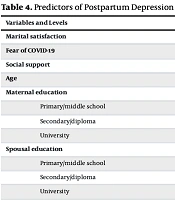
In the primary regression analysis (Table 3), several factors emerged as significant predictors. Marital satisfaction (β = -0.06, P < 0.05) and social support (β = -0.07, P < 0.05) both showed significant inverse associations with PPD. In addition, mothers with low financial satisfaction had lower PPD scores (β = -2.01, P < 0.05) than those with no financial satisfaction. Exclusive breastfeeding was also associated with lower depression scores than mixed feeding (β = -2.89, P < 0.05). Other variables did not show statistically significant effects (P > 0.05). In the final integrated model (Table 4), which demonstrated the highest predictive power, marital satisfaction (β = -0.06), social support (β = -0.08), and exclusive breastfeeding (β = -3.02) remained significant negative predictors. Conversely, fear of COVID-19 was a significant positive predictor of PPD (β = 0.14, P < 0.05). Finally, the effect of low financial satisfaction remained significant in the final model (β = -1.67, P < 0.05).
Table 3.
Predictors of Postpartum Depression Among the Studied Women Using Linear Regression Analysis (Univariate/Preliminary Model)
| Variables and Levels | β | 95% CI Lower | 95% CI Upper | P Value |
|---|---|---|---|---|
| Marital satisfaction | -0.06 | -0.1 | -0.02 | 0.004 |
| Self-efficacy | 0.02 | -0.1 | 0.13 | 0.779 |
| Social support | -0.07 | -0.13 | 0 | 0.047 |
| Fear of COVID-19 | 0.15 | -0.01 | 0.31 | 0.075 |
| Age | -0.014 | -0.028 | 0 | 0.054 |
| Maternal education | ||||
| Primary/middle school | 3.21 | -8.23 | 14.56 | 0.583 |
| Secondary/diploma | 4.64 | -6.99 | 16.28 | 0.436 |
| University | 6.46 | -5.27 | 18.2 | 0.282 |
| Spousal education | ||||
| Primary/middle school | 0.41 | -3.55 | 4.37 | 0.84 |
| Secondary/diploma | -1.18 | -5.32 | 2.93 | 0.574 |
| University | -2.51 | -6.96 | 1.93 | 0.27 |
| Marital status | ||||
| Divorced | 1.68 | -2.22 | 5.59 | 0.4 |
| Widowed | 8.19 | -0.95 | 17.33 | 0.081 |
| Maternal occupation | ||||
| Employed | 0.13 | -2.63 | 2.89 | 0.928 |
| Spousal occupation | ||||
| Worker | 0.83 | -2.33 | 3.99 | 0.607 |
| Employee | 3.75 | -5.4 | 12.91 | 0.423 |
| Retired | 1.56 | -0.86 | 3.98 | 0.209 |
| Insurance | ||||
| Covered (yes) | -1.04 | -2.58 | 0.5 | 0.189 |
| Family income | ||||
| 10 - 20 million Rials | -1.36 | -3.61 | 0.89 | 0.238 |
| 20 - 30 million Rials | -1.64 | -4.03 | 0.76 | 0.182 |
| Residence | ||||
| Rural | 0.78 | 2.39 | -0.84 | 0.349 |
| Urban | 0.18 | 3.09 | -2.74 | 0.905 |
| Financial satisfaction | ||||
| Low | -2.01 | -3.66 | 0.35 | 0.019 |
| Moderate | -0.87 | -2.91 | 1.16 | 0.402 |
| High | -2.08 | -5.94 | 1.77 | 0.291 |
| Infant gender | ||||
| Male | 0.01 | -1.25 | 1.26 | 0.993 |
| Gravidity | ||||
| 2 | -1.93 | -4.56 | 0.61 | 0.137 |
| 3 | -0.65 | -3.72 | 2.41 | 0.677 |
| 4 | -1.18 | -5.02 | 2.6 | 0.549 |
| 5 | -1.09 | -7.01 | 4.83 | 0.718 |
| 6 | 4.76 | -5.09 | 14.61 | 0.345 |
| Living children | ||||
| 1 | 8.01 | -1.12 | 17.14 | 0.088 |
| 2 | 9.21 | -0.3 | 18.73 | 0.06 |
| 3 | 9.06 | -0.51 | 18.62 | 0.065 |
| 4 | 11.87 | -0.18 | 23.56 | 0.048 |
| Delivery type | ||||
| Cesarean section | -0.02 | -1.48 | 1.44 | 0.982 |
| Spontaneous pregnancy | ||||
| Yes | -0.8 | -2.26 | 0.65 | 0.281 |
| Labor analgesia | ||||
| Yes | 0.77 | -0.66 | 2.19 | 0.293 |
| Planned pregnancy | ||||
| Yes | -0.05 | -1.73 | 1.63 | 0.952 |
| Infant feeding | ||||
| Formula | -1.4 | -3.86 | 1.05 | 0.265 |
| Exclusive breastfeeding | -2.89 | -5.14 | -0.64 | 0.013 |
| Infant sleep quality | ||||
| Adequate | -1.32 | -3.13 | 0.49 | 0.156 |
| Previous birth experience | ||||
| Yes | 0.05 | -1.93 | 2.02 | 0.963 |
| Hospital stay duration | ||||
| 2 days | -1.13 | -2.81 | 0.55 | 0.188 |
| 3 days | -1.63 | -3.97 | 0.71 | 0.175 |
| History of depression | ||||
| Yes | 2.01 | -1.31 | 5.33 | 0.237 |
| Antidepressant use | ||||
| Yes | 0.92 | -3.18 | 5.02 | 0.661 |
| Family history of depression | ||||
| Yes | -0.07 | -2.17 | 2.04 | 0.951 |
| Family emotional support | ||||
| Yes | 0.35 | -1.23 | 1.23 | 0.71 |
| Family COVID-19 history | ||||
| Yes | 0.81 | -0.61 | 2.23 | 0.263 |
| Maternal COVID-19 status | ||||
| Suspected | -0.53 | -2.24 | 1.17 | 0.541 |
| Infected (in treatment) | -2.44 | -7.18 | 2.29 | 0.313 |
| Infected (recovered) | 0.31 | -4.44 | 5.05 | 0.9 |
Table 4.
Predictors of Postpartum Depression Among the Studied Women: Multivariate Regression Analysis (Final Integrated Model)
| Variables and Levels | β | 95% CI (Lower, Upper) | P Value |
|---|---|---|---|
| Marital satisfaction | -0.06 | (-0.09, -0.02) | 0.001 |
| Fear of COVID-19 | 0.14 | (0.00, 0.28) | 0.048 |
| Social support | -0.08 | (-0.13, -0.02) | 0.005 |
| Age | -0.10 | (-0.22, 0.02) | 0.107 |
| Maternal education | |||
| Primary/middle school | -3.46 | (-11.81, 4.88) | 0.417 |
| Secondary/diploma | -2.54 | (-10.90, 5.86) | 0.554 |
| University | -0.85 | (-9.38, 7.68) | 0.846 |
| Spousal education | |||
| Primary/middle school | 0.69 | (-2.47, 3.85) | 0.670 |
| Secondary/diploma | -0.63 | (-3.91, 2.64) | 0.704 |
| University | -2.02 | (-5.61, 1.57) | 0.272 |
| Financial satisfaction | |||
| Low | -1.67 | (-3.05, -0.30) | 0.018 |
| Moderate | -0.34 | (-2.07, 1.40) | 0.706 |
| High | -0.26 | (-3.57, 3.05) | 0.878 |
| Marital status | |||
| Divorced | 2.40 | (-0.91, 5.71) | 0.157 |
| Widowed | 6.25 | (-1.63, 14.13) | 0.122 |
| Infant feeding | |||
| Formula | -1.01 | (-2.94, 0.92) | 0.308 |
| Exclusive breastfeeding | -3.02 | (-4.95, -1.10) | 0.002 |
| Antidepressant use | |||
| Yes | 3.53 | (0.78, 6.28) | 0.013 |
5. Discussion
The present study demonstrated that social support and marital satisfaction were inversely related to PPD, whereas fear of COVID-19 was positively associated with the disorder. The results showed a mean PPD score of 16.56 ± 5.66. This finding is consistent with previous studies that used similar assessment tools and reported comparable mean scores for postpartum depression. For instance, Salehi, in a study investigating the prevalence of PPD among primiparous and multiparous mothers, reported no significant difference in prevalence between the 2 groups (14.29% and 14.89%, respectively). These findings suggest that parity does not significantly increase PPD rates. Specifically, among multiparous women, 8.5% experienced severe depression and 6.39% had mild depression, whereas all cases in the primiparous group were classified as mild depression.
In a study conducted in Australia by Clout and Brown (14), titled "Social, Pregnancy, and Obstetric Predictors of Stress, Anxiety, and Depression in Primiparous Mothers," the prevalence of PPD was reported as 19.3%. Their findings indicated a significant positive correlation between cesarean section and PPD, anxiety, and stress. They also observed that infant sleep problems were positively associated with PPD, whereas infant health problems were associated with maternal anxiety. Maternal sleep disturbances also showed a significant positive relationship with PPD. Overall, women who underwent cesarean section experienced higher levels of stress, anxiety, and depression than those who had vaginal deliveries.
Similarly, Ghafarzadeh investigated the relationship between PPD and mental health levels in primiparous women and reported a PPD prevalence of 21.6%. The study highlighted that PPD is significantly associated with women's health literacy, suggesting that enhancing health literacy can substantially contribute to reducing the incidence of PPD. Moreover, Hahn-Holbrook et al. (15), in their study titled "Economic and Health Predictors of Postpartum Depression," found an overall PPD rate of 17.7%. They further noted that in communities characterized by health inequities, the prevalence of PPD and associated maternal and neonatal complications is significantly higher.
An et al. (16), in their study titled "Postpartum Depression and Healthcare Needs Among Chinese Women During the COVID-19 Pandemic," reported a high prevalence rate of 56.9%. They identified significant positive correlations between PPD and factors such as age, history of miscarriage, and perceived stress. The authors emphasized the need for timely psychological counseling, mental health screening, interventions, and COVID-19-related health education for postpartum women. Furthermore, Keykhalah (17) investigated the prevalence of PPD during the COVID-19 pandemic and reported a rate of 12%, describing it as relatively high. Given the psychological consequences of the pandemic and the vulnerability of pregnancy and the postpartum period to mental disorders, particularly depression, providing physical and psychological support and interventions appears essential.
The COVID-19 outbreak appears to exacerbate psychological problems, such as depression and anxiety, among high-risk populations, including pregnant and postpartum women. The findings of these studies are consistent with the results of the present investigation. Because failure to accurately diagnose PPD can adversely affect the mother-infant bond and family dynamics, the findings of this research support the implementation of supportive and educational programs during and after pregnancy for both mothers and their relatives to prevent the onset of this disorder.
The results of the present study indicated a total social support score of 47.05 ± 17.18, which showed a significant inverse correlation with PPD. This finding is consistent with previous research using similar instruments. Other studies have also emphasized that social support during pregnancy and the postpartum period plays an important role in reducing PPD levels (18). Furthermore, the results of a study by Sword et al. (19) showed that poor social support, combined with a lack of breastfeeding knowledge, is significantly associated with PPD. Findings by Kozinszky et al. (20) further suggest that identifying at-risk mothers and providing psychosocial support are effective in mitigating the severity of PPD. In a study titled "Factors Contributing to Postpartum Depression," Hutchens (21) identified high life stress, lack of social support, current or past abuse, prenatal depression, and marital dissatisfaction as the most common contributing factors. Because untreated PPD represents the greatest risk factor for both mothers and their children, healthcare providers must anticipate the needs of affected women to improve mother-infant relationships.
The results of the present study showed a mean marital satisfaction score of 134.54 ± 24.15, indicating a significant inverse relationship between marital satisfaction and PPD. This finding aligns with a study conducted in Bandar Abbas that used a similar instrument and reported a significant correlation between marital satisfaction and PPD across all subscales of the marital relationship measure (22). Furthermore, Akhbary et al. (23) concluded that there is a significant positive correlation between domestic violence and PPD.
In the current study, the mean fear of COVID-19 score was 25.59 ± 6.06, which showed a significant positive correlation with PPD. This finding is consistent with recent literature examining the psychological impact of the pandemic. For instance, Ghasedi et al. (24) reported that fear of COVID-19 infection has a significant positive impact on obsessive-compulsive disorder symptoms. Furthermore, they found that fear of COVID-19 plays a significant predictive role in depression and anxiety. The positive predictive role of COVID-19 fear in anxiety and depression has also been highlighted in previous studies, which identified this unusual fear as a primary contributing factor to depressive and anxious symptoms (25-27).
During the COVID-19 outbreak, negative emotions, including anxiety, depression, and anger, increased significantly. Furthermore, as emphasized by Gong et al. (28), under crisis conditions such as the COVID-19 pandemic, the effects of the disease not only lead to immediate mental health challenges but also have a long-lasting impact on the population's negative emotional state. There are numerous reasons why outbreaks of infectious diseases, followed by lockdowns, result in devastating psychological effects. Lai et al. (29), in a study involving healthcare workers, reported that most participants had symptoms of depression, anxiety, insomnia, and distress. Their findings suggested that a substantial proportion of individuals experience clinically significant fear and anxiety during infectious disease outbreaks.
Consequently, negative emotional reactions stemming from COVID-19 increase the risk of depression, anxiety, and obsessive-compulsive symptoms in adults. Moreover, understanding the role of these emotional responses in the association between COVID-19 and obsessive symptoms could pave the way for effective interventions. This pandemic has not only raised concerns regarding public physical health but has also profoundly affected the mental well-being of society. The findings of the aforementioned studies align with the present research, confirming that increased fear of COVID-19 directly contributes to increased PPD.
One of the key strengths of the present study is the simultaneous investigation of social support, marital satisfaction, self-efficacy, and fear of COVID-19 during the critical period of the pandemic. Using an adequate sample size and robust statistical methods, this research analyzed several concurrent predictors of PPD. However, certain limitations should be acknowledged, including the cross-sectional design and reliance on self-report questionnaires, which may affect the depth of the findings. Despite these limitations, the results provide a valuable foundation for future research to design and evaluate interventions specifically tailored to reduce PPD.
Given that modern healthcare systems increasingly prioritize postpartum mental health, early identification of individuals susceptible to psychological disorders, especially during precarious global situations, is essential. Because the main predictors identified in this study, such as social support, marital satisfaction, self-efficacy, and fear of COVID-19, are modifiable factors, they can be targeted through psychological interventions and educational programs for healthcare personnel. In alignment with global health policies that seek to strengthen maternal support and prevent persistent PPD, these findings can be used to screen for and manage mental health throughout the prenatal and postpartum periods. Ultimately, focusing on these modifiable factors and improving mothers' emotional well-being will play an important role in preventing long-term psychological complications for both mothers and infants.
5.1. Conclusions
Based on the results of the present study, social support and marital satisfaction emerged as significant negative predictors, whereas fear of COVID-19 was identified as a significant positive predictor of PPD during the pandemic. These findings suggest that PPD levels can be reduced through targeted counseling aimed at enhancing support from spouses and immediate family members, improving marital dynamics, and reducing COVID-19-related fear and anxiety.