
1. Background
The concept of cloud services emerged as a solution to outsource data processing infrastructure and store customer data and applications via remote servers (1, 2). Cloud computing, a novel technology, offers a range of IT services, including data center services, without the need for physical data centers. Its popularity spans globally, including within the education sector, where it holds potential for various benefits. However, challenges exist in its adoption in higher education, such as readiness, awareness, deployment capabilities, and cost. Identifying critical success factors for cloud computing adoption in higher education is essential to address these challenges (3-7).
1.1. The Relationship between Cloud Computing and University Development
Cloud computing facilitates the provision of shared resources, software, and information to computers and devices on-demand over the internet. Its increasing popularity in educational institutions stems from its ability to reduce information technology costs and provide an effective solution for educational technology benefits. By offering easy and cost-effective access to resources for teaching and learning, cloud computing enhances collaboration efficiency between students and teachers. This adoption may enable universities to focus more on their primary goals related to teaching and learning while minimizing expenditure. Moreover, cloud computing in education reduces IT and data management costs, enhances accessibility to course materials, and enables flexible learning opportunities from anywhere (8-16).
While cloud computing is widely embraced in educational institutions, strategic guidelines must be followed to address concerns regarding security, privacy preservation, and cloud server reliability. Challenges in the adoption of cloud computing in higher education include data insecurity, unsolicited advertisement, lock-in, reluctance to eliminate traditional IT infrastructure, and lack of trust in cloud computing providers. Addressing these challenges is crucial to ensure the successful integration of cloud technology in higher education settings (10, 17-21).
Another study emphasizes the significance of comprehending these factors to formulate strategies that foster the adoption of cloud computing in higher education institutions (22). The article underscores the necessity of understanding these factors to develop strategies that encourage the adoption of cloud computing in higher education institutions (23).
1.2. Factors Influencing Cloud Computing Adoption in Higher Education Institutions
Some specialized companies have introduced specific cloud computing models to assist institutions in managing their IT costs, such as Google and Microsoft (8, 22) (Table 1).
Table 1.
Cloud Computing Acceptance
| Variable | Technology | Organizational | Environmental |
|---|---|---|---|
| Cloud computing acceptance | Cost reduction | Top management | Cloud service provider |
| Relative advantages | Infrastructure readiness | Governance | |
| Reputation | IT knowledge and skillset | Policies and regulations | |
| Ease of use | Cost-benefit analysis | SLA (service level agreement) | |
| Compatibility | Financial considerations | Legal and compliance | |
| Operational requirements | Geographic location | ||
| Cloud deployment model | Data privacy | ||
| System nature | |||
| Stability | |||
| 1.10 Testability | |||
| 1.11 Security |
2. Objectives
Due to the importance and necessity of cloud computing in medical universities, the aim of this study is to identify and rank the critical success factors for cloud computing deployment at Mazandaran University of Medical Sciences.
3. Methods
3.1. Study Design and Sampling
The current research was conducted using a mixed approach (qualitative and quantitative) with an exploratory design. In the qualitative part, the three-step Delphi method was employed, and in the quantitative part, the descriptive method (survey type) was utilized. The statistical population of the study comprised the faculty members of Mazandaran University of Medical Sciences in 1402 (N: 975).
An inclusion criterion was set for faculty members who held a PhD degree, possessed more than 10 years of teaching experience, and held the academic rank of associate professor or higher. Participants' unwillingness was considered as an exclusion criterion. In the qualitative phase, purposive sampling was employed for semi-structured interviews. The interviews continued until data saturation was reached (n: 27). For the Delphi panel, 17 individuals were identified based on the inclusion and exclusion criteria.
The study samples in the quantitative section were also selected based on Cochran's formula at a 95% confidence level and a 5% measurement error, resulting in the selection of 276 individuals using the stratified random sampling method.
3.2. Data Collection
In the qualitative part of the study, components and items were identified through the study of the theoretical foundations and background of the research, followed by their classification and tabulation. Subsequently, through semi-structured interviews with experts and obtaining the necessary agreement using the Delphi method, the final components and items for the development of higher education and the establishment of cloud computing were identified and determined.
In the quantitative part, based on the criteria extracted from the qualitative stage, the researcher's questionnaire, developed by the University of Cloud Computing and Higher Education Development, was designed and utilized to collect the required data.
3.3. Data Tools
The researcher's questionnaire, created for cloud computing, comprises 50 questions organized into 5 main components. Questions 1 - 6 pertain to planning, questions 7 - 23 relate to model selection, questions 24 - 35 concern the selection of service vendors, questions 36 - 43 are associated with the service level agreement, and questions 44 - 50 are related to the fourth factor, optimization. The questionnaire utilizes a 5-point Likert scale (ranging from "very low" to "very high"), graded from 1 to 5, respectively.
(A) To confirm face validity, questionnaires were distributed to technical experts and professors to obtain their opinions (n: 10).
(B) Content Validity: To ensure the content validity of the instrument, the following steps were taken: After identifying the dimensions of the variables through a literature review and expert interviews (n: 10), a preliminary questionnaire was prepared and provided to the experts. Based on their corrective feedback, corrections and adjustments were made. Subsequently, secondary edits were made to the tools in collaboration with supervisors, mentors, and expert advice. Necessary modifications were made based on their input. In the final stage, under the supervision of supervisors and advisors, final edits were made to each instrument, thus establishing its content validity (Figure 1).
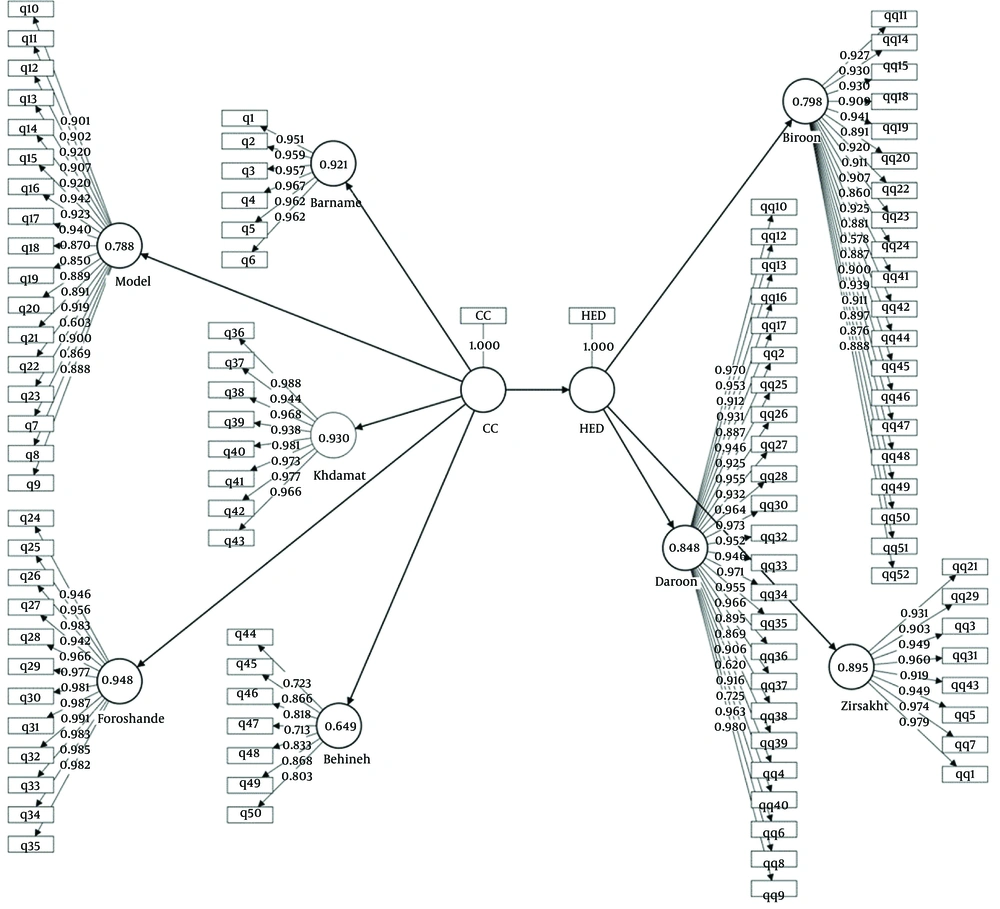
Figure 1.
Validity of the components and variables used in the research AVE.
The researcher's questionnaire created for cloud computing comprises 50 questions organized into 5 main components. Questions 1 - 6 pertain to planning, questions 7 - 23 relate to model selection, questions 24 - 35 concern the selection of service vendors, questions 36 - 43 are associated with the service level agreement, and questions 44 - 50 relate to the fourth factor, optimization. The questionnaire utilizes a 5-point Likert scale (ranging from "very low" to "very high"), graded from 1 to 5, respectively.
- The average extracted variance coefficients (AVE) for all variables should be above 0.5. The formula for the extracted average variance is as follows:
Where ʎ represents the factor loading and n is the number of questions.
- The composite reliability (CR) should be greater than the average variance extracted for all variables. In this regard, CR should exceed 0.7, and AVE should be higher than 0.5.
Convergent validity can be easily calculated using factor loadings.
4. Results
First, we conducted exploratory factor analysis to determine if the designed structure effectively measures the intended objective. Exploratory factor analysis aims to identify the main dimensions of the designed structure (discriminant validity) to measure the desired variable, which in this study are the dimensions of cloud computing deployment.
To evaluate the suitability of the available data (sample size and the relationship between variables) for factor analysis, we utilized the Kaiser-Meyer-Olkin measure of sampling adequacy and Bartlett's test of sphericity. The Kaiser-Meyer-Olkin measure assesses the partial correlations between variables, ranging from zero to one. A value close to one indicates that the data (sample size) are suitable for factor analysis. Conversely, a value below 0.5 generally suggests that the results of factor analysis may not be appropriate for the given data. If the value falls between 0.5 and 0.69, the data are considered average, and caution should be exercised when extracting factors. Values exceeding 0.7 indicate the suitability of the sample size (Table 2).
Table 2.
KMO Measure and Bartlett's Test of Sphericity Results for the Questionnaire on Cloud Computing Deployment
| Statistics | Amount |
|---|---|
| KMO | 0.623 |
| Bartlett's test | 36842.596 |
| DF | 1225 |
| Sig. | 0.00001 |
Table 2 demonstrates that the KMO value (sampling adequacy) is 0.623, and the significance level of Bartlett's sphericity test is 0.0000. Therefore, besides the sampling adequacy, conducting factor analysis based on the correlation matrix of the study is also justified. The scree diagram (Figure 2) illustrates the total variance explained by each variable concerning other variables. Typically, the significant factors are shown at the top, and other factors are displayed side by side with a gradual slope. Such designs, which are similar to the slope of a mountain, are called scree designs. The primary statistical characteristics obtained in the implementation of principal components analysis are presented in Table 3.
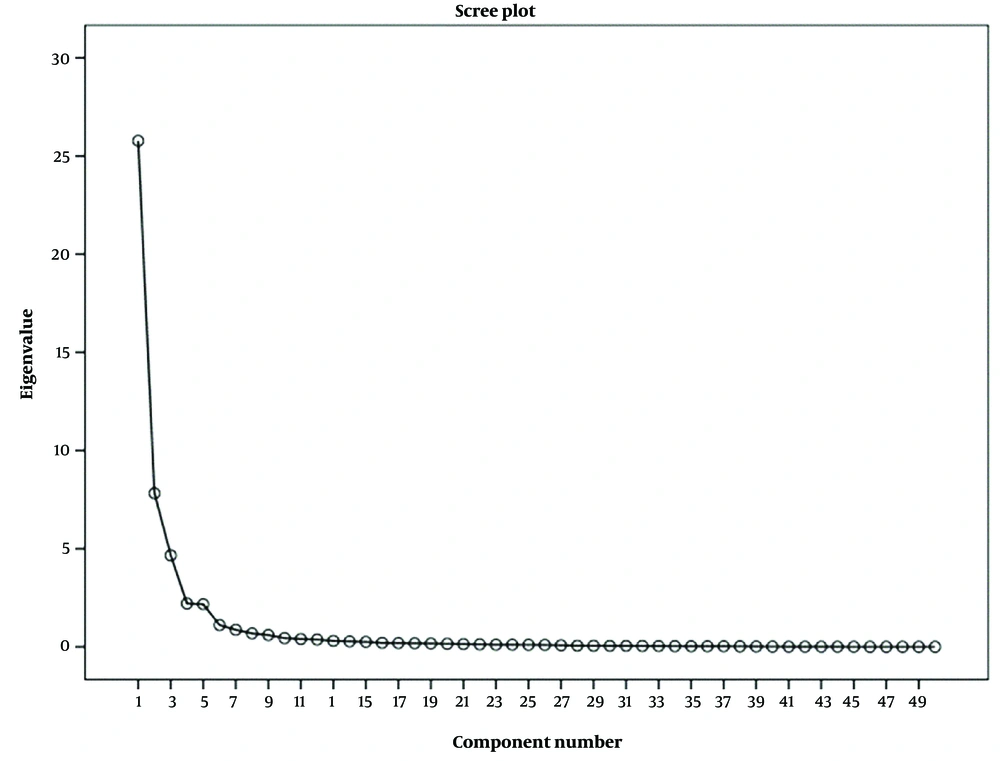
Figure 2.
Scree plot of the five factors of cloud computing deployment.
Table 3.
Extracted Factors Related to the Deployment of Cloud Computing and the Percentage of Variance Explained by These Factors
| Components | Initial Special Values | The Extracted Square Product of Factor Loadings | The Rotated Square Product of Factor Loadings | ||||||
|---|---|---|---|---|---|---|---|---|---|
| Total | Percent of Variance | Cumulative Percent | Total | Percent of Variance | Cumulative Percent | Total | Percent of Variance | Cumulative Percent | |
| 1 | 25.773 | 51.545 | 51.545 | 25.773 | 51.545 | 51.545 | 13.131 | 26.262 | 26.262 |
| 2 | 7.817 | 15.634 | 67.180 | 7.817 | 15.634 | 67.180 | 11.996 | 23.992 | 50.255 |
| 3 | 4.655 | 9.310 | 76.489 | 4.655 | 9.310 | 76.489 | 7.124 | 14.249 | 64.504 |
| 4 | 2.203 | 4.406 | 80.895 | 2.203 | 4.406 | 80.895 | 5.416 | 10.832 | 75.336 |
| 5 | 2.168 | 4.336 | 85.231 | 2.168 | 4.336 | 85.231 | 4.775 | 9.550 | 84.886 |
| 6 | .108 | 2.215 | 87.446 | 1.108 | 2.215 | 87.446 | 1.280 | 2.561 | 87.446 |
In Table 3, it can be observed that the eigenvalues of the five major factors were greater than those of the other factors. Among them, the eigenvalue of the first factor was 25.773, the eigenvalue of the second factor was 7.817, the eigenvalue of the third factor was 4.655, the eigenvalue of the fourth factor was 2.203, and the eigenvalue of the fifth factor was 2.168. However, the sixth factor had a very large distance from the other factors. The eigenvalues of the other factors were less than 1, which means they were not considered as factors. These five factors justify approximately 84% of the total variance among the primary factors. The Scree plot was used to determine the number of factors that needed to be extracted for the final solution (Figure 2).
The study utilized the Varimax method to rotate the matrix of factors in the higher education development questionnaire. Results indicate that cloud computing metrics can be categorized into five factors: Planning, model selection, supplier service level selection, service level agreement, and optimization. Planning encompasses questions 1 through 6, while model selection encompasses questions 7 through 23. Supplier service level selection includes questions 24 through 35, and service level agreement includes questions 36 through 43. Finally, optimization encompasses questions 44 through 50.
The Friedman test, a statistical method, was employed to determine the ranking of factors and aspects of cloud computing implementations. This test compares average developments in various scenarios and ranks or prioritizes dimensions and components. The highest mean value in Table 4 corresponds to the "service level agreement" dimension, while the lowest value is associated with the "model selection" dimension. To establish the ranking of components in the Cloud Computing Deployment Questionnaire, data beyond the raw data is required for comparison. Hence, the Friedman test was conducted to evaluate the ranking of cloud computing implementation aspects (Table 4).
Table 4.
Friedman's Test Regarding the Ranking of Factors of Different Components of Cloud Computing Deployment
| Components of Cloud Computing Deployment Questionnaire | The Average of the Ranks |
|---|---|
| Planning | 3.25 |
| Model selection | 2.69 |
| Choosing a service vendor | 3.08 |
| Service level agreement | 3.26 |
| Optimization | 2.73 |
Comparison of the average ratings reveals that the most critical aspect is the service level agreement, with an average score of 3.26, ranking first. Planning follows closely with an average score of 3.25, ranking second, while selecting a service vendor ranks third with an average score of 3.08. Optimization holds the fourth position with an average score of 2.73, and choosing a model ranks fifth with an average score of 2.69.
The quadratic value obtained from the Friedman test in Table 4 is 45.22, which is significant at a level less than 0.05. The significance of the Friedman test indicates that the ratings of dimensions in the cloud computing implementation questionnaire hold meaning and are distinct from the opinions of the study participants (Table 5).
Table 5.
Friedman's Test Regarding the Ranking of Different Factors and Components of Cloud Computing Deployment
| Friedman's Statistical Values | Values |
|---|---|
| Number | 276 |
| Chi-square | 45.227 |
| Standard deviation | 4 |
| The significance level | 0.000 |
4.1. Inferential Findings
The dimensions of cloud computing deployment at Mazandaran University of Medical Sciences were identified through exploratory factor analysis. The KMO value was 0.623, and the significance level of Bartlett's Test of Sphericity was 0.000. Five factors had eigenvalues greater than the rest, defining the indicators related to cloud computing as planning, model selection, selection of service vendors, service level agreement, and optimization. The questions corresponding to each factor were delineated, and the outcomes were presented in the study.
The study aimed to ascertain the ranking of dimensions for cloud computing deployment at Mazandaran University of Medical Sciences. Exploratory factor analysis identified indicators linked to cloud computing, revealing five factors: Planning, model selection, selection of service vendors, service level agreement, and optimization. Subsequently, the Friedman test was employed to rank these factors, demonstrating that the service level agreement held the highest significance, followed by planning, choice of service vendor, optimization, and model selection.
5. Discussion
This study adopts an innovative approach to advancing higher education by exploring the Identification and Ranking of Critical Success Factors for Cloud Computing Deployment at Mazandaran University of Medical Sciences.
The outcomes of the initial inquiry indicate that the dimensions of cloud computing deployment at Mazandaran University of Medical Sciences encompass planning, model selection, service vendor selection, service level agreement, and optimization. These findings are congruent with studies by Firoozi et al. (24), Firouzi et al. (7), Kazem Pourian et al. (8), Ghallabi et al. (25), Kumar and Sharma (26), Shahzad et al. (27), El Mhouti et al. (28), Sabi et al. (29), Bhatiasevi and Naglis (30), Changchit (19), and Okai et al. (17).
Cloud computing is widely utilized across various sectors, including education, research, and healthcare services. By leveraging this technology, Mazandaran University of Medical Sciences can enhance the quality and efficiency of its services.
To establish cloud computing at Mazandaran University of Medical Sciences, the following steps can be outlined: Planning, model selection, choosing a service vendor, Service Level Agreement, and optimization.
According to the findings of the second inquiry, the dimensions of cloud computing deployment at Mazandaran University of Medical Sciences were ranked based on average ratings. The service level agreement is identified as the top priority, followed by planning and the selection of the service vendor. Optimization and model selection are considered less important. In summary, the service level agreement holds significant value, with planning and service vendor selection also being crucial, while optimization and model selection are less vital. These findings align with previous studies by Shahzad et al. (27), Changchit (19), and Okai et al. (17).
The ranking of dimensions for cloud computing deployment at Mazandaran University of Medical Sciences highlights the high importance of the service level agreement and planning, followed by service vendor selection and optimization. Model choice is deemed the least important. Therefore, particular attention should be directed towards the service level agreement and planning when implementing cloud computing at the university.
5.1. Conclusions
The study underscores the versatility of cloud computing, applicable across various sectors including education, research, and healthcare services. The identified dimensions of cloud computing deployment at Mazandaran University of Medical Sciences encompass planning, selection, model, service vendor selection, service level agreement, and optimization. Implementing cloud computing at the university could enhance the quality and efficiency of medical, research, and educational services.