


1. Background
Today, the increasing development and expansion of information and communication technology, along with mobile devices such as smartphones and tablets, have brought about significant changes in various sectors of people's lives, including trade, economy, business, health, social relations, and education (1, 2). E-learning, as a direct consequence of the integration of information technology and education, has rapidly expanded and emerged as a powerful tool for learning utilizing Internet technology (3). The paradigm of electronic learning encompasses the utilization of media and information technology in the realm of education, with a crucial principle being the restructuring of the education system and the creation of a new model for the teaching-learning process (4). Given that the quality of education is among the paramount concerns in e-learning, the coordination of human, financial, and material resources is imperative to prevent wastage (5).
In recent years, most universities, higher education institutions, and educational and industrial organizations have taken significant strides in designing and implementing electronic education systems. In Iran, too, higher education institutions and universities have been adopting this novel educational approach for many years, which not only saves time and educational costs but also enables distance learning and facilitates the evaluation system and access to resources (4). Digitization of education has made it feasible to reuse compiled educational materials, spurred by the rise in smartphone usage, improvement of the global Internet network, and the demand for flexibility in the educational process. This has rendered electronic learning indispensable in human society, eliminating temporal and spatial constraints and providing equitable education. Furthermore, given that traditional education systems are unable to meet the needs of the information society, it is imperative to internally reform education systems to align with the requirements of contemporary societies.
With the advancement of software and hardware facilities, along with increased emphasis on information technology-based activities in universities and educational institutions, the groundwork for the growth, nurturing, and fostering of talent should be laid. Therefore, to enhance and effectively utilize e-learning, it is crucial to identify needs, educational behaviors, learning pace, and educational programs according to the users' capabilities (5).
Given the significance of learning and discussions surrounding e-learning, various indicators, including infrastructural (hardware, software), human, economic, and cultural factors, play a crucial role in the establishment, advancement, and implementation of this educational method (6). Many researchers utilize valid models and frameworks available in the field to explore issues and challenges pertinent to the domain. In the realm of information technology acceptance, several models have been validated through scientific surveys and research. These include Davis's technology acceptance model, Roger's innovation diffusion theory, the theory of planned behavior, and the theory of acceptance of social-technical systems (7).
In a study conducted at Mazandaran University of Medical Sciences, Eskandari et al. concluded that there exists a significant correlation between the two primary and foundational factors of the technology acceptance model, namely, the subjective perception of usefulness and the subjective perception of ease of use, and the decision to utilize information technology, indicating a positive association (8). Similarly, Mahmoodi et al. carried out a study at Tabriz University of Medical Sciences. The findings revealed that variables such as perceived usefulness, perceived ease, and system usability significantly influenced students' attitudes toward mobile learning. However, factors like support, self-efficacy, and trust did not impact attitudes toward mobile learning. Furthermore, variables including trust, perceived ease, and support played a role in the decision to use mobile phones for learning, while system usage and perceived usefulness did not affect this decision (9).
Additionally, Ebrahimi et al. conducted a study at Zahedan University of Medical Sciences. The average scores of variables such as perceived usefulness, behavioral intention, importance of information security, intensity of information technology use, perceived ease of use, e-health knowledge, significance of standardization, and importance of familiarization processes exceeded 3, indicating above-average levels. Moreover, the model structures examined in this research demonstrated a positive impact on the utilization of electronic health services among physicians (10).
Based on the results of the search in information databases among the mentioned models, it is evident that the technology acceptance model and the innovation diffusion theory are more practical and stable. Researchers have employed these two models in various types of research across different fields (11). The technology acceptance model does not incorporate the subjective norm, as seen in the theory of reasoned action, as a determinant factor in the decision to use. The correlation between subjective norms and behavior, whether through their direct impact on behavior or indirectly through their influence on attitude, is complex. Therefore, due to the uncertain theoretical and psychometric status of subjective norms, this factor is excluded from the technology acceptance model. Attitude toward use is another crucial determinant of technology acceptance, which is jointly influenced by the subjective perception of usefulness and ease of use.
In the technology acceptance model, the decision to perform behavior is considered one of the determining factors of computer usage. This decision is determined by personal attitude toward system use, subjective perception of usefulness, and subjective perception of ease of use. Here, personal attitude directly influences the decision to use, while subjective perception of usefulness and ease of use indirectly impact the decision. The correlation between attitude toward behavior and the decision to behave, as presented in the technology acceptance model, indicates that individuals choose to engage in behaviors or actions that yield positive effects (12).
2. Objectives
The utilization of information technology in educational systems represents an active educational program and framework, defining modern education for effective integration in the third millennium. However, before its adoption, it is essential to identify the factors influencing its acceptance and use. In this study, the researchers aim to investigate the factors affecting the acceptance of e-learning among professors and students of macro-medical sciences universities in the third region, based on the Davis model in the year 2023.
3. Methods
This study employed a quantitative cross-sectional design. The population included professors and students from macro medical sciences universities in Macro Region 3. The study utilized the standard technology acceptance questionnaire, comprising 25 questions rated on a 5-point Likert scale. This questionnaire, originally developed by Davis, consists of four components: Perceived usefulness, perceived ease, attitude towards use, and willingness to use. Following expert consultation and pre-testing to confirm validity and reliability, the questionnaire was distributed both in-person and virtually. This tool has been translated into Persian in Iran and has demonstrated validity and reliability in previous studies (13, 14). In this study, validity was confirmed by four relevant experts, and reliability was determined by a Cronbach's alpha coefficient of 0.86. To assess the tool's stability in terms of repeatability, the inter-class correlation coefficient was calculated for all dimensions, yielding a value of 0.86 for the entire tool. Spearman's correlation coefficient was used to describe the linear correlation between the factors, revealing a strong positive correlation between the main factors. Agreement among participants was also assessed to evaluate the instrument's stability, with item scores as follows: Item 1 (0.81), item 2 (0.79), item 3 (0.81), and item 4 (0.80). Furthermore, the tool was evaluated using the CVI and CVR indices, with scores meeting acceptable thresholds (CVI > 0.79, CVR > 0.62, and α = 0.88) based on Lawshe’s table.
To enhance the internal and external validity of the research, several measures were implemented. These measures included random sample allocation, adherence to study protocols, meticulous management of variables, identification and elimination of confounding variables, prevention of the Rosenthal effect, and minimization of unwanted variables. The statistical population comprised 308 professors and 400 students from medical sciences universities in the third region (Kermanshah, Hamadan, Kurdistan, Ilam, and Asadabad), totaling 1582 faculty and 18284 students (Figure 1). Inclusion criteria encompassed faculty members and students with at least two academic semesters of experience in teaching and learning with the aid of information technology, including virtual education. Based on these criteria, 330 faculty members and 440 students were initially selected. After some withdrawals, the final studied population consisted of 308 faculty members and 400 students (Figure 1). Students from all five universities were selected proportionally to their student population; for instance, considering the larger population of medical students in Kermanshah, 128 students from this university were included in the sample (Table 1).
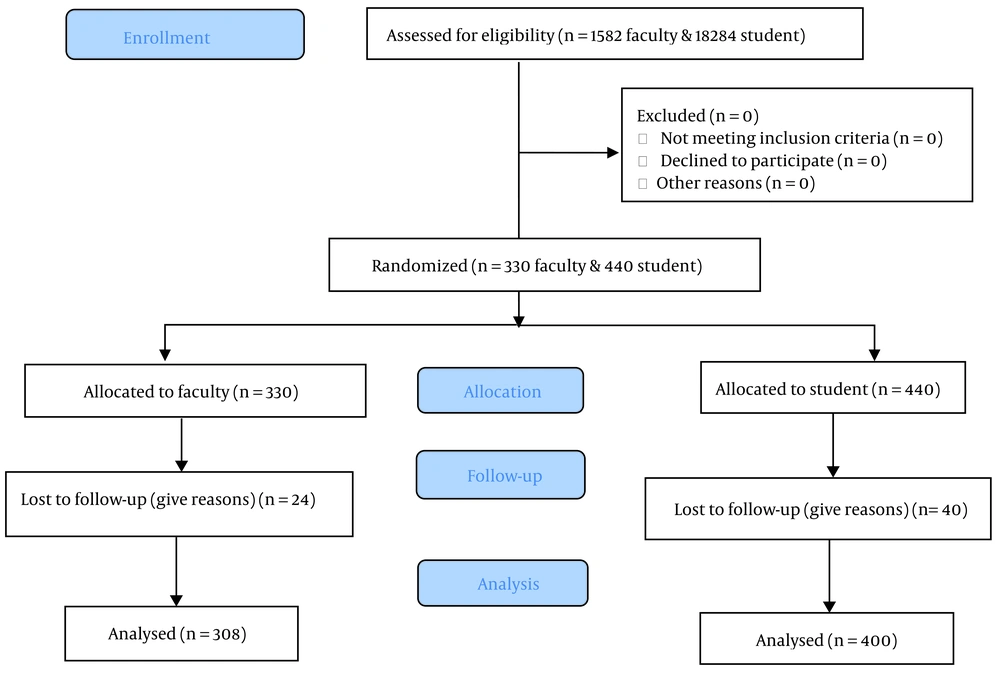
Figure 1.
The stages of research sampling
Table 1.Characteristics of Participants a
| Variables and Gender | Values | Age |
|---|---|---|
| Faculty | ||
| Female | 114 (0.37) | 44 ± 8.32 |
| Male | 194 (0.63) | 47 ± 9.20 |
| Student | ||
| Female | 219 (0.55) | 22 ± 4.82 |
| Male | 181 (0.45) | 23 ± 5.57 |
| University | ||
| Variables | Frequency | |
| Kermanshah | ||
| Faculty | 107 | |
| Student | 128 | |
| Hamedan | ||
| Faculty | 84 | |
| Student | 109 | |
| Kurdistan | ||
| Faculty | 75 | |
| Student | 93 | |
| Ilam | ||
| Faculty | 42 | |
| Student | 70 | |
a Values are expressed as No. (%) or mean ± SD unless otherwise indicated.
To minimize bias, the sample was randomly selected from the target population. To address non-response, participants received an email prior to survey distribution, explaining the survey's objectives and inviting their voluntary participation. Participants were assured of the confidentiality of their personal information and the aggregated nature of data analysis, maintaining anonymity. The questionnaire was designed to be user-friendly.
Data analysis employed descriptive statistics (prevalence, percentage, mean, and standard deviation) and inferential methods (correlation, analysis of variance, and related tests) using SPSS version 19 and LISREL software for structural equations.
4. Results
Table 1 presents the Characteristics of Participants, indicating that 37% of the faculty sample were female and 63% were male, while 55% of students were female and 45% were male. Table 1 also illustrates the composition of selected samples by university.
Table 2 displays the mean and standard deviation of the investigated variables from the sample's perspective.
Table 2.Mean and Standard Deviation of the Variables
| Variables | Student | Faculty |
|---|---|---|
| Mental perception of usefulness | 3.36 ± 2.62 | 3.29 ± 1.91 |
| Mental perception of ease of use | 3.88 ± 2.07 | 3.69 ± 2.48 |
| Attitude towards use | 4.19 ± 2.24 | 4.07 ± 1.90 |
| Decide to use | 3.81 ± 2.59 | 3.38 ± 1.16 |
| Use | 3.92 ± 2.17 | 3.71 ± 1.19 |
Table 3 shows the correlation matrix analysis results between research variables, revealing positive and significant correlations, indicating a direct and significant relationship between all research variables.
Table 3.Correlation Matrix and Discriminant Validity
| Variables | Mental Perception of Usefulness | Mental Perception of Ease of Use | Attitude Towards Use | Decide to Use | Use |
|---|---|---|---|---|---|
| Mental perception of usefulness | 1 | ||||
| Mental perception of ease of use | 0.502 (P < 0.001) | 1 | |||
| Attitude towards use | 0.496 (P < 0.001) | 0.570 (P < 0.001) | 1 | ||
| Decide to use | 0.515 (P < 0.001) | 0.536 (P < 0.001) | 0.598 (P < 0.001) | 1 | |
| Use | 0.532 (P < 0.001) | 0.529 (P < 0.001) | 0.603 (P < 0.001) | 0.614 (P < 0.001) | 1 |
Regarding the impact of the subjective perception of technology's ease of use on its perceived usefulness, the standardized regression coefficient (path coefficient) was 0.34. The coefficient's t-value of 6.11 was significant. Table 4 further demonstrates the significance of all variables. The ease of use variable had a coefficient of 0.41 and a T-score of 7.16, while the usefulness variable had a coefficient of 0.46 and a T-score of 6.31. Similarly, the attitude towards use had a coefficient of 0.49 with a T-score of 5.92, and the decision to use had a coefficient of 0.47 with a T-score of 5.65. Finally, the decision to use on actual use had a coefficient of 0.49 with a T-score of 6.42. All these variables were found to be significant (Table 4).
Table 4.Path Coefficients and t-Values of the Hypothesis
| Predictor | Criterion | Index | Coefficients | ||||
|---|---|---|---|---|---|---|---|
| b | T | R2 | T | β | Result | ||
| Ease of use | Attitude towards use | 0.51 | 7.75 | 0.31 | 6.11 | 0.34 | Confirm |
| Be useful | Decide to use | 0.62 | 6.39 | 0.40 | 7.16 | 0.41 | Confirm |
| Be useful | Attitude towards use | 0.59 | 5.24 | 0.35 | 6.31 | 0.46 | Confirm |
| Be useful | use | 0.48 | 5.08 | 0.42 | 6.05 | 0.50 | Confirm |
| Attitude to use | Decide to use | 0.63 | 6.19 | 0.44 | 5.92 | 0.49 | Confirm |
| Decide to use | Use | 0.61 | 5.38 | 0.48 | 5.65 | 0.47 | Confirm |
| Ease of use | Be useful | 0.60 | 6.35 | 0.52 | 6.42 | 0.49 | Confirm |
| Ease of use | Decide to use | 0.56 | 5.72 | 0.39 | 4.11 | 0.52 | Confirm |
Figure 2 illustrates that the model indicators have positive and significant effects on technology adoption.
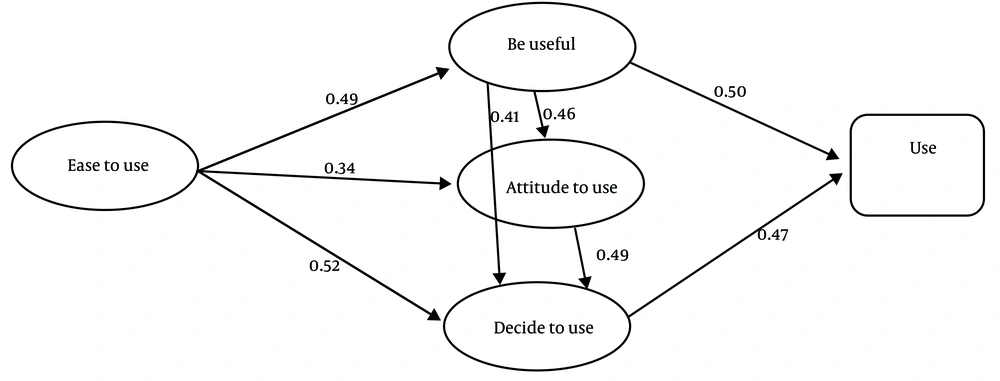
Figure 2.
Structural equation modeling
To confirm the homogeneity of the scale items, a four-factor confirmatory factor analysis was conducted on the dimensions, and the results of their fit are presented in Table 5.
Table 5.Model-Fit Indices
| Finding | Standard Index | Index Value in the Desired Model | Index Name |
|---|---|---|---|
| The fit of the tool is appropriate | Between 2 and 3 | 2.27 | Chi-square |
| The fit of the tool is appropriate | 0.01 > | 0.024 | RMSE |
| The fit of the tool is appropriate | 0.90 < | 0.96 | NFI |
| The fit of the tool is appropriate | 0.90 < | 0.94 | NNFI |
| The fit of the tool is appropriate | 0.90 < | 0.93 | CFI |
| The fit of the tool is appropriate | 0.90 < | 0.94 | RFI |
| The fit of the tool is appropriate | 0.90 < | 0.93 | IF |
| The fit of the tool is appropriate | 0.90 < | 0.95 | GFI |
5. Discussion
The results of this study demonstrate that the structural model of electronic learning technology acceptance among students of the University of Medical Sciences in the 3rd region is suitable and applicable in the academic community. Khorasani et al. conducted a study titled "Factors Affecting the Acceptance of Electronic Learning among Students of Tehran University of Medical Sciences" based on the Technology Acceptance Model. Their findings indicated that variables such as the subjective perception of ease of use, perceived usefulness, attitude towards use, and decision to use e-learning significantly influenced its acceptance and these factors have positive effects on the acceptance and use of e-learning at the level of 0.01 among students (15). These results align with our findings; however, our study included both faculty and students, conducted across a broader geographical area encompassing 5 universities with diverse conditions.
Ahmady et al. explored "Effective Factors in the Acceptance and Use of E-learning Systems among Students of Iran University of Science and Technology." They found a strong correlation between satisfaction and the desire to continue using e-learning systems, suggesting that satisfaction plays a pivotal role in users' willingness to continue utilizing electronic learning platforms (11).
Behari and Modi investigated "Factors Affecting the Creation and Development of Electronic Learning from the Perspective of Students at Zahedan University of Medical Sciences." Their study revealed six significant factors influencing the creation and development of electronic learning at Zahedan University of Medical Sciences, with the quality of information and content (4.25) being the most impactful factor, followed by students' willingness (4.11), system quality (4.10), facilitating factors (4.05), student-teacher interaction (3.98), and teacher quality (3.84) (12).
Hadavand and Kashanchi conducted a study titled "Effective Factors on E-learning," where they concluded that belief in continuous education was the most crucial variable affecting e-learning from employees' perspectives, while the provision of educational certification was the least significant (16). Management's support for electronic education and the ease of course utilization had the highest factor load (0.967), whereas attention to organizational and employee characteristics in course development had the lowest factor load (0.504). These four main factors explained a total of 69.92% of the total variance (15).
Mazloom et al. conducted a study titled “Identifying and Ranking Factors Affecting the Use of E-learning in Shahid Sadoughi University of Medical Sciences, Yazd.” They concluded that 15 factors, including technical infrastructures, clear educational goals, educational incentives, innovative management, and supportive leadership, were effective in the application of e-learning. Additionally, they found that the model had nine levels of influence, ranging from the deepest and most impactful to the most superficial and least influential (13).
The results of our study align with the theories of Ajzen and Fishbein, Davis, Bagozzi and Warshaw, Dillon and Morris, Park, and Salim and colleagues regarding the correlation between research variables as factors influencing technology/e-learning acceptance and the model's structure and fit (13, 14, 16-18).
Considering the impact of the decision to use variable on actual use, it is recommended that managers and designers of electronic learning systems emphasize the importance and advantages of technology in education. This approach can empower students to make informed decisions and embrace various technologies. Furthermore, given the influence of attitude towards use on the decision to use, it is advisable for managers and designers to assess students' attitudes towards technology selection and implementation in educational settings. This approach ensures that technologies integrated into the system are conducive to increasing students' willingness to utilize them.
Considering the global changes and the advent of the information age, where knowledge creation holds the highest added value, we are confronted with a fundamental challenge that can only be addressed through electronic education. However, achieving effective electronic education necessitates a model that considers spatial, temporal, and individual constraints while enhancing access to university education, course materials, and content, and improving the quality and quantity of education. Presently, medical science universities underscore the importance of this issue by establishing virtual education departments and providing the necessary infrastructure and specialized personnel training. The findings of this study align with the research conducted by Zandi et al., Eslami et al., Choudhury and Pattnaik, Farhan et al., Zimmerman et al., and Ganjeali et al. (19-27).
5.1. Conclusions
The data analysis revealed that the structural model of electronic learning technology acceptance among students of Macro Region 3's University of Medical Sciences is suitable and applicable within the academic community. The ease of use variable regarding attitude towards use yielded a coefficient of 0.41 and a T-score of 7.16, while usefulness on the decision to use garnered a coefficient of 0.46 and a T-score of 6.31. Similarly, usefulness regarding attitude towards use displayed a coefficient of 0.49 and a T-score of 5.92, and the attitude towards use on the decision to use showed a coefficient of 0.47 and a T-score of 5.65. Finally, the decision to use on actual use exhibited a coefficient of 0.49 and a T-score of 6.42. All of these factors are significant. The present study demonstrates the practical outcomes of effective factors influencing electronic learning acceptance based on the technology acceptance model, achieved through identifying and emphasizing the factors in the infrastructure affecting electronic learning acceptance within the studied society, including individual factors such as the subjective perception of technology ease of use, usefulness, attitude towards technology use, decision to use, and actual technology utilization.
According to the aforementioned documents and the notification of the comprehensive program of justice, excellence, and productivity in medical sciences education sent to all universities, one of the key working groups of this program emphasizes the advancement of education and learning through the development of new technologies. Conducting preliminary studies to understand the current situation and elucidate the influencing factors in this direction can facilitate the implementation of related programs and take effective steps towards their success. Given the significance of e-learning and based on the findings of this study, the Davis model can be applied in other medical sciences universities.
5.2. Limitations
The primary limitation of the current study was the reliance on quantitative data, which could have provided researchers with more comprehensive insights. Incorporating a qualitative component into the study design could have enriched the findings.



