
1. Background
Adolescence is a crucial stage of development marked by significant physical, cognitive, and social changes. It's a period characterized by increasing independence from parents and exploration of identity. Teenagers actively form their sense of self, often by trying different roles and behaviors (1). During this time, adolescents are drawn to experimentation and risk-taking (2), which can include positive exploration, such as trying new activities or developing close friendships. However, it can also lead to high-risk behaviors like substance use, unsafe sexual practices, or delinquent acts (3). Understanding these high-risk behaviors is important because they can have negative consequences for adolescents and society as a whole (4). High-risk behaviors in adolescents encompass a wide range of actions, including substance use, delinquency, and risky sexual activity (4, 5). Some studies suggest that the prevalence of these behaviors may be increasing (6, 7).
Many factors may affect the emergence of high-risk behaviors in adolescents, including personal, familial, and social influences. Family is one of the major environmental factors that can shape a person’s life, making it crucial to understand how family functioning affects high-risk behaviors among adolescents (8). Family functioning plays a significant role in adolescent development, referring to the quality of a family's interactions and its ability to meet the emotional, social, and practical needs of its members. This includes clear and consistent communication, where open dialogue allows adolescents to express themselves freely and feel heard, while clear expectations foster understanding and cooperation. Effective conflict resolution is also crucial, as families that manage disagreements constructively teach adolescents healthy coping skills and emotional regulation (9). A supportive and nurturing environment is vital, as adolescents feeling loved, accepted, and supported by family members contributes to their self-esteem and well-being. Additionally, the establishment of appropriate roles and boundaries is important. Clear roles provide adolescents with a sense of responsibility and structure, while healthy boundaries foster independence within a safe environment. Finally, discipline and enforcement of rules are necessary, with consistent and fair discipline helping teenagers learn self-control and understand consequences (10).
Family functioning can be influenced by factors such as inconsistent rules, limited parental involvement, and unsupportive parent-child relationships, which significantly impact adolescent development (11). Abbasi et al. (12) indicated that the perception of a family’s mental-emotional atmosphere and parenting style had a significant relationship with the tendency toward high-risk behaviors. Anbari et al. (13) reported that family functioning plays a decisive role in high-risk behaviors exhibited by teenagers; moreover, the quality of life at school can mediate the relationship between family functioning and high-risk behaviors.
Cognitive failure is another factor related to high-risk behaviors (14). Cognitive failure refers to the propensity for normally functioning individuals to experience lapses due to interfering matters or distracting factors, leading to errors through inattention or reduced attention (15). Cognitive failure is a multidimensional construct that includes errors in forming goals, activating schemas, and setting up activities (16, 17). Compared with their peers, students with cognitive failure experience difficulties in learning and remembering concepts, performing calculations, employing efficient problem-solving strategies, dealing with memory complications, processing visual-spatial information, planning, monitoring, organizing, and maintaining attention in executive functions (18).
Students with a history of learning disabilities are more likely to engage in high-risk behaviors than their peers due to the stressors associated with their condition (19). In other words, students with learning disabilities are more prone to high-risk behaviors and report higher levels of emotional problems compared to their peers (20, 21). Given the importance of learning disorders and their impacts on personal, social, and academic aspects of individuals’ lives, this study aimed to examine the roles of family functioning and cognitive failure in predicting high-risk behaviors among students with a history of learning disabilities. No other study of the same title has been found in the literature.
2. Objectives
Therefore, based on the research background, the present study aimed to investigate the effects of family functioning and cognitive failure in predicting high-risk behaviors among students with a history of learning disabilities.
3. Methods
This research is a descriptive-correlational study. The statistical population included 411 high school students with a history of learning disabilities in Ahvaz, Khuzestan Province, Iran, in 2023. The inclusion criteria encompassed male and female senior high school students aged 16–18 years, whereas the exclusion criteria included incomplete information or noncooperation of students. District 3 was randomly selected from the four districts of Ahvaz. The researcher then visited the Education Department of District 3 to inquire about the number of girls' and boys' senior high schools and acquire the research permit. In this district, six schools (three girls' schools and three boys' schools) were randomly selected. After making the necessary arrangements with principals and teachers, four classes were randomly selected from each school.
Adherence to common rules of thumb suggests a minimum sample size of 10 participants per estimated parameter for robust model testing (22). However, for enhanced precision and generalizability, a sample size approaching 25 participants per parameter is often recommended. Students with a history of learning disabilities were recruited from school records (170 students). Questionnaires were administered to assess high-risk behavior, family functioning, and cognitive abilities. Incomplete questionnaires were excluded from the analysis. The reasons for exclusion were analyzed to identify potential biases and improve future data collection methods. A final sample of 158 participants completed the questionnaires.
This study adhered to ethical principles outlined in (IR.IAU.AHVAZ.REC.1402.007). Before participation, all students provided written informed consent, which outlined the purpose of the study, data collection procedures, potential risks and benefits, and participant rights. These rights included the right to withdraw from the study at any time without penalty and the assurance of confidentiality and anonymity. Data were stored securely, and only authorized researchers had access to the information.
3.1. Tools
3.1.1. High-risk Behavior Scale
This scale was developed and normalized by Zadeh Mohammadi et al. (23). The High-Risk Behavior Scale consists of 38 items scored on a five-point Likert scale ranging from “strongly disagree” (1) to “strongly agree” (5). This tool evaluates the tendency to exhibit high-risk behaviors in seven areas: Substance abuse, alcohol use, smoking, violence, sexual relations and behaviors, opposite-sex relations, and dangerous driving, as well as one general area of high-risk behavior. The High-Risk Behavior Scale yields a total score ranging from 38 to 190, with higher scores reflecting a greater propensity for engaging in high-risk behaviors (23). The Cronbach’s alpha for this scale was measured at 0.94, with its subscales ranging between 0.74 and 0.93. Moreover, its face validity was reported at 0.77. The reliability of the High-Risk Behavior Scale, as measured by Cronbach's alpha coefficient, was 0.94 (23).
3.1.2. Family Functioning Questionnaire
This 53-item questionnaire was designed to evaluate family functioning based on the McMaster approach. The Family Functioning Questionnaire includes seven subscales: Communication, emotional intimacy, role-playing, overall performance, problem-solving, emotional companionship, and behavioral control. Participants read each item and indicate the extent of the corresponding characteristics in their families on a four-point Likert scale: “Strongly agree” (4), “agree” (3), “disagree” (2), and “strongly disagree” (1). The total score is the sum of all scores, with minimum and maximum possible scores of 53 and 145, respectively (24). Yousefi (25) reported a total Cronbach's alpha coefficient for this questionnaire of 0.92.
3.1.3. Cognitive Failure Questionnaire
Designed by Broadbent et al. (26), the Cognitive Failure Questionnaire consists of 25 items scored on a five-point Likert scale ranging from “never” (0) to “always” (4). The instrument utilizes a scoring range from 0 to 100, with higher scores indicating greater degrees of cognitive failure (13). Scores were categorized as follows: Low cognitive failure (25-41), average cognitive failure (42-82), and high cognitive failure (above 82). This categorization scheme allows for a more nuanced interpretation of the data (26). Javandel Soumehsaraei et al. (27) reported a Cronbach’s alpha coefficient of 0.84 for the reliability of the Cognitive Failure Questionnaire.
3.2. Data Analysis
Descriptive statistics (e.g., mean and standard deviation) and inferential statistics (e.g., Pearson’s correlation coefficient and stepwise regression) were used for data analysis in SPSS v 27.0 to predict high-risk behaviors based on family functioning and cognitive failure.
4. Results
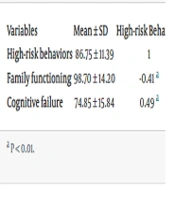
The study included a sample of 158 high school students with a history of learning disabilities. The average age of the participants was 17.45 ± 2.13 years. In terms of grade level, the sample distribution was as follows: 61 (38.61%) tenth-graders, 52 (31.91%) eleventh-graders, and 45 (28.48%) twelfth-graders. The sample also comprised 66 (41.77%) female and 92 (58.23%) male students. Table 1 reports the means, standard deviations, and correlation coefficients of the research variables.
The analysis revealed significant correlations between the studied variables. Family functioning was negatively correlated with high-risk behaviors (r = -0.41), indicating that stronger family functioning was associated with lower levels of high-risk behaviors. Conversely, cognitive failure displayed a positive correlation with high-risk behaviors (r = 0.49), suggesting that higher cognitive difficulties were linked to a greater likelihood of engaging in risky activities. While these correlations are statistically significant, the strength of the associations can be characterized as moderate.
Furthermore, stepwise regression analysis was employed to determine which variable had a more significant role in predicting high-risk behaviors. The results indicated that family functioning and cognitive failures were predictive variables, whereas high-risk behavior was the criterion variable. Table 2 reports the results.
According to Table 2, the correlation coefficient between cognitive failure and high-risk behaviors was 0.49, indicating that cognitive failure predicted 24.1% of the variance in high-risk behaviors. In the second model, family functioning was added to the equation after cognitive failure. The combined correlation coefficient between these two variables and high-risk behaviors was 0.54, predicting 29.4% of the variance in high-risk behaviors. The inclusion of family functioning increased the predictive power by 5.0%. Among the variables, cognitive failure, with a standard beta of 0.49, had the greatest role in predicting changes in high-risk behaviors. Additionally, both cognitive failure and family functioning, with a standard beta of -0.25, played an effective role in predicting high-risk behaviors.
5. Discussion
This study aimed to investigate the effects of family functioning and cognitive failure in predicting high-risk behaviors among students with a history of learning disabilities. The research results indicated that both family functioning and cognitive failure had significant relationships with high-risk behaviors among high school students, predicting 29.4% of the variance in these behaviors. According to the first finding, there was a significant negative relationship between family functioning and high-risk behaviors. This finding is consistent with the results reported by Asghari and Moshkani (28), and Iorio et al. (29). Most psychologists believe that early childhood experiences, usually formed within the family, develop a child's personality foundation and influence future behaviors (30). Family members, especially adolescents, pay attention to how others judge them and base their self-images on others' evaluations. In a healthy family with appropriate relations, family members consider themselves valuable due to the satisfaction of psychological needs, such as accepting others, being accepted by others, feeling valuable, and manifesting love and intimacy. Therefore, family members become positive and optimistic and generally have positive traits and mental health. The outcomes of such relationships between parents and children can profoundly affect children’s personalities, leading to positive or negative behaviors (31).
Family functioning refers to a family's capacity to adjust to life changes, manage conflicts, foster intimacy among members, effectively implement disciplinary measures, respect interpersonal boundaries, and enforce rules to safeguard the family system as a whole. Families operate at diverse levels and have a wide range of needs, from basic to complex. Consequently, issues in family functioning can lead adolescents to seek high-risk behaviors as a means of escaping excessive control and tension within their families, resulting in a lack of emotional and psychological support (28).
The positive correlation between cognitive failure and high-risk behaviors in this study aligns with prior research by Niranjan et al. (32). This association can be explained by several factors. Students with cognitive difficulties may experience limitations in metacognitive awareness, hindering their ability to identify their emotions and cognitive states. This can lead to difficulties in self-regulation and utilizing executive functions effectively. Consequently, they might experience procrastination and social challenges due to communication problems stemming from memory issues. These challenges can have a negative impact on overall well-being, potentially exacerbating depression and increasing the likelihood of engaging in risky behaviors (33). Furthermore, cognitive failure itself encompasses difficulties like distraction, memory problems, and unintentional errors (34).
These limitations can hinder effective problem-solving and decision-making, making individuals with cognitive failures more susceptible to engaging in high-risk behaviors. Niranjan et al. (32) further suggest that the uncertainty associated with cognitive failure can motivate risky behavior. Individuals experiencing such difficulties may struggle to maintain emotional equilibrium and feel a sense of worthlessness, potentially leading to loneliness, self-blame, depression, and impulsive behaviors (35). This highlights the complex interplay between cognitive abilities, beliefs, and interpretations of experiences. These factors can significantly influence a person's vulnerability to negative emotions like anxiety, anger, and aggression, which may, in turn, contribute to high-risk behaviors.
The first limitation of this study was the use of convenience sampling to select students with a history of learning disabilities. The names of students needed to be extracted from their elementary education files, and it was impossible to contact some of the students; therefore, convenience sampling was selected. Moreover, the statistical population was limited to male and female high school students with a history of learning disabilities in Ahvaz, Khuzestan Province, Iran. As a result, it is difficult to generalize the research results to students of other age groups with other disorders and from other cultures. Another limitation of this study was the use of self-reporting tools for data collection.
This study highlights the potential importance of family functioning and cognitive abilities in understanding high-risk behaviors among adolescents with learning disabilities. However, further research is needed to explore these relationships in more detail. Employing longitudinal designs would allow researchers to investigate the causal direction of the relationships between family functioning, cognitive abilities, and high-risk behaviors. This could help determine if family interventions or cognitive training programs can reduce high-risk behaviors in this population. Expanding the study sample beyond high school students with learning disabilities from a single region would enhance the generalizability of the findings. Future research could include adolescents of different ages, with various learning disabilities, and from diverse cultural backgrounds. Future studies could explore potential mediating variables that might explain the link between family functioning, cognitive abilities, and high-risk behaviors. For example, social support networks, self-esteem, or coping mechanisms might play a role in this association.
5.1. Conclusions
This study indicated that family functioning and cognitive failure affected high-risk behaviors among high school students. Improving family functioning decreased the high-risk behaviors of adolescents. Furthermore, increasing cognitive failure exacerbated the high-risk behaviors of students. This study contributes to our understanding of factors influencing high-risk behaviors in adolescents with learning disabilities. A key strength lies in its focus on the interplay between family functioning, cognitive abilities, and these risky behaviors. This comprehensive approach sheds light on potential protective and vulnerability factors that can be targeted in future interventions. Given the important role of family and its functions in the high-risk behaviors of adolescents, the results of this study can be employed to enhance knowledge among adolescents, students, families, and education officials. The results can also be used to further involve adolescents in education and inhibit them from considering high-risk behaviors. Moreover, practical plans and actions should be developed to improve parenting supervision methods and psychological factors of adolescents to prevent high-risk behaviors.
Table 1.
Mean, Standard Deviation, and Pearson Correlation Coefficient Between the Variables
| Variables | Mean ± SD | High-risk Behaviors |
|---|---|---|
| High-risk behaviors | 86.75 ± 11.39 | 1 |
| Family functioning | 98.70 ± 14.20 | -0.41 a |
| Cognitive failure | 74.85 ± 15.84 | 0.49 a |
a P < 0.01.
Table 2.
Results of Stepwise Regression Analysis
| Predictor Variables | F | R | R2 | B | SE | β | t | P |
|---|---|---|---|---|---|---|---|---|
| Cognitive failure | 98.64 | 0.49 | 0.24 | 0.38 | 0.04 | 0.49 | 9.93 | 0.001 |
| Cognitive failure and family functioning | 64.45 | 0.54 | 0.29 | 0.31 | 0.05 | -0.25 | -4.82 | 0.001 |