


1. Background
Intellectual disability (ID) is a neurodevelopmental disorder that manifests in childhood, characterized by impairments in cognitive abilities such as reasoning and problem-solving, which hinder independence and social responsibilities (1). Globally, the estimated prevalence of ID in children and adolescents ranges between 1.5% to 2.2%, with recent international epidemiological studies indicating variable rates influenced by differing diagnostic criteria and reporting methods (2, 3). A recent systematic review underscores the variation in prevalence estimates across regions, emphasizing the need for standardized diagnostic practices (4). In Iran, a local study reports approximately 47 per 10,000 individuals living with ID (2), but it’s crucial to interpret this within the context of global data. Accurate diagnosis before age five remains complex, often relying on broad indicators of developmental delay, as highlighted in recent global reviews challenging, often relying on general developmental delay (5). Children with ID tend to face a higher incidence of social and behavioral issues, including anxiety, depression, and sleep disturbances — factors significantly influenced by parenting styles and parental stress. Multiple international studies have documented that behavioral and psychiatric issues in individuals with ID occur at rates three to five times higher than in the general population, impacting social integration and educational outcomes (6-8). Global research highlights that these behavioral challenges are consistent across diverse cultural settings, although the extent and manifestation can vary (9).
A key factor influencing these behavioral challenges is parental style. Baumrind’s (1971) classification into authoritarian, authoritative, and permissive styles has been validated across different countries and cultural contexts, with recent cross-cultural studies reaffirming their relevance to child behavioral outcomes (10, 11). Parental stress plays a pivotal role, as heightened stress levels can promote less effective parenting practices (12), further exacerbating behavioral problems — an observation consistent in recent international studies (13, 14).
Parents of children with ID worldwide report elevated stress levels compared to parents of typically developing children, and this stress correlates strongly with children’s behavioral issues and family well-being (15). Recent cross-national studies further demonstrate that misinterpretation of children’s behaviors can intensify parental burden, emphasizing the importance of culturally sensitive parenting support measures (11, 16). A growing body of international evidence suggests that adopting positive parenting strategies can significantly improve parent-child interactions and reduce perceived stress, ultimately enhancing overall family quality of life (17). Conversely, research from various regions indicates that parents lacking positive parenting skills often experience greater worries about their children’s futures, which can lead to heightened familial conflict and adverse emotional states (4, 18, 19).
Furthermore, international studies underline that parental stress influences children’s behavioral regulation, with behaviors such as obsessive tendencies and perfectionism contributing to a challenging developmental environment (20). Given these global patterns, this research aims to explore the mediating effects of maternal stress and family quality of life on the association between parenting styles and behavioral problems among children with ID. Despite the high prevalence of behavioral issues — estimated around 40% — there is an urgent need for comprehensive, internationally informed research to guide effective interventions (6, 21). By integrating insights from diverse cultural contexts, this study aspires to better understand these dynamics and inform global strategies for parental support, educational practices, and policy development. Enhanced understanding of these interactions may improve parenting strategies and promote mental health and well-being for both children and their families worldwide.
2. Objectives
The current study aims to investigate the mediating factors between parenting styles and behavioral problems in students with IDs. Specifically, it focuses on examining the impact of maternal stress and quality of life on parenting practices, enhancing understanding of how these elements influence students' behavioral challenges, ultimately informing effective interventions for families affected by IDs.
3. Methods
This cross-sectional descriptive study involved 109 students aged 10 to 14 years with mild ID, recruited from exceptional schools and rehabilitation centers in southern Tehran. A cluster sampling approach was employed, with geographic regions (counties) within Tehran province serving as clusters. The study areas Varamin, Pishva, and Pakdasht were defined as separate clusters. Within each cluster, participants were selected using simple random sampling to ensure each eligible individual had an equal probability of selection. Guided by established standards (22), we estimated the required sample size using a correlational approach focused on the primary variables of interest — parenting styles and child behavior. Recognizing the importance of a cautious and realistic estimate, we considered a significance level of 0.05, a statistical power of 0.90, and a medium effect size of 0.21 (f2), derived from the observed correlation of 0.41 between parenting styles and child behavior [using the formula f2 = R2 / (1 – R2)]. The calculation also accounted for three predictor variables (maternal stress, parenting styles, quality of life) to reflect the complexity of the study’s design. To ensure that our findings would be robust even if some participants dropped out, we incorporated a 30% attrition rate into the estimate. Taking all these factors into account, we determined that approximately 100 participants would be needed to reliably detect significant correlations between variables, providing a solid foundation for understanding how these aspects influence each other in real life and ensuring the study’s results are both scientifically valid and practically significant. Inclusion criteria required an IQ of up to 70 (i.e., mild ID), parental consent and child willingness, and no sensory impairments or other neurodevelopmental disorders for children. Exclusion criteria encompassed children with severe ID. Data were collected using various questionnaires, including the Parenting Styles Questionnaire (PSQ), Parenting Stress Index, Quality of Life, and the Rutter Behavior Scale (RBS).
To better understand the correlations among the study variables, a conceptual model was developed, as shown in Figure 1. The model hypothesizes that parenting styles influence behavioral problems in children with IDs, and this association is mediated by maternal stress and family quality of life. Specifically, we propose that different parenting styles may affect the level of maternal stress and the overall family quality of life, which in turn impact children's behavioral issues.
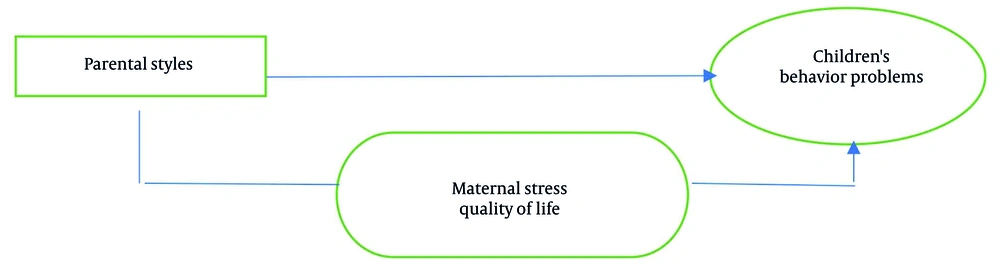
Figure 1.
Conceptual model of parenting styles, maternal stress, quality of life, and children’s behavioral problems
3.1. Parenting Styles Questionnaire
The Robinson Parenting Styles Scale, developed in 1995 and revised in 2001, is a self-report tool designed to measure three common parenting styles — authoritarian, permissive, and authoritative — among parents of children aged 4 to 14. It includes 30 items rated on a five-point Likert scale, with each style’s total score indicating the parent’s dominant approach. Previous studies reported reliability coefficients of 0.69 for permissive, 0.77 for authoritarian, and 0.73 for authoritative styles, alongside good validity demonstrated through Guttman coefficients of 0.62, 0.75, and 0.74 (23). In the Persian adaptation, Cronbach's alpha coefficient was highest for the authoritative and authoritarian styles at 0.86, indicating excellent internal consistency, while it was lower for the permissive style at 0.41. The correlation analyses showed all three styles had significant results, with subscale correlations between 0.81 and 0.89, supporting the scale’s reliability. Confirmatory factor analysis further confirmed the scale’s construct validity, with fit indices — such as CMIN/DF (2.1), GFI (0.91), CFI (0.90), IFI (0.90), and RMSEA (0.04) — indicating a good model fit. Overall, the Persian version of the PSQ demonstrates strong reliability and validity, making it a useful tool for assessing parenting styles in Iran, especially in interventions and research related to parenting behaviors (24). The content validity ratio (CVR) values for all items were above 0.75, and the Content Validity Index (CVI) values for all items were above 0.83 (25).
3.2. Parenting Stress Index-Short Form
The Parenting Stress Index-Short Form (PSI-SF), created by Abidin et al. in 2006, is a widely used tool designed to measure parental stress. It consists of 36 items that assess three main areas: Parental distress, parent-child dysfunctional interaction, and difficult child characteristics, with each area including 12 items. Respondents rate each item on a five-point Likert scale, and higher total scores — ranging from 36 to 180 — indicate greater levels of stress (26). The Persian version of the PSI-SF was carefully translated and tested for reliability and validity. Results showed strong internal consistency, with an overall Cronbach's alpha of 0.90, and good stability over time, with a test-retest reliability of 0.75. When looking at the subscales, reliability scores were 0.75 for parental distress, 0.82 for difficult child characteristics, and 0.73 for parent-child dysfunctional interactions (27). The results of the confirmatory factor analysis for the Persian PSI-SF revealed that models with three distinct factors, whether independent or correlated, fit the data significantly better than a single-factor model. Reliability testing demonstrated high internal consistency, with Cronbach’s alpha ranging from 0.80 to 0.91 for both overall and subscale scores, and test-retest reliability exceeding 0.70 over an 18-day period, reflecting good stability. Existing studies support that the CVI and CVR for the Persian version are within acceptable ranges, confirming strong content validity (27).
3.3. World Health Organization Quality of Life Questionnaire
The World Health Organization (WHO) developed the WHOQOL-100 in 1991, a comprehensive 100-item questionnaire for standardizing quality of life evaluations. To address the need for a more concise tool, the World Health Organization Quality of Life Questionnaire (WHOQOL-BREF) was created in 1996, featuring 26 items that assess physical health (7 items), mental health (6 items), social relationships (3 items), and environment (8 items), plus 2 general quality of life (general mental health) items. Each question is rated on a five-point Likert scale, with higher scores indicating improved quality of life. The WHOQOL-BREF has shown comparability to the WHOQOL-100, with a discriminative validity of 0.96 and reliable internal consistency (Cronbach’s alpha: 0.82 for physical health, 0.81 for mental health, 0.68 for social relationships, and 0.80 for the environment) (28).
A study conducted in Tehran on the Persian version of the WHOQOL-100 involved 1167 participants and found satisfactory reliability, with Cronbach’s alpha exceeding 0.70 in most subscales, except for social relationships (0.55), supporting its usability across diverse populations. The model fit indices further confirm its validity, with a chi-square/df ratio of approximately 2.26 (P = 0.65), GFI of 0.901, AGFI of 0.953, RMR of 0.077, CFI of 0.924, TLI of 0.906, BBI of 0.926, and RMSEA of 0.048 — all indicating a strong fit. Reliability assessments also show excellent internal consistency, with a total Cronbach’s alpha of 0.91 and subscale values above 0.75, alongside test-retest stability indicated by internal consistency coefficient values ranging from 0.78 to 0.89 across subscales, with an overall internal consistency coefficient of 0.83. Collectively, these results demonstrate that the Persian version is a valid and reliable instrument for assessing quality of life among the elderly (29). The instrument demonstrated both the CVI and CVR, indicating strong suitability for the Iranian context. Specific studies reported a CVI of 0.85 and CVRs ranging from 0.7 to 1.0, supporting the tool’s appropriateness for use in Iran (30).
3.4. Rutter Behavior Scale
The RBS comprises two key components: The Rutter Parent Questionnaire developed in 1975 and the Rutter Child Scale B, both consisting of 26 items designed to assess behavioral problems in children. The Rutter Child Scale B, designed specifically for children aged 7 years and older, evaluates five domains: Aggression/hyperactivity, anxiety/depression, social maladjustment, antisocial behaviors, and inattention. The scoring system employs a three-point Likert scale, ranging from 0 to 2, with total scores spanning from 0 to 52. Higher total scores indicate greater severity of behavioral issues, which are categorized according to intensity levels: Normal, moderate, and severe, based on the 80th, 80th to 95th, and above the 95th percentile, respectively.
For the Persian version of the RBS, the original instrument was translated from English into Persian (RBS-P) and then back-translated into English to ensure accuracy. Ten psychiatrists evaluated the face validity of the translated version, confirming its clarity and appropriateness. Between 2020 and 2021, a total of 384 Persian-speaking adults aged 18 to 60 from various cities across Iran, all with internet access, participated in the study. Most participants were aged 28 to 37 years (53.9%), predominantly female (64.6%), married (51.6%), unemployed (67.7%), and all were educated (100%). The reliability of the RIS-P was high, with a Cronbach's alpha of 0.732, indicating good internal consistency. Additionally, the test-retest analysis showed stability over time, with no significant differences between the two assessments. For content validity, experts evaluated the scale using the CVI and CVR. The CVI values ranged from 0.80 to 0.91, reflecting strong agreement on the relevance and clarity of each item. The CVR values exceeded the minimum threshold of 0.62, confirming that most items were deemed essential for the scale (31).
3.5. Study Procedure
Following approval of the research proposal and securing the necessary ethical approval, we obtained permissions to access rehabilitation centers and special schools in southern Tehran. We employed a purposive sampling method, inviting parents of students with mild IDs (identified by an IQ of 70 or below) to participate. A total of 109 students (47 boys and 62 girls) whose mothers consented voluntarily were included. The inclusion criteria required students to have a mild ID, while those with IQ scores above 70 or with other severe disabilities, sensory impairments, or other neurodevelopmental disorders were excluded.
To facilitate participation, a group session was held to inform mothers about completing questionnaires, resulting in 100 students (44 boys and 56 girls) whose mothers completed the consent process. The process included both online and in-person questionnaire administration, depending on participants’ digital literacy. This approach ensured a representative sample of children with mild IDs and their families, adhering to the inclusion and exclusion criteria specified for the study.
The data collection for this study was conducted over a three-month period, from November 2023 to January 2024. During this time, we worked closely with rehabilitation centers and special schools in southern Tehran, supporting the participants and ensuring proper communication throughout the process. After collection, scoring was conducted by a trained research assistant.
3.6. Statistical Analysis
To analyze mediation and moderation effects, we utilized the PROCESS macro in SPSS, developed by Hayes and Preacher (32). This tool allowed us to assess direct and indirect effects, as well as complex models involving multiple mediators and moderators, through ordinary least squares (OLS) regression. The user-friendly interface requires no advanced coding, and we employed model 4 for simple mediation and model 6 for serial mediation analyses.
4. Results
According to the Rutter Questionnaire, students' behavioral problems are classified into two categories: Mild (below the 80th percentile) and moderate (80th to 95th percentiles). The study involved 82 students with mild issues and 18 with moderate problems. The overall mean age of participants was 11.22 ± 1.29 years, with girls averaging 11.57 ± 1.45 years and boys 11.27 ± 1.38 years. The mean age of mothers was 45.21 ± 6.39 years.
Table 1 presents the average scores for maternal stress and its factors among mothers of children with IDs, categorized by parenting style — authoritarian, authoritative, and permissive. Mothers practicing authoritative parenting reported the highest overall stress (median = 97.00, IQR = 14.3), along with increased maternal distress (42.9, 9.8), mother-child dysfunctional interactions (35.6, SD = 4.9), and difficult child characteristics (36.2, 10.5). Conversely, mothers with authoritarian parenting had significantly lower scores across these measures (stress: 82.0, 12.9). The P-value of 0.001 indicates these differences are statistically significant, meaning parenting style has a significant effect on maternal stress and associated factors. Overall, the data suggest that while authoritative parenting is linked to better child outcomes, it is also associated with higher maternal stress — highlighting the importance of tailored support for mothers based on their parenting approach.
Table 1.Descriptive Indices of Maternal Stress Index and Its Factors in Mothers of Students with Intellectual Disabilities Based on Parenting Styles a
| Variables | Maternal Stress | Maternal Distress | Mother-Child Dysfunction | Difficult Child | P-Value |
|---|---|---|---|---|---|
| Parenting styles | 0.001 | ||||
| Authoritarian | 82.0 (12.9) | 32.5 (9.8) | 23.8 (3.5) | 23.5 (5.2) | |
| Authoritative | 97.0 (14.3) | 42.9 (9.8) | 35.6 (4.9) | 36.2 (10.5) | |
| Permissive | 88.4 (11.9) | 33.5 (7.5) | 31.7 (2.5) | 27.1 (5.9) |
a Values are expressed as median (IQR).
Quality of life includes physical, mental, environmental health, and social relations, analyzed by parenting styles in parents of students with IDs (Table 2).
Table 2.Descriptive Indices of General Health and Quality of Life and Its Domains in Mothers of Students with Intellectual Disabilities Based on Parental Styles a
| Variables | Quality of Life | P-Value | ||||
|---|---|---|---|---|---|---|
| Mental Health | Social Relations | Physical | Environmental | General Health | ||
| Parenting styles | 0.001 | |||||
| Authoritarian | 47.1 (9.0) | 41.7 (12.9) | 47.5 (9.6) | 45.3 (10.1) | 52.4 (12.9) | |
| Authoritative | 48.5 (13.4) | 64.0 (35.9) | 75.0 (20.9) | 51.9 (9.4) | 81.4 (21.5) | |
| Permissive | 45.5 (6.3) | 40.48 (27.1) | 49.49 (18.1) | 45.09 (6.8) | 50.7 (24.2) | |
a Values are expressed as median (IQR).
Table 2 shows that mothers with an authoritative style report better quality of life across all areas — especially in social relations (median = 64.0, IQR = 35.9) and general health (81.4, 21.5) — indicating greater health and social support. They also scored higher in mental health (48.5, 13.4), physical health (75.0, 20.9), and environmental health (51.9, 9.4). In contrast, authoritarian and permissive mothers scored lower across these domains, with authoritarian mothers particularly facing challenges in mental health (47.1, 9.0) and social relations (41.7, 12.9). The P-value of 0.001 confirms these differences are statistically significant, emphasizing that parenting style has a significant effect on family quality of life.
In Table 3, we present the results of the Spearman correlation analysis examining the association between different parenting styles and behavioral problems. Table 3 summarizes the strength and significance of these associations, offering insights into how specific parenting approaches may be linked to behavioral issues in children.
The correlation analysis reveals several noteworthy associations. There is a strong negative correlation between authoritarian and authoritative parenting styles (R = -0.725, P = 0.014), indicating that higher levels of authoritarian parenting are associated with lower levels of authoritative parenting. Additionally, authoritarian parenting shows a positive correlation with behavioral problems (R = 0.571, P = 0.025), suggesting that more authoritarian approaches may be linked to increased behavioral issues. Conversely, authoritative parenting is negatively correlated with behavioral problems (R = -0.471, P = 0.031), implying a potential protective effect against behavioral issues. Permissive parenting is positively correlated with both authoritarian and authoritative styles but shows a weaker, non-significant correlation with behavioral problems (R = 0.291). These results highlight the complex interplay between different parenting styles and behavioral outcomes in children.
Table 4 illustrates how different parenting styles influence behavioral problems — both mild and moderate — in students with IDs, with maternal stress serving as a key mediator. For mild behavioral issues, authoritarian parenting shows a significant positive effect, with a direct impact of 0.12 and an overall effect of 0.22, indicating a tendency to increase behavioral problems. This correlation is strongly mediated by maternal stress, which has a notable indirect effect of 0.43. In contrast, authoritative parenting appears to have a protective effect, reducing mild behavioral problems with a direct effect of -0.13 and an overall effect of -0.23. The beneficial influence of the authoritative style is also mediated by maternal stress, with an indirect effect of -0.14. Permissive parenting has a minimal overall effect (-0.02), but it may slightly exacerbate behavior issues when maternal stress is involved, as reflected by a significant indirect effect of -0.37.
Table 4.Effects of Parenting Styles on Behavioral Problems (Mild and Moderate) in Students with Intellectual Disabilities Mediated by Maternal Stress and Its Factors
| Parenting Style | Beta | Standard Error | 95% Confidence Interval | P-Value | |
|---|---|---|---|---|---|
| Lower | Upper | ||||
| Authoritarian | |||||
| Mild | |||||
| Overall effect | 0.22 | 0.05 | 0.12 | 0.32 | < 0.001 |
| Direct effect | 0.12 | 0.03 | 0.06 | 0.18 | < 0.001 |
| Indirect effect (difficult child) | 0.10 | 0.06 | -0.02 | 0.22 | 0.345 |
| Indirect effect (mother-child interaction) | 0.12 | 0.07 | -0.02 | 0.26 | 0.654 |
| Indirect effect (maternal distress) | 0.18 | 0.19 | -0.19 | 0.55 | 0.675 |
| Indirect effect (maternal stress) | 0.43 | 0.12 | 0.19 | 0.67 | < 0.001 |
| Moderate | |||||
| Overall effect | 0.22 | 0.05 | 0.12 | 0.32 | < 0.001 |
| Direct effect | 0.12 | 0.03 | 0.06 | 0.18 | < 0.001 |
| Indirect effect (difficult child) | 0.10 | 0.06 | -0.02 | 0.22 | 0.321 |
| Indirect effect (mother-child interaction) | 0.12 | 0.07 | -0.02 | 0.26 | 0.234 |
| Indirect effect (maternal distress) | 0.18 | 0.19 | -0.19 | 0.55 | 0.123 |
| Indirect effect (maternal stress) | 0.43 | 0.12 | 0.19 | 0.67 | < 0.001 |
| Authoritative | |||||
| Mild | |||||
| Overall effect | -0.23 | 0.07 | -0.37 | -0.09 | < 0.001 |
| Direct effect | -0.13 | 0.06 | -0.25 | -0.01 | < 0.001 |
| Indirect effect (difficult child) | -0.10 | 0.05 | -0.20 | 0.00 | 0.567 |
| Indirect effect (mother-child interaction) | -0.07 | 0.06 | -0.19 | 0.05 | 0.567 |
| Indirect effect (maternal distress) | -0.02 | 0.07 | -0.16 | 0.12 | 0.654 |
| Indirect effect (maternal stress) | -0.14 | 0.09 | -0.32 | 0.04 | 0.342 |
| Moderate | |||||
| Overall effect | -0.23 | 0.07 | -0.37 | -0.09 | < 0.001 |
| Direct effect | -0.13 | 0.06 | -0.25 | -0.01 | < 0.001 |
| Indirect effect (difficult child) | -0.10 | 0.05 | -0.20 | -0.00 | < 0.001 |
| Indirect effect (mother-child interaction) | -0.07 | 0.06 | -0.19 | 0.05 | 0.678 |
| Indirect effect (maternal distress) | -0.02 | 0.07 | -0.16 | 0.12 | 0.843 |
| Indirect effect (maternal stress) | -0.14 | 0.09 | -0.32 | 0.04 | 0.178 |
| Permissive | |||||
| Mild | |||||
| Overall effect | -0.02 | 0.05 | -0.12 | 0.08 | 0.087 |
| Direct effect | 0.09 | 0.04 | 0.01 | 0.17 | < 0.001 |
| Indirect effect (difficult child) | -0.11 | 0.07 | -0.25 | 0.03 | 0.345 |
| Indirect effect (mother-child interaction) | -0.02 | 0.15 | -0.31 | 0.27 | 0.453 |
| Indirect effect (maternal distress) | -0.01 | 0.06 | -0.13 | 0.11 | 0.564 |
| Indirect effect (maternal stress) | -0.37 | 0.08 | -0.53 | -0.21 | < 0.001 |
| Moderate | |||||
| Overall effect | -0.02 | 0.05 | -0.12 | 0.08 | 0.321 |
| Direct effect | 0.09 | 0.04 | 0.01 | 0.17 | < 0.001 |
| Indirect effect (difficult child) | -0.11 | 0.07 | -0.25 | 0.03 | 0.421 |
| Indirect effect (mother-child interaction) | -0.02 | 0.15 | -0.31 | 0.27 | 0.768 |
| Indirect effect (maternal distress) | -0.01 | 0.06 | -0.13 | 0.11 | 0.679 |
| Indirect effect (maternal stress) | -0.37 | 0.08 | -0.53 | -0.21 | < 0.001 |
When examining moderate behavioral problems, authoritarian parenting tends to increase difficulties (+0.17), while authoritative parenting helps decrease them (-0.18). All these effects are statistically significant, underscoring that parenting style — especially when mediated by maternal stress — plays a crucial role in shaping behavioral outcomes in children with IDs.
For a more detailed view, Figures 2 and 3 display the standardized beta coefficients, illustrating the direct and indirect effects of parenting styles on two levels — mild to moderate — of behavioral problems, mediated by maternal stress.
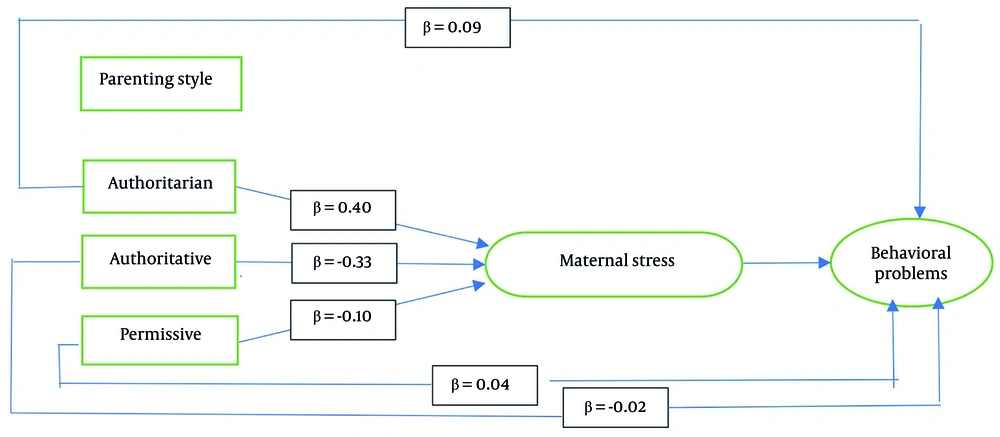
Figure 2.
Direct and indirect pathways between parenting styles, mild behavioral problems, and maternal stress
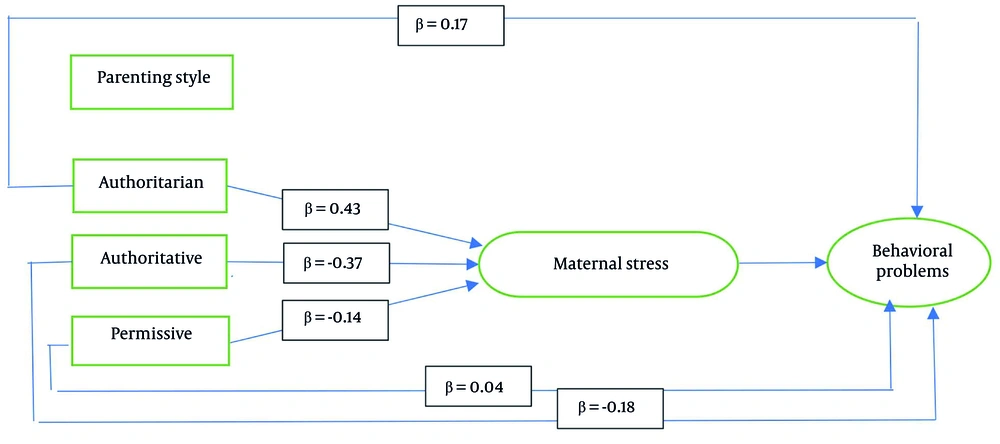
Figure 3.
Direct and indirect pathways between parenting styles, moderate behavioral problems, and maternal stress
Based on the data in Table 5, different parenting styles significantly affect mild behavioral problems in students with IDs, especially through their impact on family quality of life. Authoritarian parenting tends to be associated with a notable increase in behavioral issues, evidenced by a direct effect of 0.17, and a negative indirect effect on mental health of -0.15. In contrast, authoritative parenting appears to mitigate these problems, showing a reduction of around 0.16 to 0.19 in behavioral difficulties. Permissive parenting, on the other hand, is linked to an increase of approximately 0.19, though its effect is less pronounced.
Table 5.Effects of Parenting Styles on Mild Behavioral Problems in Students with Intellectual Disabilities Mediated by Quality of Life and Its Domains
| Parenting Style | Beta | Standard Error | 95% Confidence Interval | P-Value | |
|---|---|---|---|---|---|
| Lower | Upper | ||||
| Authoritarian | |||||
| Mild | |||||
| Overall effect | 0.59 | 0.08 | 0.43 | 0.75 | < 0.001 |
| Direct effect | 0.17 | 0.09 | -0.01 | 0.35 | < 0.001 |
| Indirect effect (physical health) | 0.42 | 0.07 | 0.28 | 0.56 | < 0.001 |
| Indirect effect (mental health) | -0.11 | 0.02 | -0.15 | -0.07 | > 0.05 |
| Indirect effect (social relations) | 0.16 | 0.05 | 0.06 | 0.26 | < 0.001 |
| Indirect effect (environmental health) | 0.19 | 0.04 | 0.11 | 0.27 | < 0.001 |
| Indirect effect (general health) | 0.14 | 0.07 | 0.00 | 0.28 | < 0.001 |
| Moderate | |||||
| Overall effect | 0.32 | 0.05 | 0.22 | 0.42 | < 0.001 |
| Direct effect | 0.11 | 0.05 | 0.01 | 0.21 | < 0.001 |
| Indirect effect (physical health) | 0.21 | 0.04 | 0.13 | 0.29 | < 0.001 |
| Indirect effect (mental health) | -0.15 | 0.06 | -0.27 | -0.03 | > 0.05 |
| Indirect effect (social relations) | 0.02 | 0.07 | -0.12 | 0.16 | < 0.001 |
| Indirect effect (environmental health) | 0.18 | 0.09 | 0.00 | 0.36 | < 0.001 |
| Indirect effect (general health) | 0.11 | 0.06 | -0.01 | 0.23 | < 0.001 |
| Authoritative | |||||
| Mild | |||||
| Overall effect | -0.47 | 0.11 | -0.69 | -0.25 | < 0.001 |
| Direct effect | -0.16 | 0.09 | -0.34 | 0.02 | < 0.002 |
| Indirect effect (physical health) | -0.31 | 0.07 | -0.45 | -0.17 | < 0.001 |
| Indirect effect (mental health) | -0.42 | 0.04 | -0.50 | -0.34 | < 0.001 |
| Indirect effect (social relations) | -0.16 | 0.06 | -0.28 | -0.04 | < 0.001 |
| Indirect effect (environmental health) | -0.28 | 0.07 | -0.42 | -0.14 | < 0.001 |
| Indirect effect (general health) | -0.39 | 0.07 | -0.53 | -0.25 | < 0.001 |
| Moderate | |||||
| Overall effect | -0.40 | 0.07 | -0.54 | -0.26 | < 0.001 |
| Direct effect | -0.19 | 0.08 | -0.35 | -0.03 | < 0.002 |
| Indirect effect (physical health) | -0.21 | 0.05 | -0.31 | -0.11 | < 0.001 |
| Indirect effect (mental health) | -0.15 | 0.06 | -0.27 | -0.03 | > 0.05 |
| Indirect effect (social relations) | 0.02 | 0.07 | -0.12 | 0.16 | < 0.001 |
| Indirect effect (environmental health) | -0.19 | 0.06 | -0.31 | -0.07 | < 0.001 |
| Indirect effect (general health) | -0.31 | 0.06 | -0.43 | -0.19 | < 0.001 |
| Permissive | |||||
| Mild | |||||
| Overall effect | 0.12 | 0.07 | -0.02 | 0.26 | < 0.001 |
| Direct effect | 0.19 | 0.05 | 0.09 | 0.29 | < 0.001 |
| Indirect effect (physical health) | -0.07 | 0.06 | -0.19 | 0.05 | < 0.001 |
| Indirect effect (mental health) | 0.03 | 0.02 | -0.01 | 0.07 | > 0.05 |
| Indirect effect (social relations) | -0.03 | 0.04 | -0.11 | 0.05 | > 0.05 |
| Indirect effect (environmental health) | 0.14 | 0.05 | 0.04 | 0.24 | > 0.05 |
| Indirect effect (general health) | -0.02 | 0.06 | -0.14 | 0.10 | > 0.05 |
| Moderate | |||||
| Overall effect | 0.09 | 0.05 | -0.01 | 0.19 | < 0.001 |
| Direct effect | 0.11 | 0.04 | 0.03 | 0.19 | < 0.001 |
| Indirect effect (physical health) | -0.02 | 0.06 | -0.14 | 0.10 | < 0.001 |
| Indirect effect (mental health) | 0.05 | 0.05 | -0.05 | 0.15 | > 0.05 |
| Indirect effect (social relations) | -0.11 | 0.06 | -0.23 | 0.01 | > 0.001 |
| Indirect effect (environmental health) | 0.20 | 0.08 | 0.04 | 0.36 | > 0.05 |
| Indirect effect (general health) | -0.07 | 0.09 | -0.25 | 0.11 | > 0.05 |
These results underscore the complex interaction between parenting styles and students’ behavioral outcomes. Overall, there is a negative association between authoritative parenting and behavioral problems — meaning it tends to be protective — while authoritarian and permissive styles are positively linked, indicating increased risks. Additionally, maternal stress plays a mediating role in these associations, and factors related to quality of life further influence the behavioral issues observed in students with IDs.
For a more detailed view, Figures 4 and 5 display the standardized beta coefficients, illustrating the direct and indirect effects of parenting styles on two levels — mild to moderate — of behavioral problems, mediated by quality of life and general health.
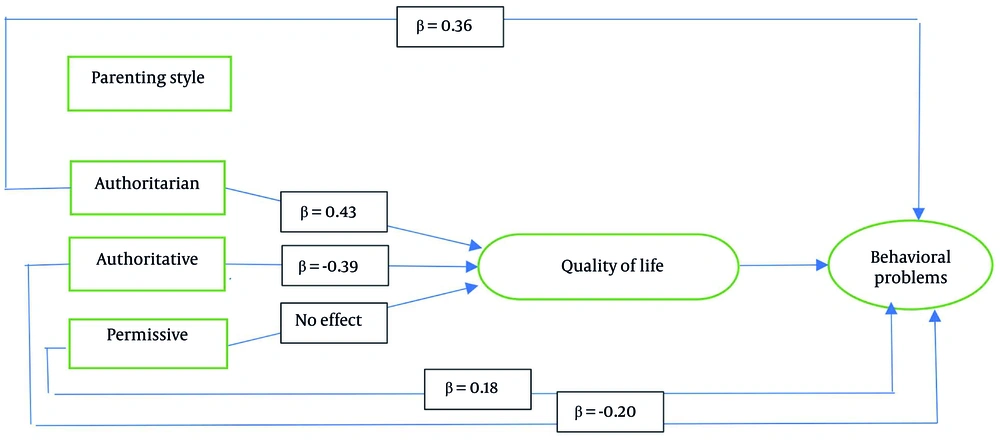
Figure 4.
Direct and indirect pathways between parenting styles, mild behavioral problems, and quality of life
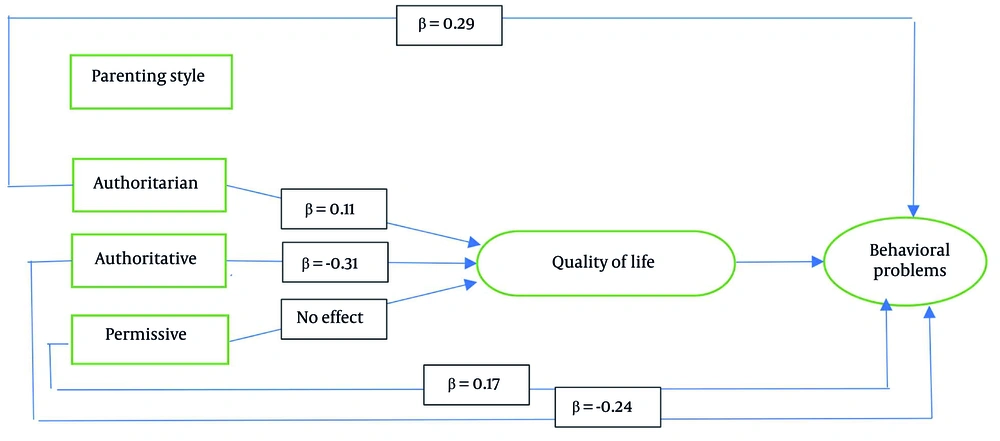
Figure 5.
Direct and indirect pathways between parenting styles, moderate behavioral problems, and quality of life
5. Discussion
This study examined how maternal stress and quality of life mediate the association between parenting styles and behavioral problems in students with IDs. The results showed that authoritarian and permissive styles are linked to more behavioral issues, whereas authoritative parenting tends to be associated with fewer problems. A key finding is that maternal stress plays a vital role in this association. Interestingly, parents who adopt an authoritative approach often experience higher stress levels than those using other styles. The data suggests that stress is a significant factor connecting authoritarian parenting with behavioral problems in children. Conversely, while permissive mothers report high levels of stress, their children tend to have milder behavioral issues. However, in authoritative parents, stress levels do not seem to worsen these problems.
The study also focused on maternal distress, which emerged as an important element. Parenting that is controlling and strict — typical of authoritarian styles — tends to increase parental anxiety, which can negatively affect children’s emotional and behavioral development because children often imitate their parents’ reactions (20). Interestingly, authoritative parents reported experiencing more distress than other groups (33). While this high distress from authoritarian parenting led to more behavioral problems, it appeared to have less impact in authoritative and permissive styles (14, 19, 34). Overall, these findings suggest that improving parenting practices may help reduce maternal stress and, in turn, decrease behavioral issues in children (35).
We also looked at how the quality of mother-child interactions affects these associations. Results showed that negative parenting behaviors — especially authoritarian and permissive styles — are linked to more tension and conflict between parents and their children. This higher level of conflict can worsen children’s behavioral problems (11, 19). Interestingly, parents who followed an authoritative style reported more difficulties with parent-child interactions than others (33). The findings reveal that poor mother-child interactions partly explain the connection between authoritarian parenting and behavioral issues in children with IDs (35). Surprisingly, permissive parents who reported more interaction difficulties had children with fewer behavioral problems. This aligns with previous research suggesting that the impact of parenting style on behavior can be complex and context-dependent (12, 20, 34).
Regarding the third component of maternal stress, the difficult child characteristics, the results showed that negative parenting styles — particularly strict or neglectful approaches — are associated with more behavioral problems, especially when children exhibit more pronounced difficult traits. Parents with an authoritative style reported observing more traits of problematic behavior compared to other groups (35). These child traits act as a mediator between authoritarian parenting and behavioral issues, meaning that harsh parenting can amplify problematic behaviors (12, 34). Conversely, permissive parents with children showing more difficult characteristics tended to report fewer behavioral problems, which supports findings from prior research (33, 36). Overall, parental involvement and the child’s temperament both play significant roles in shaping behavioral outcomes.
An important contribution of this study is the confirmation that quality of life mediates the link between parenting styles and behavioral problems. Specifically, parents with an authoritative style reported better overall quality of life — covering physical, mental, social, and environmental health — compared to those with authoritarian or permissive styles. Moreover, lower quality of life in authoritarian parents was associated with more behavioral issues in their children. On the other hand, authoritative parents who reported higher quality of life also observed fewer problems. These findings suggest that better quality of life can buffer against behavioral challenges, especially in authoritative parenting; however, it appears less relevant in permissive styles (33). Previous research supports this, showing that overall health is linked to fewer emotional and behavioral issues in youths with autism spectrum disorder (37).
When examining specific domains of quality of life, physical health stood out. Parents who practiced authoritative parenting generally reported better physical health, which, in turn, helped reduce their children’s behavioral problems (38). Good physical health in parents enhances their ability to manage stress and provide supportive care. Conversely, negative parenting styles tend to weaken perceptions of health, increasing psychological and physical struggles that can worsen children’s behavioral issues like aggression or depression (38).
In terms of mental health, parents with authoritative styles generally reported better emotional well-being. High mental health in these parents is associated with a decrease in behavioral problems in their children. However, mental health did not significantly mediate the effects of permissive parenting. This aligns with prior studies that demonstrate a stronger link between parental mental health and behavioral outcomes in authoritative families (33, 39). When mothers face mental health challenges, children are more likely to exhibit problematic behaviors, emphasizing the importance of supporting parental mental health to improve child outcomes.
The environmental aspect of quality of life was also explored. Parents practicing authoritative parenting generally experienced better environmental conditions — such as access to green spaces or a safe neighborhood — which can support healthier behaviors in children (21). Good environmental health can subtly help reduce behavioral issues, although its mediating effect appears to be modest (37). Improving home environments and addressing parenting styles together can provide a comprehensive way to support children with IDs.
Quality of life significantly impacts parental health, with authoritative parenting fostering better physical and mental well-being and leading to fewer behavioral challenges in children. In contrast, authoritarian parenting, characterized by strict rules, and permissive parenting, which lacks structure, are associated with deteriorating parental health. These negative parenting styles can exacerbate behavioral issues in students. Authoritarian parents often face difficulties in social relationships, further compounding their children's behavioral problems (19, 35). By improving parenting practices, particularly through authoritative approaches, parents can enhance their well-being while also reducing the prevalence of behavioral issues in their children (20, 34).
This study offers valuable insights into how different parenting styles are related to behavioral problems in students with IDs, shedding light on an area that deserves greater attention for intervention. One of the strengths of this research is its focus on a group that is often overlooked, helping to lay the groundwork for creating more targeted and effective support strategies. By exploring the roles of maternal stress and family quality of life as possible mediators, it provides a deeper understanding of the complex factors that influence children’s behavior.
However, some limitations should be acknowledged. The study’s cross-sectional and correlational design means we cannot establish causality or determine the direction of these interactions — longitudinal research is needed for that. Additionally, the participants were all from Tehran city, which may limit how well the findings apply to other regions or communities. Future research should aim for more diverse samples through random sampling, include a wider range of age groups, and explore behavioral issues of varying severities. Considering other demographic factors like gender and maternal education as potential moderators could also refine our understanding. Finally, incorporating observational methods alongside questionnaires would help provide a more accurate and comprehensive picture of children’s behaviors.
5.1. Conclusions
The findings indicate that parenting styles directly affect behavioral issues in students, particularly those with IDs. Authoritarian and permissive styles are associated with higher levels of behavioral problems, while authoritative parenting is linked to fewer problems. Consequently, educating parents about effective parenting strategies is essential for preventing behavioral challenges in children. Given the mediating roles of parental stress and family quality of life, interventions should emphasize managing stressors and improving overall quality of life, as these factors influence behavioral outcomes.
These results also suggest practical applications for psychologists and educators; developing family workshops to support parents of children with IDs. Because parental stress and quality of life can mediate the association between parenting styles and behavior, empowerment programs for families with special-needs children have the potential to enhance overall health and well-being.

