
1. Background
Universities and higher education institutions are foundational pillars of scientific advancement and societal development (1). With the increasing number of academic centers and students, together with growing economic, social, and educational complexities, continuous improvement in the quality of higher education has become a strategic necessity. In this context, internal evaluation has emerged as a key instrument for assessing the effectiveness, credibility, and quality of academic units, particularly within the Ministry of Health and Medical Education, thereby enabling data-driven planning and quality enhancement (2, 3).
The field of nutrition sciences in Iran is at a critical stage. The country has undergone a significant nutritional transition characterized by a dual burden of malnutrition, in which undernutrition coexists with a rising prevalence of obesity and diet-related chronic diseases (4). This public health challenge underscores the urgent need for robust academic departments capable of producing highly skilled graduates, generating relevant research, and informing effective public health policy. Therefore, systematic evaluation of nutrition sciences departments is not merely an administrative exercise but a vital component of national health strategy.
Although internal evaluation studies have been conducted for various departments in medical universities, such as social medicine, physiology, and midwifery, revealing challenges in facilities, curricula, and graduate outcomes (5), a significant gap remains. Published systematic internal evaluations focusing specifically on nutritional sciences departments in Iran are scarce. This gap limits the ability of these key departments to benchmark their performance, share best practices, and strategically address their unique challenges within the evolving public health landscape.
The Department of Nutritional Sciences at Kermanshah University of Medical Sciences, established in 2009 and later expanded into a faculty, is a pivotal institution in western Iran. Since its inception, it has expanded its academic scope to include master's and PhD programs and plays a crucial role in regional public health. To date, however, few comprehensive published internal evaluations of its performance across core academic indicators have been conducted. This study aimed to address this gap. Recent studies indicate that structured checklists and standardized evaluation tools, together with well-designed educational interventions and validated assessment methodologies, can improve student performance, satisfaction, and the overall quality of clinical and academic training; these findings support the rationale for our Education Development Office checklist and its use in departmental internal evaluation (6-8).
2. Objectives
This descriptive cross-sectional study was conducted in 2025 to systematically evaluate the key performance indicators, including educational, research, and organizational indicators, of the Department of Nutritional Sciences at Kermanshah University of Medical Sciences. The findings are intended to establish a benchmark for the department’s current status, identify strengths and critical areas for improvement, and provide evidence-based recommendations to inform strategic development and enhance the department’s contribution to public health nutrition.
3. Methods
3.1. Study Design and Participants
This descriptive cross-sectional study was conducted to perform an internal evaluation of the Department of Nutrition Sciences at Kermanshah University of Medical Sciences in 2025. All individuals affiliated with the Department of Nutrition Sciences at Kermanshah University of Medical Sciences in 2025 were eligible to participate, including faculty members, undergraduate and graduate students, department graduates, and administrative staff. Eligibility required a current or prior formal affiliation with the department and willingness to provide informed responses to the evaluation questionnaires. Individuals without a departmental affiliation or those who declined participation were excluded. Because the total eligible population was small (N = 22: 1 manager, 6 faculty members, 10 students, and 5 graduates), a census approach was used, and all eligible individuals were invited to participate. Participation was voluntary, and the confidentiality of personal information was strictly maintained.
3.2. Data Collection
Data were collected using standard questionnaires for the manager, faculty members, students, and graduates. The questionnaires were designed to assess the following domains: 1) goals, organizational position, management, and organization; 2) educational courses and curriculum; 3) faculty members; 4) students; 5) the teaching and learning process; 6) educational facilities and equipment; 7) theses and dissertations; and 8) graduates. Data were collected using the University of Tehran internal evaluation questionnaires, which were revised by the internal evaluation committee to align with the evaluation criteria and the development of the desired status for each criterion. This questionnaire and checklist approach follows recent field-tested methodologies used to evaluate clinical and educational programs in nutrition and medical education (6, 7). All eligible department members were invited to participate, and responses were collected anonymously using a standardized internal evaluation questionnaire. To mitigate membership-related bias, responses were anonymized, the questionnaire was reviewed by the internal evaluation committee, and data entry and aggregation were performed by an investigator not involved in departmental management.
3.3. Scoring and Statistical Analysis
The analytical process began with the evaluation of individual indicators, each scored based on corresponding questionnaire items using a three-point Likert scale: unfavorable (score 1), relatively favorable (score 2), and favorable (score 3). These indicators served as the foundational units of measurement within the assessment framework. Subsequently, the score for each criterion was calculated as the arithmetic mean of the scores assigned to its associated indicators. In turn, the score for each main factor was computed by averaging the scores of the criteria nested within that factor. To facilitate interpretation and ensure consistency across domains, all criteria and factors were classified into three qualitative performance levels: unfavorable (mean scores ranging from 1.00 to 1.66), relatively favorable (1.67 to 2.32), and favorable (2.33 to 3.00). This stratification enabled a structured comparison of strengths and areas requiring improvement across the evaluated components.
Each questionnaire item was scored on a three-point Likert scale (1 = unfavorable, 2 = relatively favorable, 3 = favorable). These item scores were treated as ordinal data but aggregated as continuous variables to compute mean values. Because the study invited the entire eligible population (census, N = 22), the analysis was descriptive, and domain means and standard deviations are reported to summarize performance. All analyses were performed using SPSS version 26.
3.4. Ethical Considerations
In this study, participants’ personal information remained confidential, and the study commenced after obtaining permission from the responsible authorities and approval of the plan.
4. Results
4.1. Study Population
Table 1 summarizes the invited study population and the final analytic sample. The study used a census of all eligible department members (N = 22). The sample included 1 manager (4.5%), 6 faculty members (27.3%), 10 students (45.5%), and 5 graduates (22.7%).
Table 1.
Study Characteristics
| Characteristics | No. (%) |
|---|---|
| Participant | 22 (100) |
| Manager | 1 (4.5) |
| Faculty members | 6 (27.3) |
| Students | 10 (45.5) |
| Graduates | 5 (22.7) |
4.2. Internal Evaluation Scores
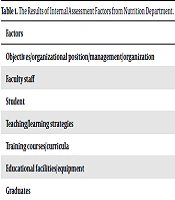
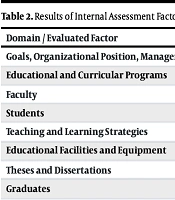
Based on the internal evaluation conducted in 2025, the Department of Nutrition at Kermanshah University of Medical Sciences demonstrated a desirable level of performance across all assessed domains. The mean scores for each evaluated factor indicated consistent alignment with academic, administrative, and educational standards. Table 2 presents the mean scores for each internal evaluation factor.
Table 2.
Results of Internal Assessment Factors in the Department of Nutrition at Kermanshah University of Medical Sciences a
| Domain/Evaluated Factor | Mean Score ± SD | Performance Level |
|---|---|---|
| Goals, Organizational Position, Management, and Structure | 2.54 ± 0.35 | Favorable |
| Educational and Curricular Programs | 2.55 ± 0.21 | Favorable |
| Faculty | 2.50 ± 0.16 | Favorable |
| Students | 2.46 ± 0.29 | Favorable |
| Teaching and Learning Strategies | 2.50 ± 0.29 | Favorable |
| Educational Facilities and Equipment | 2.63 ± 0.12 | Favorable |
| Theses and Dissertations | 2.65 ± 0.21 | Favorable |
| Graduates | 2.76 ± 0.31 | Favorable |
a Performance Level: Favorable (2.33 - 3.0), relatively favorable (1.67 - 2.32), unfavorable (1.0 - 1.66).
The domain of Goals, Organizational Position, Management, and Structure had a mean score of 2.54, indicating coherent strategic planning and effective organizational leadership. Educational and Curricular Programs scored 2.55, reflecting well-designed academic offerings aligned with professional and societal needs. The Faculty domain scored 2.50, suggesting satisfactory engagement in teaching and research activities.
The Students domain scored 2.46, indicating acceptable levels of student participation and interaction within the academic environment. Teaching and Learning Strategies scored 2.50, indicating the use of diverse instructional methods and adequate educational resources. Educational Facilities and Equipment scored 2.63, highlighting access to appropriate infrastructure and technological support.
In the domain of Theses and Dissertations, a score of 2.65 reflected the quality and relevance of student research activities. Finally, the Graduate domain achieved the highest score of 2.76, indicating strong professional competencies among graduates, effective postgraduation engagement, and alignment of academic programs with labor market expectations.
Overall, these results confirm the department’s favorable status and provide a basis for strategic planning to support continuous improvement in educational quality and academic performance.
5. Discussion
This internal evaluation provides a systematic assessment of the Department of Nutritional Sciences at Kermanshah University of Medical Sciences in 2025. The overall favorable performance across all eight domains (mean scores: 2.46 - 2.76) indicates a functionally sound department that meets core academic standards. These findings reflect the department’s sustained commitment to quality enhancement and strategic development across academic and operational dimensions (9).
The Goals, Organizational Position, Management, and Structure domain achieved a mean score of 2.54, suggesting coherent organizational planning and effective leadership. This is consistent with the 2018 evaluation (9), in which the same domain was also rated favorably, although with a slightly higher mean score of 2.9. This minor decline may reflect evolving expectations and more rigorous assessment criteria rather than a regression in performance. The Educational and Curricular Programs domain score improved to 2.55 compared with 2018, suggesting enhanced alignment between curriculum design and competency-based education frameworks. This finding is consistent with global trends emphasizing outcome-based education, market responsiveness, and the integration of community needs in health sciences curricula (10). Unlike earlier evaluations that highlighted limited responsiveness to learner and labor-market needs, the current findings suggest institutional adaptation to evolving educational standards. This alignment strengthens the construct validity of the evaluation outcomes.
The faculty domain showed stable performance, with qualitative evidence of improved scholarly productivity compared with 2018. Previous institutional evaluations in medical universities have identified faculty development, research incentives, and structured promotion pathways as key drivers of improved academic output (11). The observed improvement in faculty performance in 2025 is therefore consistent with broader evidence indicating that structured evaluation systems positively influence academic engagement and productivity.
The modest increase in the student domain (2.46 vs. 2.41 in 2018) indicates improvement in student engagement and participation. Contemporary quality assurance literature emphasizes student-centered learning, feedback integration, and participatory governance as indicators of educational maturity. The improved scores may reflect the implementation of interactive pedagogical approaches and enhanced communication mechanisms. Similarly, the Teaching and Learning Strategies domain indicates effective diversification of instructional methods. In line with global reports highlighting rapid digital transformation in higher education after COVID-19 (12), the slight decline in educational facilities (2.63 vs. 2.9 in 2018) may reflect rising expectations for advanced digital infrastructure rather than actual infrastructural insufficiency. This interpretation aligns with studies indicating that benchmarks for technological adequacy have risen significantly in recent years.
The favorable score of 2.65 in the Theses and Dissertations domain indicates acceptable research supervision quality and graduate research output. Although this domain was not distinctly evaluated in 2018, its current performance is consistent with the expansion of graduate programs and strengthened research policies. Evidence from the academic quality literature supports the notion that structured thesis monitoring systems improve research quality and timely completion (13).
Finally, the most notable improvement occurred in the Graduates domain (2.76 vs. 1.59 in 2018). This substantial increase suggests enhanced graduate tracking, professional competency, and labor-market alignment. Similar improvements have been documented in institutions that establish systematic alumni follow-up systems and competency-based curricula (14). The magnitude of change in this domain appears justified by documented administrative reforms implemented after the 2018 evaluation. Therefore, the improvement reflects measurable structural enhancement rather than random variation.
Overall, the findings indicate progressive institutional strengthening over time. Minor declines in certain domains are plausibly attributable to elevated standards, digital transformation demands, or stricter evaluation criteria rather than regression. This pattern is consistent with maturation models of academic quality assurance, in which institutions demonstrate incremental improvements alongside recalibration of benchmarks (15). Importantly, the results should be interpreted within the study’s internal evaluation framework. The findings provide evidence of institutional development at Kermanshah University of Medical Sciences but should not be generalized beyond similar academic contexts.
5.1. Study Limitations
Despite providing valuable insights, this internal evaluation has several limitations. Because many evaluators were members of the same department, the findings may have been affected by leniency or social-desirability bias, although anonymized questionnaires and aggregated reporting were used to reduce this risk. Reliance on self-reported, questionnaire-based data may also have introduced response bias. In addition, the study was limited to a single academic year, 2025, and involved a relatively small sample size, restricting the ability to assess long-term trends or conduct subgroup analyses. The results are primarily applicable to the Department of Nutritional Sciences at Kermanshah University of Medical Sciences and should be interpreted as an internal quality assurance measure rather than a generalizable benchmark.
To minimize bias, standardized questionnaires adapted from the University of Tehran model were used, anonymity and confidentiality were ensured, data collection procedures were uniform, and scoring was based on predefined benchmarks. Although some residual bias may remain due to the self-reported nature of the data, these measures strengthened the validity and consistency of the evaluation process.
5.2. Conclusions
This internal evaluation demonstrates that, in 2025, the Department of Nutritional Sciences at Kermanshah University of Medical Sciences performs within favorable quality standards across all eight assessed domains. Compared with the 2018 evaluation, the department shows measurable improvement in curriculum responsiveness, faculty engagement, student participation, and, most prominently, graduate outcomes. Minor declines in organizational structure and facilities likely reflect heightened evaluation benchmarks rather than performance regression.
Based on the present findings, priority areas for targeted improvement include modernization of educational infrastructure and continued strengthening of student diversity and orientation mechanisms. The evidence supports the continued use of structured internal evaluation as a tool for quality monitoring and strategic planning within the department.