
1. Background
Medical students must acquire both theoretical knowledge and practical skills to prepare for future clinical practice. One important tool that bridges this gap is the logbook, which serves as a record of clinical activities, reflective learning, and procedural experiences (1, 2). Traditionally, paper-based logbooks have been the most common method of documentation. They allow students to track their activities and receive feedback from supervisors, thereby promoting accountability and skill mastery (3, 4).
With technological advances, electronic logbooks (e-logbooks) have emerged, offering several advantages over paper-based versions, including real-time monitoring, ease of access, automated record management, and timely feedback (5). Despite these benefits, e-logbooks are not without challenges. Many students perceive them as administrative formalities rather than educational tools, which reduces motivation and limits meaningful engagement (6, 7). Without clear guidance and consistent supervision, the educational value of logbooks, whether paper-based or electronic, may be undermined.
Despite widespread implementation, concerns remain about whether logbooks genuinely enhance clinical competency or merely function as administrative requirements. Studies from various countries have reported mixed outcomes, including improved reflective practice and skill monitoring, as well as workload burden and superficial completion (8-10). The effectiveness of logbooks may depend on the quality of supervision, institutional design, technological accessibility, and stage of training.
Although the international literature has explored both strengths and weaknesses, no study has systematically evaluated these dimensions within the medical education context of the Kurdistan Region of Iraq. Institutional variability and resource constraints in this region may uniquely influence logbook implementation and effectiveness. This represents a clear knowledge gap regarding the educational impact and acceptability of logbooks in this setting.
2. Objectives
This study aimed to evaluate the effectiveness of paper and electronic logbooks among medical students enrolled at universities in the Kurdistan Region of Iraq. The specific objectives were to assess students’ perceptions of the usefulness of logbooks in enhancing clinical skills and independent practice, identify challenges associated with logbook use, and determine factors predicting student satisfaction with and recommendations of logbooks.
We hypothesized that regular logbook use and perceived template clarity would be positively associated with student satisfaction, whereas unclear guidelines and time constraints would be negatively associated with satisfaction.
3. Methods
3.1. Study Design and Setting
This study used a convergent cross-sectional mixed-methods design, in which quantitative survey data and qualitative open-ended responses were collected simultaneously and analyzed independently before integration during interpretation. The cross-sectional design involved collecting data at a single point in time to assess associations between logbook characteristics and student satisfaction outcomes. Quantitative data were collected using a structured questionnaire, whereas qualitative insights were obtained from open-ended responses. This approach enabled a comprehensive assessment of logbook use, student satisfaction, and perceived educational value. The study followed a convergent mixed-methods framework, in which quantitative and qualitative strands were analyzed independently and integrated during interpretation to provide comprehensive insight into the research question.
The research was conducted across seven medical universities in the Kurdistan Region: Koya University, Hawler Medical University, University of Sulaimani, University of Duhok, University of Zakho, University of Garmian, and University of Kurdistan Hewler. Participants were recruited from clinical teaching hospitals and medical campuses affiliated with these universities.
Data collection took place during the 2024 - 2025 academic year, from November 15, 2024, to March 1, 2025, spanning approximately 3.5 months.
3.2. Study Population and Sampling
The target population comprised medical students in the clinical years (stages 2 - 6 and final-year graduates) with prior experience using either paper or electronic logbooks. Students in preclinical years or those without logbook experience were excluded.
Convenience sampling was used because of accessibility and feasibility, resulting in the participation of 210 students. Participants were invited through institutional communication channels and student groups, and those who voluntarily responded to the online questionnaire were included. Although this approach enabled efficient data collection across multiple institutions, it may limit the generalizability of the findings.
The sample size was determined based on feasibility and the availability of eligible participants during the data collection period. No formal sample size calculation was performed.
3.3. Variables
The primary outcome variable was student satisfaction with logbook use, measured as a categorical variable (satisfied vs. not satisfied/recommendation vs. non-recommendation). For ordinal logistic regression, satisfaction was initially measured using five response categories, from very dissatisfied to very satisfied. For binary logistic regression, categories were collapsed into satisfied (satisfied/very satisfied) versus not satisfied (neutral/dissatisfied/very dissatisfied).
Key exposure and predictor variables included frequency of logbook use (regular vs. irregular), type of logbook (paper vs. electronic), template clarity (clear vs. unclear), and perceived challenges, such as time constraints, unclear guidelines, and difficulty recalling clinical details.
Potential confounders considered in the regression analyses included gender, university affiliation, and academic level.
3.4. Data Collection Tool
Data were collected using a structured, self-administered questionnaire distributed via Google Forms. The tool was adapted from a previously validated instrument (11) and refined for the study context. Minor wording modifications were made to ensure contextual relevance. Content validity was assessed through consultation with two faculty members in medical education, and minor adjustments were made accordingly.
The questionnaire comprised four sections: 1) demographics, including age, gender, university, and level of study; 2) logbook characteristics, including type, frequency of use, and activities recorded; 3) perceived benefits, including self-confidence, learning, communication, and progress tracking; and 4) challenges and satisfaction, including difficulties faced, overall satisfaction, and suggestions for improvement.
Closed-ended questions used categorical response options, whereas satisfaction was assessed using ordinal response categories that were later grouped for regression analysis.
3.5. Ethical Considerations
Ethical clearance was obtained from the ethics committee of the Faculty of Medicine, Koya University. Participation was voluntary, and electronic informed consent was obtained from all participating medical students before completion of the questionnaire. Participants were provided with detailed information about the study purpose, procedures, confidentiality, and their right to withdraw at any stage without penalty. Submission of the completed questionnaire was considered an indication of informed consent. Data were collected anonymously, with no personally identifiable information recorded.
3.6. Bias
To minimize selection bias, the questionnaire link was distributed across multiple universities to capture a diverse sample of medical students. Information bias was reduced by using a standardized, structured questionnaire. However, recall bias may have occurred because the measures were self-reported. The cross-sectional design also limits causal inference. Residual confounding may persist despite adjustment in multivariable regression models.
3.7. Data Analysis
Quantitative data collected through Google Forms were exported to Microsoft Excel for cleaning and subsequently analyzed using IBM SPSS Statistics version 27.
Descriptive statistics, including frequencies and percentages, were used to summarize demographic characteristics and categorical study variables.
Student satisfaction with logbook experience was treated as an ordinal outcome variable using five response categories, from very dissatisfied to very satisfied. Ordinal logistic regression analysis was performed to identify factors associated with higher levels of satisfaction. Variables with a P value < 0.20 in univariate analysis were entered into a multivariable ordinal logistic regression model to adjust for potential confounding. Regression coefficients (β), 95% confidence intervals (CIs), and P values were reported.
For the analysis of logbook recommendation, the outcome variable was dichotomized as recommend versus not recommend/unsure. Binary logistic regression was used to examine predictors of recommendation, and results were presented as odds ratios (ORs) with corresponding 95% CIs and P values.
Independent variables included logbook use frequency, template clarity, perceived challenges, academic stage, university affiliation, gender, and age group. Multicollinearity was assessed before regression modeling to ensure model stability. A P value ≤ 0.05 was considered statistically significant.
Qualitative data obtained from open-ended responses were analyzed using a descriptive thematic analysis approach, following the framework of Braun and Clarke (12). Of the 210 participants included in the quantitative analysis, 162 (77.1%) provided responses to at least one open-ended question and were included in the qualitative strand of the study. Responses were exported verbatim from Google Forms, anonymized, and checked for completeness before analysis.
Two researchers independently reviewed the responses multiple times for familiarization and generated initial inductive codes. Discrepancies between coders were discussed and resolved through consensus to enhance analytical rigor. Codes were subsequently organized into broader themes reflecting perceived benefits, challenges, rewarding clinical stages, and suggested improvements. Themes were reviewed and refined to ensure coherence and internal consistency.
Recurrent patterns across responses indicated adequate descriptive depth for interpretation. Quantitative and qualitative findings were integrated during the interpretation phase, consistent with a convergent mixed-methods design, to provide a comprehensive understanding of logbook effectiveness.
4. Results
A total of 243 students responded to the online questionnaire. After eligibility screening, 33 responses were excluded because participants were in preclinical years or had no prior logbook experience. Thus, 210 clinical-year medical students were included in the final analysis. All included participants completed the questionnaire, and no responses were excluded because of missing data. Of the 210 participants included in the final quantitative analysis, 162 (77.1%) responded to at least one open-ended question and were included in the qualitative analysis.
4.1. Participant Characteristics
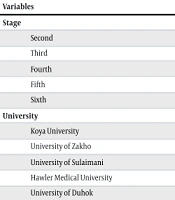
The demographic characteristics of the participants are summarized in Table 1. The largest proportion of students was from Koya University, followed by the Universities of Sulaimani and Duhok, Zakho University, and Hawler Medical University. The sample was nearly gender-balanced, with a slight predominance of male students. Most participants were aged 21 - 24 years. Students in advanced clinical stages constituted most of the sample, particularly fourth-, fifth-, and sixth-year students.
Table 1.
Demographic Characteristics of the Participants
| Variables | No. (%) |
|---|---|
| Stage | |
| Second | 8 (3.8) |
| Third | 14 (6.7) |
| Fourth | 73 (34.8) |
| Fifth | 52 (24.8) |
| Sixth | 63 (30.0) |
| University | |
| Koya University | 68 (32.4) |
| University of Zakho | 39 (18.6) |
| University of Sulaimani | 43 (20.5) |
| Hawler Medical University | 17 (8.1) |
| University of Duhok | 43 (20.5) |
| Gender | |
| Female | 100 (47.6) |
| Male | 110 (52.4) |
| Age group (y) | |
| 18 - 20 | 20 (9.5) |
| 21 - 24 | 167 (79.5) |
| ≥ 25 | 23 (11.0) |
4.2. Logbook Use, Characteristics, and Perceived Educational Benefits
Logbook utilization patterns and perceived benefits are presented in Table 2. Nearly two-thirds of students reported maintaining their logbooks regularly, whereas more than one-third completed them primarily before assessments. Approximately half perceived the logbook template as clear and easy to use, whereas others considered it improvable or unclear. Similar proportions indicated that the logbook adequately covered essential training components, although some believed that additional content was needed.
Table 2.
Logbook Use, Characteristics, and Perceived Educational Benefits
| Variables and Responses | No. |
|---|---|
| Logbook Use | |
| Keep logbook regularly | |
| Yes | 134 (63.8) |
| Catch up before assessment | 76 (36.2) |
| Template clarity | |
| Clear | 99 (47.1) |
| Adequate but improvable | 68 (32.4) |
| Unclear | 43 (20.5) |
| Coverage of training | |
| Yes | 97 (46.2) |
| Could include more | 66 (31.4) |
| Missing topics | 47 (22.4) |
| Perceived Benefits | |
| Helps achieve learning aims | |
| Yes | 134 (63.8) |
| No | 49 (23.3) |
| Not sure | 27 (12.9) |
| Main benefit | |
| Monitoring skills | 154 (73.3) |
| Exam preparation | 56 (26.7) |
| Improves interaction | |
| Yes | 123 (58.6) |
| Confidence after training | |
| Yes | 118 (56.2) |
| Training Impact | |
| Summer training beneficial | |
| Yes | 147 (70.0) |
| Influenced specialty choice | |
| Yes | 112 (53.3) |
Regarding educational value, most students reported that logbooks helped them achieve learning objectives, primarily by monitoring clinical skill development. More than half indicated that logbooks improved patient and peer interactions and enhanced self-confidence after training. Summer training was widely perceived as beneficial, and more than half of students reported that it influenced their specialty preferences.
4.3. Thematic Categorization of Logbook Experience
Qualitative findings related to rewarding stages, challenges, and professional development are summarized in Table 3.
Table 3.
Thematic Categorization of Logbook Experience
| Variables | No. (%) |
|---|---|
| Section A. Most Rewarding Stages | |
| Stage 4 | 66 (31.4) |
| Stages 4 - 6 | 33 (15.7) |
| Stage 6 | 27 (12.9) |
| Others/mixed | Remaining categories |
| Section B. Difficulties Reported | |
| Lack of time | 114 (54.3) |
| Noncooperative individuals | 67 (31.9) |
| Unclear guidelines | 52 (24.8) |
| Recall difficulty | 44 (21.0) |
| Other minor issues | - |
| Section C. Personal and Professional Development Themes | |
| Clinical confidence | 24 (11.4) |
| History-taking and documentation | 22 (10.5) |
| Communication skills | 21 (10.0) |
| Learning and reflection | 19 (9.0) |
| Negative feedback | 42 (20.0) |
Students most frequently identified Stage 4 as the most rewarding period for logbook completion, followed by combinations of later clinical stages.
The most commonly reported challenge was insufficient time to complete entries. Other difficulties included noncooperative individuals, unclear guidelines, and difficulty in recalling clinical case details.
Regarding personal and professional development, students highlighted improvements in clinical confidence, communication skills, and history-taking/documentation abilities. However, some responses reflected negative perceptions, describing logbook use as burdensome or overly bureaucratic.
Representative quotations further illustrate these themes. One fourth-year student stated, "Writing cases in the logbook helped me feel more confident when interacting with patients." Conversely, a sixth-year student commented, "Sometimes the logbook feels like paperwork rather than meaningful learning."
These quotations reflect the dual perception of logbooks as both developmental and, at times, bureaucratic tools.
4.4. Satisfaction, Recommendation, and Suggested Improvements
Overall satisfaction levels and recommendations are shown in Table 4. Student satisfaction varied, with the largest proportion reporting neutral attitudes. Nevertheless, most students recommended continued use of logbooks and expressed support for ongoing summer training.
Table 4.
Satisfaction, Recommendation, and Suggested Improvements a
| Variables | Values |
|---|---|
| Section A. Overall Satisfaction | |
| Very satisfied | 20 (9.5) |
| Satisfied | 55 (26.2) |
| Neutral | 79 (37.6) |
| Dissatisfied | 31 (14.8) |
| Very dissatisfied | 25 (11.9) |
| Section B. Recommendation (Yes) | |
| Recommend logbooks | 61.9 |
| Prefer summer training | 66.7 |
| Section C. Suggested Improvements | |
| Simplified design | 20 (9.5) |
| Clearer instructions | 14 (6.7) |
| Digitization | 9 (4.3) |
| Positive comments | 23 (11.0) |
| Negative feedback | 25 (11.9) |
a Values are expressed as No. (%) or percentage.
Regarding suggested improvements, the most common recommendations included simplifying the logbook design, providing clearer instructions, and transitioning toward electronic formats. A smaller proportion of responses reflected either positive reinforcement or critical feedback.
4.5. Factors Associated with Satisfaction
Results of the ordinal logistic regression analysis are presented in Table 5.
Table 5.
Ordinal Regression of Satisfaction with Logbook Experience
| Predictor | Coefficient (β) | 95% CI (Lower-Upper) | P-Value | Interpretation |
|---|---|---|---|---|
| Keep logbook regularly | +0.98 | 0.36 - 1.61 | 0.002 | Students who kept logbooks regularly were significantly more likely to report higher satisfaction. |
| Template clarity | +1.04 | 0.46 - 1.63 | < 0.001 | Clearer templates were strongly associated with higher satisfaction. |
| Difficulty | ||||
| Lack of time | -0.27 | -0.84 to 0.31 | 0.365 | Not significant. |
| Unclear guidelines | -0.66 | -1.24 to -0.08 | 0.025 | Students who reported unclear guidelines were significantly less satisfied. |
| Recalling details | -0.68 | -1.27 to -0.08 | 0.026 | Forgetting case details significantly lowered satisfaction. |
| Stages (y) | ||||
| Sixth | -0.80 | -1.58 to -0.03 | 0.043 | Sixth-year students were less satisfied than fourth-year students. |
| Fifth | -0.77 | -1.52 to -0.02 | 0.044 | Fifth-year students also showed lower satisfaction compared with fourth-year students. |
| Second | +2.50 | +0.69 to +4.31 | 0.007 | Second-year students were more satisfied, likely because of the novelty of exposure. |
| Third | +1.37 | +0.04 to +2.70 | 0.044 | Third-year students showed higher satisfaction compared with fourth-year students. |
| University | ||||
| Duhok | -1.41 | -2.30 to -0.53 | 0.002 | Students from Duhok reported significantly lower satisfaction. |
| Hawler | -1.72 | -2.94 to -0.50 | 0.006 | Students from Hawler reported significantly lower satisfaction. |
| Koya | -0.76 | -1.63 to 0.12 | 0.090 | Not significant. |
| Sulaimani | -0.63 | -1.51 to 0.26 | 0.166 | Not significant. |
| Gender (male) | -0.05 | -0.60 to 0.49 | 0.847 | No significant difference was observed between male and female students. |
| Age (21 - 24, ≥ 25) | - | CIs crossed 0 | > 0.40 | Age group did not affect satisfaction. |
Regular logbook use and template clarity were significant positive predictors of higher satisfaction. In contrast, reporting unclear guidelines and difficulty in recalling case details were associated with significantly lower satisfaction. Although lack of time was the most frequently reported difficulty, it was not statistically associated with satisfaction.
Academic stage influenced satisfaction levels. Compared with fourth-year students, who served as the reference category, fifth- and sixth-year students reported significantly lower satisfaction, whereas second- and third-year students were more likely to report higher satisfaction.
Institutional differences were also observed. Students from Duhok and Hawler Medical University reported significantly lower satisfaction compared with the reference university. Gender and age group were not significantly associated with satisfaction.
4.6. Factors Associated With Recommendation of Logbooks
Binary logistic regression findings are presented in Table 6.
Table 6.
Binary Logistic Regression of Recommendation of Logbooks
| Predictor | Odds Ratio (OR) | 95% CI (Lower - Upper) | P-Value | Interpretation |
|---|---|---|---|---|
| Keep logbook regularly | 1.59 | 0.79 - 3.20 | 0.196 | Students who kept logbooks regularly were somewhat more likely to recommend them, but the effect was not statistically significant. |
| Template clarity | 1.14 | 0.58 - 2.24 | 0.695 | Clear templates showed no significant association with recommendation. |
| Difficulty | ||||
| Lack of time | 0.60 | 0.30 - 1.19 | 0.144 | Students reporting time difficulties were less likely to recommend logbooks, but not significantly. |
| Unclear guidelines | 0.59 | 0.30 - 1.16 | 0.127 | Those facing unclear guidelines were less likely to recommend logbooks, but not significantly. |
| Recalling details | 0.75 | 0.38 - 1.48 | 0.402 | Not significant. |
| Stages (y) | ||||
| late (5th-6th) | 0.32 | 0.07 - 1.57 | 0.160 | Senior students were less likely to recommend logbooks, but this effect was not significant. |
| middle (4th) | 0.99 | 0.20 - 4.83 | 0.987 | No difference was observed compared with early years. |
| University | ||||
| Hawler | 0.15 | 0.03 - 0.68 | 0.013 | Students from Hawler Medical University were significantly less likely to recommend logbooks compared with the reference university. |
| Duhok | 0.42 | 0.15 - 1.19 | 0.102 | A trend toward lower recommendation was observed, but it was not significant. |
| Koya | 0.70 | 0.23 - 2.08 | 0.517 | Not significant. |
| Sulaimani | 0.58 | 0.20 - 1.70 | 0.319 | Not significant. |
| Gender (male) | 0.94 | 0.48 - 1.82 | 0.846 | No difference was observed between male and female students. |
| Age | ||||
| 21 - 24 | 1.81 | 0.46 - 7.11 | 0.393 | Not significant. |
| ≥ 25 | 2.94 | 0.40 - 21.85 | 0.291 | Not significant. |
Institutional affiliation emerged as the strongest predictor of recommendation. Students from Hawler Medical University were significantly less likely to recommend logbooks compared with the reference university. Although students from Duhok demonstrated a trend toward lower recommendation, this association was not statistically significant.
Other factors, including regular logbook use, template clarity, reported difficulties, academic stage, gender, and age, were not significantly associated with recommending logbooks.
5. Discussion
This study explored the use of paper and electronic logbooks among medical students in the Kurdistan Region of Iraq, providing new insights into their perceived benefits, challenges, and overall effectiveness. The findings indicate that logbooks are valuable educational tools, particularly for enhancing students’ clinical skills, confidence, and communication. Approximately two-thirds of students reported that logbooks helped them achieve learning objectives, and nearly three-quarters recognized their value in tracking clinical progress. These results align with previous research highlighting logbooks as tools that promote reflective learning, accountability, and structured skills acquisition (13, 14).
Beyond procedural skill acquisition, educational research among medical students has shown that knowledge and attitudinal factors significantly influence professional behaviors and preventive practices (15). This underscores that structured educational tools, such as logbooks, may extend their impact beyond documentation by shaping students’ learning attitudes and engagement with clinical responsibilities.
In relation to the study objectives, the findings confirm that logbooks positively influence clinical skill development and self-confidence (Objective 1), while also revealing substantial implementation challenges, such as time constraints and unclear guidelines (Objective 2). Furthermore, multivariable regression analyses identified regular logbook use and template clarity as significant predictors of satisfaction, whereas unclear guidance and recall difficulties were associated with lower satisfaction (Objective 3). These findings support the prespecified hypotheses and provide empirical evidence to inform targeted institutional improvements.
5.1. Clinical Stages and Educational Value
Students identified the later clinical stages (4 - 6) as the most rewarding for logbook use, reflecting higher patient exposure and greater procedural responsibilities at these levels. This trend corresponds with international evidence that advanced clinical years provide more meaningful opportunities for experiential learning with structured logbooks (16, 17). Conversely, earlier stages (2 - 3) were perceived as less beneficial because of limited clinical engagement. This finding suggests the need for stage-specific adaptations, including simplified logbooks for early exposure and more comprehensive formats for advanced years.
5.2. Challenges in Logbook Implementation
Despite the benefits, students faced notable barriers. The most common issues included insufficient time for documentation, unclear guidelines, and difficulty recalling case details. These challenges mirror global findings in which students perceive logbooks as time-consuming and, at times, bureaucratic (18, 19). Without clear instructions and supervisory involvement, logbooks risk being reduced to administrative exercises rather than effective learning tools (20).
Faculty engagement therefore plays a critical role in supporting logbook use. Regular supervision, structured feedback, and integration into clinical teaching are necessary to maximize its value. Institutional-level reforms should focus on clearer templates, defined expectations, and streamlined processes that reduce unnecessary workload.
5.3. Student Satisfaction and Acceptance
Although most students acknowledged the usefulness of logbooks, satisfaction levels varied. More than one-third reported neutral feelings, whereas nearly one-quarter expressed dissatisfaction. This pattern reflects mixed global experiences in medical, nursing, and midwifery education, where logbooks are useful but often require refinement to meet learners’ needs (11, 21, 22).
Psychological and contextual factors may also shape students’ perceptions of educational tools. Research on medical students’ professional quality of life has demonstrated that psychological self-care and emotional well-being are significant predictors of professional satisfaction and resilience (23). In this context, logbooks may contribute not only to technical competence but also to professional identity development and perceived preparedness, particularly when supported by structured supervision and feedback.
The finding that more than 60% of students still recommended logbooks for future cohorts suggests that, despite limitations, their perceived benefits outweigh their drawbacks.
5.4. Preference for Electronic Logbooks
A substantial number of students recommended transitioning to electronic logbooks, consistent with evidence that digital platforms improve accessibility, reduce paperwork, and enable real-time monitoring and feedback (24). However, successful implementation in the Kurdistan Region will require investment in infrastructure, faculty training, and adaptation to local contexts to avoid reinforcing existing barriers.
5.5. Summer Training and Professional Development
Summer training emerged as another influential factor, with many students reporting increased confidence, pride, and even changes in specialty preference. Integrating logbooks with structured summer training reinforces their potential as tools for both clinical competence and professional identity formation. Previous studies emphasize that logbooks are most effective when aligned with authentic clinical experiences and contextual realities (25). The integration of quantitative and qualitative findings demonstrated convergence across data sources. Although regression analyses identified template clarity and regular use as significant predictors of satisfaction, qualitative responses provided contextual explanations, indicating that unclear expectations and administrative burden contributed to dissatisfaction. This triangulation strengthens confidence in the findings and supports targeted institutional improvements.
5.6. Strengths and Limitations
This study has several strengths. The mixed-methods approach captured both quantitative trends and qualitative insights, while the inclusion of students from seven universities increased sample diversity. The balanced gender distribution and representation across clinical stages enabled meaningful subgroup comparisons.
Nonetheless, limitations must be acknowledged. Reliance on convenience sampling may introduce selection bias and limit generalizability beyond the study population. The self-administered questionnaire carries risks of recall bias and socially desirable responses, which may have resulted in information bias. In addition, the overrepresentation of students in later clinical stages may have skewed the findings toward more advanced experiences. Residual confounding may also exist despite multivariable analysis, as unmeasured factors such as academic performance or faculty engagement were not assessed. Finally, the cross-sectional design precludes causal conclusions about the long-term impact of logbook use and limits temporal inference.
Regarding external validity, the inclusion of seven universities across the Kurdistan Region enhances the contextual representativeness of the findings within this region. However, variations in institutional policies, supervision models, and technological infrastructure may limit extrapolation to other regions of Iraq or to different health care education systems. The findings may be more applicable to similar resource-limited educational contexts than to highly digitalized training environments.
5.7. Conclusions
Logbooks are valuable tools in medical training in the Kurdistan Region of Iraq, particularly during advanced clinical stages, where they support reflective practice, clinical skill monitoring, and confidence development. However, their effectiveness is limited by time constraints, unclear guidelines, and perceptions of administrative burden. Despite these challenges, most students recommend continued use of logbooks. Standardization of content, stronger faculty engagement, and adoption of electronic formats are essential to maximize their educational value. Future longitudinal studies are needed to assess their long-term impact on clinical competence and professional development.