
1. Background
Clinical training in radiology is a cornerstone of medical education, bridging theoretical knowledge and practical diagnostic competence (1, 2). The effectiveness of this training depends not only on curriculum design, faculty supervision, and patient volume but also on the reliability and performance of imaging equipment used in daily clinical care (3, 4). Modern diagnostic modalities, including multislice spiral CT, advanced MRI systems, and digital radiography platforms, have evolved rapidly over the past two decades, substantially enhancing diagnostic capabilities while increasing expectations for consistent image quality, standardized acquisition protocols, and minimal equipment downtime in teaching hospitals (5).
The association between imaging equipment management and educational outcomes is increasingly recognized in the literature. Contemporary radiology residency programs require access to fully functional, properly calibrated equipment to ensure that residents are exposed to high-quality diagnostic studies and develop competencies in protocol optimization, artifact recognition, and image interpretation under real-world conditions (6, 7). When equipment fails to meet these standards, the educational experience is compromised: residents may have reduced exposure to diagnostically adequate studies, experience workflow interruptions that disrupt structured learning, and have fewer opportunities to practice the nuanced decision-making required for optimal imaging (8, 9).
Infrastructure disparities in imaging capacity remain a major global concern. International data from organizations such as the Organization for Economic Co-operation and Development (OECD) have documented substantial variations in CT and MRI equipment density across countries, with equipment availability often failing to align with population health needs (10). Even when equipment quantity appears adequate, the age profile of existing devices and gaps in preventive maintenance can substantially undermine system effectiveness. Studies from middle-income settings have highlighted concerns regarding the high proportion of aging imaging equipment in public and teaching facilities, where replacement cycles frequently exceed manufacturer-recommended useful-life expectations (11).
From an educational perspective, equipment malfunction, reduced calibration accuracy, and inconsistent quality assurance protocols can have cascading effects that extend beyond technical concerns. Poor image quality resulting from inadequate equipment performance necessitates repeat exposures, which not only increase patient radiation dose but also disrupt structured training schedules and reduce the educational value of each clinical encounter (12). High reject rates attributable to equipment-related factors can adversely affect resident learning if they are not systematically identified and addressed through robust quality control programs (13, 14).
2. Objectives
In light of these considerations, this cross-sectional study aimed to examine the association between CT equipment maintenance management metrics, including repair time, costs, and preventive maintenance ratios, and radiology residents’ educational satisfaction in teaching hospitals. Specifically, we evaluated whether institutions reporting more proactive maintenance strategies and lower equipment downtime reported higher levels of resident satisfaction with their clinical training environment.
3. Methods
3.1. Study Design and Setting
This descriptive study used a cross-sectional design. The research setting included university-affiliated teaching hospitals across seven provinces, in collaboration with the Deputy Offices for Treatment and Food and Drug Affairs of the participating Universities of Medical Sciences. This study was approved by the Ethics Committee of Kermanshah University of Medical Sciences (Approval Code: IR.KUMS.REC.1402.036). All participants provided informed consent, and institutional confidentiality was maintained through de-identification of hospital and participant data in accordance with the approved protocol.
The study population comprised 30 medical equipment experts purposively selected from seven university hospitals and from the Deputy for Treatment and the Deputy for Food and Drug of the country's Universities of Medical Sciences. Of the 30 medical equipment experts, five hospitals had 4 experts each (5 × 4 = 20), and two hospitals had 5 experts each (2 × 5 = 10); thus, the difference in expert counts between any two hospitals was at most one. The hospitals were selected from seven different provinces with a relatively uniform geographical distribution nationwide. A purposive sampling strategy was used to ensure representation across major geographical regions. "Uniform geographical distribution" was operationally defined as selecting one tertiary-level university teaching hospital from each of seven distinct provinces spanning northern, southern, eastern, western, and central areas of the country, to minimize regional bias in equipment maintenance practices.
All participating sites were accredited teaching hospitals with established radiology residency programs. To balance institutional confidentiality with scientific transparency, aggregated and de-identified facility characteristics are reported. Each hospital operated 1 - 3 CT scanners, with equipment ages ranging from 2 to 15 years. Annual CT examination volumes ranged from 6,200 to 18,500 procedures, and each site trained between 5 and 8 radiology residents annually across all training years. Given administrative and logistical constraints, a national census was not feasible; therefore, purposive sampling was used to identify institutions with accessible maintenance records and active clinical training programs.
In accordance with the approved ethical protocol (IR.KUMS.REC.1402.036), all institutional identifiers were removed to protect organizational privacy and prevent potential administrative repercussions. However, de-identified operational and demographic data were systematically retained and reported to satisfy STROBE requirements for reproducibility, methodological transparency, and cross-study comparability. In addition, all hospitals had comparable conditions in terms of bed distribution and the number of CT scanners. Radiology residents were trained at these hospitals. Expert questionnaire data, maintenance records, and resident satisfaction data were matched by hospital identifier. Due to existing sensitivities, participants' occupational positions, and ethical commitments, more detailed information about the research setting is not reported.
3.2. Data Collection Instruments
Data collection instruments included a questionnaire, observation, and review of documents and records. The 46-item questionnaire was structured across five domains: 1) maintenance management and organization (10 items), 2) planning and coordination with higher authorities (9 items), 3) equipment selection and procurement (8 items), 4) quality control and evaluation (11 items), and 5) repair processes (8 items). Each item was scored on a 5-point Likert scale, ranging from 1 = strongly disagree to 5 = strongly agree. Domain scores were calculated as the mean of constituent items, yielding a possible range of 1 - 5 per domain. For interpretation, scores were categorized as follows: 1.00 - 2.49 = poor management practice, 2.50 - 3.49 = moderate practice, and 3.50 - 5.00 = optimal practice. Higher scores indicated more favorable equipment-management processes.
Content validity was established through a panel of experts comprising three radiology program directors, two medical education specialists, and four biomedical engineering faculty members. The Content Validity Index (CVI) and Content Validity Ratio (CVR) were calculated for each item, yielding an overall scale CVI of 0.88 and CVR of 0.75, indicating acceptable content validity. To assess reliability, a test-retest method was used with a 10-day interval among 10 experts not included in the main study. The internal consistency of the questionnaire was assessed using Cronbach's alpha, which yielded a coefficient of 0.87, indicating high reliability. The intraclass correlation coefficient (ICC) for test-retest reliability was 0.89. Domain scores were calculated as the mean of constituent items, with higher scores reflecting more favorable equipment-management practices.
To assess satisfaction with CT-related training, a nationwide survey was conducted among 48 radiology residents. Residents were asked to respond to the following primary item: "Overall, how satisfied are you with the quality, availability, and hands-on training opportunities related to CT scanner operation during your clinical rotation?" To capture multidimensional aspects of the training experience, three supplementary items assessed: 1) exposure to standardized acquisition protocols, 2) frequency of supervised scanning practice, and 3) consistency of image quality and equipment readiness. Responses to these items were aggregated into a composite CT-related educational satisfaction score on a 1 - 10 scale.
The satisfaction instrument was developed specifically for this study based on a review of established radiology training evaluation frameworks. Content and face validity were confirmed through expert review by three radiology program directors and two medical education specialists. A pilot test (n = 10) was conducted among residents not included in the final sample, yielding a Cronbach's alpha of 0.84, indicating acceptable internal consistency. The instrument was administered anonymously to minimize response bias. The respondent cohort comprised radiology residents across all training years. At the time of survey administration, a proportion of residents were actively rotating through the CT imaging unit, while others reported having accumulated at least 3 months of CT scanner exposure during their training.
Data were collected anonymously via a secure institutional platform to ensure participant confidentiality. Demographic characteristics and training-exposure variables, including residency year and clinical rotation history, were examined to assess potential confounding effects on educational satisfaction scores. All maintenance metrics were extracted from institutional records covering a 24-month period from March 2021 to February 2023, corresponding to the Iranian calendar years 1401 - 1402. This time window was selected to capture a complete cycle of seasonal variation in equipment utilization while ensuring data completeness across all participating hospitals.
3.3. Process Implementation
The questionnaire was developed through library- and internet-based searches, and its validity was confirmed using specialized texts and by collecting the opinions of faculty members and experts. After the questionnaire was designed, a test-retest method was applied to establish confidence in the data collection tool. Accordingly, after 10 questionnaires were distributed, the same questionnaires were redistributed and collected again after a 10-day interval. The questionnaire demonstrated high internal consistency (Cronbach's α = 0.87) and stability over time (ICC = 0.89), confirming its suitability for data collection.
On a specified date, the questionnaires were distributed to the study population and, based on participants' agreement, were collected by the researchers on the predetermined date. Participants were assured that their information would remain confidential and that no identifying information would be reported that could disclose their identity or jeopardize their occupational position. In addition, based on the documentation obtained from these educational centers, RC, CT, MTTR, and the ratio of preventive programs to total repairs (PM) were calculated. Three key maintenance metrics were extracted from institutional records for each hospital:
1) MTTR was defined as the average duration from equipment failure notification to full operational restoration, calculated as:
MTTR = Σ(Repair completion time - Failure report time) / Total number of repair events
Units: hours per repair event. For analysis, MTTR values were aggregated at the hospital level over the study period.
2) RC was defined as the total direct expenditure incurred for unscheduled repairs, including parts, labor, and external service contracts, calculated as:
Units: local currency (IRR). Costs were adjusted for inflation using the national consumer price index to ensure comparability across the study period.
3) The PM ratio was defined as the proportion of scheduled preventive maintenance activities relative to total maintenance interventions, including preventive and corrective interventions, calculated as:
Units: percentage (%). A higher PM ratio indicates a more proactive maintenance strategy.
The 48 radiology residents in the educational centers were asked to rate their views regarding CT-related educational satisfaction on a scale from 1 = dissatisfied to 10 = complete satisfaction. The distribution of radiology residents across the seven university hospitals was as follows: six hospitals had 7 residents each (6 × 7 = 42), and one hospital had 6 residents (1 × 6 = 6). The difference in resident counts between any two hospitals was at most one. All residents were assured that their information would remain confidential. Ultimately, the mean score of CT-related educational satisfaction was calculated for each teaching hospital.
3.4. Evaluation and Statistical Analysis
Data analysis of the 30 completed questionnaires was performed using descriptive statistics and appropriate software, including SPSS and Matlab. For analysis, items were scored on a 5-point scale, with a maximum score of 5 and a minimum score of 1 for each question. The statement obtaining the highest score was considered the medical equipment authorities' proposed recommendation. Furthermore, associations between repair metrics and mean resident evaluation scores were calculated to examine the effect of downtime duration on radiology residents' educational satisfaction.
Before calculating the Pearson correlation coefficient, assumptions of linearity and normality were assessed using scatterplot visualization and Shapiro-Wilk tests for the aggregated hospital-level variables. Given the small sample size (n = 7) and potential deviation from normality, a sensitivity analysis was also conducted using Spearman's rank-order correlation. The Spearman correlation coefficient was ρ = -0.857 (P = 0.018), consistent in direction and magnitude with the Pearson result, supporting the robustness of the observed inverse association.
The primary unit of analysis for the correlation between equipment maintenance metrics and educational satisfaction was the hospital level (n = 7). For each participating hospital, data were aggregated from three sources: 1) maintenance records (MTTR, CR, and PM) were extracted and averaged across the 24-month study period, 2) expert questionnaire responses (n = 4 - 5 per hospital) were averaged to produce a consensus-based assessment of equipment-management practices, and 3) resident satisfaction scores (n = 6 - 7 per hospital) were averaged to generate a hospital-level mean satisfaction score. All linkage was performed using de-identified hospital codes to preserve institutional confidentiality. Consequently, the Pearson correlation coefficient (r = -0.875; P = 0.012) reflects the association between hospital-aggregated CT downtime and hospital-aggregated resident satisfaction across seven independent institutions.
4. Results
Using medical equipment documentation, imaging center records, and input from biomedical equipment experts, the total CT scanner repair and recovery time was calculated for each hospital; the results are presented in Figure 1. In this figure, the horizontal axis represents the hospitals, and the vertical axis indicates the total CT scanner repair and recovery time for each hospital. The results also present the mean scores for each of the five questionnaire domains. Overall, Domain 4, quality control and evaluation, received the highest mean score (3.82 ± 0.61), indicating relatively strong practices in this area, whereas Domain 2, planning and coordination, had the lowest score (2.91 ± 0.74), suggesting opportunities to improve interdepartmental communication.
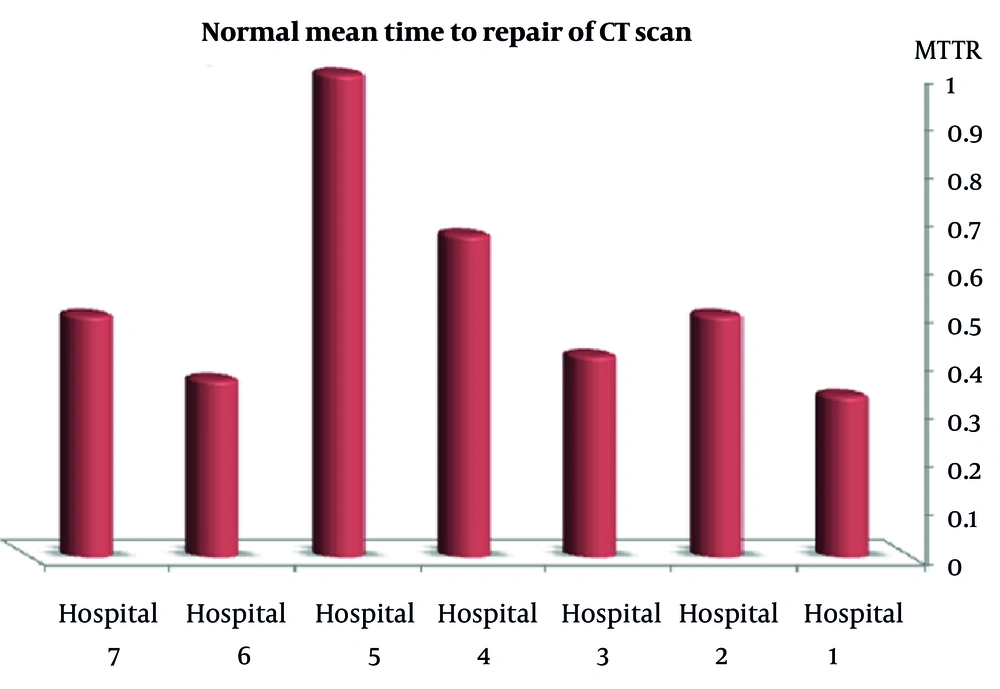
Figure 1.
Normalized chart of CT scanner MTTR for all hospitals. Values represent MTTR (in hours per repair event) normalized to a 0 - 1 scale using min-max scaling to facilitate visual comparison across hospitals with different absolute downtime magnitudes.
Similarly, using data from the same sources, the ratio of preventive maintenance programs to total CT scanner repairs was determined for all hospitals, as shown in Figure 2. The horizontal axis denotes the hospitals, and the vertical axis represents the ratio of preventive maintenance programs to total repairs for each hospital.
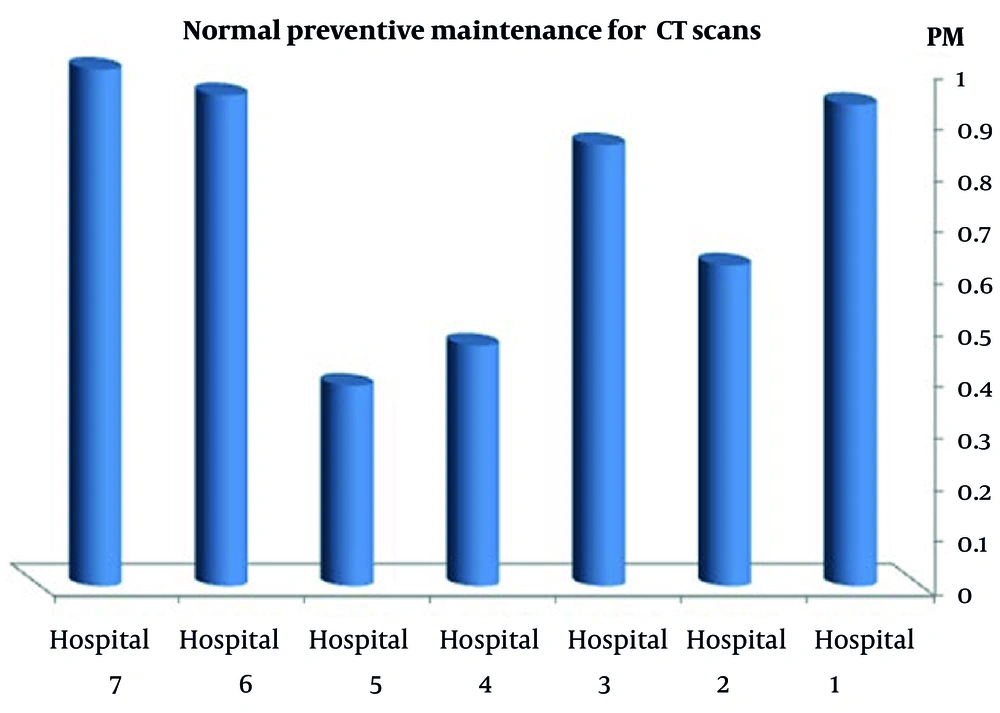
Figure 2.
Normalized Preventive Maintenance Ratio (PM) for the CT scanner across all hospitals. PM is expressed as the percentage of scheduled preventive activities relative to total maintenance interventions.
The total cost of CT scanner repair and recovery across all participating hospitals was calculated based on medical equipment documentation, imaging center records, and expert input. These results are presented in Figure 3, in which the horizontal axis represents the hospitals and the vertical axis shows the total repair and recovery cost for each hospital.
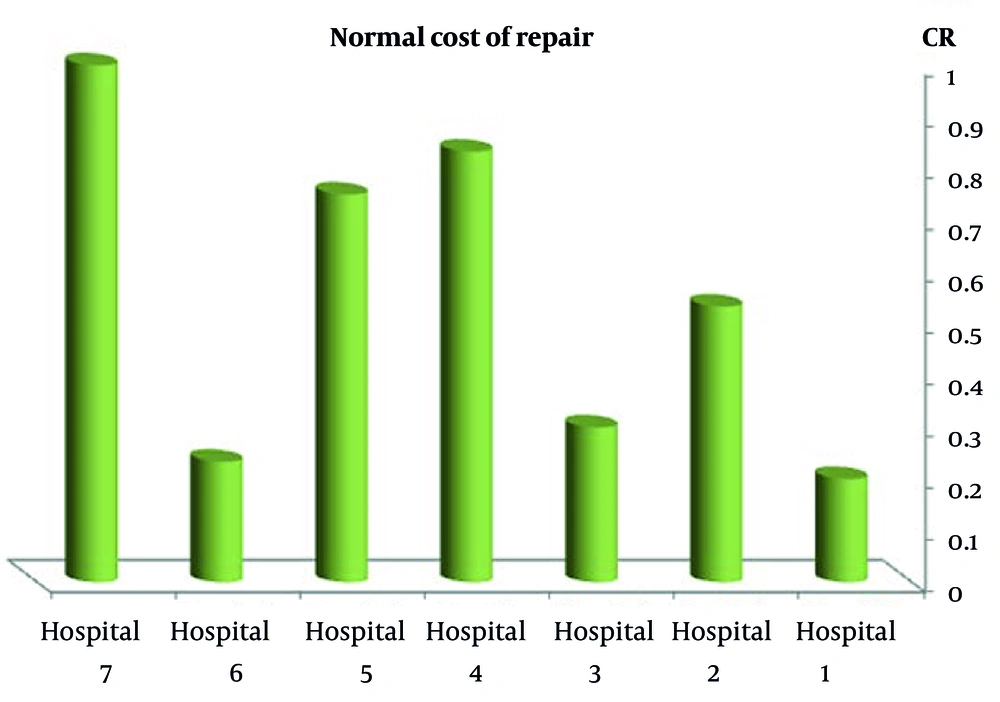
Figure 3.
Distribution of total CR for CT scanners among the studied hospitals. Costs are reported in millions of Iranian Rials (×106 IRR) and adjusted for inflation.
A comparative analysis of cost, the ratio of preventive maintenance to total repairs, and CT scanner repair time was conducted for all hospitals. To facilitate comparison, these results are consolidated and presented in Figure 4. The horizontal axis represents the hospitals, and the vertical axis shows the normalized values for cost, the number of CT repairs, and repair time for each hospital.
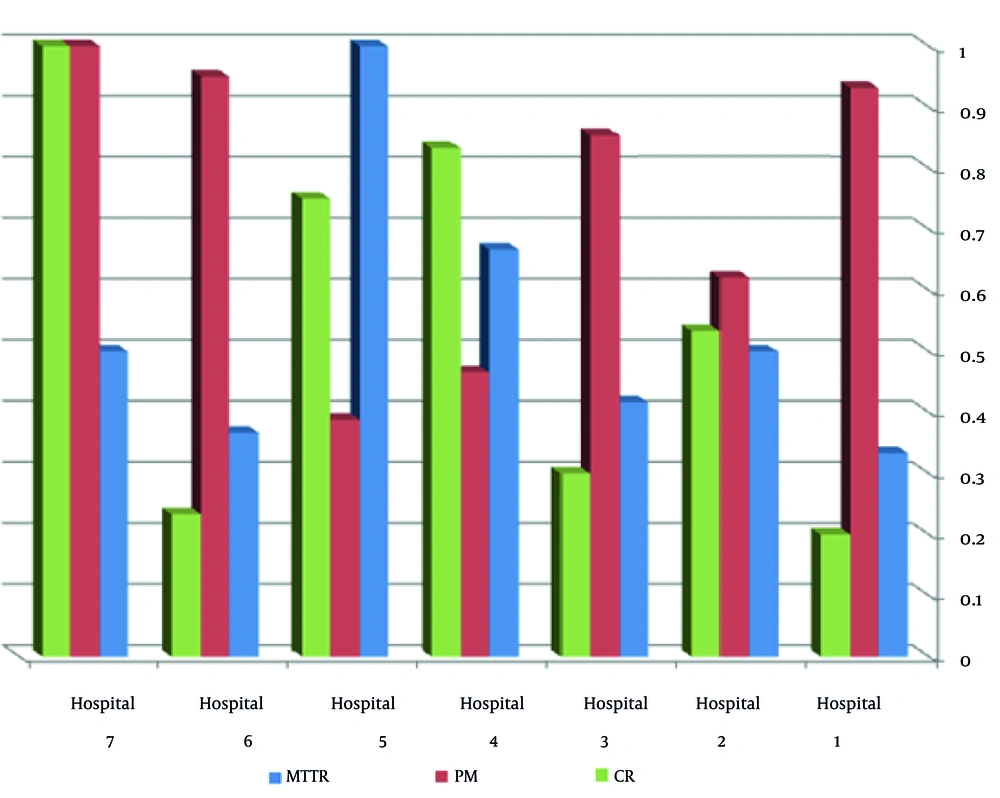
Figure 4.
Comparative bar chart of normalized maintenance metrics (MTTR, CR, PM) for all hospitals.
The mean educational satisfaction score, based on a survey of radiology residents, and the total repair time were calculated for all hospitals. The results are illustrated in Figure 5A. The horizontal axis represents the hospitals, and the vertical axis displays both total repair time and the mean educational satisfaction score for each hospital. The primary correlation analysis was conducted at the hospital level (n = 7). Expert questionnaire data, maintenance records, and resident satisfaction data were matched by hospital identifier. For each hospital, the 4 or 5 biomedical engineering experts provided consensus-based or averaged input on equipment status, such as CT downtime. Resident satisfaction scores were averaged per hospital from the 6 or 7 residents at that hospital. For each hospital, the following variables were calculated: 1) average CT downtime, based on maintenance records and expert input, and 2) average resident satisfaction score, aggregated from individual resident ratings within that hospital.
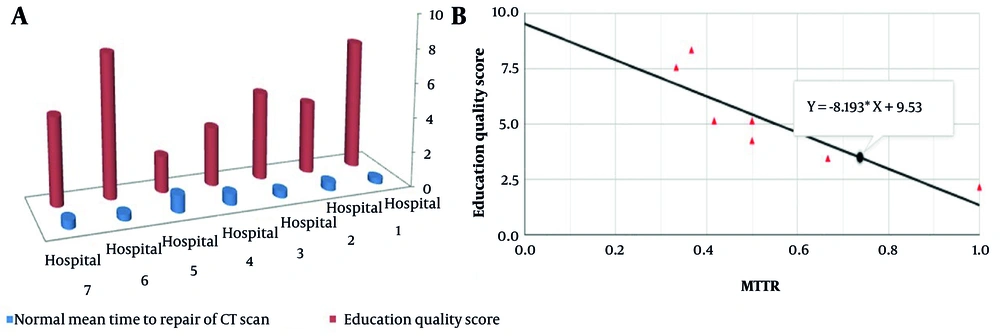
Figure 5.
Scatter plot illustrating the correlation between resident educational satisfaction scores and total CT scanner downtime. Each point represents one hospital (n = 7), with coordinates corresponding to the hospital-level mean satisfaction score (y-axis) and mean MTTR (x-axis). The solid line represents the linear regression fit; the shaded area indicates the 95% confidence interval.
The correlation analysis was conducted at the hospital level (n = 7), with each data point representing the aggregated mean CT downtime and mean resident satisfaction score for a single institution. The Pearson correlation coefficient was r = -0.875 (95% CI, -0.982 to -0.321; P = 0.012), indicating a strong inverse association between equipment downtime and educational satisfaction. The wide confidence interval reflects the limited sample size and underscores the need for cautious interpretation. These results indicate a significant inverse relationship between the mean educational satisfaction of residents and CT scanner downtime. To evaluate the potential influence of individual hospitals on the observed correlation, Cook's distance and leverage values were calculated for each data point. No hospital exceeded the conventional threshold for influential outliers (Cook's distance > 0.57), suggesting that the correlation was not driven by a single extreme observation. Nevertheless, given the small sample size, the estimate remains sensitive to the inclusion or exclusion of any individual institution.
The correlation analysis was conducted at the hospital level (n = 7), with each data point representing the aggregated mean CT downtime and mean resident satisfaction score for a single institution. The Pearson correlation coefficient was r = -0.875 (95% CI, -0.982 to -0.321; P = 0.012), indicating a strong inverse association between equipment downtime and educational satisfaction. The wide confidence interval reflects the limited sample size and underscores the need for cautious interpretation.
5. Discussion
This study provides empirical evidence of a critical but often overlooked link between the operational management of medical technology and the quality of clinical education. The principal finding was a strong, statistically significant negative correlation (r = -0.875; P = 0.012) between CT scanner downtime (MTTR) and radiology residents’ educational satisfaction. This result quantitatively demonstrates that as equipment repair time increases, residents’ perceptions of the quality of their educational experience decrease, with important implications for medical education in technology-dependent specialties.
Given the cross-sectional design of this study, our findings should be interpreted as hypothesis-generating evidence regarding the association between equipment reliability and educational satisfaction. Although the strong inverse correlation suggests that downtime adversely affects the learning environment, causal inference requires longitudinal or interventional studies to confirm whether improvements in maintenance protocols directly enhance educational outcomes.
Our analysis of maintenance metrics across the seven teaching hospitals revealed a significant lack of a standardized strategic approach to equipment management. The wide variation in MTTR, preventive maintenance (PM) ratios, and RC costs (Figures 1-4) indicates that most institutions likely operate within a reactive rather than a proactive maintenance model. For instance, Hospital 7 exhibited both the highest MTTR and the highest repair costs, a classic indicator of a reactive “break-fix” cycle. Notably, Hospital 7 also had a relatively high PM ratio, suggesting that the mere existence of a preventive maintenance program is insufficient. The quality and effectiveness of maintenance, equipment age, and technical staff skills are likely critical mediating factors that determine program success. In contrast, Hospital 1, which showed low MTTR, low costs, and a high PM ratio, exemplifies the optimal outcomes of a well-implemented strategic maintenance framework.
From a pedagogical standpoint, the impact of equipment downtime extends far beyond inconvenience; it directly disrupts the clinical learning environment. Each hour during which a CT scanner is nonoperational represents an hour of lost learning opportunity for residents, limiting hands-on experience, case exposure, and the development of diagnostic confidence. This forced inactivity or reliance on potentially older, lower-quality backup systems can create a stressful and frustrating learning atmosphere. This observation aligns with broader research in medical education identifying the quality of the clinical learning environment as a key determinant of resident well-being and competency development (15-18). Our findings suggest that equipment reliability is a fundamental component of this environment. An unreliable system may inadvertently become part of a “hidden curriculum,” teaching residents to accept technical failures and workarounds as normal, which is contrary to the principles of a high-reliability healthcare organization (19).
The connection between high downtime and low educational satisfaction (Figure 5) is therefore logical. Residents may perceive extended downtime as a devaluation of their training by the institution. It may signal that providing consistent, high-quality educational experiences is a lower priority than managing immediate operational budgets. This perception can erode morale and disengage residents from the learning process. The strong inverse relationship demonstrated in this study provides a clear mandate for academic medical centers: Investing in strategic equipment maintenance is a direct investment in the quality of educational programs and trainee satisfaction.
5.1. Strengths and Limitations
The primary strength of this study lies in its multifaceted approach, combining objective quantitative data, including MTTR, PM, and RC, from institutional records with subjective feedback from the primary learners, namely radiology residents. This dual-source validation strengthens the conclusions. Furthermore, the inclusion of hospitals from seven different provinces enhances the geographical generalizability of the findings within the national context.
However, several limitations must be acknowledged. First, the cross-sectional design allows the establishment of correlation but not causation. Although the link between downtime and dissatisfaction is strong, longitudinal studies are needed to confirm a causal relationship. Second, the sample size, although sufficient for initial correlational analysis, was relatively small (30 experts and 48 residents). A larger, multinational study could provide more robust and generalizable results. Finally, the educational outcome measure was based on resident satisfaction. Future research should incorporate objective measures of clinical competency, such as diagnostic accuracy scores or performance in objective structured clinical examinations (OSCEs), to more directly assess the impact of equipment reliability on learning.
5.2. Implications for Practice and Future Research
The implications of these findings are clear and actionable. Hospital administrators and radiology department chairs in teaching institutions should reframe equipment maintenance from a simple operational expense to a strategic educational investment. This requires the following actions:
1) Implementing effective PM programs by moving beyond reactive repairs toward data-driven preventive maintenance schedules.
2) Establishing benchmarks by setting institutional targets for acceptable MTTR in academic departments.
3) Integrating technical and educational leadership by fostering collaboration between biomedical engineering departments and residency program directors to align maintenance goals with educational needs.
5.3. Conclusions
The discourse on radiology education has traditionally focused on curricular design, assessment methods, and faculty development. This study highlights a frequently overlooked element of the learning ecosystem: the technological environment itself. These cross-sectional findings indicate that the operational reliability of CT scanners is strongly associated with the perceived quality of the clinical learning environment. Institutions characterized by lower equipment downtime and strategic preventive maintenance reported higher resident educational satisfaction. These results suggest that optimizing equipment reliability may reduce system-induced interruptions to the learning process and support a more favorable clinical training experience.
From an educational theory perspective, this research underscores how institutional infrastructure may implicitly shape trainee perceptions. A well-maintained system fosters an environment conducive to structured learning, whereas frequent technical disruptions may negatively influence trainee morale and perceived educational value. This study does not establish causation or measure objective clinical performance; rather, it provides hypothesis-generating evidence that technical operations and clinical pedagogy should be considered in tandem. Future longitudinal or interventional studies are warranted to determine whether targeted improvements in maintenance protocols directly enhance objective training outcomes. Ultimately, recognizing the interplay between equipment reliability and trainee satisfaction may inform more holistic approaches to supporting the medical education environment.