Journal of Semnan University of Medical Sciences
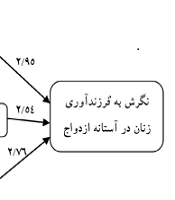
Image Credit:Koomesh
Outline
Attitude Towards Having Children in Women at the Threshold of Marriage in the Southwestern Region of Khuzestan
Authors

Abstract
Background: Reluctance to have children is one of the major challenges facing the world and Iran.
Objectives: Due to the lack of sufficient information regarding the motivation and preferences of young couples regarding fertility, this study was conducted to determine the desire of women on the verge of marriage to have children.
Methods: 252 women on the eve of marriage in Khorramshahr, Abadan & Shadegan cities were selected by convenience sampling method. Information about the attitude toward childbearing was collected using the Attitude Towards Childbearing Questionnaire (AFCS).
Results: The women in the study were on average 25.75 ± 7.97 years old. Most of them lived in the city and half of them were housewives. The score of attitudes toward having children in women aged 40 years and above, women looking for work, and women with Persian and Arab ethnicities were higher than other groups (P < 0.001). Also, women who considered government support "very effective" had a higher
attitude score (P < 0.001). On the other hand, women with "no income" and women with "postgraduate and doctorate" education had a lower attitude score (P ≥ 0.001).
Conclusion: The attitude towards childbearing is positive in most women, but the impact of various personal and social conditions of childbearing is worth considering and requires careful policy-making in this field. It is recommended to strengthen and change childbearing policies in the government according to the provincial conditions (geographical, political, cultural, economic, and welfare conditions).
Highlights
References
- 1.Jalal Abbasi-Shavazi M, McDonald P. Fertility decline in the islamic republic of iran: 1972–2000. Asian Population Stud. 2006;2(3):217-37. https://doi.org/10.1080/17441730601073789.
- 2.Mohammadi M, Rastergarkhaled A. [Cultural changes, and reduce fertility in Iran (Based on second analyze of data of Iranianâs survey values and attitudes)]. J Appl Sociol. 2015;26(2):159-80. Persian.
- 3.Saberi N, Mahmoodi Z, Nasiri M. [Model for the relationship between sexual function and social determinants of health: path analysis]. Koomesh. 2018;20(2):391-402. Persian.
- 4.Schoen R, Astone NM, Kim YJ, Nathanson CA, Fields JM. Do Fertility Intentions Affect Fertility Behavior? J Marriage Fam. 1999;61(3). https://doi.org/10.2307/353578.
- 5.Mehri N, Messkoub M, Kunkel S. Trends, Determinants and the Implications of Population Aging in Iran. Ageing Int. 2020;45(4):327-43. https://doi.org/10.1007/s12126-020-09364-z.
- 6.Bongaarts J. Global fertility and population trends. Seminars Reproductive Med. 2015;33(01). [PubMed ID:25565505]. https://doi.org/10.1055/s-0034-1395272.
- 7.Bagi M. [Childlessness and one-child intentions among recently married couples in Iran]. Payesh (Health Monitor) J. 2022;21(1):69-79. Persian. https://doi.org/10.52547/payesh.21.1.69.
- 8.Aghayari Hir T, Farokhi Nekarestan M, Latifi Mojreh SS. [Childbearing as Risk: (Qualitative Study of Milieu for Bearing Few Children in Tabriz City)]. Women's Strateg Stud. 2016;19(73):7-33. Persian. https://doi.org/10.22095/jwss.2016.44367.
- 9.Hoodfar H, Assadpour S. The politics of population policy in the Islamic Republic of Iran. Stud Fam Plann. 2000;31(1):19-34. [PubMed ID:10765535]. https://doi.org/10.1111/j.1728-4465.2000.00019.x.
- 10.Miller WB, Millstein SG, Pasta DJ. The measurement of childbearing motivation in couples considering the use of assisted reproductive technology. Biodemography Soc Biol. 2008;54(1):8-32. [PubMed ID:19350758]. https://doi.org/10.1080/19485565.2008.9989129.
- 11.Khadivzadeh T, Hadizadeh Talasaz Z, Shakeri MT. [Predicting factors affecting the delay in first childbearing among young married women using the Bandura’s social learning theory]. J Hayat. 2017;23(3):226-42. Persian.
- 12.Kaboudi M, Ramezankhani A, Manouchehri H, Hajizadeh E, Haghi M. [The decision-making process of childbearing: a qualitative study]. Payesh (Health Monitor) J. 2013;12(5):505-15. Persian.
- 13.Foroutan Y, Karami F. [Childbearing Desires in Iran: Patterns and Determinants]. J Population Assoc Iran. 2017;11(22):72-101. Persian.
- 14.Khadivzadeh T, Arghavani E, Shakeri MT. [Relationship between Fertility Motivations and Preferences in Couples]. Iran J Obstetrics, Gynecol Infertility. 2014;17(114):8-18. Persian. https://doi.org/10.22038/ijogi.2014.3414.
- 15.Tavousi M, Motlagh ME, Eslami M, Haerimehrizi A, Hashemi A, Montazeri A. [Fertility desire and its correlates: a pilot study among married citizens living in Tehran, Iran]. Payesh (Health Monitor) J. 2015;14(5):697-702. Persian.
- 16.Eshaghi M, Mohebi SF, Papynezhad S, Jahandar Z. [Childbearing Challenges for Working Women; a Qualitative Study]. Woman Dev Politics. 2014;12(1):111-34. Persian. https://doi.org/10.22059/jwdp.2014.51356.
- 17.Shiri T, Bidarian S. [A survey of the effective economic-demographic factors on the fertility of employed women aged15-49 in education organization-tehran's 22 district]. Garmsar Azad Soc Sci J. 2009;3. Persian.
- 18.Ali Dosti H, Hariri M, Safarian M. [Fertility desire among Kermanshah: Determinants and limitations]. Ferdowsi Univ Mashhad J Soc Sci. 2023;20(1):109-83. Persian. https://doi.org/10.22067/social.2023.79351.1251.
- 19.Keshavarz Z, Abbasi-Shavazi MJ, Ebadi A. [Factors affecting on fertility behavior from the perspective of professionals: A qualitative study]. Koomesh. 2019;21(1):155-63. Persian.
- 20.Savadzadeh S, Madadzadeh N. Explanation of Emotional Feelings of Women with Infertility: A Qualitative Study. J Ilam Univ Med Sci. 2013;21(1):16-24. Persian.
- 21.Bokaie M, Simbar M, Yassini-Ardekani SM. [Social factors affecting the sexual experiences of women faced with infertility: A qualitative study]. koomesh. 2018;20(2):e152953. Persian.
- 22.Soderberg M, Lundgren I, Christensson K, Hildingsson I. Attitudes toward fertility and childbearing scale: an assessment of a new instrument for women who are not yet mothers in Sweden. BMC Pregnancy Childbirth. 2013;13:197. [PubMed ID:24165014]. [PubMed Central ID:PMC4231394]. https://doi.org/10.1186/1471-2393-13-197.
- 23.Kordzanganeh J, Mohamadian H. [Psychometric Assessment of the Validity of the Iranian Version of Attitude Toward Fertility and Childbearing Inventory in Women Without a History of Pregnancy in the South of Iran]. J Sch Public Health Institute Public Health Res. 2019;17(1):83-94. Persian.
- 24.Baezzat F, Ahmadi Ghozlojeh A, Marzbani Y, Karimi A, Azarnioshan B. [A study of psychometric properties of Persian version of attitudes toward fertility and childbearing scale]. Nurs Midwifery J. 2017;15(1):37-47. Persian.
- 25.Pahlavanzade BKM MPaocsiIp.
- 26.Enders CK. Performing Multivariate Group Comparisons Following a Statistically Significant MANOVA. Measurement Evaluat Counseling Dev. 2003;36(1):40-56. https://doi.org/10.1080/07481756.2003.12069079.
- 27.Sharif-Nia H, Ahmadzadeh Tori N, Behmanesh F, Ghaffari F, Pourreza A. Development and psychometric evaluation of the questionnaire on the contributing factors of tendency towards voluntary single-childedness and childlessness: a mixed method study. Sci Rep. 2024;14(1):1305. [PubMed ID:38225376]. [PubMed Central ID:PMC10789787]. https://doi.org/10.1038/s41598-024-51178-5.
- 28.Behmanesh F, Taghizadeh Z, Vedadhir AA, Ebadi A, Pourreza A, Abbasi Shavazi MJ. [Explaining the Causes of Single Child Based on Women's Views: A Qualitative Study]. Iran J Epidemiol. 2019;15(3):279-88. Persian.
- 29.Shapiro G. Voluntary childlessness: A critical review of the literature. Stud Maternal. 2014;6(1). https://doi.org/10.16995/sim.9.
- 30.Ghaffari F, Motaghi Z. [Factors Affecting Childbearing Based On Women's Perspectives: A Qualitative Study]. Navid No. 2021;23(76):33-43. Persian. https://doi.org/10.22038/nnj.2020.52797.1238.
- 31.Graham M, Smith C, Shield M. Women’s attitudes towards children and motherhood: A predictor of future childlessness? J Soc Inclusion. 2015;6(2). https://doi.org/10.36251/josi.81.
- 32.Sorensen NO, Marcussen S, Backhausen MG, Juhl M, Schmidt L, Tyden T, et al. Fertility awareness and attitudes towards parenthood among Danish university college students. Reprod Health. 2016;13(1):146. [PubMed ID:27964723]. [PubMed Central ID:PMC5154162]. https://doi.org/10.1186/s12978-016-0258-1.
- 33.Alijanzadeh M, Bahrami N, Jafari E, Noori M, Miri F, Joftyar M, et al. Iranian women's attitude toward childbearing and its' association with generalized trust, social support, marital satisfaction and governmental childbearing incentives. Heliyon. 2023;9(5):e16162. [PubMed ID:37215895]. [PubMed Central ID:PMC10199260]. https://doi.org/10.1016/j.heliyon.2023.e16162.
- 34.Fakehi M, Hashemnejad MM, Ghanbari S, Hashemi N, Saadati Shamir R, Heidary Z, et al. Nulliparous Women’s Attitudes Toward Fertility and Childbearing in COVID-19 Pandemic. Fertility, Gynecol Androl. 2022;1(1). https://doi.org/10.5812/fga.123477.
- 35.Heiland F, Prskawetz A, Sanderson WC. Are Individuals’ Desired Family Sizes Stable? Evidence from West German Panel Data. Europ J Popul. 2008;24(2):129-56. https://doi.org/10.1007/s10680-008-9162-x.
- 36.Fahlén S, Oláh LS. Economic uncertainty and first-birth intentions in Europe. Demographic Res. 2018;39:795-834. https://doi.org/10.4054/DemRes.2018.39.28.
- 37.Afarini F, Akbari NS, Montazeri A. [The relationship between social support and the intention of childbearing in women of reproductive age]. Payesh (Health Monitor) J. 2018;17(3):315-28. Persian.
- 38.Abbasi A, Sadeghi R, Maleki A, Balakhani G. A meta-analysis of factors related to fertility attitudes, desires, and childbearing intentions in Iranian studies. Interdisciplinary Studies Humanities. 2022;14(4):63-92. https://doi.org/10.22035/isih.2021.4546.4509.
Copyright
© 2024, Author(s). This open-access article is available under the Creative Commons Attribution 4.0 (CC BY 4.0) International License (https://creativecommons.org/licenses/by/4.0/), which allows for unrestricted use, distribution, and reproduction in any medium, provided that the original work is properly cited.
Similar Articles
Socioeconomic, cultural and demographic determinants of childbearing desires among married women attending health centers in Hamedan (2012)
Hosseini H, Bagi B. Socioeconomic, cultural and demographic determinants of childbearing desires among married women attending health centers in Hamedan (2012). J Kermanshah Univ Med Sci. 2014;18(1):e74273. doi: https://doi.org/10.22110/jkums.v18i1.1578
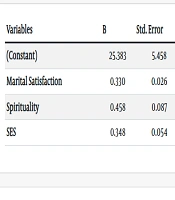
The Role of Spirituality, Marital Satisfaction and Socio-Economic Status on Attitudes Toward Childbearing Among Married Women Without the Intention and History of Pregnancy: A Cross-Sectional Study
Sarsharbeidokhti P, Bagherzadeh Ledari R, Bagheri M. The Role of Spirituality, Marital Satisfaction and Socio-Economic Status on Attitudes Toward Childbearing Among Married Women Without the Intention and History of Pregnancy: A Cross-Sectional Study. J Nurs Midwifery Sci. 2024;11(4):e154615. doi: https://doi.org/10.5812/jnms-154615
Determinants of Fertility Desires and Associated Factors among Married Women Attending Comprehensive Health Centers in Iran
Mohamadloo A. Determinants of Fertility Desires and Associated Factors among Married Women Attending Comprehensive Health Centers in Iran. Health Scope. 2026;15(2):e168296. doi: https://doi.org/10.5812/healthscope-168296
The role of social capital on unwillingness toward childbearing in reproductive-aged women
Yahyanejad A, Hamzegardeshi Z, Mousavinasab SN, Azizi M, Shahhosseini Z. The role of social capital on unwillingness toward childbearing in reproductive-aged women. J Nurs Midwifery Sci. 2022;9(1):e140688. doi: https://doi.org/10.4103/jnms.jnms_81_20
Effective Factors in the Number of Children Among Iranian Women: An Application of Poisson Regression Model
Ghorbani R, Gharibi M, Ansari-Nia F, Ghorbani N, Safari H, et al. Effective Factors in the Number of Children Among Iranian Women: An Application of Poisson Regression Model. Middle East J Rehabil Health Stud. 2025;12(1):e140354. doi: https://doi.org/10.5812/mejrh-140354
- Scopus by DOI: 0
Last Update: 2 weeks ago
- Scopus by Title: 0
Last Update: 2 weeks ago
- Scopus by Title (Ref): 0
Last Update: 2 weeks ago
- CrossRef: 0
Last Update: 6 days ago
- OpenAlex: 0
Last Update: 1 day ago
- OpenCitations: 0
Last Update: 4 days ago

