
1. Context
Assisted reproductive technologies (ARTs) are innovative tools for improving reproductive efficiency and accelerating genetic progress. One of the most widely used ART techniques is in vitro embryo production (IVEP) (1). In vitro embryo culture has opened new avenues for investigating early embryonic development (2). The quality and quantity of embryos obtained through IVEP are substantially influenced by in vitro culture conditions (3). One of the most important limitations of in vitro production is the low efficiency of embryo development to the blastocyst stage, with only about 30% of in vitro-matured oocytes reaching this stage (4). Despite technological advances, the quantity and quality of embryos derived from in vitro culture remain lower than those of their in vivo counterparts (1). A key determinant of successful in vitro embryo production is the ability of oocytes to achieve nuclear and cytoplasmic maturation, undergo successful monospermic fertilization, and support early embryonic development (5).
Conventional 2D culture systems have major limitations. In these systems, proliferating granulosa cells spread across the culture surface, disrupting bidirectional communication between oocytes and granulosa cells (6). This process impairs gap junctions, which play a crucial role in oocyte–granulosa cell communication (7). The consequences of this disruption include reduced oocyte developmental competence, abnormal granulosa cell differentiation, altered follicular metabolism, and epigenetic abnormalities, such as global DNA hypomethylation and increased variability in methylation at imprinted gene loci in blastocysts (6). Furthermore, 2D models are affected by selective pressures for survival under nonphysiological conditions, including altered mechanosignaling, exposure to uniform nutrient and oxygen gradients, and a lack of interaction with the extracellular matrix (ECM) (8). In addition, culture conditions may be suboptimal for completing nuclear and cytoplasmic maturation in vitro, resulting in unsatisfactory maturation rates (9).
With the growing demand for high-yield livestock, optimizing oocyte and embryo culture techniques has become both a scientific and an economic imperative (10, 11). In response to these challenges, several 3D culture systems have been developed (6). Three-dimensional culture is a novel cell culture technique that has been widely adopted (12). It has emerged as an alternative to conventional cell culture and is widely used in various biomedical research fields. This system is based on establishing a suitable cellular microenvironment that resembles in vivo conditions, allowing cells to maintain their 3D architecture and enhancing their interaction with the environment (13). Accordingly, 3D culture systems offer advantages over 2D culture, including preservation of natural cell morphology, cell-to-cell communication, improved gene expression, and mechanical stimulation, as 3D culture activates the ECM and prompts cells to respond biologically to these physical signals (14) (Figure 1). It is well established that the ECM participates in regulating various cellular functions in many tissues, with cell adhesion being a common biological function that controls cell proliferation, migration, and differentiation (7).
In this context, hydrogels have emerged as a promising option. Hydrogels are cross-linked polymers containing more than 90% water and offer advantages such as the absence of apical–substrate polarity and the provision of 3D adhesion. These characteristics enable hydrogel-based 3D culture systems to support cell survival, proliferation, and differentiation (15). Favorable outcomes in IVM have been reported using 3D agarose hydrogels to improve oocyte developmental competence (16). Given the documented problems of 2D culture and the demonstrated benefits of 3D culture, hydrogel-based systems may represent an appropriate strategy for enhancing oocyte competence and increasing the efficiency of in vitro embryo production.
2. Evidence Acquisition
This article is a narrative review. The review question was defined as follows: How do hydrogel-based 3D culture systems affect follicle survival, oocyte maturation, and embryo development across different species? A literature search was conducted in PubMed, Scopus, and Google Scholar, covering the period from 2005 to 2025. The main keywords used included "hydrogel", "alginate", "3D culture", "oocyte maturation", "follicle culture", "embryo development", "IVF", and "ART", in combination with species names such as "mouse", "porcine", "bovine", "ovine", "caprine", "human", and others. Only articles directly related to the reproductive applications of hydrogels were included in this review. Conflicting findings were reported and discussed in the context of species-specific differences and experimental conditions.
3. Results
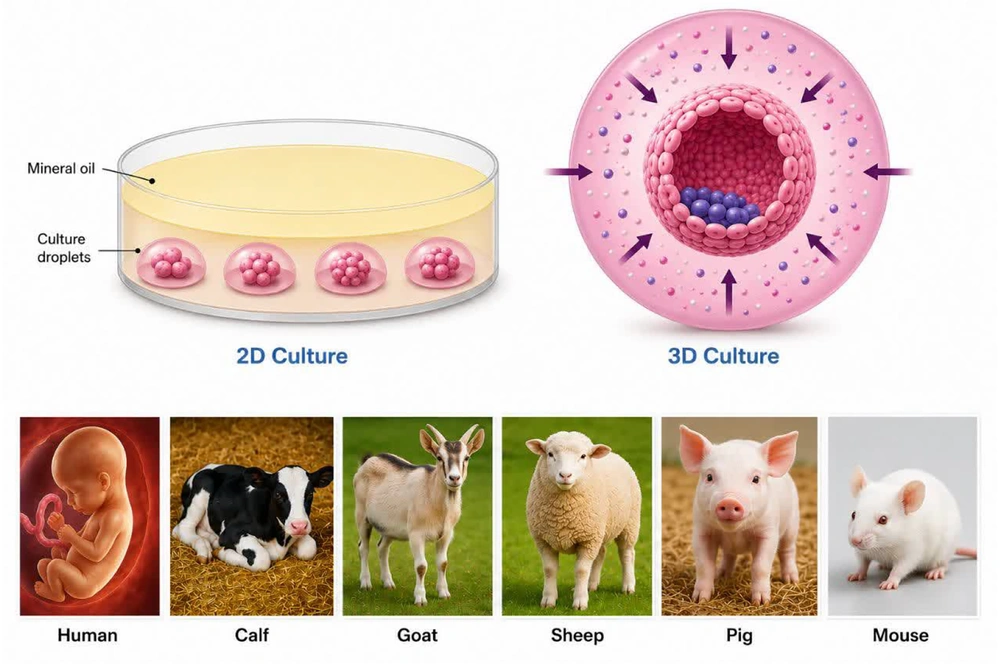
Figure 1.
Comparative schematic of 2D versus 3D culture systems for oocytes and embryos.
3.1. Hydrogel-Based Methods
In vitro follicle and ovarian tissue culture have emerged as advanced reproductive technologies, enabling fertility preservation, the production of mature oocytes for IVF, and investigation of mechanisms underlying follicular growth. The success of these methods depends on accurately simulating the physiological ovarian microenvironment, for which hydrogels have shown great promise as 3D scaffolds (17). Hydrogels provide an optimal culture environment for follicles and embryos owing to their 3D network structure, high biocompatibility, and capacity to maintain cell viability (18). Composed primarily of cross-linked polymers with more than 90% water content, these materials can effectively mimic the natural ECM (19). Unique characteristics, including controlled porosity, tunable mechanical properties, and structural similarity to native tissues, make hydrogels a strong option for ovarian tissue engineering (18).
Studies have demonstrated that both natural and synthetic hydrogels can serve as effective scaffolds for embryo and embryonic stem cell culture (20). These systems not only provide optimal conditions for cell survival and proliferation but also support specialized cell differentiation and function (19). In the context of in vitro follicle culture (IVFC), hydrogels have shown remarkable efficacy in simulating the ovarian follicular microenvironment and supporting embryo growth. However, major challenges remain in optimizing this technology, including maintaining cell-matrix interactions, meeting the complex metabolic demands of follicles, and accurately replicating the hypothalamic-pituitary-ovarian axis in vitro. Addressing these challenges requires interdisciplinary research in tissue engineering, cell biology, and reproductive medicine (17, 18).
3.2. Natural Hydrogels
3.2.1. ECM-Based Hydrogels
ECM-based natural hydrogels have gained prominence in 3D culture systems because of their structural and functional similarity to living tissues. These hydrogels primarily consist of structural proteins, such as collagen, fibronectin, and laminin, along with glycosaminoglycans, which guide cellular growth and differentiation by regulating signaling pathways and providing essential biomolecules. A key feature of these materials is their ability to maintain tissue structure and native biochemical microenvironments, thereby optimizing cell-matrix and cell-cell interactions (19, 20). Collagen, the most abundant ECM protein, is among the most widely used natural hydrogels because of its high biocompatibility, optimal permeability, and controlled degradability (21). Studies have shown that collagen scaffolds not only support somatic cell growth but also maintain steroid hormone secretion. However, limitations such as low mechanical strength and rapid degradation pose challenges for clinical applications (20, 22).
Other ECM components, such as fibronectin and laminin, also play crucial roles in reproductive systems. Evidence suggests that these compounds can facilitate oocyte maturation by maintaining cumulus cell connections and improving blastocyst formation rates. In buffalo, the use of ECM-based 3D scaffolds has significantly enhanced oocyte maturation and embryonic development. This effect is mediated through multiple mechanisms, including regulation of the PI3K/AKT pathway, reduced apoptosis, and increased proliferation of cumulus cells (20, 23). Despite their numerous advantages, natural hydrogels face several challenges. Technical complexity in production, high costs, and intersample variability are among the most significant limitations of these systems (24). Nevertheless, characteristics such as maintenance of follicular spherical structure, support of cell-cell interactions, and resemblance to the physiological environment make these materials a promising option for reproductive research (19, 20).
Overall, natural ECM-based hydrogels, such as collagen, fibronectin, and laminin, are well suited for 3D culture in reproductive systems because of their high biocompatibility and ability to mimic physiological environments. Despite challenges such as high costs and mechanical limitations, these materials play a key role in advancing fertility research and regenerative medicine by maintaining tissue structure and improving cellular function.
3.2.2. Polysaccharide-Based Natural Hydrogels
3.2.2.1. Polysaccharide Hydrogels in 3D Ovarian Follicle Culture
Polysaccharide hydrogels, particularly alginate, are widely used in 3D ovarian follicle culture systems (25). Alginate, a natural polymer derived from brown algae, forms a stable 3D structure and provides biocompatibility through network formation with divalent ions such as calcium, resembling the natural ECM (26). This material increases follicular cell survival because of its unique characteristics, including low cellular toxicity, maintenance of cellular morphology, and antioxidant properties (27). The chemical structure of alginate consists of repeating β-D-mannuronic acid and α-L-guluronic acid units, which enable the diffusion of nutrients and hormones throughout the 3D scaffold. This feature is essential for follicle growth and differentiation (28). However, alginate lacks the cell-binding motifs and signaling molecules present in the natural ECM that are crucial for cell adhesion and differentiation (13). To overcome these limitations, modification of alginate with ECM components, such as laminin, hyaluronan, and arginine-glycine-aspartic acid (RGD), has been proposed (29). In addition, natural biological matrix components can be added to alginate hydrogels to improve the 3D environment (13). Future research should focus on optimizing the mechanical and chemical properties of these hydrogels to better mimic the natural in vivo microenvironment.
Studies have shown that combining alginate with Matrigel yields better results than combining it with fibrin (30). Furthermore, alginate modification with hyaluronic acid has been shown to enhance bioactivity and improve follicular survival rates. Among all natural and synthetic polymers used in artificial ovary development, alginate stands out as one of the most promising biomaterials because of its gentle divalent cross-linking gelation process and nontoxic properties (31). The combination of alginate with cell-free bovine ovarian ECM-derived hydrogel created optimal stiffness, representing a promising alternative for engineered ovarian tissue (32). The alginate hydrogel-based 3D culture system facilitates embryonic morphological changes while enhancing steroidogenic gene expression and estrogen production, mirroring in vivo embryonic development patterns (33).
Researchers initially observed that alginate hydrogels could serve as substrates for the in vitro culture of various organs and embryos. In addition, encapsulation in alginate hydrogel can effectively enhance follicular growth in mice and nonhuman primates under in vitro conditions. Studies have demonstrated that alginate hydrogel is beneficial for in vitro elongation of porcine embryos and improves the growth of cumulus-free oocytes in cats (12). Three-dimensional scaffolds for cell and tissue culture provide a potential model for studying embryonic development, particularly for post-hatching embryos. In cattle, constrained elongation of post-hatching embryos has been achieved through physical induction using an agarose gel tube system. However, embryos cultured in this system exhibited developmental deficiencies in the embryonic disc (28). Three-dimensional barium-alginate microcapsules have been used for culturing felid oocytes and domestic cat oocytes to improve the quality of cumulus-free oocytes (34, 35). Studies have shown that 3D bioprinting with alginate hydrogel can significantly improve the quality of cumulus-oocyte complex (COC) maturation. This system enhances the bioenergetic and oxidative status of oocytes, increases IVM rates, and positively regulates transcripts related to oocyte competence (36). In addition, alginate hydrogels enable investigation of embryonic developmental processes such as blastocyst elongation, which is not achievable in conventional IVEP systems (28).
Chitosan, a natural cationic polymer derived from chitin, has attracted increasing attention. With its antibacterial properties and bioadhesive capabilities, this material has a wide range of biomedical applications. The presence of charged amino groups in the chitosan structure enables effective interactions with cell membranes and binding to vital molecules such as growth factors (37). Its ability to enhance cell adhesion, accelerate proliferation, and induce cell differentiation has made it a promising candidate for advanced technologies such as bioprinting. Research findings indicate that chitosan-based scaffolds outperform alginate- and collagen-based scaffolds in forming antral structures, estradiol secretion, maintaining follicle size, and survival rates. In addition, these scaffolds show significant advantages in facilitating oocyte nuclear maturation. Scientific evidence suggests that combining different biomaterials can provide a more optimal environment for nutrient exchange and tissue growth (17). Overall, polysaccharide hydrogels represent promising scaffolds for 3D culture systems. Future research should focus on optimizing the mechanical and chemical properties of these hydrogels to better mimic the natural in vivo microenvironment.
3.2.2.2. Polysaccharide Hydrogels in 3D Culture of Human Reproductive Systems
Kim et al. (38) successfully developed an advanced 3D culture system that accurately recapitulates the critical process of blastocyst implantation in the uterine endometrium. By simulating the embryo-endometrium interface, this innovative model enables detailed investigation of the molecular mechanisms involved in early pregnancy. Notably, the system is compatible with both mouse embryos and human embryo-like structures, making it a valuable tool for basic and applied research in infertility and miscarriage. In another study, researchers used 3D alginate scaffolds to successfully differentiate human endometrial stem cells (hEnSCs) into oocyte-like cells. Specifically, they engineered a 3D composite alginate scaffold to enhance the differentiation of hEnSCs into oocyte-like cells (18).
Ji et al. (39) used advanced 3D bioprinting technology to fabricate a hydrogel scaffold incorporating human induced mesenchymal stem cells (hiMSCs) for endometrial tissue regeneration. Their findings demonstrated significant structural restoration of endometrial tissue, including successful regeneration of both stromal and epithelial cellular components, along with neoangiogenesis. The study also reported enhanced functional markers indicating partial restoration of endometrial receptivity, as evidenced by improved embryo implantation capacity. Collectively, these results suggest that the synergistic combination of 3D-bioprinted scaffolds with hiMSCs represents a promising therapeutic strategy for treating infertility associated with endometrial injury. A key advantage of this approach is its potential for autologous cell therapy, which substantially reduces immunological rejection risks while promoting endogenous tissue repair mechanisms.
Alginate-based 3D systems demonstrate significant effects on human follicular maturation. Notably, interspecies differences exist in optimal alginate concentrations, which are attributed to the unique tissue characteristics of each species. Studies demonstrate significant species-specific responses to alginate concentrations in follicular maturation. While Skory et al. (40) achieved a 92% metaphase II (MII) maturation rate for secondary follicles in 0.5% alginate capsules, Lin et al. (41) reported reduced MII efficiency in human follicles using the same concentration, highlighting important interspecies variation in culture requirements. This phenomenon suggests that human and mammalian follicles develop within the ovarian cortex, a collagen-dense region. For murine follicles, decreasing alginate concentration in 3D scaffolds may improve maturation outcomes. An other study have shown that 0.5% alginate hydrogels not only exhibit favorable biocompatibility but also significantly enhance the expression of antioxidant genes in follicular cells. These findings highlight the importance of precise optimization of culture parameters.
Hyaluronic acid, one of the natural components of the ECM, has also gained attention. The use of tyramine-conjugated hyaluronic acid as an innovative material for the 3D culture of mouse ovarian follicles resulted in the production of MII oocytes with developmental competence, capable of fertilization and growth to the blastocyst stage. This system has even been successful in achieving pregnancy through the transfer of embryos derived from IVM. However, further studies are needed to optimize culture conditions for primordial follicles and adapt them to different species (42). Overall, recent advances in 3D modeling of the human reproductive system have raised new hopes for treating infertility and reproductive disorders. However, species-specific differences and the need for further optimization of methods for clinical applications remain significant challenges.
3.2.2.3. Polysaccharide Hydrogels in 3D Culture of the Porcine Reproductive System
Positive results have been reported for the IVM of oocytes using 3D agarose hydrogels, which enhance the competence of porcine oocytes cultured in a soft agarose-based matrix (16). Wang et al. demonstrated that the use of a glass scaffold to create a 3D environment increases the rate of first polar body extrusion (24). Furthermore, studies emphasize that, regardless of the material used to establish the 3D culture system, the rate of first polar body extrusion improves, indicating the positive impact of 3D culture on the IVM of porcine oocytes (43). The 3D culture of oocytes in an agarose matrix containing granulosa cells, which mimics the natural follicular microenvironment, significantly enhances the maturation quality and developmental competence of porcine oocytes. This system provides an optimized microenvironment and improves oocyte maturation quality and embryonic developmental potential (44).
Alginate hydrogel encapsulation has been introduced as a promising material for the 3D culture of porcine oocytes (12). Encapsulation of mural granulosa cells (MGCs) in sodium alginate hydrogel and their 3D co-culture with oocytes effectively simulates the follicular microenvironment and improves the developmental competence of porcine oocytes by increasing the IVM rate, enhancing granulosa cell metabolic activity, and promoting higher levels of oocyte metabolism and gene expression (43). Furthermore, by encapsulating porcine blastocysts while maintaining their viability and structure, this system facilitates reproducible morphological changes, steroidogenic enzyme transcript expression, and estrogen production in accordance with the elongation process observed in vivo (45).
These findings represent a crucial step in the development of in vitro culture systems capable of better simulating physiological conditions and improving the quality of matured oocytes and developing embryos (12). Key advantages of these methods include the ability to controllably manipulate culture conditions and their potential application in comparative interspecies studies (45). Overall, hydrogel-based 3D culture systems, particularly those using alginate and agarose, improve oocyte maturation quality and embryonic developmental potential by simulating the follicular microenvironment. However, further research is necessary to optimize the parameters of these systems and develop novel biodegradable scaffolds. This technology has considerable potential to reduce embryonic losses, improve reproductive outcomes in the livestock industry, and support advances in farm animal reproduction and embryological research (12, 43, 45).
3.2.2.4. Polysaccharide Hydrogels in 3D Culture of Bovine, Ovine, and Caprine Reproductive Systems
Three-dimensional alginate-based culture systems, particularly the alginate-encapsulated culture system (AECS), have provided new opportunities in ruminant reproductive biotechnology by effectively mimicking physiological conditions. Research demonstrates that these systems can maintain bovine embryo morphological characteristics and cellular tension similar to in vivo environments (28). However, recent findings by Ferronato et al. (26) reveal that, despite successful blastocyst production, factors such as epigenetic alterations, osmotic imbalance, and species-specific variations may affect embryo quality. System optimization requires careful consideration of optimal polysaccharide concentration, incubation duration, and cross-linking solution formulation, and further research is needed to fully understand the molecular and cellular effects on embryonic development. Although alginate systems show great promise for ART, achieving reliable standards requires additional comprehensive studies.
Numerous studies have investigated the effects of 3D culture systems on follicular growth and oocyte maturation in small ruminants, revealing species- and stage-dependent optimization requirements. For early-stage follicles, Hornick et al. (46) demonstrated that a stiffer physical environment (2% alginate) supports better growth in primates, consistent with findings in sheep, where 2% alginate encapsulation better preserved follicular integrity and promoted superior growth compared with 1% alginate (47). In ovine models, a 28-day aggregated culture using lectin significantly increased oocyte diameter (48). These findings underscore the critical role of matrix stiffness and species-specific adaptations in optimizing 3D follicular culture systems. In goats, studies demonstrated that preantral follicles cultured in permeable alginate matrices (0.25%) exhibited superior growth rates, enhanced steroid production, and improved meiotic resumption compared with 2D cultures or higher alginate concentrations (49). These findings suggest that 3D alginate systems can partially mimic in vivo conditions, offering a promising alternative to conventional 2D methods. Collectively, this research highlights the necessity of tailoring hydrogel concentration and ECM type to the animal species, follicular stage, and experimental objectives. Although 3D systems show considerable potential, further optimization is critical to better replicate physiological conditions and mitigate adverse effects on follicular and oocyte development.
3.3. Synthetic Hydrogels
Synthetic hydrogel-based 3D culture systems have played a pivotal role in advancing reproductive research. The use of a decellularized ovarian scaffold combined with alginate as a 3D culture system is a promising approach for IVFC because it preserves viability and has a favorable impact on gene expression. These findings could pave the way for the development of more efficient methods in ART. ECM-alginate composite hydrogels demonstrate beneficial effects on estrogen production, follicular development, and oocyte maturation (50, 51). In general, synthetic or nonspecific natural hydrogels, such as gelatin, laminin, or collagen, are commonly used for culturing embryos or embryonic stem cells. The cell-depleted ECM is primarily composed of structural proteins such as collagen, elastin, and laminin, as well as glycosaminoglycans (GAGs). In addition, this matrix may contain significant concentrations of endogenous growth factors, cellular secretions, and matrix-bound nanovesicles. These components can influence embryonic development by regulating signaling pathway activity and providing specific biomolecules and cytokines in the culture environment. Given these characteristics, the use of tissue-specific ECM hydrogels as a coating for in vitro culture systems represents a promising approach for achieving stable and reliable embryo cultivation (20, 52).
The use of both synthetic and natural hydrogels in the 3D culture of ovarian follicles and oocytes has been extensively studied. The combination of Matrigel with low-adhesion plates significantly enhanced the in vitro growth of livestock embryos to the advanced blastocyst stage (53). In other studies, encapsulating porcine oocytes in fibrin-alginate beads, a hybrid hydrogel, maintained the 3D organization of COCs for up to 96 hours, although the developmental potential of these oocytes and the optimization of the encapsulation method were not fully evaluated (54). Recent research has focused on synthetic hydrogels, such as PEG and ECM-derived hydrogels modified with RGD peptide (6). These systems have supported the growth of secondary follicles and oocyte maturation in mouse models (55, 56). PEG hydrogels with proteolytically degradable peptide cross-linkers have enabled the growth of preantral follicles to the antral stage and the production of MII oocytes (57).
Higuchi et al. used 3D culture of mouse ovarian slices within adhesive hydrogels and demonstrated that mature oocytes derived from this system could produce viable embryos following fertilization (58). In addition, Desai et al. demonstrated that tyramine-based hyaluronan (HA) hydrogel, particularly when combined with ECM proteins (ECM-HA), creates an optimized 3D culture system for ovarian follicles. This system not only preserves the natural structure and granulosa-oocyte interactions but also enhances follicular function in terms of hormone secretion and oocyte maturation efficiency (42). These findings underscore the necessity of a 3D microenvironment for proper oocyte maturation because, in vivo, oocytes develop within luminal follicles that possess a 3D architecture (24).
Candelaria et al. used engineered PEG hydrogels for the 3D culture of bovine preantral follicles. Although the hydrogels outperformed 2D culture systems, biological variability among samples and the inherent tendency of some follicles to undergo atresia were observed. Limitations included the lack of control over factors affecting survival, such as age, nutrition, and health, and the aggregation of bovine ovarian cells (BOCs), which resulted from the absence of basement membrane-binding proteins in the PEG composition. This led to reduced cell adhesion to the matrix and impaired integration into the hydrogel. In addition, the decreased expression of genes associated with the pre-theca cell phenotype after culture indicated a loss of cellular identity, which could compromise the success of the 3D culture system. Studies suggest that synthetic hydrogels, such as PEG and its composites with ECM proteins, are promising candidates for the 3D culture of follicles and oocytes because of their chemical modifiability. However, significant challenges remain, including incomplete mimicry of the native matrix environment, maintenance of cellular identity, prevention of unwanted cell aggregation, and the need to optimize culture conditions for different species. The development and refinement of these 3D culture systems could pave the way for the production of high-quality mature oocytes in vitro, leading to significant advancements in ART (57). Overall, synthetic hydrogels with tunable chemical and mechanical properties represent a promising platform for 3D follicle and oocyte culture. Further improvements in these systems may drive substantial progress in ART.
4. Conclusions
Hydrogel-based 3D culture systems more accurately simulate in vivo conditions and therefore overcome fundamental limitations of 2D culture, including disrupted cellular communication and a lack of interactions with the ECM. Evidence accumulated across various species indicates that this approach significantly improves follicular structural preservation, nuclear and cytoplasmic oocyte maturation, embryonic developmental competence, and the regulation of key gene expression. However, the successful implementation of this technology requires optimization of parameters such as hydrogel concentration and stiffness, as well as biochemical composition, including the addition of RGD peptides, while accounting for species-specific differences. Despite existing challenges, these systems offer a promising strategy for improving the efficiency of in vitro reproduction and fertility preservation, as well as for advancing fundamental studies of early embryonic development in animal husbandry and reproductive medicine.