1. Background
COVID-19 was first reported in Wuhan (China) (1). Respiratory and non-respiratory symptoms of COVID-19 patients may not subside during hospitalization. The duration of symptoms in COVID-19 patients is usually 2 weeks for mild cases and 3-6 weeks for severe cases (2).
The clinical problems may continue long after the acute stage of the disease. Depending on the severity of the disease, they are called "long–COVID-19 syndrome" (symptomatic for 4 to 12 weeks) or “post–COVID-19 syndrome" (symptomatic for more than 12 weeks) (3).
Studying COVID-19 patients after discharge can help better manage post–COVID-19 or long–COVID-19 syndrome. In addition, COVID-19 imposes costs on the healthcare system, which can be better managed by identifying the conditions and consequences of the disease (4).
2. Objectives
The aim of this study is to determine the prevalence of COVID-19 related problems after discharge from the hospital.
3. Methods
This cross-sectional study was conducted on 194 COVID-19 patients hospitalized in Vali-e-Asr Hospital (Birjand University of Medical Sciences, Birjand, Iran) during 2021 - 2022. This study was approved by the Ethics Committee of Birjand University of Medical Sciences (code: IR.BUMS.REC.1399.529). All hospitalized COVID-19 patients with positive polymerase chain reaction (PCR) tests were eligible for the study. Exclusion criteria were death during hospitalization, unwillingness to participate, and transfer to the intensive care unit (ICU) due to critical conditions. A questionnaire was prepared by the researcher and approved by experts. After discharge, patients were followed up weekly for 4 weeks. The data were recorded weekly, entered into SPSS version 19 (SPSS Inc, Chicago, IL, USA), and analyzed using descriptive statistics.
4. Results
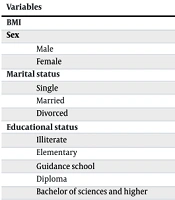
A total of 194 COVID-19 patients (110 [56.7%] men and 84 [43.3%] women) were enrolled in this study from 2021 to 2022. The mean age and body mass index (BMI) of the patients were 57.57 ± 16.79 years and 25.9 ± 4.64 kg/m2. There was a history of inhalant addiction in 8 (4.1%), oral addiction in 3 (1.5%), and smoking in 3 (1.5%) patients. The most common underlying diseases were hypertension (64; 33%), diabetes mellitus (44; 22.7%), dyslipidemia (30; 15.5%), cardiovascular diseases (13; 6.7%), and pulmonary disorder (14; 6.6%). Less common disorders were thyroid disease (7; 3.6%), epilepsy/multiple sclerosis/convulsions (5; 2.6%), kidney disease (7; 3.6%), and thalassemia (0,5%), lymphoma (0.5%), psoriasis (0.5%), tuberculosis (0.5), and prostate disease (0.5%). The most common complaints of COVID-19 patients in sequential weekly follow-ups are presented in Table 1. Increased appetite after recovery from COVID-19 was reported in 9.7% of patients. On admission, lung high-resolution computed tomography (HRCT) scans were normal in 51 patients (26.3%). The percentage of lung engagement was 5%-25%, 25%-50%, 50%-75%, and more than 75% in 37 (19%), 40 (20%), 43 (22%), and 23 (12%) of patients, respectively. Dexamethasone and remdesivir were prescribed for 166 (85.6%), beta interferon for 119 (61.3), and favipiravir for 30 (15.5%) patients.
Table 1.
The Prevalence of COVID-19–Related Symptoms in Sequential Weekly Evaluation a
| Clinical Presentation | On Admission | At Discharge | 1 Week Later | 2 Weeks Later | 3 Weeks Later | 4 Weeks Later |
|---|---|---|---|---|---|---|
| Asthenia | 118 (60.8) | 103 (53.1) | 75 (37.8) | 47 (24.2) | 19 (10) | 16 (8.3) |
| Anorexia | 95 (49 | 55 (28.4) | 36 (18.6) | 20 (10.3) | 4 (2.1) | 6 (3.1) |
| Myalgia | 63 (32.5) | 18 (9.3) | 10 (5.2) | 4 (2.1) | 4 (2.1) | 4 (2.1) |
| Nausea, vomiting, diarrhea | 36 (18.5) | 8 (4.1) | 8 (4.1) | 2 (1) | 1 (0.5) | 1 (0.5) |
| Headache | 24 (12.4) | 8 (4.1) | 5 (2.6) | 2 (1) | 1 (0.5) | 1 (0.5) |
| Anosmia | 7 (3.6) | 3 (1.5) | 3 (1.5) | 0 (05) | 0 (0) | 0 (0) |
| Sore throat | 6 (3.1) | 1 (0.5) | 1 (0.5) | 1 (0.5) | 1 (0.5) | 1 (0.5) |
| Dizziness | 6 (3.1) | 4 (2.1) | 3 (1.5) | 1 (0.5) | 1 (0.5) | 1 (0.5) |
| Hair loss | 2 (1) | 3 (1.5) | 7 (3.6) | 9 (4.6) | 5 (2.6) | 8 (4.1) |
| Forgetfulness and delirium | 2 (1) | 3 (1.5) | 4 (2.1) | 2 (1) | 1 (0.5) | 0 (0) |
| Chillness | 48 (24.7) | 4 (2.1) | 1 (0.5) | 0 (0) | 1 (0.5) | 0 (0) |
| Dyspnea | 120 (62) | 89 (46) | 65 (33.5) | 45 (23.2) | 21 (10.8) | 12 ( (6.2) |
| Cough | 113 (59.3) | 87 (44.8) | 62 (32) | 43 (22.2) | 20 (10.3) | 11 (5.7) |
| Chest pain | 54 (27.8) | 34 (17.5) | 15 (7.7) | 6 (3.1) | 4 (2.1) | 2 (1) |
a Values are expressed as No. (%).
5. Discussion
Thirty-two percent of patients were symptomatic at the end of 4 weeks of follow-up. The most common residual complaint was asthenia, followed by dyspnea, cough, anorexia, headache, smell or taste disturbance, throat discomfort, hair loss, and chest pain.
COVID-19–related symptoms may continue long after the acute stage of the disease, which are classified as post–COVID-19 syndrome or long–COVID-19 syndrome (3). Typical clinical symptoms of long–COVID-19 syndrome are cough, shortness of breath, fatigue/weakness, headache, autonomic disorder, loss of smell or taste, confusion, muscle pains, and sometimes low fever. In general, the most common remaining symptoms after the acute stage of COVID-19 are dyspnea and weakness (5).
One of the symptoms that increased in prevalence in each follow-up round was hair loss compared to the previous round. In a study conducted in Brazil, hair loss was the most common symptom in post–COVID-19 syndrome, especially in men. It was related to the duration of the disease in the acute stage and its severity (6).
In our study, 44 patients (22.7%) had diabetes. The prevalence of diabetes among patients with COVID-19 in China was reported to be 20% (7). In Italy, the prevalence of diabetes in hospitalized COVID-19 patients was 8.9%, which was relatively higher than the overall local diabetes prevalence (6.2%) (8).
There were few patients with a history of lung diseases, such as asthma and chronic obstructive pulmonary disease (COPD), in our study. In a study conducted by Vimercati et al. on hospital staff at the University Hospital of Bari, it was found that obesity and underlying respiratory diseases (such as asthma and COPD) were important risk factors in the persistence of symptoms after 35 days (9).
One of the valuable tools to evaluate COVID-19 patients is the HRCT severity score. Vijayakumar et al. did not report a difference between the rate of dyspnea 3 months and 1 year after COVID-19, according to initial CT abnormalities. They also stated that there was no correlation between the mMRC (Modified Medical Research Council) dyspnea score and HRCT severity score 3 months after the acute phase of COVID-19 (10).
5.1. Conclusions
Since prolonged COVID-19–related symptoms are relatively common; it is recommended that COVID-19 patients be followed up after hospital discharge. This follow-up should be done regardless of an underlying disease.