
1. Background
Child abuse is a widespread global issue with serious and lasting consequences for its victims (1), and it is one of the most significant preventable risk factors for mental disorders in adulthood (2). According to the World Health Organization (WHO), child abuse and maltreatment is defined as any form of physical or mental abuse, neglect, sexual abuse, or exposure to violent scenes involving children under the legal age, which may result in actual or potential harm to their physical or mental health. The WHO reports that nearly 3 out of 4 children or 300 million children aged 2 to 4 years regularly experience physical punishment or psychological violence from parents and caregivers (3). In the United States, over 600,000 children are subjected to abuse and neglect annually, and in 2021, around 1,820 children lost their lives due to such mistreatment, with 77% of verified cases involving parental abuse (4). In Iran, child abuse ranks as the leading form of domestic violence, with 20 to 25 cases of child abuse reported daily to social emergency services (5). A systematic review conducted in Iran found that around 2.58% to 4.5% of children reported physical abuse, 3.7% to 6.91% reported psychological abuse, and 5.5% to 5.83% reported neglect. Several social and cultural factors influence the occurrence of child abuse (6).
2. Objectives
Given the importance of this issue, the high prevalence of child abuse, and its profound effects on the future of children, this study was conducted to investigate the prevalence of child abuse and the factors influencing it among parents of elementary school children in the city of Abadan.
3. Methods
3.1. Study Subjects
The current study is an analytical-descriptive study conducted in 2023. The study population consisted of elementary school students in Abadan county. Since the total number of boys in elementary schools in Abadan is approximately one-third that of girls, 7 schools were randomly selected, including 3 girls' schools and 4 boys' schools. A total of 378 male and female students were included in the study using the cluster sampling method. From each school, 54 students were randomly selected, with 9 students from each grade (second to sixth).
The inclusion criteria for the study were children from second to sixth grade who were willing to complete the questionnaires, while the exclusion criteria involved incomplete questionnaires. Children with at least one positive response to questions related to each domain of psychological abuse, physical abuse, or neglect were considered victims of that specific type of abuse.
3.2. Ethical Concerns
The Ethics in Research Committee of Kerman University of Medical Sciences approved the study protocol under the code IR.ABADANUMS.REC.1399.202.
3.3. Data Collection
The research instruments used in this study included a demographic information questionnaire and a standard child abuse questionnaire. The demographic questionnaire, based on a review of previous studies, contained questions such as the child's age, number of children in the family, child's gender, birth order, parents' addiction, divorce, parents' employment, the amount of time the child stays at home, and the health status of the parents and other family members.
The child abuse questionnaire was developed by Hossein Khani et al. and consists of 26 items across three domains. It uses a three-point Likert Scale, ranging from "never" to "always" (scored from 1 to 3). The questionnaire includes 10 questions each for physical abuse and psychological abuse, and 6 questions for neglect, all designed in simple language based on the child’s understanding. The content validity of the questionnaire was confirmed by experts in the field, and the reliability was assessed using Cronbach's alpha for the domains of physical abuse (0.98), psychological abuse (0.96), and neglect (0.83), with an overall reliability score of 0.97 for the entire questionnaire. The mean clarity and relevance of the questionnaire were 80.36% and 92.5%, respectively, with the relevance of questions ranging from 90.14% to 97.2% (7).
For second- and third-grade students, the questionnaires were completed confidentially through verbal questions asked by the teacher at school. Fourth- to sixth-grade students completed the questionnaires using a self-reporting method.
3.4. Data Analysis
After the completion of all questionnaires, the collected data were analyzed using SPSS software version 21. Descriptive statistical methods, including frequency, percentage, mean, and standard deviation, were employed to summarize the data. Additionally, inferential statistical tests, such as the independent t-test, chi-square test, ANOVA, and covariance analysis.
4. Results
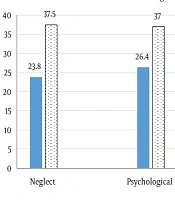
The 378 students participating in the study were aged between 7 and 13 years, with an average age of 10.43 years and a standard deviation of 1.37. Of the participants, 51.4% were boys, and the remaining were girls. Parental neglect was the most commonly reported form of abuse, affecting 75.53% of the children, followed by psychological abuse at 38.68% and physical abuse at 35.78%. Table 1 presents the prevalence of different types of abuse among elementary school children.
In examining factors associated with child abuse by parents, the results showed that girls reported higher rates of physical abuse (46.2%), while boys reported higher rates of psychological abuse (55.6%) and parental neglect (99.4%). Additionally, children whose parents had only a diploma education experienced higher rates of all forms of abuse.
Table 1.
Prevalence of Abuse Types in Elementary School Children
| Types of Abuse | Frequency (%) | Mean ± SD |
|---|---|---|
| Negligence | 287 (75.53) | 14.91 ± 2.23 |
| Psychological abuse | 147 (38.68) | 11.78 ± 2.75 |
| Physical abuse | 136 (35.78) | 11.21 ± 2.64 |
Children whose parents were suffering from a disease (86.6%), had an addiction (91.8%), or were divorced (95.7%) reported higher rates of parental neglect. The study also found that first-born children and those from two-child families experienced the highest levels of child abuse.
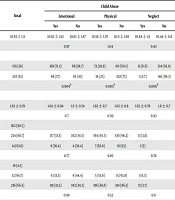
Pearson's correlation coefficient was used to assess the relationships between physical and psychological abuse and parental neglect. The results indicated a statistically significant correlation between psychological abuse (r = 0.733) and parental neglect (r = 0.871) with physical abuse. Furthermore, there was a significant relationship between psychological abuse and parental neglect, with a correlation coefficient of (r = 0.796). Table 2 outlines the factors related to physical, psychological abuse, and parental neglect in elementary school children.
Table 2.
Factors Affecting Physical, Psychological Abuse and Neglect a
| Variables | Physical Abuse | P-Value | Psychological Abuse | P-Value | Parental Negligence | P-Value |
|---|---|---|---|---|---|---|
| Gender | 0.001 | 0.005 | 0.085 | |||
| Female | 85 (46.2) | 84 (45.6) | 177 (96.1) | |||
| Male | 51 (27.7) | 109 (55.6) | 195 (99.4) | |||
| Grade | 0.183 | 0.001 | 0.014 | |||
| Second | 62 (83.8) | 23 (30.3) | 64 (85.3) | |||
| Third | 41 (54.5) | 28 (37.0) | 72 (96.3) | |||
| Forth | 32 (42.5) | 40 (53.3) | 69 (92.0) | |||
| Fifth | 31 (41.3) | 36 (48.1) | 61 (81.4) | |||
| Sixth | 48 (64.6) | 70 (90.3) | 71 (93.2) | |||
| Number of children | 0.384 | 0.577 | 0.170 | |||
| 1 | 22 (37.2) | 30 (50.8) | 58 (98.3) | |||
| 2 | 63 (48.8) | 92 (47.9) | 183 (95.3) | |||
| 3 | 33 (36.2) | 49 (53.8) | 86 (94.5) | |||
| 4 | 15 (48.4) | 18 (58.0) | 30 (96.8) | |||
| 5 | 3 (42.8) | 4 (75.0) | 7 (100.0) | |||
| Birth order | 0.650 | 0.827 | 0.004 | |||
| 1 | 68 (36.6) | 98 (52.0) | 185 (96.3) | |||
| 2 | 55 (35.4) | 77 (51.3) | 142 (94.6) | |||
| 3 | 8 (28.5) | 12 (42.8) | 28 (100.0) | |||
| 4 | 4 (0.50) | 5 (62.5) | 7 (87.5) | |||
| 5 | 0 (0.00) | 1 (50.0) | 2 (100.0) | |||
| Loneliness at home | 0.417 | 0.002 | 0.148 | |||
| 0 | 84 (33.8) | 116 (46.7) | 237 (95.5) | |||
| 1 | 29 (46.0) | 42 (66.6) | 60 (95.2) | |||
| 2 | 9 (29.0) | 17 (58.6) | 28 (96.5) | |||
| 3 | 4 (28.6) | 4 (28.6) | 14 (100.0) | |||
| 4 | 3 (50.0) | 4 (66.6) | 6 (100.0) | |||
| 5 | 6 (35.3) | 9 (52.9) | 16 (94.1) | |||
| 6 | 1 (33.3) | 3 (50.0) | 3 (100.0) | |||
| Father’s education | 0.001 | 0.840 | 0.996 | |||
| Illiterate | 1 (100.0) | 1 (100.0) | 1 (50.0) | |||
| Under diploma | 29 (46.7) | 35 (56.4) | 58 (93.5) | |||
| Diploma | 67 (35.8) | 93 (49.7) | 179 (95.7) | |||
| Bachelor | 31 (30.1) | 50 (48.5) | 100 (97.1) | |||
| Postgraduate | 8 (36.3) | 13 (59.0) | 21 (95.4) | |||
| Doctorate | 0 (0.00) | 1 (25.0) | 4 (100.0) | |||
| Mother’s education | 0.349 | 0.001 | 0.607 | |||
| Illiterate | 2 (100.0) | 2 (100.0) | 2 (100.0) | |||
| Under diploma | 25 (33.8) | 39 (52.7) | 69 (93.2) | |||
| Diploma | 75 (37.7) | 99 (49.7) | 190 (95.4) | |||
| Bachelor | 26 (35.9) | 41 (48.8) | 82 (97.6) | |||
| Postgraduate | 7 (38.8) | 10 (55.5) | 18 (100.0) | |||
| Doctorate | 1 (33.3) | 2 (66.6) | 3 (100.0) | |||
| Place of living | 0.718 | 0.986 | 0.053 | |||
| Landlord | 100 (28.2) | 180 (50.7) | 339 (95.5) | |||
| Renting | 16 (64.0) | 13 (52.0) | 25 (100.0) | |||
| Parental illness | 0.001 | 0.184 | 0.425 | |||
| Yes | 129 (46.6) | 182 (73.3) | 351 (86.6) | |||
| Parental addiction | 0.006 | 0.029 | 0.329 | |||
| Yes | 24 (49.0) | 32 (65.3) | 45 (91.8) | |||
| Parental divorce | 0.03 | 0.851 | 0.709 | |||
| Yes | 123 (35.0) | 176 (50.1) | 336 (95.7) |
a Values are expressed as No. (%).
5. Discussion
The current research aimed to investigate the prevalence of child abuse and its influencing factors by parents in elementary school children in Abadan in 2023. The most common type of abuse reported in this study was parental neglect, with a prevalence of 75.53%. Regarding factors related to neglect, the most common issues were failing to provide books and school supplies, neglecting meals, and the child's perception of family affection. Neglect has been recognized as the most common form of child abuse (8, 9), with meal preparation being one of the most prevalent forms of physical neglect by parents (10). In a meta-analysis, emotional neglect was identified as the most common form of neglect (11), which aligns with the results of this study. Additionally, the most frequent type of psychological abuse reported in this study was arguing with the child and comparing them to other children.
Research has shown that children who experience psychological abuse are more likely to develop depression, anxiety, and stress in adulthood compared to those who have experienced physical or sexual abuse alone, or both physical and sexual abuse (12). This highlights the need to increase parental awareness in this area. The most common form of physical abuse reported in the present study was pinching, followed by ear twisting. Similarly, in a study by Farnia et al., slapping and pinching were identified as the most common forms of physical abuse among boys and girls (13). Other studies have also found that physical abuse is the most common form of child abuse after neglect (9, 14), with soft tissue injuries being the most frequent physical finding in child abuse cases (15, 16).
This study also revealed significant differences between boys' and girls' perspectives on mental and physical abuse, with girls reporting more physical abuse and boys more psychological abuse. In a systematic review by Moody et al. on the prevalence of child abuse by type and gender, results showed that in Europe and America, boys reported higher rates of physical abuse, while in Asia, boys reported higher rates of psychological abuse (33.2%) compared to girls (26.9%) (17). According to Rafei et al., the number of boys experiencing abuse was significantly higher than girls (18), while Hashemi et al. found that girls reported higher levels of abuse compared to boys (19). Some studies suggest that girls are more vulnerable to sexual and psychological abuse, while boys are more susceptible to neglect (20, 21). Differences in findings across studies may be attributed to variations in the definition of abuse and the assessment instruments used.
Parental addiction in this study had a significant impact on child abuse. The results align with the findings of Dye, which indicated a statistically significant relationship between physical and emotional child abuse and parental addiction (12). Similarly, in a study by Farnia et al., it was reported that the likelihood of child abuse in families where both parents were addicted was 2.66 times higher than in families where only the father was addicted (13). This can be attributed to the financial, health, and emotional challenges that arise from addiction, which may contribute to abusive behavior toward children.
The current study also found that parental illness significantly influenced physical abuse. A meta-analysis conducted by Azam Azad indicated that physical or mental health issues in parents, with a prevalence of 44.5%, were among the most influential factors contributing to child abuse (22), consistent with our study’s findings.
In this study, students whose parents had a diploma-level education reported higher instances of child abuse. In a qualitative study conducted by Ansari et al., the level of awareness of physical abuse among parents with and without academic education was found to be the same. However, parents with academic education had a greater awareness of psychological abuse (23). Ghorbani et al. also reported that 64% of abuse cases in their study were related to parents with only elementary education or who were illiterate (24). Based on these results, it seems that in addition to education level influencing parents' awareness of different types of abuse, parents with higher education levels may display increased sensitivity toward their children, which can lead to psychological abuse from the children's perspective in this study.
Furthermore, students whose parents were divorced reported higher rates of child abuse. This is consistent with findings by Hashemi et al., who identified unstable family dynamics and single parenting as factors contributing to child abuse (19). However, Gross-Manos et al. suggested that drug abuse, alcohol consumption, and parental mental health problems were the most significant factors in parental abuse, with divorce being less impactful (25). This discrepancy may be due to differences in data collection methods while the current study relied on self-reported questionnaires completed by children, the Manus study used reports from children's caregivers. It is possible that women view "divorce" and "unemployment" as less important factors for child abuse compared to men (25).
Finally, research shows that teachers with a history of psychological abuse in childhood are more likely to report a higher number of suspected cases of child abuse (26). This suggests that personal experience of abuse may influence teachers' sensitivity to detecting child abuse in their students.
In this study, homeownership also showed a significant difference in relation to parental psychological abuse. The results align with a review study by Aziznejad Roshan and Shaker Zavardee, which identified poor economic status and renting as influential factors in child abuse (27). It's important to recognize that society's perspective on the factors contributing to child abuse evolves over time and may be shaped by individuals' socio-economic status and cultural background (25). Child abuse arises from the interplay of various risk factors present in parents, children, and the living environment (28).
Given the varying definitions of child abuse, it is unsurprising that estimates of its prevalence may differ. These discrepancies are likely due to differences in how child abuse is defined or perceived, as well as the characteristics of the samples studied. In the current research, children's self-reporting was used to fill out the questionnaires. It should be noted that factors such as shame, fear, or feelings of loyalty towards parents (29) may have influenced the results. Despite these challenges, providing supportive and educational interventions for parents and caregivers can help prevent child abuse.
It is recommended that future studies compare the levels of abuse reported by children, teachers, and school counselors to gain a more comprehensive understanding of the issue.