
1. Background
A broad range of inflammatory and degenerative illnesses affecting the muscles, tendons, ligaments, joints, peripheral nerves, and supporting blood vessels are referred to as musculoskeletal disorders (MSDs) (1). Repetitive motion in the arms and hands, static posture during work, sustained standing position, and excessive load on the nervous and somatosensory systems can cause MSDs among workers and staff (2).
Musculoskeletal disorders are now recognized as one of the most significant occupational health issues worldwide due to the rapid advancement of technology, widespread computer use, changes in working conditions and environments, growth of administrative professions, and lack of synergy between technology and human needs (3). Office workers experience a high prevalence of MSDs. The ergonomic risks associated with computer work include prolonged periods in a static position, repetitive movements, and inappropriate body functioning due to incorrect positioning of the monitor, keyboard, mouse, phone, and other devices. Studies indicate that the annual prevalence of Work-Related Musculoskeletal Disorders (WMSDs) among computer users ranges from 33.8 to 95.3 percent (4).
According to the World Health Organization, approximately 58% of people over the age of 10 spend one-third of their waking hours at work, and between 30 and 50% of these individuals are exposed to serious physical occupational hazards (5). Based on previous studies, the prevalence of WMSDs in Finland, France, and Denmark was 79%, 75%, and 73%, respectively (6). In the US, MSDs accounted for 30% (272,780 cases) of the total 900,380 days away from work (DAFW) cases in the private sector reported as of 2018 (7). Approximately 470,000 workers in the United Kingdom were affected by WRMSDs in 2020/2021, accounting for 28% of all work-related illnesses (8). Furthermore, a study by Mohammadipour et al. revealed a high prevalence of WMSDs among Iranian computer users (9).
The prevention of MSDs in the workforce is regarded as a national priority in many nations (10). The National Institute for Occupational Safety and Health (NIOSH) states that the main cause of low back discomfort is unsuitable working conditions (11). In Patterson's study on 170 computer users, it was shown that 65% of participants experienced shoulder and neck pain (12). Abaraougo et al. reported neck and lower back pain prevalence at 50% and 51.8% in men and 48.5% and 62.1% in women computer users, respectively (13). A study on computer users in Estonia reported that the most prevalent pain occurred in the neck (51%), followed by low back pain (42%), wrist/hand pain (35%), and shoulder pain (30%) (14).
In organizations, education and training are the best initial strategies for preventing occupational injuries. Offering specialized ergonomics training is one way to reduce the frequency of symptoms associated with MSDs. Training in office ergonomics helps staff understand appropriate posture for their workstations (15).
One review study assessing the effect of office ergonomics online training on user-related outcomes showed that this training leads to reduced musculoskeletal pain, improved work postures, adjusted computer workstations, increased knowledge about ergonomics, and improved functional disabilities (16). Mahmud et al. investigated the effect of an educational intervention on MSDs among computer users. These interventions were found to significantly decrease neck, upper limb, and lower back pain. Significant improvements in workstation habits were also observed (17).
One study looked into several educational interventions, such as instructive pamphlets, seminars, posters, E-mails, and photographs showing how to perform stretching and stress-relieving exercises. These approaches improved workers' understanding of cumulative trauma disorder and changes in the upper extremities when using computers (1). However, when comparing training and teaching methods alone to training combined with an adjustable chair as an intervention, another study found that participants' progress in musculoskeletal symptoms was not reduced (18).
There are limited studies on work-related MSDs in Iran. According to reports from social affairs organizations and the Ministry of Health, MSDs can cause about 14% of disability, and 76% of employees work in awkward postures in Iran (19, 20). However, when employees received ergonomics training, WMSDs were found to significantly reduce (21).
Given the limited studies concerning MSDs and the effect of training on body posture improvement, particularly among bank staff, the present study aimed to evaluate working postures and MSDs among bank staff in southeastern Iran. Since office workers, especially bank workers, often use the upper parts of the body, the RULA method was used to evaluate posture.
2. Objectives
We aimed to investigate the effectiveness of two types of training on body postures and to determine which intervention is more effective in improving body posture.
3. Methods
This interventional study was conducted on 120 bank staff in Zahedan city, southeast of Iran. The bank employees were divided into three study groups: A control group (n = 40), a group receiving E-mail training (n = 40), and a group receiving lectures (n = 40). None of the individuals had any physical anomalies or infectious or potentially life-threatening illnesses.
Approximately 10 staff members were selected from each bank in Zahedan city based on convenience sampling and inclusion criteria. Before assigning the training, methods and selecting subjects, the branch heads and staff were informed about the objectives of the study.
Data were collected using the rapid upper limb assessment (RULA) method. The validity and reliability of this method have been established in previous studies (22, 23). Additionally, the reliability of this method was confirmed in this study, with a Cronbach's Alpha of 0.73 based on assessments conducted on 30 subjects.
In this study, the final RULA score was used to assess the overall musculoskeletal risk associated with the postures of office workers. Every participant in the training groups took a pre- and post-RULA test. During the pre-test phase, the body postures of all subjects were measured using the RULA method, and their scores were determined. A specific code was assigned to each subject for identification purposes.
To implement the intervention, subjects allocated to the lecture group were invited to participate in a training class. An ergonomic specialist led the class and taught ergonomic topics related to MSDs and standard body posture in office work, focusing on bank workstations. The training course utilized PowerPoint presentations. The E-mail content sent to staff included PowerPoint packages with slides that featured simulations and interactive elements regarding body postures. The educational package covered ergonomics and body posture issues, emphasizing good posture, habits, and stretching exercises.
The training course was conducted in two sessions, each lasting 2 hours, with one-week intervals. For the E-mail group, the same PowerPoint was sent in two different E-mails. After one week, a reminder E-mail was sent to the E-mail group to encourage them to review the training content and confirm their engagement with the material. All subjects in the E-mail group responded to our E-mail, claiming that they had received and studied the training content. It should be noted that the educational content for both groups (lecture and E-mail) was identical. The control group received no training.
The bank staff were instructed not to engage in any additional study concerning ergonomic topics during the study period. Additionally, employees were asked to adjust their workstations according to the training they received before the post-assessment. Two months after the intervention, the RULA method was used again to assess the effects of the intervention in all three groups.
Demographic variables such as age, gender, weight, height, job history, years of education, hand laterality, and working hours per day were measured for all subjects and recorded on an information form. It should be mentioned that there were no losses to follow-up, and all subjects were evaluated in the post-test assessment. If any staff member did not participate in their job due to permission, their assessment was performed on another day.
The data were analyzed using SPSS version 18. The chi-square and ANOVA tests were utilized to compare the three groups concerning qualitative and quantitative demographic variables. The Bowker criterion, ANOVA, and paired t-test were used to compare the RULA scores between the three groups. The normality of the data was checked using the Kolmogorov-Smirnov test. The distribution of all quantitative variables and RULA scores was normal (P > 0.05). The significance level was set at P-values less than 0.05.
4. Results
In this study, 120 bank staff were surveyed regarding ergonomic body postures and MSDs. The demographic characteristics of the participants by training and control groups are shown in Table 1. None of the demographic variables were statistically different between the two training groups and the control group (Table 1). According to Table 1, none of the characteristic variables differed among the three groups.
Table 1.
Demographic Characteristics of the Participants by Training Groups a
| Demographic Variables | Intervention | Control Group | P-Value | |
|---|---|---|---|---|
| Lecture | ||||
| Hand laterality | 0.963 | |||
| Right | 33 (82.5) | 35 (80) | 33 (80) | |
| Left | 7 (7.5) | 5 (20) | 7 (20) | |
| Working (h/day) | 0.92 | |||
| < 8 | 3 (7.5) | 3 (7.5) | 3 (7.5) | |
| 8 - 10 | 20 (50) | 21 (52.5) | 21 (52.5) | |
| 10 - 12 | 14 (35) | 12 (30) | 14 (30) | |
| > 12 | 3 (7.5) | 4 (10) | 2 (5) | |
| Job history (y) | 0.51 | |||
| < 10 | 10 (25) | 13 (32.5) | 17 (42.5) | |
| 10 - 20 | 18 (45) | 17 (42.5) | 14 (35) | |
| > 20 | 12 (30) | 10 (25) | 9 (22.5) | |
| Gender | 0.29 | |||
| Male | 28 (70) | 30 (75) | 31 (77.5) | |
| Female | 12 (30) | 10 (25) | 9 (22.5) | |
| Height (cm) | 172.11 ± 6.6 | 173.01 ± 7.1 | 174.11 ± 6.1 | 0.4 |
| Weight (kg) | 71.4 ± 5.3 | 69.5 ± 4.9 | 71.5 ± 5.1 | 0.15 |
| Age (y) | 35.3 ± 4.2 | 35.9 ± 3.6 | 34.9 ± 3.8 | 0.51 |
| Education (y) | 15.2 ± 3.5 | 15.9 ± 3.2 | 15.4 ± 4.4 | 0.46 |
a Values are expressed as No. (%) or mean ± SD.
Table 2 shows the distribution of RULA scores before and after the intervention by training and control groups. The Bowker tests indicated that the distribution of RULA scores before and after the intervention was significantly different in the E-mail (P = 0.016) and lecture (P = 0.032) training groups, but not significantly different in the control group (P = 0.9) (Table 2). The exact chi-square test revealed that the distribution of RULA scores among the three groups before the intervention was not significantly different (P = 0.34), but the distribution of RULA scores among the three groups was significantly different after the intervention (P = 0.04). Meanwhile, the histogram of the data for Table 2 is presented in Figure 1.
Table 2.
Frequency Distribution of Rapid Upper Limb Assessment Scores Before and After Intervention by Groups a
| Study Group | 1 - 2 | 3 - 4 | 5 - 6 | ≥ 7 | P-Value b | ||||
|---|---|---|---|---|---|---|---|---|---|
| Before | After | Before | After | Before | After | Before | After | ||
| 2 (5) | 6 (15) | 25 (62.5) | 32 (80) | 10 (25) | 1 (2.5) | 3 (7.5) | 1 (2.5) | 0.016 | |
| Lecture | 2 (5) | 8 (20) | 23 (57.5) | 30 (75) | 13 (32.5) | 1 (2.5) | 2 (5) | 1 (2.5) | 0.032 |
| Control | 2 (5) | 2 (5) | 22 (55) | 23 (57.5) | 14 (35) | 13 (32.5) | 2 (5) | 2 (5) | 0.9 |
a Values are expressed as No. (%).
b Based on the results of Bowker test.
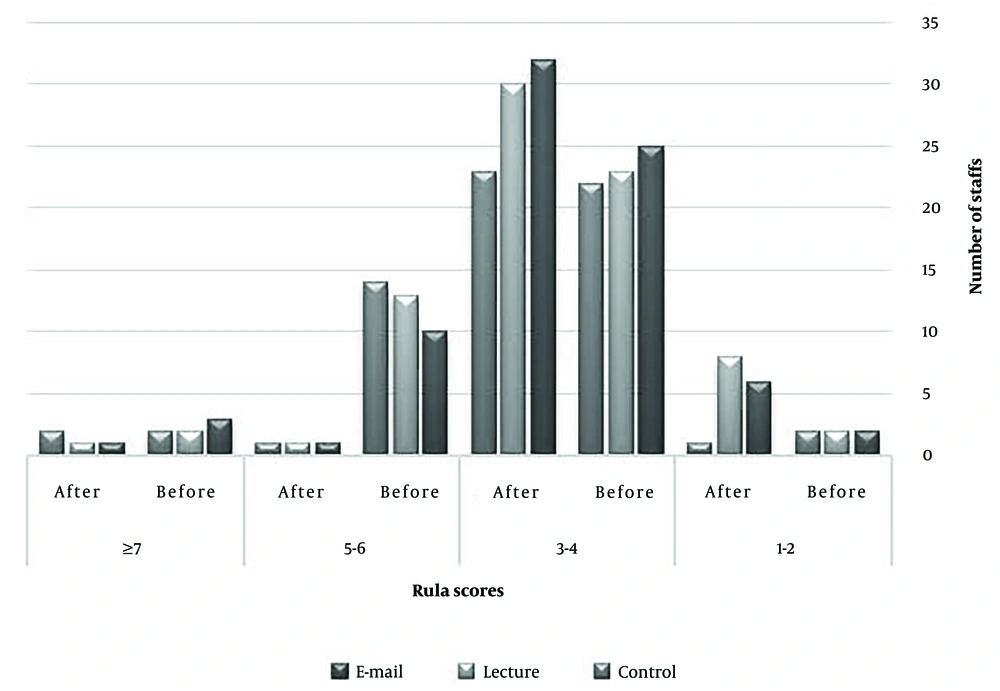
Figure 1.
Frequency distribution of rapid upper limb assessment (RULA) scores before and after intervention
The normality of RULA scores was checked and confirmed by the Kolmogorov-Smirnov test (P = 0.53). The mean RULA scores before the intervention were 4.1 ± 1.6, 4.15 ± 1.14, and 4.19 ± 1.4 for the E-mail, lecture, and control groups, respectively (P = 0.39). After the intervention, the mean RULA scores reduced to 2.92 ± 0.43, 2.87 ± 0.56, and 3.97 ± 1.6 for the E-mail, lecture, and control groups, respectively (P = 0.028). The paired t-test indicated that the RULA scores before and after the intervention were significantly different in both the E-mail (P = 0.023) and lecture (P = 0.021) training groups, but there was no significant difference in the control group (P = 0.53).
The ANOVA test showed that the data before the intervention were not significantly different among the three groups (P = 0.39), but the data after the intervention were significantly different (P = 0.028). However, the Tukey post hoc test revealed that these differences were between the control group and both the E-mail (P = 0.032) and lecture training (P = 0.036) groups.
5. Discussion
This study examined the outcomes of an office ergonomics intervention that included lectures and E-mail-based training on body postures and the risk of MSDs. The results showed that there was a significant improvement in bank staff's body posture from pre- to post-intervention with both the lecture and E-mail ergonomic training methods.
Compared to the control group, trained personnel were more likely to modify their workstation behavior appropriately. Lower RULA grand scores demonstrated that employees were more inclined to adjust their workstation, chair arrangement, and other ergonomic accessories due to their increased knowledge of office ergonomics. This led to a reduction in awkward postures and physical strain.
Due to the evolving nature of work, awkward body posture in the workplace is becoming a major concern in occupational health and ergonomics. It is also predicted that the prevalence and severity of musculoskeletal illnesses will increase, along with longer work hours and an aging workforce (18). However, there is a pressing need for teaching ergonomics and recognizing ergonomic problems in office environments, particularly in workplaces with high interaction with computer systems. The extension and promotion of electronic teaching in office settings aim to ensure that every employee can learn about ergonomic issues and apply this knowledge in their work (2).
According to recent studies, office workers face several risk factors for WMSDs, including working more than six hours a day, spending excessive time in sitting or standing positions, twisting or holding the same posture, and lacking adequate facilities to rest (21, 24). We implemented intervention measures, such as ergonomics training and occupational health education, for bank employees based on these risk factors.
Unfortunately, in the southeast of Iran, bank staff had not previously received ergonomics education to promote better body posture during work. Due to the lack of ergonomic education, the bank staff did not prioritize maintaining proper body posture at their workstations. This study suggests that providing such education can enhance their ergonomic knowledge. Implementing ergonomic topics in office environments, particularly in banking, can help staff improve their body posture while at their workstations. This result supports our hypothesis and emphasizes the importance of both forms of education. Numerous musculoskeletal diseases are linked to prolonged computer use; however, these disorders can be mitigated or alleviated through exercise and proper posture (25, 26).
Both objective and visual assessments demonstrate the efficacy of ergonomic training. According to Robertson, participants who received ergonomics training exhibited improved body posture, reduced visual discomfort, increased performance during the workday, and better outcomes compared to the control group. These findings suggest that a comprehensive training program can be crucial in helping participants achieve optimal body posture (27).
Furthermore, Robertson notes that having ergonomic knowledge enables individuals to adjust their workstations appropriately, thereby reducing the risks and discomfort associated with MSDs and enhancing organizational efficiency (27).
Given the nature of static work in bank environments, workers can benefit from modifying their work schedules to include breaks and time for stretching exercises by attending instructional seminars on occupational health. Altering static postures periodically can reduce psychological stress and physical strain, thereby having a significant impact on preventing WMSDs. This hypothesis was studied by Shuai et al. (22).
Awkward posture significantly decreased for the groups that received lecture and E-mail ergonomic training compared to the no-intervention control group. E-mail instruction in office workstations is more prevalent in developed countries; however, in developing countries, traditional teaching methods, such as lectures and face-to-face instruction, are still favored over electronic methods (5). Consequently, it appears that the lecture method is slightly more effective than the E-mail method in correcting body posture and preventing WMSDs.
Training through lectures is an effective approach for improving bank workers' attitudes towards body postures and preventing MSDs. This method may contribute to the sustainability of the training process in the future (23, 28).
The study conducted by Motamedzadeh et al. in 2021 demonstrated that significant improvements in workstations and a reduction in MSDs among bank employees were observed following interventions after nine months (29). In a 2023 study by Abbasi et al. on the impact of training in reducing MSDs, it was shown that proper ergonomics training, coupled with increased awareness among office workers and computer users, decreases the occurrence of such disorders (30).
In contrast to our study, some research has investigated the effectiveness of computer-based instruction compared to traditional lecture methods (31, 32).
Finally, this study indicates that workplace learners may benefit more from lecture-based teaching than from E-mail learning. Moreover, bank staff often learn best through experience, partially from their mistakes, and they tend to be more comfortable participating in classes, engaging in face-to-face interactions, and asking questions during their learning. This discrepancy may stem from the less widespread use of the Internet in Iranian organizations compared to developed countries. The weakness of the E-mail-learning system in Iran, coupled with limited time to check the Internet and E-mails, leads employees to prefer in-person teaching sessions and lecture-based learning.
While our study shows that lecture-based ergonomic instruction had a greater impact on improving body posture, advancements in computer learning globally suggest that it would be beneficial to promote computer-based learning, especially in developing countries. This approach would greatly benefit employees, particularly bank staff, who are often under constant time pressure. Computer-based training can address the challenge of educating large numbers of employees spread across various locations and facilitate standardized instruction across organizations. Moreover, computer-based learning can be made more interactive to enhance deeper learning.
In this study, we only assessed the short-term effects of the interventions after two months. Further studies are needed to evaluate the long-term effects and sustainability of the interventions.
Several recommendations are offered in different papers to aid in the implementation of computer learning systems in developing countries like Iran, which are relevant for both researchers and practitioners.
5.1. Limitations and Strengths
The limitations of our study include the following: First, justifying employees' participation in lecture-based classes and finding free time to conduct these classes was a time-consuming process. Second, there was a lack of E-mail engagement for several months and insufficient knowledge about using PowerPoint. This limitation was addressed by conducting one session to familiarize participants with E-mail and PowerPoint. A third limitation involved the use of low-cost educational interventions and the inability to modify office workplace equipment, job design including workflow programs or work-rest schedules and to implement organizational interventions or changes in autonomy and decision-making processes. The strength of our study lies in the use of a control group and the implementation of pretest and posttest assessments.
5.2. Conclusions
Overall, the results of our study indicate that staff members were able to modify and reorganize their workstations more ergonomically and efficiently due to the knowledge gained from office ergonomics training. To validate these results and replicate them with alternative office workplace training programs, more field intervention research is needed. These findings will contribute to the body of knowledge regarding effective interventions through various training techniques to help office workers prevent injuries. Both training approaches had a significant impact on bank employees' body posture. In conclusion, lecture-based learning should be viewed as a complement and extension of traditional learning methods. While computer-based learning is increasingly prevalent globally, traditional classes and lecture-based training should not be replaced by computer learning.