
1. Background
Working has an essential role in social and economic development of a country while work environment and conditions could cause work-related physical disorders (1). Furthermore, the personnel of the medical departments are also exposed to health hazards like any other occupation (2). Various harmful factors exist in the work environment that may cause fatigue, burnout, illness, and waste of time, energy and expenses. In the meantime, musculoskeletal disorders are the most common hazards and injuries related to the work environment (3). Musculoskeletal disorders are any type of tissue injury to the supportive structures that affects movement, and has a documented causal relation to the ergonomic risk factors (4, 5). Epidemiologic studies have also shown evidence regarding the relationship between occupational factors and musculoskeletal disorders (6). One study has mentioned the significant increase in the rate of these disorders since 1980 (7). Furthermore, these disorders are the main cause of work-related disability in the developing countries because most of the adults spend half of their wake time at work environments and are consequently affected by various factors there (8-10). Operating room environment and the nature of surgery poses various risk factors such as physical, psychological, biological and chemical risk factors to the staff (11). Review of the literature showed that most of the studies concerned nurses. Few studies have examined occupational disorders in more important groups such as operating room technologists, who are prone to constant stress (such as long standings, fixed positions, and holding tools like retractors during the surgery) and manual work (such as pushing, pulling and holding the set of the tools, the patients and heavy equipment) (12, 13). Another study stated that occupational disorders were inevitable in professions such as operating room nursing due to the inappropriate working conditions, extreme bending and rotating, holding equipment like surgical hooks, and applying great stretch and force (14, 15).
Ergonomics is a helping tool for decreasing these disorders (16). Currently, controlling and decreasing musculoskeletal disorders among the labor force is one of the major concerns of the ergonomics specialists. The importance of controlling these disorders is so high that in many countries, preventing these disorders has been considered a national priority. Various factors affect the incidence of these disorders including occupational factors such as ergonomically inappropriate working conditions, manual work, lifting heavy equipment and performing repetitive and heavy duties (17, 18). Ergonomics is the science of modifying and refining the workplace, occupation and equipment and its compliance with human abilities and limitations. Definitely, applying ergonomics considerations and education in this field has a significant effect on productivity management in any organization. Failure to comply with these considerations would lead to decreased motivation and efficiency of the human resources, increased rate of employee displacement and absenteeism and eventually decreased effectiveness, efficacy and productivity of the organization (19). Ergonomics originated from two Greek words of ergo, meaning work, and nomos, meaning law. In fact, ergonomics is the science that assesses the relation among human, the system and the environment and its final intention is to provide a condition in which an occupation is in accordance with the human and to decrease the injuries and illnesses caused by the occupation and the risk factors; in other words, its goal is to improve the health and well-being of service providers (20). Considering that one of the most important assets of an organization is its human resources, one of the most important reasons for early retirement is musculoskeletal disorders which are mostly preventable (21). Also, the report of the National Academy of Sciences indicated that the existing ergonomic risks in the workplaces, which cause musculoskeletal disorders, can be prevented by applying appropriate interventions; meanwhile, some studies have also attributed lack of appropriate ergonomic principles to poor occupational education in the individuals (1). Educational interventions are necessary because they can decrease and prevent musculoskeletal disorders in people suffering from ergonomic problems at their workplace (22). Educational interventions can be provided using cellphones and social media, which are easily accessible for everyone in the society nowadays, are simple to use, and have provided a valuable opportunity for researchers to benefit from the advantages of decreased costs and the workload of in-person education (23-25). Virtual education can also be provided through brochures. Nowadays, brochures have penetrated every aspect of our lives. They can be seen in the physicians’ waiting rooms, travel agencies and public places such as banks and post offices. We might even receive them in our mailbox. Although brochures are mostly seen as intruders, they act as permanent sources of information (26).
2. Objectives
Considering the importance of ergonomics principles for operating room technologists, and the effect of musculoskeletal disorders on the man power, which are the most important asset for an organization, the present study was conducted to compare the effect two educational methods of brochures and virtual education on the level of compliance with the ergonomics principles among the operating room technologists of the Iran University of Medical Sciences in 2017.
3. Methods
The present quasi-experimental study was conducted on two educational groups (brochure and virtual educating methods) and one control group with a pretest-posttest approach. Study population included 100 surgical technologists working in the operating rooms of the teaching hospitals affiliated with Iran University of Medical Sciences, selected and assigned through simple randomization method. For each individual, a file was created in which their specific pre-test and post-test checklists were documented. The inclusion criterion was having a bachelor’s or assistant’s degree in operating room major. Data were gathered using Rapid Entire Body Assessment (REBA) checklist before and after the educational intervention. Content validity was utilized to confirm the validity of functional REBA checklist. Its validity and reliability have also been verified in Iran. Thus, the standard checklist was used in this regard (14). Its Cronbach's alpha was calculated to be 85%. This checklist contains items about the condition of different musculoskeletal parts of the body including trunk, neck, feet, hands, arms, forearms and wrists and the manner of lifting equipment and activities during the surgery. Each item in REBA receives a score from 1 to 6, and higher scores indicate higher risks of musculoskeletal disorders. After visiting the mentioned operating rooms and selecting the participants, the researcher completed REBA. Then, participants in the educational groups received brochures and electronic files based on virtual education method for two months. Training lasted 8 sessions. The content of electronic files and brochures were adopted from “Ten Principles of Ergonomics” (27) regarding the correct ergonomics of the trunk, neck, feet, hands, arms, forearms and wrists, and also the correct method of carrying heavy loads with hands and activities during the surgeries for technologists of operating rooms. Furthermore, participation was voluntary and their information was kept confidential. Participants were briefed that their colleagues would participate in this study as well, that they were instructed differently, so they had to conceal the information until the end of the study. To describe and report the study information, descriptive statistics (mean and standard deviation) were used. For inferential statistics, relative abundance was used and considering the non-normal distribution of the data, non-parametric Kruskal-Wallis and U Mann-Whitney test were used. The significance level for all the statistical tests was set at 0.05. Data were analyzed in SPSS software version 20.
4. Results
Demographic characteristics of the participants are as follows: 48 were single and 52 were married, their mean age was 30.78 ± 5.6 years, their mean height was 166.3 ± 8.24 cm, their weight was 68.48 ± 9.19 kg, their work experience was 6.73 ± 5.36 years, and their stationary time during day was 8.26 ± 5.97 hours (Table 1).
Table 1.
Demographic Characteristics of the Participants
| Demographic Characteristics | Mean | Standard Deviation |
|---|---|---|
| Age, y | 30.78 | 5.6 |
| Height, cm | 166.3 | 8.24 |
| Weight, kg | 68.48 | 9.19 |
| Work experience, y | 6.73 | 5.36 |
| Stationary time during day | 8.26 | 5.97 |
Shapiro Wilk test was employed to assess the normal distribution of data. Accordingly, the variables of compliance with ergonomic principles was not normally distributed (P < 0.05) before and after exam, and neither were the difference before and after compliance with ergonomic principles. Hence, Wilcoxon and U Mann-Whitney non-parametric tests were utilized.
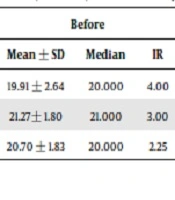
Table 2 displays the comparison between the average rankings of compliance with ergonomic principles scores before and after exam among study groups (Table 2).
Table 2.
Pre-exam and Post-exam Comparison in Control, Brochure, and Virtual Groups Using Wilcoxon Test
| Groups | Before | After | P Value | ||||
|---|---|---|---|---|---|---|---|
| Mean ± SD | Median | IR | Mean ± SD | Median | IR | ||
| Control | 19.91 ± 2.64 | 20.000 | 4.00 | 20.75 ± 1.64 | 21.000 | 1.5 | 0.10 |
| Brochure | 21.27± 1.80 | 21.000 | 3.00 | 13.51 ± 2.73 | 14.000 | 3.00 | 0.001 |
| virtual | 20.70 ± 1.83 | 20.000 | 2.25 | 10.79 ± 1.92 | 10.000 | 3.00 | 0.001 |
According to Table 2, no significant difference was observed in the control group before and after exam (P = 0.100). However, the mean scores of pre-test and post-test were respectively 21.27 ± 1.80 and 13.5 ± 2.73, which indicates the positive and significant impact of training (P = 0.001). A significant deference was also observed in virtual training group with the means of 20.70 ± 1.830 for pre-test and 10.79 ± 1.92 for post-test (P = 0.001). Lower scores in virtual training group indicate its higher efficiency in training.
Table 3 displays the comparison between the changes in brochure and virtual groups before and after the test using U Mann-Whitney test.
Table 3.
Comparison of Pre- and Post-test Changes in Brochure and Virtual Groups Using U Mann-Whitney Test
| Groups | Pre-test and Post-test Mean Difference ± Standard Deviation | Test Results |
|---|---|---|
| Virtual | 5.47 ± 9.91 | Z = -3.068 |
| Brochure | 7.76 ±3.20 | P = 00.2 |
Comparison of pre- and post-test changes in brochure and virtual groups using Mann-Whitney test also indicated that the mean ranking of score change in compliance with ergonomic principles in brochure and virtual groups had a statistically significant difference (P = 0.002).
5. Discussion
Comparing pre-test and post-test in both groups revealed a significant difference, which shows the effect of education through brochures and virtual method. In line with this finding, Omid Kalteh et al. stated that ergonomic educational program could be an effective method for decreasing musculoskeletal harmful factors (22). Also, Tirgar et al. showed that after providing the educational content, students’ awareness of ergonomic considerations for working with computer was significantly improved and the performance of about 95% of them was evaluated as average or good (20). Furthermore, Yaghobi and Ismaili concluded that the scores of dentists before and after educating ergonomics principles were significantly different and education had a positive effect on them (28). Nourani et al. reported the effect of educating ergonomics principles on decreasing the prevalence of musculoskeletal disorders (29). Another study stated the effect of an educational intervention on modifying health behaviors (30). All of the mentioned studies were in line with the present study. The results improved in both the brochure and virtual groups after the intervention compared to the control group.
Significant differences were observed between the brochure and virtual groups in that the virtual group scored better than the brochure group. In this regard, Jalali stated that the effectiveness of using technology and cellphones is higher and more sustainable than printed presentation methods (31). Fatehi et al. stated the superiority of virtual education over other educational methods (32). Moreover, Azizi et al. mentioned that regular use of education through social media is more effective compared to traditional methods (33). In another study, Safari et al. indicated the positive and significant effect of education using electronic files in the participants (30). The presented studies confirm the superiority of the educational method used in the present study. The reason for this superiority could be the extensive use of social media during the recent decades, accessibility of cellphones during the day and continuity of the content in social media. However, some studies showed the superiority of the brochure method over virtual education and using cellphone. Studies by Ghanbari et al. (34) and Safari et al. (25) were not similar to the present study. The reason for this difference might be the increasing prevalence of social media among people compared to previous years and the accessibility of social media at any hour and any time.
5.1. Conclusions
Results of the present study indicate the positive effect of the brochure and virtual education methods on compliance with the ergonomics principles and also the superiority of virtual education over brochures in operating room technologist. Therefore, using these methods instead of the traditional educational methods is recommended.