
1. Background
Due to the high fertility rate in most developing countries, different attempts have been made to decrease fertility. However, rapid decline of fertility may expose the population to ageing and reduce reproductive and active populations. In addition, it imposes financial burdens and health costs on societies moving rapidly towards ageing. The desired population of every country is determined according to the economic and social conditions at a specific time (1, 2).
Every country has to adjust its fertility rate and population growth with regard to the long- and short-term economic and social resources. This adjustment should be compatible with health strategies, welfare of children, mothers, and families, and economic development (3). The total fertility rate in Iran has increased from 6.5 in 1976 to 1.6 in 2012 due to successful implementation of family planning programs (4).
Population control policies, which have been established in Iran since April 20, 2014, have officially embraced population growth and fertility promotion above the replacement level. The main reasons behind this change of policy include reduction of population growth and total fertility rate, increase of marriage age in recent years, and prediction of the ageing phenomenon in imminent future (5).
Overall, reproductive performance is under the influence of economic, social, cultural, and environmental factors (6-8). Total fertility has decreased around the world, and some researchers have reported total fertility rates below the replacement level in many countries. However, in some countries, a considerable number of unintended births still occur. With regard to the total desired number of children, parents may want at least 1 child of each sex or sometimes equal numbers of male and female children. Therefore, some couples may continue to have children until they reach their desired family size or have the favorable number of sons and daughters (9).
Maternal and under-five mortality rates are directly influenced by fertility rate, pregnancy intervals, and quality of care for mothers and children (10-12). In fact, health of 2 vulnerable groups, including pregnant mothers and children under 5 years, is so critical that it has been embedded in the third millennium development goals (13).
Sistan and Balouchestan province (Southeast Iran) has the highest household size and total fertility rate in Iran, based on the census in 2011 (4.3 and 3.5, respectively). This province also has the highest maternal mortality rate (15.8% of all maternal mortalities in the country in 2012) and the highest under-five mortality (29.5 out of 1000 births during 2004 - 2010) (14).
As mentioned above, Sistan and Balouchestan province has an undesirable maternal and neonatal health status in comparison with other provinces of Iran. It should be noted that the higher fertility rate in this province is one of the influential factors. With this background in mind, in the present study, we aimed to evaluate the fertility pattern and determinants of the desired number of children among urban and rural women in Zahedan, center of Sistan and Balouchestan province in 2015.
2. Methods
It this cross sectional study, the mean number of children was determined to be 3.6 ± 1.4 and 2.7 ± 1.5, respectively, based on a pilot study on 20 rural and 20 urban women in Zahedan. The sample size was calculated as 41 cases per group (significance level, 0.05; power, 0.8). To improve the study power, the sample size was almost doubled, and 160 couples (81 urban and 79 rural women) were recruited.
The study population included married women of childbearing age, who were receiving care at urban and rural healthcare centers of Zahedan (teaching centers); their partners were recruited, as well. In order to determine the representative population, we selected 5 urban and 3 rural centers from different areas as clusters. Then, sampling was performed via convenience method in every cluster (15 - 16 couples in every urban health center and 25 - 27 couples in every rural health center).
The data collection tool included a questionnaire, comprised of demographic information, fertility pattern, and family planning details. First, the study objectives were explained to the participants. Then, after obtaining the informed consent forms, the questionnaires were completed via interview. The questions included: maternal age, mother’s education, father’s age, father’s education, rural or urban residence, ethnicity, use of birth control methods, interpregnancy intervals, number of children, parity, place of delivery, preference of child gender, and the desired number of children from the parents’ point of view (the number of children preferred until the end of fertility).
For determination of gender preferences, we asked the following question: “What gender do you prefer for your children?” The possible answers were as follows: 1) male; 2) female; and 3) it makes no difference. The validity of the questionnaire was confirmed by 3 faculty members of the community Medicine department, Zahedan University of Medical Sciences. Also, its reliability was evaluated via Cronbach’s alpha (0.76).
Distinction of Balouch and Sistani ethnicities is difficult due to interethnic marriages in the province. Therefore, 2 criteria were used simultaneously to distinguish the Balouch from Sistani. These criteria were as follows: having a recognized Balouchi last name (both wife and husband) and speaking Balouchi as the first language among Balouch people and having a recognized Sistani last name (both wife and husband) and a Sistani accent among Sistani people. The inclusion criteria were as follows: 1) being married, 2) being at childbearing age, 3) receiving care at urban or rural health centers, 4) being an Iranian, and 5) same ethnicity of the couple.
Finally, the data were entered to SPSS version 20. Descriptive results are presented as percentage, mean, and standard deviation. Chi square, independent t test, and Mann-Whitney U test were used to analyze the data. Binary logistic regression test was used to determine the association of different variables with the desired number of children (≤ 3 children or ≥ 4 children). Selection of the cut-off point was based on the total fertility rate of 3.5 in Sistan and Balouchestan province before changing the population policies in 2011 (11).
3. Results
This study was carried out on 160 couples (81 urban and 79 rural couples), who were receiving care at urban and rural health centers of Zahedan in 2015. The subjects were 50.6% Balouch (81 couples), 35% Sistani (56 couples), and 14.3% nonnative (23 couples). The women’s age ranged from 14 to 45 years (mean, 26.6 ± 4.8 years), and there was no significant difference between rural and urban women regarding the mean age. Also, the partners’ age ranged from 19 to 65 years (mean, 32.2 ± 7.1 years).
The demographic information was compared between urban and rural couples (Table 1). We found no significant difference between rural and urban fathers regarding the mean age. However, as shown in Table 1, the education level of urban parents was significantly higher than their rural counterparts (P < 0.001).
Table 1.
Comparison of Parents’ Demographic Information
| Variables | Mean ± SD | P Value for Normality Testa | Statistical Test | P Value | ||
|---|---|---|---|---|---|---|
| Maternal age | t test | 0.716 | ||||
| Urban | 27.34 ± 5.54 | 0.124 | ||||
| Rural | 25.97 ± 3.90 | 0.402 | ||||
| Father’s age | t test | 0.978 | ||||
| Urban | 32.28 ± 7.00 | 0.169 | ||||
| Rural | 32.25 ± 7.41 | 0.174 | ||||
| Number of previous pregnancies | Mann-Whitney U | 0.011 | ||||
| Urban | 2.01 ± 1.64 | 0.003 | ||||
| Rural | 2.71 ± 2.05 | 0.002 | ||||
| Number | Percentage | |||||
| Continuous use of a contraceptive method over the past 6 months | Chi square | 0.004 | ||||
| Urban | 60 | 74.1 | ||||
| Rural | 40 | 51.9 | ||||
| Mother’s education level | Chi square | < 0.001 | ||||
| Illiterate % | Primary school % | Middle school % | Secondary school and above % | |||
| Urban | 1.2 | 14.8 | 13.6 | 70.4 | ||
| Rural | 7.6 | 32.9 | 26.6 | 32.9 | ||
| Father’s education level | Chi square | < 0.001 | ||||
| Illiterate, % | Primary school, % | Middle school, % | Secondary school and above, % | |||
| Urban | 6.2 | 11.2 | 16.2 | 66.4 | ||
| Rural | 7.7 | 19.2 | 53.8 | 19.3 | ||
aKolmogorov-Smirnov test.
Based on the findings, 74.1% (60 women) and 54.4% (43 women) of urban and rural women had used a contraceptive method over the past 6 months, respectively; the difference was statistically significant, based on the Chi square test results (P = 0.023). The number of previous pregnancies in rural women (2.7 ± 2) was significantly higher than their urban counterparts. In addition, the number children in rural families (2.5 ± 1.8) was significantly higher than the urban ones (1.8 ± 1.4) (P = 0.019).
The mean desired number of children (number of children desired until the end of fertility) was 3.18 ± 1.7 for women and 3.56 ± 1.9 for their partners. Based on the Pearson’s correlation test, there was a significant positive correlation between the mean desired number of children in women and their partners (P < 0.001; r, 0.633). Moreover, the parents’ desired number of children in urban and rural areas with respect to ethnicity (Sistani or Balouch) is presented in Table 2. Clearly, the desired number of children for rural parents was significantly higher than their urban counterparts; it was also significantly higher in Balouch parents, compared to Sistani ones.
Table 2.
The Desired Number of Children from the Parents’ Point of View in Urban and Rural Areas with Respect to Ethnicity (Sistani and Balouch)
| Variables | Number | Mean ± SD | P Value for Normality testa | Statistical Test | Mean Rank | P Value |
|---|---|---|---|---|---|---|
| Desired number of children from the mother’s point of view | ||||||
| Urban | 81 | 2.9 ± 1.7 | 0.001 | Mann-Whitney U | 61.64 | < 0.001 |
| Rural | 79 | 3.6 ± 1.5 | 0.003 | 93.01 | ||
| Balouch | 81 | 3.8 ± 1.9 | 0.001 | Mann-Whitney U | 80.14 | < 0.001 |
| Sistani | 56 | 2.5 ± 1.1 | 0.005 | 44.51 | ||
| Desired number of children from the father’s point of view | ||||||
| Urban | 81 | 3.1 ± 1.5 | 0.002 | Mann-Whitney U | 59.85 | < 0.001 |
| Rural | 79 | 4.3 ± 2.3 | 0.006 | 93.25 | ||
| Balouch | 81 | 4.3 ± 2.2 | 0.003 | Mann-Whitney U | 80.11 | < 0.001 |
| Sistani | 56 | 2.7 ± 1.1 | 0.007 | 42.56 |
aKolmogorov-Smirnov test.
Data regarding the mother’s place of previous delivery are presented in Table 3. As shown in this table, the rate of out-of-hospital delivery (delivery at home) was higher among rural women in comparison with their urban counterparts. In total, 39 women were pregnant in this study. The mean interpregnancy interval was 13.02 ± 3.9 months for rural women and 29.75 ± 10.3 months for urban women; the difference was significant, based on the Mann-Whitney U test results (P = 0.045).
Table 3.
Distribution of the Location of Previous Delivery Among Womena
| Variables | Delivery at Home by Unskilled Attendants | Delivery at Home by Skilled Attendants | Delivery at Home by Educated Midwives | Delivery at Rural or Urban Birth Centers | Delivery at Hospital | Total |
|---|---|---|---|---|---|---|
| Rural | 6 (9) | 2 (3) | 0 (0) | 32 (47) | 28 (41) | 68 (100) |
| Urban | 0 (0) | 1 (1.5) | 1 (1.5) | 1 (1.5) | 63 (95.5) | 66 (100) |
aValues are expressed as No. (%).
By considering the mean desired number of children as a dichotomous variable (≤ 3 children, 0; ≥ 4 children, 1), we used the binary logistic regression test to evaluate the association of different factors with this variable. The examined variables included maternal age, mother’s education, father’s age, father’s education, rural/urban residence, ethnicity, and child gender preference from the parents’ point of view.
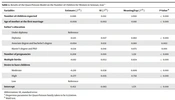
The results of binary logistic regression analysis (backward method) were used to determine the association between different variables and the desired number of children from the parents’ point of view (Table 4). It is obvious that male gender preference and Balouch ethnicity were significantly associated with the desired number of children from the parents’ point of view.
Table 4.
Effects of Different Variables on the Desired Number of Children (≤ 3 Children vs. ≥ 4 Children) from the Participants’ Point of View, Based on the Binary Logistic Regression Analysis (Backward Method)
| Variables | Independent Variables | β | SD | Wald | df | P Value | Odds Ratio 95% CI |
|---|---|---|---|---|---|---|---|
| Fathers | Gender preference (male vs. female) | 1.14 | 0.622 | 3.41 | 1 | 0.05 | 3.15, 0.93 - 10.68 |
| Ethnicity (Sistani vs. Balouch) | -2.41 | 0.495 | 23.73 | 1 | < 0.001 | 0.090, 0.034 - 0.237 | |
| Constant | 2.61 | 0.669 | 15.23 | 1 | < 0.001 | 13.63 | |
| Mothers | Gender preference (male vs. female) | 0.964 | 0.445 | 4.70 | 1 | 0.030 | 2.62, 1.09 - 6.26 |
| Ethnicity (Sistani vs. Balouch) | -1.72 | 0.439 | 15.48 | 1 | < 0.001 | 0.178, 0.075 - 0.420 | |
| Constant | 0.741 | 0.988 | 0.563 | 1 | 0.45 | 2.09 |
4. Discussion
In the present study, urban women in comparison with their rural counterparts used birth control methods more frequently (74.1% vs. 54.4%). The Iranian Ministry of Health has confirmed this finding in frequently published statistics (14). In addition, rural women had a history of more pregnancies (2.7 ± 2), compared to urban women (2 ± 1.6) (P = 0.033). Also, the number of children in rural families (2.5 ± 1.8) was significantly higher than the urban ones (1.8 ± 1.4) (P = 0.019).
The results of the present study showed rural women’s shorter interpregnancy intervals, compared to urban women (13.02 vs. 29.75 months). Moreover, more out-of-hospital deliveries (without appropriate care) were reported in rural women in comparison with their urban counterparts (57.8% vs. 4.5%). The higher fertility rate in rural women has been reported in other studies, as well, especially in developing countries. In this regard, Asamoah et al. examined the use of modern contraceptive methods and fertility rate among urban and rural women of Ghana from 1998 to 2008. They concluded that inequality in education and use of modern contraceptive methods is one of the reasons for the higher fertility rate among rural women (15).
Factors such as high fertility rate, low family planning coverage, short interpregnancy intervals, and out-of-hospital deliveries (especially at home) have been mentioned as the risk factors for pregnancy and delivery complications and higher maternal and under-five mortality rates (16-19). In our study, these risk factors were significantly higher among rural women; therefore, these women and children under 5 years are more vulnerable than urban women.
As mentioned in the results, the mean desired number of children for women and their partners was more than 3 in this study. The total fertility rate (mean number of children during fertility) was estimated at 3.5 in Sistan and Balouchestan province in the census of 2011, which correlates with the present study (14). In our study, one of the determinants of the desired number of children was the parents’ male child preference. Overall, one of the factors, which can influence the fertility rate in societies, is gender preference. Families may tend to have only 1 of each gender due to social, cultural, and economic factors; therefore, it is possible to exceed the desired number of children in order to have a child with the preferred gender.
Sexual discrimination has always been one of the major issues in different communities. This problem also exists in developed and developing countries, with a greater intensity in traditional communities. Tendencies and behaviors emanating from gender preferences are prevalent in many developing countries (6, 20-24). In our study, Balouch ethnicity was a determinant of the desired number of children (≥ 4 children).
The relationship of race and ethnicity with fertility health has been shown in various studies (25-27). In 2009, Borrero et al. in a study on single American men (age range, 18 - 29 years) showed that awareness and attitude of black and Hispanic men about contraceptive methods and their application were much poorer, compared to white people (28).
Moreover, Abbasi Shavazi et al. carried out a research in 2001 at Tehran University, Tehran, Iran. They showed that fertility differences related to ethnicity decrease considerably after controlling for social and demographic indices. However, despite the statistical control of these indices, some fertility differences remain without explanation, which may emanate from different determinants of fertility in different ethnicities and influence of norms, beliefs, culture, and social history of ethnicities (29).
Additionally, Abbasi Shavazi et al. in 2004 examined fertility behaviors in 4 selected provinces of Iran (Western Azerbaijan, Sistan and Balouchestan, Gilan, and Yazd) and showed that attitudes and fertility behaviors were related to ethnicity. In this study, the rates of live births were documented in women: Balouch (4.9%), Kurd (4.85%), Fars (3.4%), Azeri (3.5%), and Gilak (3%); also, similar findings were reported for the desired number of children (30). In addition, the results of a study by Nadim and Salarilak in 2000 in Western Azerbaijan showed that the percentage of having ≥ 4 children was higher in Kurdish people, compared to Turks (31). The results of the mentioned studies, similar to the present research, confirm the role of ethnicity in fertility behaviors.
4.1. Conclusion
Fertility pattern and determinants of reproductive performance can vary in different populations. Sistan and Balouchestan province has the lowest coverage of reproductive health programs and a high unsafe delivery rate. Therefore, reproductive and pregnancy health programs should be supplemented, parallel to population growth policies.