
1. Background
The demographic transition theory posits that a society’s path to modernization necessitates a shift from a premodern state characterized by high fertility and mortality rates to a postmodern state characterized by low fertility and mortality rates (1). A Census Bureau report reveals that Iran ranks among the top 20 most populous countries; however, it has experienced a substantial decline in its total fertility rate. Specifically, the fertility rate plummeted from an average of more than 6.58 births per woman in the early 1980s to an average of 1.92 births per woman in 2006 (2-5). Consequently, policymakers are concerned about declining fertility rates and the number of children within households (3).
On one hand, the number of children born into a family has significant implications for the physiological well-being of the mother’s reproductive system and her overall health (2). Birth and fertility rates are pivotal variables when examining the evolution of human behavior, a phenomenon influenced by numerous demographic, social, and economic factors in society (6, 7). Understanding the factors shaping reproductive preferences and trends enables us to predict fertility patterns and the number of children while effectively managing population growth. Formulating sustainable demographic policies necessitates a comprehensive and thorough investigation of the determinants affecting the number of children within households (3, 8).
Bankole and Audam contended that, most importantly, spouses respected each other’s reproductive preferences, including desired family size and future childbirth aspirations. In instances of discord, men typically desired a more significant number of children than their spouses did. Consequently, examining the number of children within fertility studies assumes paramount importance (3, 9).
Substantial evidence indicates that children from low-income households outperform their peers across various developmental indicators. Furthermore, an inverse relationship exists between larger household sizes and food security status, implying that children’s awareness of their family’s economic circumstances motivates them to work diligently and find innovative ways to manage limited financial resources (10-13).
The rising costs associated with childcare might dissuade many households from expanding their families (14-16). Another factor to consider is that longer-lasting marriages often result in larger families (15-17). Couples with fewer children might seek to increase their family size; however, those with more children might not necessarily aspire to have additional offspring (15, 18, 19). Consequently, examining factors influencing the number of children within a family holds significant relevance. It is worth noting that, compared to previous research, one of the distinguishing features of the current study is the utilization of the Quasi-Poisson model, a choice driven by the limitations inherent in the Poisson model.
2. Objectives
This study aimed to explore the number of living children (NLC) among married women in Semnan, Iran, and the effective social, cultural, and economic factors using the Quasi-Poisson model, which posits that the variance is a linear function of the mean.
3. Methods
3.1. Study Population
This cross-sectional study meticulously examined the reproductive histories of 600 married women aged 15 to 49 years residing in Semnan, Iran. The participant selection occurred in 2018, specifically within April and October. This study employed a multistage random selection process from health center lists. Initially, 18 health centers were chosen through cluster sampling from a pool of 21. Subsequently, households within each selected health center were systematically and randomly picked in the second stage. In the final stage, one married woman aged 15 to 49 years was randomly selected from each household. To determine the required sample size, the primary variable under consideration was the number of children expected (NCEX), with a pilot study indicating a rate ratio of 0.885. PASS software estimated the sample size to be 359 married women. The study adjusted the final sample size to encompass 600 participants, considering a presumed 10% attrition rate and a design effect of 50%.
Notably, this study’s calculations, factoring in a 5% type I error rate and an 80% power, were followed by approval from the Ethics Committee at Semnan University of Medical Sciences. Trained interviewers then conducted interviews with the selected married women, providing comprehensive explanations regarding the study’s objectives and emphasizing the importance of maintaining the confidentiality of information during these interviews.
A uniform set of interview questions was employed consistently across all interviewees to mitigate interviewer bias. These questions were intentionally brief, direct, and unambiguous. Additionally, complex concepts were broken down into more straightforward, focused queries to enhance clarity and ensure respondents provided clear and concise answers.
Data collection was conducted through face-to-face interviews and the completion of specific forms. These forms included a wide range of information covering demographics and fertility history. The data collection tool used was a checklist explicitly developed for this study, drawing inspiration from retrospective studies.
It is important to note that women who declined to participate in the study and those who had not given birth were excluded from the analysis. In the end, the study involved 600 mothers. Although 7 women declined to participate, an additional 20 were excluded from the study as they had not given birth. Consequently, the final study cohort comprised 573 women.
The explanatory variables considered in this study included age at marriage (measured in years), the NCEX, maternal and paternal education levels, maternal occupation, paternal occupation, economic status, place of residence, desire to have children (DHCH), number of pregnancies, and instances of multiple births. It is important to emphasize that the data used in this study were obtained from projects that had received university approval, and rigorous ethical considerations were meticulously observed throughout the research process.
3.2. Ethical Considerations
This study was approved by the Semnan University of Medical Sciences (ethics code: IR.SEMUMS.REC.1396.278). Written informed consent was obtained from all the participants.
3.3. Statistical Analysis
The Poisson model operates under the premise that the variance equals the mean, a presumption that might not always hold. Consequently, this model assumes the absence of over-dispersion and under-dispersion within the dataset. In the current investigation, the assessment of goodness of fit revealed the presence of under-dispersion, as indicated by a “Value/df” ratio of 0.12 in the Pearson chi-square statistic. As a result, the standard Poisson regression could not be employed. To overcome this challenge, the Quasi-Poisson model came into play. The Quasi-Poisson regression model, belonging to the family of generalized linear models, incorporates a log or log-link function and can be expressed as follows:
In this study, μ symbolizes the mean response variable; however, xj represents the predictor variable for j = 1, …, p, and βj signifies the regression parameter. Quasi-Poisson regression parameters were estimated using the iterative weighted least squares (IWLS) method (20, 21). This study employed scatterplots to evaluate the presence of collinearity among independent variables and calculated the variance inflation factor (VIF).
All statistical analyses were conducted using Statistical Package for the Social Sciences (SPSS) software (version 17.0; SPSS Inc., Chicago, Illinois, USA). Additionally, the glm2 package in R (version 3.6.3) was utilized for specific analyses (22). The significance level for all analyses was set at 5%.
4. Results
The mean (standard deviation [SD]) age of mothers and husbands at their first marriage was estimated at 21.02 (4.80) and 25.10 (4.70) years, respectively. Similarly, the mean (SD) values for the number of expected and lived children and the number of pregnancies were 2.19 (0.96), 1.85 (0.81), and 2.15 (1.03), respectively. Approximately 38.7% of mothers possessed educational qualifications higher than diplomas; nevertheless, 37.2% of fathers had similar educational backgrounds. A small percentage of mothers (5.3%) were self-employed; nonetheless, most fathers (5.7%) fell into this category. Conversely, the lowest percentage of mothers (7.3%) resided in rural areas, and a moderate DHCH was reported by 11.9% of them. Additionally, 3.3% of the mothers experienced multiple births, and most subjects (59.3%) were classified as having a weak economic status (Table 1 and Figures 1 and 2).
Table 1.
Covariates Characteristics for Women in Semnan, Iran
| Variables | Min | Max | Mean ± SD |
|---|---|---|---|
| Number of children expected | 0 | 8 | 2.19 ± 0.96 |
| Number of pregnancies | 0 | 8 | 2.15 ± 1.03 |
| Age of mother at the first marriage | 17 | 49 | 21.02 ± 4.80 |
| Age of father at the first marriage | 20 | 51 | 25.10 ± 4.70 |
| Number of living children | 0 | 5 | 1.85 ± 0.81 |
Abbreviations: Min, minimum; Max, maximum; SD, standard deviation.
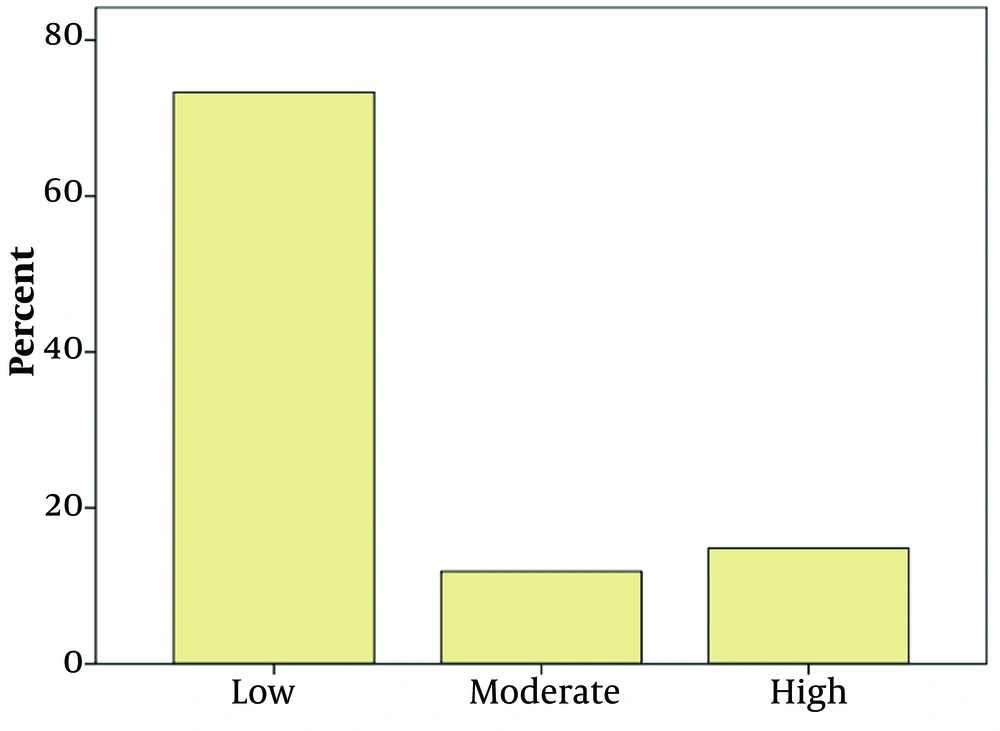
Figure 1.
Distribution of desire to have children
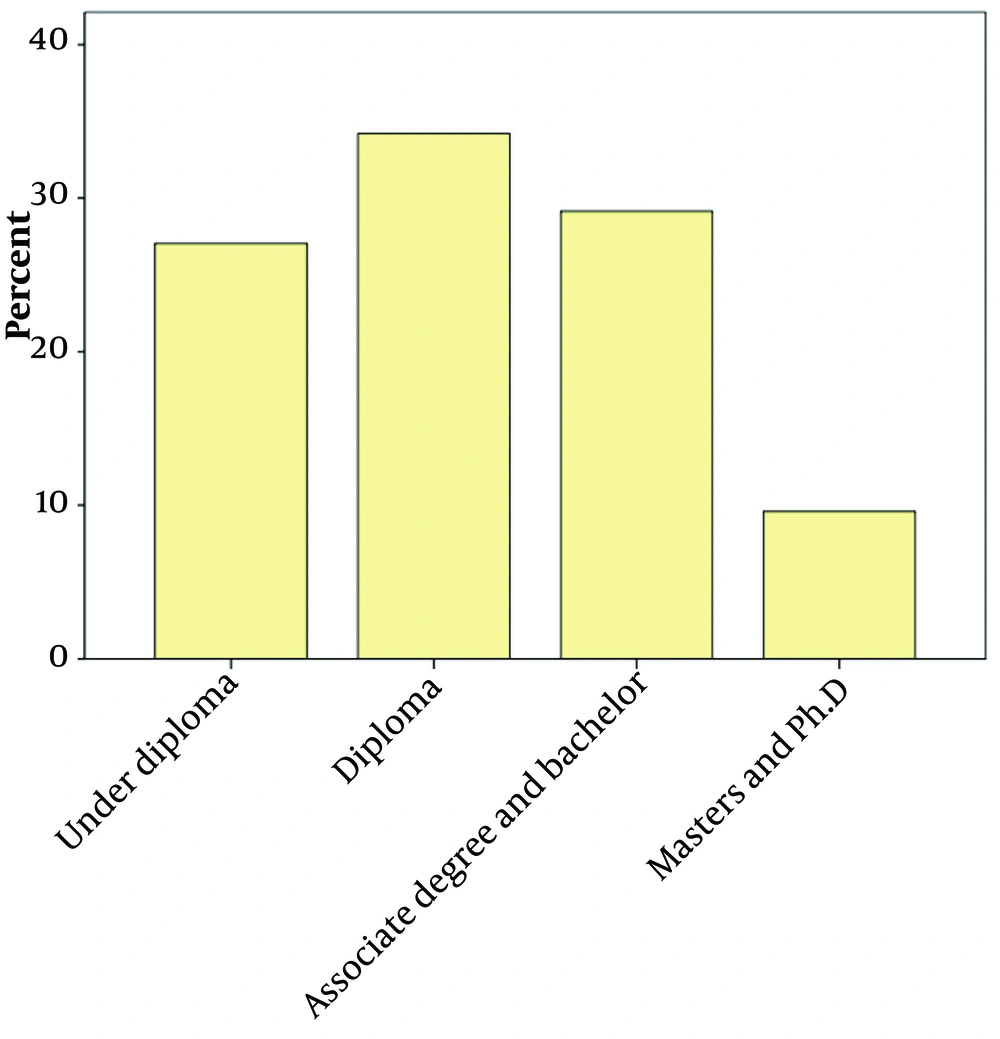
Figure 2.
Distribution of father’s education
A Quasi-Poisson model was employed, and the final results are presented in Table 2. The VIF values for the independent variables ranged from 1.01 to 1.30, indicating no significant multicollinearity issues among the independent variables (23).
Table 2.
Results of the Quasi-Poisson Model on the Number of Children for Women in Semnan, Iran a
| Variables | Estimate (β∆) | SE (β∆) | Meaning/Exp (β∆) | P-Valueb |
|---|---|---|---|---|
| Number of children expected | 0.086 | 0.012 | 1.090 | < 0.001 |
| Age of mother at the first marriage | -0.009 | 0.002 | 0.991 | < 0.001 |
| Father’s education | ||||
| Under diploma | Reference | |||
| Diploma | -0.125 | 0.027 | 0.882 | < 0.001 |
| Associate degree and bachelor’s degree | -0.094 | 0.031 | 0.910 | 0.002 |
| Master’s degree and PhD | -0.134 | 0.041 | 0.875 | 0.001 |
| Number of pregnancies | 0.208 | 0.010 | 1.231 | < 0.001 |
| Multiple births | -0.193 | 0.053 | 0.824 | < 0.001 |
| Desire to have children | ||||
| Moderate | -0.216 | 0.038 | 0.806 | < 0.001 |
| High | -0.277 | 0.035 | 0.758 | < 0.001 |
| Low | Reference | |||
| Intercept | 0.452 | 0.083 | 1.571 | < 0.001 |
Abbreviation: SE, standard error.
a Dispersion parameter for Quasi-Poisson family taken to be 0.1214044.
b Wald test.
The model utilized the backward elimination method to select influential explanatory variables. This method initially includes all factors in the model and subsequently retains only the essential variables (24). Consequently, only the NCEX, MAM, father’s education, the number of pregnancies, occurrences of multiple births, and DHCH significantly influenced the NLC. The NCEX and the number of pregnancies were associated with an increase in the number of children; however, the remaining variables were associated with a decrease in NLC. Furthermore, for each additional year in the MAM, the childbearing rate decreased by 0.991, assuming that the other predictor variables in the model remained constant. This finding means that with each additional year in the MAM, there is an approximate 1% decrease in the childbearing rate.
5. Discussion
This study employed the Quasi-Poisson model to analyze the factors influencing the NLC among married women in Semnan, Iran. The obtained findings revealed that several variables significantly impacted NLC, including the NCEX, MAM, the father’s level of education, the number of pregnancies, occurrences of multiple births, and DHCH. Furthermore, increased multiple births, MAM, fathers’ education (related to under diploma), and DHCH (related to low desire) reduced the NLC, assuming that the other predictive variables in the model remained constant.
It is worth noting that only four studies conducted in Iran that explored the NLC in households were identified. Among these studies, only one utilized the Poisson model without assessing dispersion. These investigations revealed significant effects on NLC from variables such as the mother’s age, income, maternal and paternal education, ethnicity, place of residence, women’s employment, the NCEX, the number of pregnancies, and the DHCH (3, 7, 16, 25). Nonetheless, a study encompassing five developed countries (Japan, South Korea, the United States, France, and Sweden) demonstrated that the MAM and DHCH significantly influenced NLC (15-17). In another study conducted in Ghana and Nigeria, significant variables included place of residence, maternal education, religion, maternal age, women’s employment, and wealth index (17). Therefore, despite certain research limitations, the present study aligns with existing literature.
The current study revealed that DHCH (related to low desire) and fathers’ education (related to under diploma) contributed to a decrease in NLC, which contrasts with Schachter’s findings (26). This discrepancy is attributed to the traditional nature of Iranian society, especially in Semnan, where the male family member’s opinion holds more weight than in American society. Additionally, prolonged periods of schooling and work might impact the age at which individuals marry and, consequently, their NLC (27). The results of the present study corroborate the findings of other studies (28-30).
In previous studies, evidence from modern societies in the developed world suggests that there is a negative or null correlation between resources or power, such as income or education level, and reproductive success (11, 28, 31-33). The present study also suggests that economic status does not significantly influence the number or presence of children. Even lower-income individuals can access various forms of social support for childbirth and childcare in developed countries. Non-financial support from relatives also plays a crucial role in helping parents nurture their children (15). However, a Korean study posits that government policies supporting childbirth might have increased fertility (34).
In summary, the present study identified several variables that reduce the NLC among married women, including the MAM, father’s education, multiple births, and DHCH. In other studies, variables such as age at first marriage, economic status, DHCH, education of spouses, gender preference, paternal occupation, exposure to media, ethnicity, spousal age difference, residence, and women’s authority have also been observed to reduce the NLC among married women (1, 3, 7, 15-17, 25, 35). In this study, there is no insistence on early marriage; nevertheless, the emphasis is on timely marriage.
5.1. Conclusions
Therefore, it is imperative to prioritize education to address detrimental factors, particularly the age at which individuals marry, that can effectively boost the birth rate and prevent a significant rise in the population’s median age. In turn, prioritizing education will help ensure Iran’s society maintains a vibrant youth demographic and a robust labor force. It is important to note that the age at which women marry is a significant negative factor. Therefore, the government must promote timely marriage by fostering a supportive culture and providing sufficient facilities to facilitate it.
One of the key strengths of this study lies in its substantial sample size and the accuracy of the collected data. Undoubtedly, incorporating additional variables into the research would enhance the precision and reliability of the research findings.
5.2. Limitations
This study did not consider specific factors that could significantly affect the NLC among married women, such as age at menarche and menstrual status. It would be advisable to explore the impact of these factors to gain a more comprehensive understanding of the time it takes for women to have their first child after getting married in the country. Moreover, it is essential to conduct further research in various regions of Iran to investigate other variables not covered in this study.