1. Background
Pediculus capitis or head louse is an obligate ectoparasite found on the scalp and hair and transmitted directly via close contact with an infected person’s head or indirectly by items such as comb, headscarf, bed and cap (1-3). Incidence of secondary infections, allergy, itchy scalp, educational failure, sleeplessness, depression and losing social situation are the complications of head lice infestation. Head louse is a significant infestation, related to the communities with poor health (4). It is a serious public health challenge in many regions of the world. In several epidemiological investigations done on school pupils in other countries, the prevalence of infestation is recorded 35% in Brazil, 52% in Ukraine, 5.8% in Korea, 13% in Australia and 48.7% in France (5-9). This parasite causes significant health problems in various communities mainly among the school aged children (9-11). For example, the head lice infestation rates in school children of the following cities are: Iranshahr 27%, Tabriz 3.64%, Fars province 1%, Bahar 1.3%, Khajeh 4.8%, Sirjan 1.12% and Qeshm Island 23.9% (1, 3, 12).
Infestation with P. capitis is mostly detected by two ways: observation of live lice and nits attached to hairs and inflammation and pruritus of the neck and scalp. The empty nit shell may remain for several months. The risk of transmission to other persons is just considered by live lice, adults or nymphs (3). There are several factors associated with the host such as age group, gender, race, socio-economic status, hair length, hair type, resistance to insecticide, etc. that may be related to infestation prevalence (1, 3, 12-14).
2. Objectives
Since no research is conducted on P. capitis in Khorramshahr yet, the current study aimed to determine the head lice infestation rate and related risk factors in primary school students in Khorramshahr.
3. Materials and Methods
This descriptive, cross sectional and analytical research was conducted in Khorramshahr in 2008 - 2009. The ethical principles of this research were investigated and discussed in research committee of medical entomology department and were approved after making needed modifications. The study was conducted on the male and female students in 10 primary schools. Seven hundred and fifty subjects from grades 1 - 5 primary schools in urban the areas of the county were examined for head lice infestation. A multistep, stratified cluster random sampling strategy was employed to gather the data. The pupils’ scalp and hair were inspected by two trained health workers under the supervision of medical entomologist. The diagnosis of infestation was certified by visual examination of their hair and scalp by a hand lens and with the aid of a desk lamp to detect living lice, nymphs and/or nits, for nearly three-five minutes. In the standard questionnaire, data about school grade, school type (state or private), gender, number of family members, parents’ occupation, parents’ literacy, parents’ income, size of hair, type of hair (curly or straight), times of using comb per day, sharing personal items, Knowledge of head lice, hair density, infestation with lice in the past, infestation with lice of other family members, presence of one of life stages of lice in the head, infestation severity, frequency of hair washing per week, sanitary bathroom at home, presence or absence of dandruff in the head, birth rank, number of family members per bed room, school health educator and etc. were recorded. The questionnaire was filled out by face to face interview. For the data analysis, Chi-square or the Fisher tests (SPSS software, version 11.5) was used. Also, P < 0.05 was considered as level of significance in the current study.
4. Results
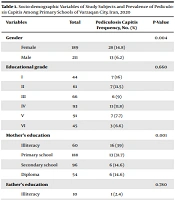
Totally 750 primary school students of 10 schools including 405 males (54%) and 345 females (46%) were screened. Among the subjects under study, 585 and 150 pupils studied in state and private schools, respectively. The overall head lice infestation rate in the studied population was 2% (n = 15). All 15 infested pupils studied in the state schools. The infestation rate among the males and females were 1.5% and 2.6%, respectively. The infestation ratio in females was 1.96 times higher than that of the males and this difference was statistically insignificant (X2 = 1.2, P = 0.30). The frequency rate of infestation to nit was 73.3%. About 26.7% of those disheveled carried nits and live lice. The infestation rate by school grade was 3.3%, 0.7%, 3.4%, 1.8% and 0.7% for the first, second, third, fourth and fifth grades, respectively. Frequency of head lice infestation in the third grade pupils was larger than those of other grades. There was no significant association between the infestation and grade level (X2 = 5.2, df = 4, P = 0.263). Additionally, in the males” and females” schools the most affected groups were the third (2.7%) and first grade (5.3%), respectively.
The prevalence of head lice infestations by frequency of hair washing were 43.5%, and 0.7%, for once in a week and twice in a week, respectively. The difference between twice or once hair washing in a week and infestation rate was highly significant (X2 = 0.2, df = 1, P < 0.001). Head lice infestations were in families which had 4 (0.3%), 5 (6.7%), 6 (9.4%) and 7 (10%) members. The prevalence of infestation was significant according to family size (F = 3.16, df = 5, P < 0.001). The prevalence of head lice in relation to length of hair was statistically significant (X2 = 43.316, df = 1, P < 0.0001) and in long hair and short hair students were 11.1% and 0.8%, respectively. The prevalence of lice in schools with lack of health teachers was 2.9 % and the pupils who studied in schools with health teachers had no infestation.
Infestation rate was higher among the students who had no bath in the home (8.3%) than the students who had a bathroom at home (1.9%). But, the Chi-square analysis presented insignificant relationship between head lice infestation and bathroom at home (X2 = 2.4, df = 1, P = 0.217). Infestation rate was significantly associated with the fathers’ literacy level (F = 15.7, df = 3, P < 0.001); the values were 11.8% for the pupils with uneducated fathers, 2.2% and 1.2% for pupils whose fathers’ literacy level were primary education and secondary education; while the pupils whose fathers’ literacy level was greater than diploma had no head lice infestation. Although the infestation rate of P. capitis was higher in students with illiterate (3.1%) and primary literacy mothers (2%) in comparison to those of the students with secondary literacy mothers (1.7%) and higher than diploma (1.3%), the difference was statistically insignificant (X2 = 0.8, df = 3, P = 0.836).
Hair type (curly and straight) was not significantly affected the infestation rate (P > 0.05). There was a significant association between the head lice infestation and father’s job (X2 = 39.4, df = 6, P < 0.001). Approximately, 8%, 3%, 2% and 2% of fathers of pupils infested to head lice were workers, sailors, unemployed and self-employed, respectively. All mothers of the cases with head lice were housewives. Nearly, 1% of pupils with straight hair and 2.6% of pupils with curly hair had head lice infestation. Also, about 2.7% of students with high density hairs and 1.3% of students with low density hair had pediculosis capitis infestation. There was no significant difference between infestation and hair style or hair density of students.
Head lice infestation rate was 0.6% among the students who had homes with enough and suitable area in comparison to students who did not have suitable homes (8.7%). Indoor size was significantly related to the infestation rate (X2 = 34.9, df = 1, P < 0.001). Also, the majority of cases had no knowledge about P. capitis. Among the students who shared their personal belongings, about 6.9% were infested with lice. But only 0.2% of students who did not use common items were infested with lice. Data analysis showed a significant association between sharing items and prevalence of head lice (X2 = 34.2, df = 1, P < 0.001). Furthermore, among the pupils who shared their headscarves, towels, combs, bed and pillows, the prevalence rates of infestation were 10.9%, 15.4%, 8.7%, 8.2% and 8.3%, respectively. On the other hand, just 1.03%, 0.7%, 0.3%, 0.17% and 0.17% of children who did not share the mentioned items were infested, respectively.
5. Discussion
In the current study, the overall prevalence of P. capitis infestation was low, and among the lowest levels reported by researches in Iran. In addition, the comparison of the current study results with those of prior surveys carried out in several parts of Iran demonstrated noticeable variation of prevalence in school pupils (1, 3, 11-16).
The difference of head lice infestation could be because of factors such as personal health, economic status, family income, knowledge and attitude about P. capitis, control methods, resistance to insecticides, frequency of direct contact, busy human dwellings and head lice infestation policy in schools. Thus, the prevalence of infestation can decline with improvement of life standards (17-19).
In the current study, the prevalence of Pediculosis spp. infestation in females was greater than that of males which is in agreement with the findings of previous investigations (12-20). The reason for this gender- related prevalence stays unknown, however it is ascribed to gender-associated behaviors; for example, females probably have closer and more long social contact in small groups than males, and the females mostly have long hair (17, 21). Head-to-head contact is a major way of transmission as well as indirect route such as sharing hair items such as comb, brush, headscarf and hat. In the current study, family size was one of the agents which were in association with infestation rate; also, in overcrowded houses the prevalence of Pediculosis was high. One reason could be that if one family member is infested, other family members have a high risk of head lice infestation (3).
The current study findings showed that school hygiene instructors have a significant role to assist the children to forbear the risk of P. capitis. The present strategies to control head lice infestation confirm the active role of hygiene tutors in education to prevent and manage this problem. When instructors are knowledgeable and have right attitude, they can teach school students to prevent and combat with head lice infestation (17, 22). In the current study, the prevalence of pupils infested with head lice was lower when they had short hair. In the studies by Saddozai et al. and Rassami et al. infestation rates were significantly higher in children with long hair (19, 23). Meanwhile, there was a significant difference between the prevalence of head lice and the length of hair which is in line with the study by Kassiri and Esteghali (24), although there is commonly an imagined association between long hair and infestation. In spite of the school authorities’ opinion cutting the hair does not reduce the incidence of head lice infestation. Since diagnosis of infestation with head lice was performed by visual screening, several students with a low level of active infestation may have been lost. Some investigators indicated that direct visual examination is less precise than use of a louse comb, and may undervalue the real prevalence of infestation (17). This study had two limitations: First, due to detection of infestation was made by visual screening; several pupils with a very low level of head lice infestation may have been missed, Second, the type of questionnaire we used was unable to assess more items.
5.1. Conclusions
According to the results of the current study, to apply effective health educational strategies for parents, pupils, teachers and authorities in order to affect the attitude, knowledge and practice about P. capitis, design effective combat programs, early detection of the head lice infestation, personal hygiene and providing appropriate healthy living places are very important to decrease head lice infestation in communities.