1. Background
The control of microorganisms at different surfaces of industrial and residential environments is the main concern regarding the spread of infectious diseases. Elevators are one of the most essential accessories of social life, since today many of the buildings are multi-storied. Elevator buttons in many different buildings could be an open growth place of biological infection agents and their potentially dispersion in the community (1).
The skin flora normally is not pathogen, but it can cause some diseases if it is localized in other organs. The human fingers’ skin is humid and has ideal temperature for microorganisms; the adult human is sheltered with around 2m2 of skin, thus contact between hands and elevator buttons help bacteria and fungi to remain on elevator buttons (2, 3).
According to some recent studies, the intestinal diseases caused by Salmonella and Campylobacter species, are developed by contaminated foods and drinks and also contact of hand to mouth, meaning direct and indirect contact with microbial contaminated surfaces, foodstuffs and beverages (4, 5). Also communicable disease surveillance center (CDSC) reported that 19% of Salmonella spp. outbreaks may be related to food and other microbial contaminated surfaces (6). In the other studies, microbial contaminations were found on computer keyboards, shopping mall trolleys and door handles (7, 8).
Actually, today in the developing countries, people consciously use detergents and hot water for hand washing and impurity removal. But they seldom want to try to disinfect or clean elevator buttons. Therefore, they are the potential sources of contamination for the transmission of bacterial and fungal agents (4).
According to the results of studies in the developing countries, infections threaten more than 25% of admitted patients. There are elevators in hospitals which are a risk of microbial contamination. It is predicted that using standard infection control guidelines could approximately prevent one third of these infections (9). Kandel et al. evaluated the prevalence of bacterial colonization of elevator buttons and toilet surfaces in large teaching hospitals. As they reported, elevator buttons had a higher prevalence of colonization than toilet surfaces and the most common organisms were coagulase-negative staphylococci, followed by Streptococcus spp. (10).
In a study similar to the current work, Khatib et al. found microbial contamination in all samples taken from elevator buttons at the faculty of science at Jazan University of Saudi Arabia. Staphylococcus species were the most dominant microorganisms followed by Gram-negative bacilli, Streptococcus spp. and Gram-positive bacilli (11).
2. Objectives
The current study aimed to isolate bacteria and fungi from elevator buttons in schools of Isfahan University of Medical Sciences, Isfahan, Iran.
3. Methods
The current cross sectional research was conducted from June to August 2013. A total of nine elevators in the schools of Isfahan University of Medical Sciences were tested for bacterial and fungal contamination. The samples were collected from seven schools including: medicine, dentistry, pharmacy and pharmaceutical sciences, health, education development center (EDC), management and medical information sciences and rehabilitation sciences (five buttons from each elevator, totally 35 buttons). It should be noted that two samples were taken from each button, one of them for bacterial tests and other one to evaluate fungal contamination.
Sample collection was performed by sterile, single-use cotton swabs. The swabs were moistened with sterile peptone water and after rotating it firmly over the entire surface of each button were returned to the holding tube and transferred to the laboratory immediately.
In the laboratory, according to the standard methods of microbiological tests sampling swabs were spread on the surface of blood and eosin methylene blue (EMB) agar culture plates. Then, plates were incubated at 37°C for 48 hours. Identification of bacteria was done through the Gram staining and biochemical analyses (12).
For quality control (QC), all prepared culture plates were stored at refrigeration temperature (4°C); 5% of each series of prepared culture media were incubated at 37°C for 24 hours to ensure their sterility. Performance of all media was checked by inoculating international standard strains such as Staphylococcus aureus (ATCC 25923) and Escherichia coli (ATCC 25922) (7) prepared from microbial collection of Pasteur institute of Iran, Tehran, Iran.
The second sample of each elevator to identify fungal contamination was inoculated on sabouraud dextrose agar (SDA) culture medium and incubation of this culture was done at 25°C. The cultures were examined every two days for evidence of growth. Identification was made according to microscopic tests and colonial morphology. One drop of 95% ethanol was located on slide and sterile needle was applied to ensure the accuracy of fungal growth tests. After ethanol evaporation, one drop of lacto phenol cotton blue was put with a cover slip. It was identified under a microscope (13).
All findings were registered in data sheets during each phase of the study and finally were analyzed by MS Excel software.
4. Results
This study was conducted on 35 buttons from seven elevators in the schools of Isfahan University of Medical Sciences. The results showed that 100% of the elevator buttons had bacterial contaminations with a kind of Gram-positive and -negative bacteria (Figure 1). Table 1 illustrates the type of bacteria isolated from the elevator buttons of each school. Detected bacteria included Serratia, Enterobacter and Staphylococcus species. All of the elevator buttons were colonized by Staphylococcus and Enterobacter species. According to Figure 1, the schools of medicine, dentistry, management and medical information sciences had the highest bacterial contamination. On the other hand, fungal contamination was not found in any of the samples.
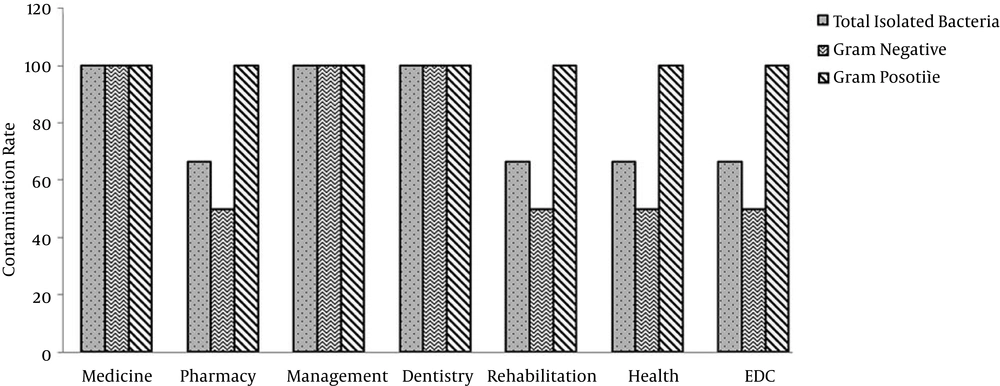
Figure 1.
Comparison Among Bacterial Contamination in Different Schools of Isfahan University
Table 1.
Bacteria Isolated From the Elevator Buttons in the Schools of Isfahan University of Medical Sciences
| Sampling School | Type of Bacteria | Type of Fungi | ||
|---|---|---|---|---|
| Gram-Positive | Gram-Negative | |||
| Staphylococcus | Enterobacter | Serratia | ||
| Medicine | + | + | + | ND |
| Pharmacy and pharmaceutical | + | + | - | ND |
| Management and medical information sciences | + | + | + | ND |
| Dentistry | + | + | + | ND |
| Rehabilitation sciences | + | + | - | ND |
| Health | + | + | - | ND |
| Education Development Center | + | + | - | ND |
Abbreviation: ND, not detected.
5. Discussion
In the present decade, human environment and public departments are at risk of many microbial contaminations. Unfortunately, many bacteria have developed resilient to some drugs. Thus, the risk of microbial infection is a serious concern. Also pathogenic microbes are dispersed in high amounts in many public areas.
Several studies demonstrated the microbial contamination of different surfaces. Selim et al. showed that 95% of cell phones were contaminated with different types of bacteria and some of them were resistant to antibiotics (9); Al-Ghamdi et al. reported the bacterial contamination on computer keyboards, computer mouses, shopping cart handles and elevator buttons in different places of Jeddah, Saudi Arabia (14).
Contact between fingers and elevator buttons may serve as vectors for transmission of microorganisms. Elevator buttons in the schools are contaminated with microbial agents and people using them are at risk of such infections. Therefore, the current study selected 35 elevator buttons from seven different schools to isolate bacterial contamination. The results of the surface swabbed samples indicated that all of the buttons were contaminated by two or more microorganisms including Staphylococcus and Enterobacter species; shown in Table 1. Also, analysis of the isolated bacteria showed the colonization of skin flora bacteria on elevator buttons. In other words, around 100% of the isolated Gram-positive bacteria were non-pathogenic and their presence on the buttons was due to direct and repeated contact with human fingers. These bacteria are usually sturdy and can persist on environmental surfaces for long periods (15). Also, detection of Gram-negative bacteria (Enterobacter and Serratia species) on the elevator buttons is compatible with the results of the other studies on public surfaces (16, 17), this may be due to inadvertent finger contaminations of students and laboratory staffs and direct contact with buttons.
Contamination prevalence varied among the seven schools (Figure 1); the highest rate of contamination was found in medicine, dentistry, management and medical information sciences, respectively. There are several microbial pilot and laboratories in these schools. A large number of students, university staff and various individuals who deal with the laboratories are using elevators several times a day.
A comparison between the results of the current study and other studies revealed that diversity of bacteria on elevator buttons was less than those of other surfaces. Nonetheless, presence of pathogenic bacteria such as Enterobacter and Serratia species on the elevator buttons, which are one of the most commonly touched and shared surfaces, could lead to transmission of infectious agents. Based on the results of other studies, it is noteworthy that these bacteria are highly resistant to antibiotics; for example, all Enterobacter species were resistant to ampicillin (95%), amoxicillin (91%) and tetracycline (87%) and Staphylococcus species were resistant to penicillin (87%), oxacillin (83), amoxicillin (80%) and tetracycline (100%) (7).
In the study by Avila-Aguero et al. contamination of children’s toys in a pediatric hospital with pathogenic bacteria and also contamination of at least one patient with these agents was reported (18). Another study on the surfaces of a hospital in Mexico demonstrated that all areas of the hospital were colonized by pathogenic bacteria including Klebsiella and Pseudomonas species, E. coli and also fungal contamination including Cladosporium spp. Microsporum canis, Aspergillus and Penicillium species (19).
Therefore, cleaning and disinfecting the high-touch public surfaces such as elevator buttons especially in hospitals, health care centers and medical schools is necessary to prevent inadvertent microbial transmission. It should be noted that fungal contamination was not detected in any of the study samples. The reason could be the high fungi sensitivity and not having fit growth conditions. The status of microbial contamination of elevator buttons in the current study was compared with some reported data from other studies on different surfaces in Table 2.
Table 2.
Comparison of Microbial Contamination Extent of Different High-Touch Surfaces in Health Care Relevant Centers
| Studied Surfaces | Most Common Detected Contamination | Reference |
|---|---|---|
| Elevator buttons and toilet surfaces in a teaching hospitals | Coagulase-negative Staphylococci, Streptococcus spp. | (10) |
| Children’s toys in a pediatric hospital | Staphylococcus spp., Bacillus spp. | (18) |
| Indoor surfaces of a hospital (armrest beds, dishwasher, medical tables and the hands of medical staff) | Bacteria: Klebsiella spp., Pseudomonas spp. and E. coli spp. Fungi: Cladosporium, Microsporum, Aspergillus and Penicillium species | (19) |
| Health care worker’s mobile phones in a teaching hospital | Staphylococcus, Enterobacter and Klebsiella species | (20) |
| Stethoscopes used by doctors and health workers | Staphylococcus, Pseudomonas and Enterobacter species, E. coli | (21) |
| Elevator buttons in medical university schools | Staphylococcus, Enterobacter and Serratia species | This study |
5.1. Conclusion
The present study investigated the extent of microbial contamination of elevator buttons in different schools of Medical University in Isfahan, Iran, as a preliminary study.
In summary, the results confirmed that all sampled areas were contaminated with skin flora bacteria (Staphylococcus species); Enterobacter and Serratia species contaminations were also found in the collected samples from medicine, dentistry and information sciences schools. These findings reveal the necessity to adapt some strategies to clean and disinfect high-touch surfaces such as elevator buttons in medical schools. The presence of pathogenic microorganisms also pointed out the need for special concern about hand hygiene. However, more detailed studies are required.