
1. Background
Behavioral decisions by human in daily life, including smoking and drug abuse, are influenced by personality traits (1, 2). On the other hand, in the transition of individuals to a new context, such as high school, particularly with new levels of behavioral freedom, personality could play a particularly important role in influencing their behavior (3). It seems that one of these personality indicators is optimism or pessimism. As a definition, optimism is the expectation of positive future events and it is related to good psychological functioning, effective coping with stress, and physical health (4, 5).
The relationship between optimism and psychological and physical well-being, have been shown in different studies (6, 7). A study by Kubzansky et al. showed that pessimism is a risk factor for coronary heart disease (8). Additionally, according to the results of the Woman’s Health Initiative (WHI) study, optimism is associated with the occurrence of coronary heart disease, postmenopausal mortality, and depression (9, 10). Moreover, unhealthy dietary, alcohol consumption, smoking, and high body mass index have also been associated with low optimism scores (5).
Based on reports of the World Health Organization (WHO), tobacco use, as the most preventable cause of death, disability, and economic pasting, is a global public health challenge around the world (11). Initiation of tobacco smoking in adolescence increases the probability of smoking in adulthood (12). According to previous studies, individuals, who have smoked during youth are five times more likely to continue to smoke and those, who started smoking in early adolescence are more likely to become heavy smokers in later life (13).
It must be mentioned that the prevalence of tobacco smoking among students and adolescents in Iran and around the world, has been reported differently in the literature, ranging from 5.9% to 56% in different studies (14-22). However, there is an increasing trend in smoking prevalence in Iranian adolescents and the rate of becoming a smoker is high among Iranian adolescents (23). Therefore, developing prevention programs to decrease smoking in high schools is necessary. On the other hand, the development of prevention programs is fundamentally needed for a better understanding of factors related to tobacco smoking and illicit drug use in adolescents. However, some earlier studies have shown psychological and social factors related to smoking onset and smoking status (24-26), yet there is a paucity of research regarding the association between optimism, tobacco smoking, and substance use in adolescents, therefore the aim of the current study was to examine the association between optimism and smoking and substance abuse in a large sample of high school male and female students in southeast of Iran. The results of this study could provide up to date data for authorities regarding the association between optimism and risky behaviors among students.
2. Objectives
The aim of the present study was to determine the association between optimism or pessimism in predicting tobacco smoking and substance abuse among high school students in Zahedan city, southeast of Iran. The results of this study, as the first study in this region, could also provide the basis for comparison in future epidemiological studies.
3. Methods
This cross-sectional study was carried out on 1094 male and female high school students in grade 2 in Zahedan city, southeast of Iran, from May 2018 to July 2018. The sample size was calculated and estimated considering to α = 0.05, d = 0.03, and P = 0.17 (based on a previous study in Iran). Firstly, the sample size was estimated as n = 602. Due to cluster sampling with design effect of 1.4 and percentage of drop out equal to 30%, the sample size increased to 1094. The participants were selected based on a multi-stage proportional cluster sampling method. First, a list of high schools in Zahedan city was provided from education organization. Then, the schools were stratified in eight stratums based on district (two education districts in Zahedan city), gender (male and female high schools), and administration (private and governmental). In the next step, one to three high schools (as cluster or clusters) were selected randomly using simple random sampling from each stratum according to proportion of students. Finally, based on the needed sample size, one or two classes of students in grade two were selected randomly from each school. In this study, those, who were unwilling to participate or were absent at the time of the study, were excluded. The data were collected using an anonymous, self-administered questionnaire by three experts in MSc degree. It should be noted that initially all students were explained completely regarding the objectives of this research. The questionnaire consisted of items on demographic and socio-economic characteristics, optimism, cigarette, and hookah smoking status, illicit drug use, and potential covariates (e.g., having smoker friend(s) and having smoker members in the family). This study was approved by the Ethics Committee of Zahedan University of Medical Sciences and the Research Committee of the Sistan and Baluchistan Province Education Organization.
Optimism questionnaire is a 48-item instrument designed to evaluate the causal explanation for positive and negative events. This questionnaire has three dimensions, including internality (internal-external), stability (stable-unstable), and globality (global-specific). Each dimension is assessed by an equal number of items for positive and negative situations (n = 8). In the mentioned questionnaire, the internal, stable, and global attribution of causality to the situation was granted a score of one and each external, unstable, and specific attribution was granted a score of zero. The optimism questionnaire has demonstrated good criterion-related reliability, test-retest reliability, and moderate internal consistency in the previous study (27). However, regarding the validity of optimism questionnaire and questionnaire for cigarette and hookah smoking status, illicit drug was approved with at least 0.88 content validity index (CVI) for every question by eight expert individuals. The reliability of the two mentioned questionnaires was approved by Cronbach’s alpha = 0.92 and 0.78, respectively, in 33 students.
Regarding the determination of cigarette smoking status among students, the subjects were classified as never cigarette smokers if they reported that they have never tried a cigarette, even a puff; cigarette experimenters, if they reported they have tried cigarette smoking, even a few puffs, but smoked less than 100 cigarettes in their lifetime; and regular cigarette smoker if they reported they have smoked 100 cigarettes or more in their lifetime, irrespective of current smoking status. On the other hand, never hookah smokers were those, who reported that they have never tried hookah, even a puff; hookah experimenters were those, who reported that they have tried hookah (even a puff) or have smoked hookah occasionally; and regular hookah smokers were those, who reported that they smoke hookah at least once per month. The students were classified as illicit drug users if they had used opium, cannabis, ecstasy, and methamphetamine at least one time in their lifetime. The socioeconomic status (SES) was determined through principal component analysis (PCA). Using this method, five dependent variables, including father’s educational level (FE), mother’s educational level (ME), family assets (FA), and family income (FI) were summarized in one main component presented below:
This component explained 71.0% of the variance. Using the 25th and 75th percentiles of the principal component of socio-economic status, the subjects were divided to three different SES levels: high, medium, and low.
3.1. Statistical Analysis
The chi-square test was used to assess the relationship between tobacco use or illicit drug abuse status and qualitative independent variables. The relationship between optimism and tobacco use or illicit drug abuse status was evaluated by one-way analysis of variance (ANOVA) and independent samples t-tests. Ordinal logistic regression was used for multiple analyses. Directed acyclic graph (DAG) was used to determine potential confounders. The data were analyzed by Stata.14 software with P < 0.05 significant level.
4. Results
In this study, 613 (56%) of students were male and 481 (46%) were female. The present study showed that 67.3% (n = 736), 22.6% (n = 247), and 10.1% (n = 111) of the students were never cigarette smokers, cigarette experimenters, and regular cigarette smokers, respectively. Regarding hookah use, 63.9% (n = 699) of students never smoked hookah, 27.9% (n = 305) were hookah experimenters, and 8.2% (n = 90) were regular hookah smokers (smoking hookah at least once per month). In terms of substance abuse, about 11.2% (n = 123) of the subjects had reported using some kind of illicit drug during their lifetime. The chi-square test showed that the distribution of students with regular cigarette smokers (P = 0.002), students with regular hookah smokers (P = 0.04), and students with experience of some kind of illicit drug during their lifetime (P = 0.012) among males was significantly more than females (Table 1).
Table 1.
The Distribution of Regular Smoker, Regular Hookah Smoker and Illicit Drug Use According to Demographic Variables and Other Characteristics of the High School Students in Zahedan, Southeast of Irana
| Characteristics | No. | Regular Smoker | P Value | Regular Hookah Smoker n (%) | P Value | Illicit Drug Use | P Value |
|---|---|---|---|---|---|---|---|
| Gender | 0.01 | 0.02 | 0.01 | ||||
| Male | 613 | 89 (14.5) | 70 (11.4) | 96 (15.6) | |||
| Female | 481 | 22 (4.6) | 20 (4.1) | 27 (5.6) | |||
| Socioeconomic status | 0.041 | 0.57 | 0.05 | ||||
| Low | 463 | 78 (16.8) | 37 (7.9) | 69 (14.9) | |||
| Middle | 501 | 33 (6.6) | 41 (8.1) | 39 (7.8) | |||
| High | 130 | 10 (7.6) | 12 (9.2) | 15 (11.5) | |||
| Having smoker friend(s) | 0.001 | 0.03 | 0.001 | ||||
| No | 831 | 53 (6.3) | 58 (6.9) | 54 (6.5) | |||
| Yes | 263 | 58 (22) | 32 (12.1) | 69 (26.2) | |||
| Having smoker in the family | 0.01 | 0.03 | 0.001 | ||||
| No | 763 | 49 (6.4) | 50 (6.5) | 47 (6.1) | |||
| Yes | 331 | 62 (18.8) | 40 (12.1) | 76 (22.9) | |||
| Living with parents | 0.0001 | 0.001 | 0.0001 | ||||
| No | 93 | 27 (29) | 19 (20.4) | 28 (30.1) | |||
| Yes | 1001 | 84 (8.3) | 71 (7.0) | 95 (9.5) | |||
| General risk tacking behaviors | 0.001 | 0.01 | 0.049 | ||||
| No | 810 | 48 (5.9) | 55 (6.8) | 81 (10.0) | |||
| Yes | 284 | 63 (22.2) | 35 (12.3) | 42 (14.8) | |||
| Hookah smoking status | 0.0001 | 0.0003 | |||||
| Never smoker | 699 | 50 (7.1) | 60 (8.6) | ||||
| Experimenter | 305 | 31 (10.1) | 35 (11.4) | ||||
| Regular smoker | 90 | 30 (33.3) | 28 (31.1) | ||||
| Cigarette smoking status | 0.0004 | 0.0003 | |||||
| Never smoker | 736 | 34 (4.6) | 59 (8.0) | ||||
| Experimenter | 247 | 26 (10.5) | 29 (11.7) | ||||
| Regular smoker | 111 | 30 (27.0) | 35 (31.5) | ||||
| Illicit drug use status | 0.0001 | 0.001 | |||||
| No | 971 | 76 (7.8) | 62 (6.4) | ||||
| Yes | 123 | 35 (28.4) | 28 (22.7) | ||||
| Previous year average grade | 0.1 | 0.01 | 0.01 | ||||
| > 15 | 535 | 50 (9.3) | 31 (5.8) | 39 (7.3) | |||
| < 14.9 | 559 | 61 (10.9) | 59 (10.5) | 84 (15.0) |
aValues are expressed as No. (%).
The frequency distribution of cigarette smoking status, hookah smoking status, and illicit drug use according to characteristics and some independent variables are shown in Table 1. As the presented result indicate in Table 1, in addition to gender, the variables, including having smoker friend(s), having a smoker in the family, living with parents, general risk-taking behaviors, hookah smoking status, illicit drug use status, and SES were significantly related to regular cigarette smoking in high school students (P < 0.05). With regards to hookah smoking, male students, students with smoker friend(s) and smoker in the family, students with general risk-taking behaviors, regular cigarette smokers and students with history of illicit drug use and low average grade, have a greater chance of becoming regular hookah smokers in the southeast of Iran (P < 0.05). On the other hand, gender, socioeconomic status, having smoker friend(s), having a smoker in the family, living with parents, general risk-taking behaviors, cigarette smoking status, hookah smoking status, and previous year average grade were significantly associated with lifetime illicit drug use (Table 1).
This study indicated that subjects, who had used illicit drugs and regularly used cigarette and hookah smoking had significantly higher scores in the negative-stability and negative-globality domains as well as lower scores in the positive-stability and positive-globality domains (P < 0.05) (Table 2). The total optimism scores according to cigarette and hookah smoking and also illicit drug use status is also shown in Figure 1. According to Figure 1, a lower optimism score is related to higher likelihood of smoking and illicit drugs use among students.
Table 2.
The Mean and Standard Deviation of Optimism Subscale’s Score by Cigarette Smoking Status, Hookah Smoking Status and Illicit Drug Use Among High School Students in Zahedan, Southeast of Irana
| Optimism Dimensions | Cigarette Smoking Status | P Value | Hookah Smoking Status | P Value | Illicit Drug Use | P Value | |||||
|---|---|---|---|---|---|---|---|---|---|---|---|
| Never Smoker | Experimenter | Regular Smoker | Never Smoker | Experimenter | Regular Smoker | No | Yes | ||||
| Positive stability | 4.17 ± 1.28 | 3.71 ± 1.61 | 3.21 ± 1.47 | 0.002 | 3.81 ± 1.09 | 3.50 ± 1.12 | 3.06 ± 1.10 | 0.09 | 3.98 ± 1.22 | 3.20 ± 1.19 | 0.011 |
| Negative stability | 2.11 ± 1.53 | 4.01 ± 1.42 | 4.56 ± 1.71 | 0.002 | 2.91 ± 1.29 | 3.60 ± 1.43 | 4.11 ± 1.55 | 0.001 | 2.39 ±1.30 | 4.20 ± 1.61 | 0.001 |
| Positive globality | 4.24 ± 1.05 | 3.22 ± 1.14 | 2.21 ± 1.50 | 0.01 | 4.33 ± 1.49 | 4.13 ± 1.34 | 3.05 ± 1.66 | 0.05 | 4.51 ±1.29 | 3.17 ± 1.09 | 0.713 |
| Negative globality | 2.56 ± 1.17 | 2.61 ± 1.44 | 2.52 ±1.71 | 0.092 | 2.72 ± 1.33 | 2.90 ± 1.09 | 3.81 ±1.51 | 0.01 | 2.88 ± 1.29 | 3.03 ± 1.31 | 0.001 |
| Positive internality | 4.73 ±1.42 | 4.09 ± 1.53 | 3.29 ± 1.44 | 0.001 | 4.45 ± 1.41 | 4.13 ± 1.35 | 4.02 ± 1.22 | 0.006 | 4.32 ± 1.20 | 3.86 ± 1.22 | 0.041 |
| Negative internality | 3.77 ± 1.1 | 3.79 ± 1.42 | 3.99 ± 1.11 | 0.59 | 3.65 ± 1.43 | 3.71 ± 1.66 | 3.79 ± 1.31 | 0.401 | 3.71 ± 1.26 | 3.88 ± 1.33 | 0.121 |
| Total optimism score | 4.29 ± 2.51 | 3.01 ± 1.17 | 2.01 ± 1.01 | 0.001 | 4.26 ± 2.41 | 3.91 ± 2.05 | 1.99 ±1.03 | 0.01 | 3.84 ± 2.28 | 2.14 ± 1.75 | 0.021 |
aValues are expressed as mean ± SD.
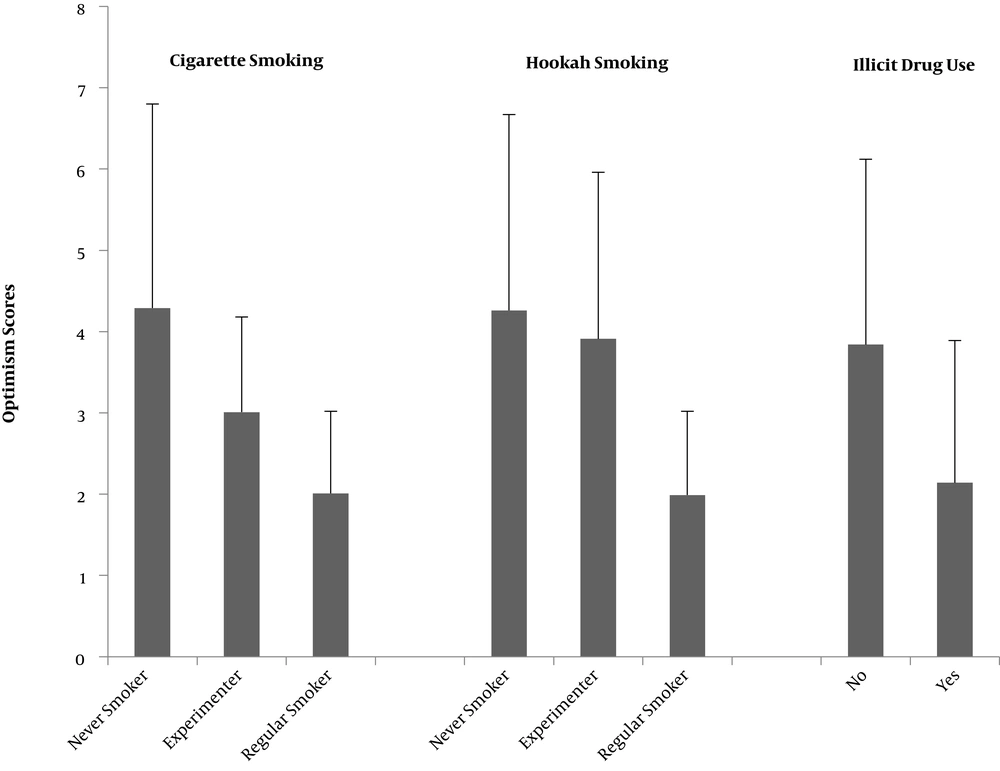
Figure 1.
Total optimism scores according to cigarette smoking, hookah smoking and illicit drug use status among high school students in Zahedan, southeast of Iran
In the present study, the total optimism score was significantly associated with gender, having smoker friend(s), having smoker in the family, living with parents and previous year average grade (P < 0.05) (Table 3).
Table 3.
The Mean and Standard Deviation of Optimism Total Score by Demographic Variables and Other Characteristics of the High School Students in Zahedan, Southeast of Irana
| Characteristics | Optimism Score | P Value |
|---|---|---|
| Gender | 0.001 | |
| Male | 2.86 ± 1.59 | |
| Female | 4.28 ± 2.33 | |
| Socioeconomic status | 0.311 | |
| Low | 3.37 ± 2.01 | |
| Middle | 3.49 ± 2.22 | |
| High | 3.59 ± 2.11 | |
| Having smoker friend(s) | 0.006 | |
| No | 4.07 ± 2.91 | |
| Yes | 2.76 ± 2.94 | |
| Having smoker in family | 0.007 | |
| No | 3.90 ± 2.44 | |
| Yes | 2.70 ± 2.09 | |
| Living with parents | 0.009 | |
| Yes | 3.79 ± 2.12 | |
| No | 2.38 ± 1.88 | |
| General risk tacking behaviors | 0.77 | |
| No | 3.72 ± 2.21 | |
| Yes | 3.63 ± 2.39 | |
| Previous year average grade | 0.004 | |
| > 15 | 4.32 ± 2.19 | |
| < 14.9 | 3.34 ± 2.51 |
aValues are expressed as mean ± SD.
In this study the ordinal logistic regression was fitted to estimate the association between optimism score as the main independent variable and cigarette smoking status, hookah smoking status, and illicit drug use as dependent variables, separately. In this regression model, the relationship between optimism score and dependent variables was adjusted for gender, SES, smoker in the family, and living with parents. According to the results of DAGitty analysis, these mentioned variables are recognized as confounding variables. As the results of the model indicate, higher scores of optimism protect students from being in advanced levels of cigarette smoking (OR = 0.9, 95% CI: 0.79 - 0.97, P = 0.05) and illicit drugs use (OR = 0.91 95% CI: 0.70 - 0.96, P = 0.044) in multiple logistic regression analysis (Table 4).
Table 4.
Ordinal and Binary Logistic Regression Analysis of the Relationship Between “Cigarette Smoking Stages” and “Hookah Smoking Status” and “Optimism”
| Optimism Score | Cigarette Smoking Stages | Hookah Smoking Status | Illicit Drug Use | |||
|---|---|---|---|---|---|---|
| OR (95% CI)a | P Value | OR (95% CI)a | P Value | OR (95% CI)b | P Value | |
| Univariate analysis | 0.73 (0.52 - 0.96) | 0.041 | 0.87 (0.67 - 0.97) | 0.043 | 0.83 (0.71 - 0.95) | 0.031 |
| Multiple logistic regression analysisc | 0.90 (0.79 - 0.97) | 0.05 | 0.98 (0.82 - 1.31) | 0.19 | 0.91 (0.70 - 0.96) | 0.044 |
Abbreviations: CI: confidence interval; OR: odds ratio.
aThe results for ordinal logistic regression analysis.
bThe results for binary logistic regression analysis.
cAdjusted for gender, SES, living with parents and smoker in the family based on DAGitty analysis.
5. Discussion
This study showed that the prevalence of ever cigarette smoking, ever hookah smoking, and using at least one illicit drug were 32.7%, 36.1%, and 11.2%, respectively. According to the reports of WHO, the prevalence of tobacco smoking among Iranian adolescents, American adolescents, and England adolescents is about 5.9%, 13.4%, and 7%, respectively (11). On the other hand, a previous study in Iran estimated that the prevalence of cigarette experimenter or regular smoking and hookah smoking in Iranian high school students is 18.4% and 38.2%, respectively (14). Another study from Iran has reported the prevalence of illegal drugs use and cigarette smoking among high school students was 19.2% and 24%, respectively (18). In the study conducted by Momtazi and Rawson in Iran, the lifetime rate of using alcohol was reported as 9.9% and prevalence of opiate use was reported between 1.2% and 8.6% in different parts of the country (20). According to the mentioned data, it could be concluded that the prevalence of cigarette or hookah smoking among high school students in southeast of Iran is rather more than other parts of the country and around the world. On the other hand, in addition to accessibility, the prevalence of illicit drug use in high school students of this region is relatively low.
The present data, however, indicated that most regular cigarette and hookah smokers and also illicit drug users were among male students and students having smoker friend(s) or family members. On the other hand, the non-smoker students and the students that did not use illicit drug were mostly from families with high SES. Also in this study, living with parents, lack of general risk tacking behaviors and higher average grade were related to less likelihood of tobacco smoking and illicit drug use. It should be noted that cigarette smoking, hookah use and illicit drug use were related to each other in this study, so that being in advanced level increased the likelihood of being in advanced stage of other ones. These results are in concordance with results of previous studies in Iran (14, 17, 18, 20, 21).
The main result of this study was the significant relationship between optimism score (as one of personality’s factors) and tobacco smoking or illicit drugs use, so that the never-smokers reported higher optimism score compared with experimenters and regular smokers. This result is in concordance with previous studies from Iran and around the world, and indicates this fact that the students with less optimism are more likely to smoke cigarettes and use illicit drugs (5, 17, 28-30). On the other hand, some studies accomplished that lack of optimism is associated with a collection of unhealthy habits and also positive association of pessimism and smoking (5, 24, 26). However, one study from the United States reported that there is no association between optimism or pessimism and smoking (31). However, this discrepancy may be due to different reasons. The different results could be due to different studied populations. Salgado-García studied the participants aged 22 to 45 years old, yet the present study was carried out on high school students. Moreover, cultural and social differences could also explain these dissimilarities. Another study conducted by Tyc et al. concluded that there is no association between optimism and smoking status (32). However, Tyc et al. used an optimism theory and assessment instrument, which is different from the current study. They used the youth life oriented test (LOT) to explore optimism among adolescents, which is an instrument for assessing dispositional optimism. The LOT refers to generalized outcome expectancies that positive events, rather than negative events, will happen (7). Some studies concluded that histrionic and depressive personalities could be considered as strong associates of smoking and the prevalence of histrionic and depressive personalities is low among optimistic persons (17). Therefore, these is evidence that pessimism could cause smoking or illicit drugs acquisition among adolescents.
The optimism questionnaire in this study was divided to several dimensions, including positive and negative stability, positive and negative globality, and positive and negative internality. In this study, the students, who were in higher levels of cigarette and hookah smoking and those, who had used illicit drugs, had higher scores in the negative-stability dimension and lower scores in negative-globality dimension. Stability refers to perceiving that an outcome is seen as permanent or temporary. Summarily, regular and experimenter smokers and individuals, who have used illicit drugs are more pessimistic than never smokers and students, who have never used illicit drugs. Although according to the results of this study, pessimism may be a risk factor for tobacco smoking, yet longitudinal studies are necessary to consider the risk of pessimism in transition between cigarette smoking, hookah smoking, and illicit drugs use stages among adolescents.
It is clear that personality or optimism is somewhat hereditary, yet it could be formed and learned through social life and social factors (33, 34). Therefore, having effective plans and interventions, such as comprehensive education to improve personality and optimism in adolescents is very important. The high school students and adolescents are at critical ages of smoking behavior initiations and their personality is shaping at these ages, therefore authorities should provide useful alternatives for reducing smoking and substance abuse and eventually promote general health. Generally, positive performance is related to health behaviors (2, 5). Thus, more studies are needed to investigate the effect of optimism and personality in onset and transition of cigarette or hookah smoking status and illicit drugs use, especially among high school students.
A limitation of this study was its cross-sectional design, thus it is not possible to make clear interpretations regarding the causal relationship between smoking and personality. However, further longitudinal studies are required to confirm the findings. On the other hand, a large sample size and high response rate could increase the generalization of this investigation.
5.1. Conclusions
The present large sample study showed that tobacco smoking (especially cigarette smoking) and illicit drug use were generally more frequent among pessimistic male and female students. Otherwise, optimism was found to be a protective factor for high risk behaviors among adolescents. It is evident that primary prevention should be targeted at young people, by enhancing their dispositional optimism and educational sessions and eventually promote healthy behavioral habits.