
1. Background
Substance abuse and addiction have long been recognized as major public health challenges across human societies. Over time, and in response to social, cultural, and economic changes, patterns of substance use have evolved, leading to increasingly complex individual, familial, and social consequences. The adverse effects of substance abuse extend far beyond physical health; they also undermine mental well-being, social relationships, academic and occupational functioning, and societal stability (1).
Among various populations, university students represent a high-risk group for substance use due to the unique characteristics of emerging adulthood, such as academic pressures, separation from family, identity exploration, changes in living environment, and relative independence. While university life offers new opportunities, it also presents challenges such as academic stress, social pressure, the need for acceptance, and the demand to manage newfound autonomy. These factors can create vulnerabilities that compromise students’ psychological well-being and decision-making processes. Therefore, examining the psychological determinants of substance use tendencies among students is of substantial importance (2).
Epidemiological evidence further underscores the magnitude of this issue. Global reports indicate that substance use remains highly prevalent among university students, with studies in North America and Europe showing that more than half of students report alcohol use within the past year, and a substantial proportion engage in binge drinking or other high-risk consumption patterns (3). Systematic reviews conducted in various regions have estimated lifetime prevalence rates of psychoactive substance use among university students to be approximately 30% or higher, depending on the substance and context (4). In Iran, national and regional studies have likewise documented notable rates of tobacco, alcohol, and other substance use among university populations, highlighting that this concern is not limited to Western societies but represents a growing public health issue within the country as well (5). These statistics emphasize the necessity of identifying psychological risk and protective factors associated with substance use tendencies in student populations.
The research literature consistently highlights the role of psychological and cognitive factors, such as self-esteem, decision-making styles, coping skills, emotion regulation, and psychological capital, in predicting substance use tendencies. For example, studies investigating “the prediction of substance use tendencies based on self-esteem and components of emotional intelligence” have reported significant negative associations between low self-esteem and addiction proneness (6).
Additionally, studies conducted in Iran based on behavioral-cognitive models have shown that behavioral activation/inhibition systems are associated with substance use tendencies, and that psychological capital, of which self-esteem and psychological skills are components, plays a mediating role in this relationship (7).
At the international level, substance use among university students remains a focus of contemporary research. For instance, a recent study in 2025 demonstrated that students’ attitudes toward the future are associated with substance abuse proclivity, underscoring the significance of psychological and cognitive factors, including self-esteem and decision-making styles (8).
Despite this body of work, relatively few studies have simultaneously examined both self-esteem and decision-making styles as predictors of substance use tendencies. Most previous research has focused on only one of these variables (e.g., self-esteem, psychological capital, or behavioral/emotional systems). However, the combination of these two constructs, one rooted in self-concept and psychological well-being, and the other reflecting cognitive and behavioral decision-making processes, has rarely been explored. This gap indicates a lack of integrated understanding regarding their interactive role in substance use vulnerability (9).
Moreover, given the rapid changes in lifestyle and the increasing psychological and social pressures faced by youth and university students, adopting a comprehensive perspective on the determinants of substance use has become increasingly necessary. Concurrent examination of self-esteem and decision-making styles may enable early identification of at-risk individuals and inform the development of preventive psychological interventions. This need is particularly evident in countries with large young and student populations (10).
Although previous research has examined self-esteem, psychological capital, or decision-making styles separately in relation to substance use tendencies, relatively few studies have investigated the simultaneous and integrated predictive role of self-esteem and decision-making styles within a single explanatory model. Most existing studies have focused on isolated psychological constructs, limiting a comprehensive understanding of how self-concept-related variables and cognitive decision-making processes may interact in shaping vulnerability to substance use. Furthermore, empirical evidence examining this combined model among university students, particularly within the Iranian cultural and educational context, remains limited. Therefore, there is a need for an integrative approach that evaluates both emotional–self-evaluative and cognitive–behavioral dimensions concurrently in order to clarify their relative and combined contributions to substance use tendencies (11).
2. Objectives
The present study aims to predict substance use tendencies based on self-esteem levels and decision-making styles among university students. It is hypothesized that students with lower self-esteem and less rational or more impulsive decision-making tendencies will exhibit higher predisposition to substance use. Moreover, the combined predictive power of these variables is expected to be stronger than the predictive ability of each variable independently.
The findings of this study may assist in identifying at-risk students and guiding counselors, psychologists, and policymakers in designing targeted preventive strategies. Furthermore, this research contributes to the growing body of knowledge on psychological factors associated with substance use among university populations and provides a foundation for future investigations.
3. Materials and Methods
3.1. Research Design
This study employed a descriptive–analytical design within a correlational framework and, in terms of purpose, falls under the category of applied research. Data were collected using self-report questionnaires, and no manipulation or intervention was performed on the variables. This approach facilitates the examination of the relationship between addiction tendency, self-esteem, and decision-making styles among university students, allowing for assessment of both the directionality and relative contributions of different predictors.
3.2. Population, Sample Size, and Sampling Method
The statistical population consisted of all students enrolled at a medical sciences university in western Iran during the 2022 - 2023 academic year. The student population was selected due to developmental characteristics of this age group and the increasing psychological, social, and academic pressures experienced during this period, which are commonly recognized as risk-enhancing factors for high-risk behaviors, including susceptibility to substance use.
Primary clusters were defined as faculties or academic departments, and within each cluster, classes were randomly selected. This approach aimed to ensure that the final sample was demographically and academically representative of the broader student population. Potential biases due to non-response or uneven class selection were mitigated by distributing extra questionnaires and using randomization within clusters (Figure 1).
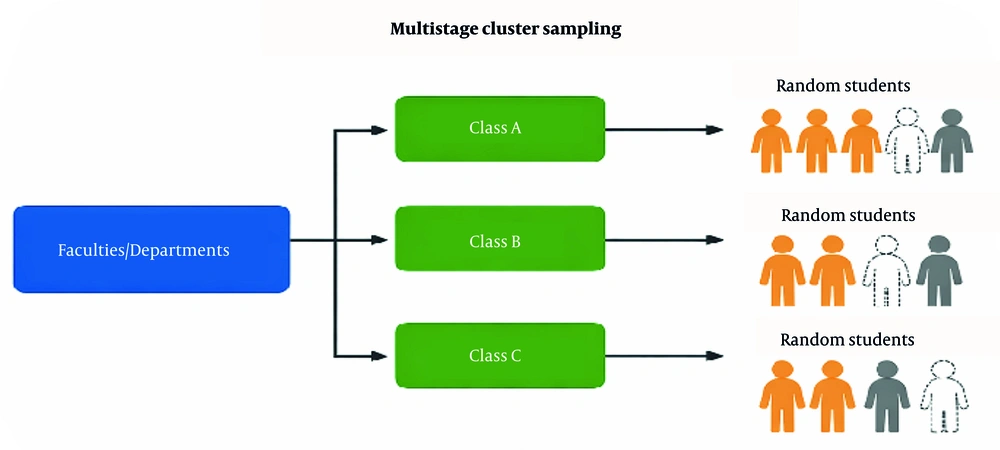
Figure 1.
Multistage cluster sampling procedure for student selection
3.3. Data Collection Procedure
Data were collected in person after explaining the study objectives and obtaining informed consent from participants. Paper-based questionnaires were administered and completed in classroom or educational settings.
3.4. Instruments
3.4.1. Addiction Readiness Scale (Zargar, 2006)
The Addiction Readiness Scale was originally developed by Weed et al. (12), and several attempts have been made to establish its validity in Iran. The present questionnaire is an Iranian adaptation developed by Zargar (2006), taking into account the psychosocial characteristics of Iranian society. The scale consists of two factors and 36 items, along with 5 lie-detection items. Items are rated on a continuum from 0 (strongly disagree) to 3 (strongly agree). Criterion validity was assessed by comparing scores between addicted and non-addicted groups, demonstrating good discriminative ability. Construct validity, assessed through correlation with the 25-item Symptom Checklist (SCL-25), yielded a coefficient of 0.45, which was significant at P < 0.001. Cronbach’s alpha reliability was reported to be 0.90, indicating excellent internal consistency (13). The Persian version of this scale has been psychometrically validated in Iranian populations (13), confirming its suitability for use in cultural contexts similar to the present study. In the present study, Cronbach’s alpha was calculated as 0.79. Example items include: There is nothing wrong with associating with people who use drugs and Narcotics also have some useful properties.
3.4.2. Rosenberg Self-Esteem Scale
The Rosenberg Self-Esteem Scale (RSES), originally developed by Rosenberg (14), contains 10 items, five positively worded and five negatively worded, rated on a four-point Likert scale (1 = strongly disagree to 4 = strongly agree). Total scores range from 10 to 40, with higher scores indicating higher self-esteem. Example items include: “I feel that I have a number of good qualities” and “On the whole, I am satisfied with myself”.
The RSES is widely recognized as one of the most reliable and valid measures of self-esteem. In Iran, Abbasi et al. (15) evaluated the Persian version among medical students. Confirmatory factor analysis supported the unidimensional structure, and reliability indices, including Cronbach’s alpha and composite reliability, were within acceptable ranges. Convergent and discriminant validity were also confirmed, supporting the structural stability of the scale. Therefore, the Persian version of the RSES has demonstrated adequate construct validity and internal consistency in Iranian student populations (15). In the present study, Cronbach’s alpha was 0.79, confirming acceptable internal consistency within the current sample.
3.4.3. Scott and Bruce Decision-Making Styles Questionnaire (1995)
Developed by Scott and Bruce (16), this 25-item instrument assesses five decision-making styles: Rational, intuitive, dependent, spontaneous, and avoidant — each represented by five items. The rational style reflects decisions based on information seeking and logical evaluation; the intuitive style reflects decisions guided by internal feelings; the dependent style involves reliance on others’ guidance; the spontaneous style reflects quick and impulsive decisions; and the avoidant style reflects tendencies to delay decision-making.
Items are scored on a five-point Likert scale (1 = strongly does not resemble me to 5 = strongly resembles me). Scores for each style range from 5 to 25. Psychometric properties of the Persian version were examined by Jebraeili, et al. (17). Confirmatory factor analysis using Mplus and SPSS supported the factor structure, with acceptable fit indices (RMSEA = 0.10, CFI = 0.91, TLI = 0.90). Test-retest reliability over three weeks was 0.80, split-half reliability was 0.79, and internal consistency was 0.85. Significant correlations with impulsivity and emotional distress supported criterion validity. These findings support the construct validity and reliability of the Persian version of the questionnaire in Iranian student samples (17). In the present study, Cronbach’s alpha coefficients for the five subscales were as follows: Rational (0.76), intuitive (0.78), dependent (0.84), spontaneous (0.81), and avoidant (0.79), indicating acceptable to good internal consistency.
3.5. Ethical Considerations
This study adhered fully to the ethical principles of the Declaration of Helsinki. The study protocol was approved by the Biomedical Research Ethics Committee (IR.MEDILAM.REC.1402.170). Participants were informed about the study objectives, procedures, and potential implications, and verbal informed consent was obtained. Confidentiality was ensured, and aggregated results were shared with participants after study completion.
3.6. Data Analysis
After coding, the collected data were entered into SPSS version 22. Descriptive and inferential statistical methods were used. Descriptive statistics included mean, standard deviation, minimum, and maximum values for quantitative variables, and frequency and percentage for qualitative variables.
For inferential analyses, normality was assessed using the Kolmogorov-Smirnov test, and Spearman’s correlation coefficient was used due to non-normal data distributions. Multiple linear regression (Enter method) was conducted, with regression assumptions checked, including independence of errors (Durbin-Watson), absence of multicollinearity [variance inflation factor (VIF) < 2], and homogeneity of residual variance. Confidence intervals for regression coefficients were calculated to facilitate interpretation of effect sizes.
For group comparisons, the Mann-Whitney U test was used to compare gender differences, and the Kruskal-Wallis test was applied to compare faculties, with a significance level of 0.05. Effect sizes (r for Mann-Whitney, η² for Kruskal-Wallis) were also reported to provide standardized measures of association.
4. Results
4.1. Response Rate and Descriptive Characteristics of the Sample
A total of 220 questionnaires were distributed among students at a medical sciences university in western Iran, of which 200 were fully completed and included in the final analysis, yielding a response rate of 91%, indicating satisfactory participant engagement. The sample comprised 113 female students (56.5%) and 87 male students (43.5%), reflecting a relatively balanced gender distribution. Students were drawn from multiple academic faculties, ensuring adequate academic diversity within the sample. The demographic characteristics and descriptive statistics of the principal study variables are presented in Table 1. The sample comprised 113 female students (56.5%) and 87 male students (43.5%). The reported means and standard deviations for addiction tendency, self-esteem, and decision-making styles demonstrate adequate variability in the data, supporting the appropriateness of subsequent inferential analyses.
Table 1.
Demographic Characteristics and Descriptive Statistics of Study Variables (N = 200)
| Variables/Categories | No. (%) | Mean ± SD | Min-Max |
|---|---|---|---|
| Gender | |||
| Female | 113 (56.5) | ||
| Male | 87 (43.5) | ||
| School | |||
| Medicine | 38 (19.0) | ||
| Paramedicine | 45 (22.5) | ||
| Nursing and midwifery | 42 (21.0) | ||
| Public health | 40 (20.0) | ||
| Dentistry | 35 (17.5) | ||
| Addiction tendency | 32.18 ± 8.45 | 14 - 56 | |
| Self-esteem | 28.65 ± 5.12 | 17 - 40 | |
| Rational style | 35.40 ± 6.23 | 18 - 48 | |
| Intuitive style | 28.75 ± 5.80 | 15 - 42 | |
| Dependent style | 31.22 ± 6.50 | 16 - 46 | |
| Spontaneous style | 25.10 ± 5.95 | 12 - 38 | |
| Avoidant style | 22.45 ± 5.30 | 10 - 36 |
The results presented in Table 1 indicate that the sample was relatively balanced in terms of gender distribution, with 56.5% female and 43.5% male participants. Students were drawn from multiple academic faculties, reflecting adequate academic diversity within the sample. Descriptive statistics showed that addiction tendency scores ranged from 14 to 56, with a mean of 32.18 ± 8.45, suggesting a moderate level of addiction tendency among participants. Among decision-making styles, the rational style had the highest mean score 35.40 ± 6.23, whereas the avoidant style demonstrated the lowest mean 22.45 ± 5.30. Overall, the pattern suggests relatively greater endorsement of rational decision-making tendencies in this population.
4.2. Correlation Analysis
Given the non-normal distribution of the variables, Spearman’s rank-order correlation was used to assess the relationships among the study variables (Table 2). Addiction tendency showed a moderate negative correlation with self-esteem (ρ = -0.49, P < 0.01) and with the rational decision-making style (ρ = -0.38, P < 0.01), indicating that higher self-esteem and greater reliance on rational decision-making are associated with lower addiction tendency. In contrast, the dependent, spontaneous, and avoidant styles were positively and significantly correlated with addiction tendency, with the spontaneous style demonstrating the strongest positive association. No significant relationship was observed between the intuitive style and addiction tendency.
Table 2.
Spearman Correlation Coefficients Among Addiction Tendency, Self-esteem, and Decision-Making Styles
| Variables | 1 | 2 | 3 | 4 | 5 | 6 | 7 |
|---|---|---|---|---|---|---|---|
| 1. Addiction tendency | - | ||||||
| 2. Self-esteem | -0.49 a | - | |||||
| 3. Rational style | -0.38 a | 0.45 a | - | ||||
| 4. Intuitive style | -0.11 | 0.10 | 0.22 a | - | |||
| 5. Dependent style | 0.31 a | -0.25 a | -0.18 b | 0.05 | - | ||
| 6. Spontaneous style | 0.43 a | -0.32 a | -0.29 a | -0.08 | 0.36 a | - | |
| 7. Avoidant style | 0.35 a | -0.28 a | -0.34 a | -0.12 | 0.41 a | 0.39 a | - |
a P < 0.01.
b P < 0.05.
The findings reported in Table 2 demonstrate that addiction tendency was negatively and moderately correlated with self-esteem (ρ = -0.49, P < 0.01), indicating that higher self-esteem is associated with lower levels of addiction tendency. A significant negative correlation was also observed between addiction tendency and the rational decision-making style (ρ = -0.38, P < 0.01). In contrast, dependent (ρ = 0.31, P < 0.01), spontaneous (ρ = 0.43, P < 0.01), and avoidant (ρ = 0.35, P < 0.01) decision-making styles showed significant positive correlations with addiction tendency. Among these, the spontaneous style exhibited the strongest positive association. The intuitive style was not significantly related to addiction tendency. Additionally, significant intercorrelations among certain decision-making styles, such as the positive association between dependent and avoidant styles (ρ = 0.41, P < 0.01), suggest conceptual overlap among these cognitive tendencies.
4.3. Multiple Regression Analysis
To test the main hypothesis that addiction tendency can be predicted by self-esteem and decision-making styles, a multiple regression analysis using the Enter method was performed. As shown in Table 3, the regression model was statistically significant [F (6,193) = 27.41, P < 0.001] and explained 46% of the variance in addiction tendency (R² = 0.46). The multiple correlation coefficient (R = 0.68) indicates a strong relationship between the set of predictor variables and addiction tendency, while the adjusted R² (0.44) suggests that the model’s explanatory power remains stable after accounting for the number of predictors. The Durbin-Watson statistic (1.92) confirmed the independence of residuals, and all VIF values were below 2, indicating no multicollinearity among predictors and supporting the adequacy of the regression model.
Table 3.
Summary of Multiple Regression Model Predicting Addiction Tendency
| Vriables | Values |
|---|---|
| R | 0.68 |
| R2 | 0.46 |
| Adjusted R2 | 0.44 |
| SE of estimate | 6.28 |
| F | 27.41 |
| P | < 0.001 |
| Durbin-Watson | 1.92 |
As shown in Table 3, the multiple regression model was statistically significant [F (6,193) = 27.41, P < 0.001] and explained 46% of the variance in addiction tendency (R²=.46). The multiple correlation coefficient (R = 0.68) indicates a relatively strong association between the set of predictor variables and addiction tendency. The adjusted R² value (0.44) suggests that the explanatory power of the model remains stable after accounting for the number of predictors. Furthermore, the Durbin–Watson statistic (1.92) indicates independence of residuals, supporting the adequacy of the regression model.
The regression coefficients presented in Table 4 indicate that self-esteem (β = -0.32, P < 0.001) and the rational decision-making style (β = -0.23, P < 0.001) were significant negative predictors of addiction tendency. In contrast, dependent (β = 0.19, P = 0.002), spontaneous (β = 0.29, P < 0.001), and avoidant (β = 0.18, P = 0.002) decision-making styles were significant positive predictors. Among all predictors, the spontaneous style demonstrated the strongest standardized effect. The 95% confidence intervals further confirmed that these effects were statistically reliable, as none of the significant predictors included zero within their intervals. The intuitive style did not significantly contribute to the model. Regression equation: Addiction tendency = 45.22 – (0.52 × Self-esteem) – (0.31 × Rational) + (0.25 × Dependent) + (0.41 × Spontaneous) + (0.28 × Avoidant).
Table 4.
Standardized and Unstandardized Regression Coefficients for Predicting Addiction Tendency
| Predictors | B | SE | β | t | P | 95% CI |
|---|---|---|---|---|---|---|
| Constant | 45.22 | 3.45 | - | 13.10 | < 0.001 | [38.40, 52.04] |
| Self-esteem | -0.52 | 0.11 | -0.32 | -4.72 | < 0.001 | [-0.74, -0.30] |
| Rational style | -0.31 | 0.09 | -0.23 | -3.44 | < 0.001 | [-0.49, -0.13] |
| Intuitive style | 0.08 | 0.07 | 0.06 | 1.14 | 0.256 | [-0.06, 0.22] |
| Dependent style | 0.25 | 0.08 | 0.19 | 3.12 | 0.002 | [0.09, 0.41] |
| Spontaneous style | 0.41 | 0.10 | 0.29 | 4.10 | < 0.001 | [0.21, 0.61] |
| Avoidant style | 0.28 | 0.09 | 0.18 | 3.11 | 0.002 | [0.10, 0.46] |
4.4. Comparative Tests
4.4.1. Comparison Across Schools: Kruskal-Wallis Test
Addiction tendency differed significantly across schools (H = 9.45, P < 0.05). Mean ranks are shown in Table 5.
Table 5.
Kruskal-Wallis Test Comparing Addiction Tendency Across Academic Faculties
| School | Mean Rank |
|---|---|
| Medicine | 85.45 |
| Paramedicine | 92.10 |
| Nursing and midwifery | 110.33 |
| Public health | 105.65 |
| Dentistry | 116.50 |
The results displayed in Table 5 indicate a statistically significant difference in addiction tendency across academic faculties [H (4) = 9.45, P < 0.05]. Students from the Dentistry and Nursing & Midwifery faculties showed higher mean ranks, whereas Medicine students demonstrated the lowest mean rank. These findings suggest variability in addiction tendency across academic contexts, potentially reflecting differences in academic pressure, environmental factors, or contextual influences.
4.4.2. Comparison by Gender: Mann-Whitney Test
Male students had significantly higher addiction tendency scores than females (U = 3850.50, P < 0.001). Results are presented in Table 6.
Table 6.
Mann-Whitney U Test Comparing Addiction Tendency by Gender
| Gender | N | Mean Rank | Sum of Ranks |
|---|---|---|---|
| Female | 113 | 89.15 | 10074.50 |
| Male | 87 | 114.20 | 9936.50 |
As presented in Table 6, male students exhibited significantly higher addiction tendency scores compared to female students (U = 3850.50, P < .001). The effect size (r = 0.28) indicates a small-to-moderate magnitude of difference. This finding suggests that gender may represent an important factor associated with variation in addiction tendency within the student population.
5. Discussion
The primary aim of this study was to examine the role of self-esteem and decision-making styles in predicting addiction tendency among university students, specifically to investigate whether psychological and cognitive variables could significantly contribute to substance misuse tendencies. The findings indicated that the combination of these variables (self-esteem + decision-making styles) explained approximately 46% of the variance in addiction tendency, highlighting the substantial importance of these psychological factors in predicting high-risk behaviors. This relatively high proportion of explained variance suggests that cognitive–emotional variables are not peripheral, but central determinants in understanding vulnerability to addictive tendencies within university populations (18).
The results demonstrated that self-esteem and the rational decision-making style were inversely associated with addiction tendency; specifically, these findings support the first hypothesis, indicating that individuals with higher self-esteem and a more rational decision-making approach were less likely to exhibit tendencies toward substance misuse. This finding aligns with contemporary research on self-control, emotion regulation, and psychological resilience. Similar associations between low self-esteem and higher substance use tendencies have also been reported in international contexts. For example, studies conducted among adolescents in Spain and the United States have shown that reduced self-esteem is significantly associated with alcohol and substance misuse, suggesting that the protective role of self-esteem may operate across different cultural settings (19). These cross-national findings support the generalizability of the present results beyond the Iranian university context. For instance, a study among medical students in Iran reported that impulsivity, which can be considered in contrast to rational decision-making, was significantly associated with internet addiction, indicating that poor impulse control increases the likelihood of addictive behaviors (20).
From a theoretical perspective, self-esteem may function as a psychological buffer. Individuals with higher self-esteem tend to experience greater perceived self-efficacy, stronger coping resources, and lower susceptibility to peer pressure, all of which reduce the likelihood of engaging in maladaptive coping strategies such as substance use. Similarly, the rational decision-making style involves systematic information processing, evaluation of consequences, and delayed gratification. These cognitive capacities directly counteract impulsive tendencies and short-term reward seeking, mechanisms frequently implicated in addiction models (19).
These results indicate that decision-making style and impulse control capacity play an important role in addictive behaviors, and therefore a rational decision-making style may act as a protective factor, supporting the second hypothesis.
Conversely, in this study, the “spontaneous”, “dependent”, and “avoidant” decision-making styles emerged as significant positive predictors of addiction tendency. In other words, individuals who make decisions quickly without sufficient reflection, rely heavily on others in their decision-making, or avoid confronting decisions showed higher tendencies toward substance misuse. This finding is consistent with contemporary cognitive-psychological approaches, particularly studies emphasizing that psychological adaptation and self-regulatory capabilities (self-regulation/resilience) can mitigate tendencies toward high-risk behaviors such as substance use or addiction (21). Comparable patterns have been observed in European samples. Balada et al. (22), in a study conducted in Spain, reported that maladaptive decision-making styles, particularly spontaneous and avoidant tendencies, were significantly associated with alcohol misuse. Their findings similarly emphasized impulsivity and deficient consequence evaluation as key cognitive vulnerabilities. The convergence of findings across different cultural contexts strengthens the robustness of the present results.
The potential mechanisms underlying these associations merit further consideration. The spontaneous style is characterized by urgency and impulsivity, increasing vulnerability to immediate rewards and risk-taking behaviors. The dependent style may heighten susceptibility to peer influence, especially in university environments where social networks strongly shape behavioral norms. The avoidant style, in turn, reflects difficulty confronting stressors or making challenging decisions; substance use may then function as an emotion-focused coping strategy to escape psychological discomfort. These pathways are consistent with cognitive-behavioral models of addiction that emphasize impaired self-regulation and maladaptive coping (11).
Regarding Hypothesis 3, it was expected that addiction tendency would differ according to gender and faculty. The results confirmed this hypothesis, showing that male students and students from certain faculties (in this sample: Dentistry and nursing/midwifery) had higher mean ranks of addiction tendency. This finding may reflect a complex interplay of psychological, social, and environmental factors, such as differing academic pressures, lifestyle differences between male and female students, variable access to resources, or structural differences in faculty social networks. This result is consistent with previous studies reporting gender or academic field as influential factors in high-risk behaviors (23, 24). International research likewise indicates higher prevalence rates of substance use among male university students in various regions, including North America and parts of Europe, often attributed to gender-related norms, risk-taking tendencies, and socialization patterns. This consistency suggests that gender-based vulnerability to addictive behaviors may reflect broader socio-cultural dynamics rather than purely local influences (23).
Notably, the intuitive decision-making style did not significantly predict addiction tendency in this study. This suggests that decision-making based solely on feelings, intuition, or instinct (without rational reflection) is insufficient for analyzing addictive behaviors; rather, the ability to make logical decisions, evaluate consequences, and exercise self-control, core components represented by the rational style, holds greater predictive importance. This perspective aligns with contemporary models of self-regulation and conscious decision-making (11). It is possible that intuitive decision-making, unlike spontaneous decision-making, does not inherently involve impulsivity but may instead reflect experience-based processing, which does not necessarily increase addiction risk.
Collectively, the findings of this study, along with emerging evidence, underscore the need to consider psychological and cognitive factors, beyond environmental or access-related factors, when preventing substance misuse in university populations. For example, university-based psychological interventions could focus on enhancing self-esteem, strengthening rational decision-making skills, and promoting self-control and resilience; such strategies may serve as effective protective measures (25, 26). More specifically, structured workshops on cognitive decision-making skills, training in consequence evaluation, assertiveness training to reduce maladaptive dependency, and resilience-based interventions may be integrated into university counseling programs. Screening programs targeting students with low self-esteem or dominant avoidant/spontaneous styles could also facilitate early identification of at-risk individuals. These applications translate the present findings into actionable preventive strategies (27). In practice, such interventions can help reduce students’ vulnerability to substance use by strengthening psychological resources, improving self-regulation, and fostering adaptive coping mechanisms. Universities and policymakers can use these insights to design evidence-based prevention programs, allocate resources effectively, and implement targeted support services tailored to high-risk student groups (28).
5.1. Limitations
However, several limitations should be considered. First, the cross-sectional design of this study precludes causal inference. Although significant associations were identified, it cannot be determined whether low self-esteem and maladaptive decision-making styles lead to addiction tendency, or whether early addictive behaviors negatively influence psychological functioning. Longitudinal designs are required to clarify directionality and causal pathways.
This study was restricted to a single university; therefore, generalization of the results to other universities or student populations may not be appropriate. The use of a single-site sample limits external validity and cultural generalizability.
Additionally, the self-report measures used could be influenced by social desirability or self-deception biases. Because all variables were assessed using self-report questionnaires, common method variance and response bias may have inflated associations between variables.
Future research is recommended to utilize larger, multicenter samples and employ mixed-methods approaches (questionnaires + interviews + experimental frameworks). Incorporating behavioral tasks, longitudinal follow-ups, and experimental designs could substantially strengthen the robustness and explanatory power of future findings.
Ultimately, these findings provide a foundation for planning preventive interventions and promoting mental health in university settings, drawing attention from policymakers, student affairs offices, university counseling centers, and researchers to the critical role of psychological and cognitive factors in addictive behaviors.
5.2. Conclusions
The present study demonstrated that psychological and cognitive factors, particularly self-esteem and decision-making styles, play a key role in predicting addiction tendency among university students. Self-esteem and the rational decision-making style functioned as protective predictors, whereas the spontaneous, dependent, and avoidant decision-making styles emerged as risk predictors, significantly influencing substance use tendencies. In contrast, the intuitive decision-making style did not provide a significant predictive effect. Moreover, significant differences in addiction tendency based on gender and academic background highlight the complex interplay of individual and environmental factors in high-risk behaviors.
These findings underscore the need to design targeted psychological and educational interventions in university settings. Programs that focus on enhancing self-esteem, strengthening rational decision-making skills, and promoting self-control and resilience among students may serve as effective protective strategies against substance misuse. The results of this study offer valuable practical insights, drawing the attention of policymakers, university administrators, and clinical psychologists toward the development of comprehensive, evidence-based preventive programs.