1. Background
Hepatitis B virus (HBV) infection is a major health issue. Approximately two billion people worldwide are infected with HBV and about 240 million suffer from chronic hepatitis B (CHB) (1). In past decades, about 25% of adults who were infected with HBV during childhood died of decompensated liver cirrhosis or hepatocellular carcinoma (HCC) (1). However, due to the licensing of oral nucleos(t)ide, the treatment of CHB has been revolutionized with a significant improvement in disease progression and HCC occurrence (2, 3).
An epidemic survey published in 2006 estimated that 7.18% of Chinese population were still hepatitis B surface antigen (HBsAg)-positive (4). Therefore, China is still considered to be a highly endemic region. Due to a relative lack of professional health services and patients’ poor awareness and knowledge of disease, many CHB patients (especially poor patients living in rural areas) missed the opportunity for timely diagnosis and appropriate antiviral therapy. To standardize the diagnosis, treatment, and management of CHB, the updated treatment guideline of hepatitis B (2015) has been formulated by the Chinese society of infectious diseases and Chinese society of hepatology, Chinese medical association (5). Afterwards, free continuing education courses of guide-interpretation have also been provided to clinicians who are engaged in the field of CHB.
2. Objectives
In real-life clinical practice, the diagnosis and treatment options of diseases are largely determined by the physicians; so, the level of primary physician’s knowledge, training, and practice is closely related to the quality of medical services (6). Thus, this questionnaire-based survey was designed to assess the knowledge of junior doctors on the 2015 CHB guideline recommended by Chinese society of infectious diseases and Chinese society of hepatology, Chinese medical association.
3. Methods
This was a cross-sectional study. The junior doctors working in Sichuan province of China in the field of CHB were invited to complete a questionnaire-based survey between May and July 2016. The questionnaire was validated by the scientific committee of the West China workgroup for the management of liver diseases.
In May 2016, this questionnaire was sent to all junior doctors who participated in a clinical training course hosted by our department. This survey was then extended to other junior doctors belonging to West China workgroup for the management of liver diseases (including 30 primary hospitals in 21 cities of Sichuan province, (see Figure 1). The questionnaires were sent and collected by post. In this survey, responses were collected before 31 July 2016.
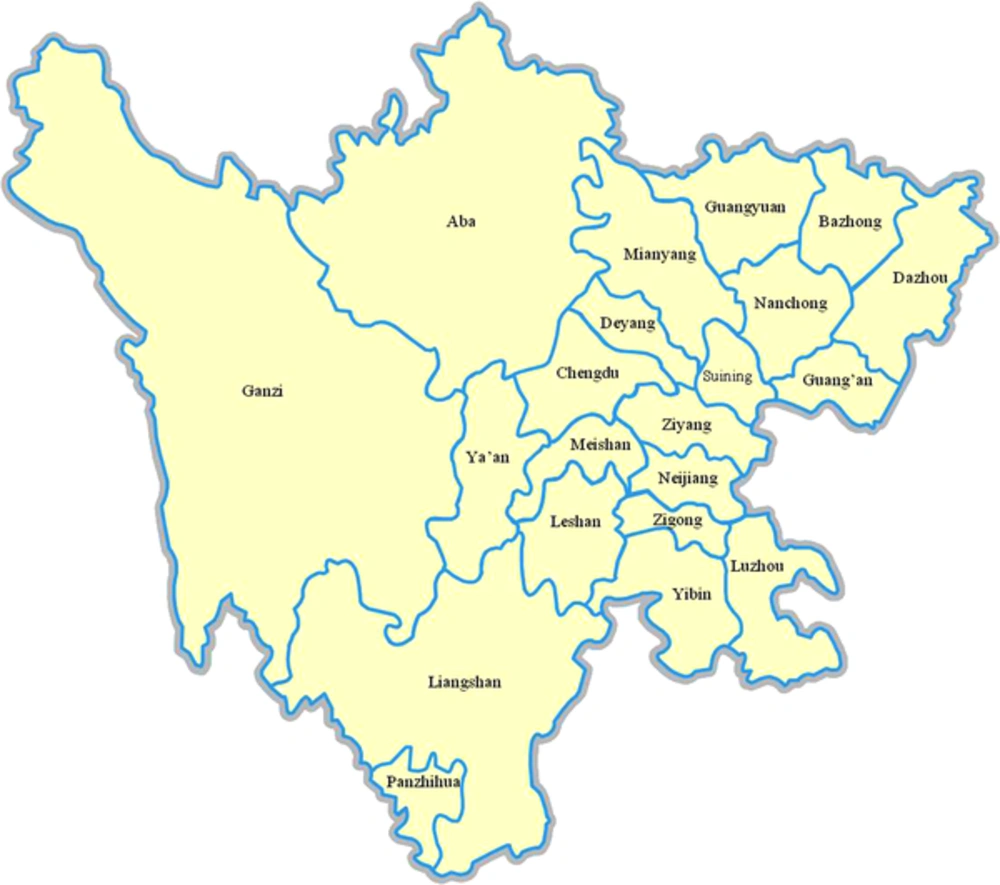
Figure 1.
The Location of 30 Primary Hospitals in 21 Cities of Sichuan Province, China
The content of the questionnaire was based on the Chinese CHB guideline launched in 2015 (5), which consisted of 28 questions focusing on the following three aspects: mother-to-child transmission (MTCT) prevention, response-guided therapy (RGT) strategies, and special patients antiviral therapy (Table 1). The answer to each question was classified as known or unknown conforming to the recommendations from guideline. In this study, the questionnaire was available in simplified Chinese, and the draft questionnaire was revised by the research team through consensus.
Table 1.
The Questions Listed in the Questionnaire in this Survey
| Section | Subject / Question |
|---|---|
| Section 1 | Mother-to-Child Transmission (MTCT) Prevention |
| Q1 | Do you know that the dose of HBIG should be ≥ 100 IU for newborns exposed to HBsAg-positive mothers? |
| Q2 | Do you know that HBIG and vaccine should be given intramuscularly at different sites? |
| Q3 | Do you know the type and dose of hepatitis B vaccine available in clinical practice? |
| Q4 | Whether the dose and times of vaccination should be increased for infants with weak immune system or low vaccine response? |
| Q5 | If newborns were exposed to HBsAg-positive mothers, whether they could be breastfed after giving HBIG and vaccine? |
| Section 2 | Response-guided therapy (RGT) strategies |
| Q6 | Do you know the suggestions for treatment withdrawal among HBeAg-positive patients? |
| Q7 | Do you know the time of consolidate treatment to patients after HBeAg/anti-HBe seroconversion? |
| Q8 | For HBeAg-positive patients receiving lamivudine, telbivudine or adefovir, whether the antiviral strategies should be adjusted according to HBV DNA levels at treatment week 24? |
| Q9 | Whether the treatment should be stopped for patients receiving interferon treatment, if serum HBsAg level was still more than 20, 000 IU/mL after 24 weeks of treatment? |
| Q10 | Whether pegIFN treatment should be stopped if there were no decline in serum HBsAg level and less than 2 log IU/ml decline in HBV DNA? |
| Section 3 | Special patients antiviral therapy |
| Q11 | Is pegIFN treatment absolutely forbidden for CHB patients with compensated cirrhosis? |
| Q12 | Whether serum HBsAg, anti-HBc, and HBV DNA should be routinely screened in patients with chemotherapy or immunosuppressive therapy? |
| Q13 | Do you know that antiviral therapy should be initiated at least one week before chemotherapy or immunosuppressive therapy? |
| Q14 | Do you know that prophylactic antivirus therapy should be considered for HBsAg-negative and anti-HBc-positive patients with immunotherapy using monoclonal antibodies to specifically target B cells? |
| Q15 | For liver failure patients, whether nucleos(t)ide analog should be used for those with positive HBsAg but negative HBV DNA? |
| Q16 | Whether nucleos(t)ide analog should be used for HCC patients with detectable HBV DNA? |
| Q17 | The antiviral strategy for HBV-HIV co-infections with CD4+T cell ≤ 500/mL |
| Q18 | Do you know the major antiviral strategy for patients with high risk of HBV reinfection after liver transplantation? |
| Q19 | Whether HBIG could be used for patients with negative-HBV DNA before liver transplantation and low risk of HBV reinfection after liver transplantation? |
| Q20 | For active hepatitis B patients during pregnancy, which nucleos(t)ide analog could be considered after obtaining the informed consent of the patients? |
| Q21 | For accidental pregnancy during antiviral therapy, whether pregnancy should be terminated during pegIFN treatment? |
| Q22 | How should be dealt with pregnancy during TDF or LdT treatment? |
| Q23 | For HBsAg-positive mothers with HBV DNA level of more than 2,000,000 IU per milliliter, when should TDF and LdT treatment be given to prevent mother-to-child transmission? |
| Q24 | Whether IFN could be considered for children with advanced liver disease or cirrhosis? |
| Q25 | Do you know that ETV could be considered for children with age ≥ 2 years? |
| Q26 | Whether TDF could be considered for children with age ≥ 12 years? |
| Q27 | For patients with pre-existing renal diseases or at high-risk of renal diseases, whether ADV or TDF should be avoided? |
| Q28 | For patients with pre-existing renal diseases or at high-risk of renal diseases, which nucleos(t)ide analog could be considered? |
4. Results
4.1. General Characteristics of Participants
A total of 600 junior doctors were invited to participate in this study. However, usable responses were received from 562 out of the 600 junior doctors, yielding a participation rate of 93.7%. In those junior doctors, the mean age was 31.5 years; 329 (58.5%) of them were male and 233 (41.5%) were female; and 91.8% (516/562) of them were from infectious (contagious) diseases department.
4.2. Responses on Infant Vaccination
For the questions related to hepatitis B vaccine and hepatitis B immunoglobulin (HBIG) application in newborns exposed to HBsAg-positive mothers, 18.3% of junior doctors did not know the dose of HBIG (≥ 100 IU), 13.9% did not know that HBIG and vaccine should be given intramuscularly at different sites, and up to 32.1% of junior doctors did not know the type and dose of hepatitis B vaccine available in clinical practice.
For infants with weak immune system or low vaccine response, 24.9% of junior doctors did not know that the dose and frequency of vaccination could be increased. Additionally, 18.8% of respondents did not know that the newborns could be breastfed after giving HBIG and vaccine, if they were exposed to HBsAg-positive mothers.
4.3. Responses on Response-Guided-Therapy Strategy
In this study, about 20.6% of junior doctors did not know the possible withdrawal indications recommended by the guideline. For HBeAg-positive patients receiving lamivudine (LAM), telbivudine (LdT), or adefovir dipivoxil (ADV), 29.7% of junior doctors did not know that the antiviral strategies should be adjusted according to HBV DNA levels at treatment week 24.
For patients receiving interferon treatment, 29.7% of junior doctors did not know that the treatment should be stopped if serum HBsAg level was still more than 20,000 IU/mL after 24 weeks of treatment; and up to 35.3% did not know that the treatment should be stopped if there are no decline of serum HBsAg level and less than 2 log IU/mL decline of HBV DNA.
4.4. Responses Relating to Antiviral Therapy in Special Populations
For those patients with chemotherapy or immunosuppressive therapy, 6.4% of junior doctors did not know that serum HBsAg, anti-HBc, and HBV DNA should be routinely screened; 23.9% did not know that antiviral therapy should be initiated at least one week earlier; and up to 43.1% did not know that prophylactic antivirus therapy should be considered for HBsAg-negative and anti-HBc-positive patients with immunotherapy using monoclonal antibodies to specifically target B cells.
For liver failure patients, 29.1% did not know that nucleos(t)ide analog (NAs) should be used for those with positive HBsAg but negative HBV DNA. For patients with high risk of HBV reinfection after liver transplantation, up to 34.3% of junior doctors did not know that low-dose HBIG plus NAs therapy should be the major antiviral strategy. For patients with negative-HBV DNA before liver transplantation and low risk of HBV reinfection after liver transplantation, up to 43.7% of junior doctors did not know that HBIG could not be used.
For active hepatitis B patients during pregnancy, 19.5% of junior doctors did not know that tenofovir disoproxil fumarate (TDF) or LdT could be considered after obtaining the informed consent of the patients. For accidental pregnancy during antiviral therapy, 15.2% of participants did not know that pregnancy should be terminated during interferon treatment; and 19.2% did not know that pregnancy could be continued during TDF or LdT treatment. For HBsAg-positive mothers with an HBV DNA level of more than 2,000,000 IU per milliliter, up to 32.7% of junior doctors did not know that TDF and LdT could be used during the third trimester to prevent mother-to-child transmission.
Up to 30% - 40% of junior doctors were not familiar with the antiviral related issues among children with progressive liver disease and cirrhosis. For patients with pre-existing renal diseases or at high risk of renal diseases, 22.4% of junior doctors did not know that ADV or TDF should be avoided as much as possible, and 25.5% of junior doctors did not know ETV or LdT could be considered.
5. Discussion
Hepatitis B is one of the most common infectious diseases in China, and it has greatly affected the physical health of the Chinese people as well as the economic and social development of the country (7). At present, improving the scientific understanding of hepatitis B for general population and sharing the professional medical knowledge encoded in a specific guideline for clinicians and other health-care providers are both extremely important for the effective prevention and treatment of CHB in real life clinical practice.
Previous studies have already revealed a lower knowledge on hepatitis B in general population, medical students, and patients (8-11). One study from China also investigated Chinese physicians' awareness regarding the 2010 guidelines on the treatment of CHB. The results showed that more than 10% of physicians did not adhere to the guidelines, and physicians from infectious disease or liver disease departments were better informed than those from gastrointestinal or other departments (12). To investigate the knowledge about the 2015 CHB guideline among the junior doctors from primary hospitals, several typical questions focusing on MTCT prevention, RGT strategies, and special patients antiviral therapy were surveyed. We found that about 30% of junior doctors were not familiar with the vaccine and HBIG used for infants with HBsAg-positive mother; about 20% were unclear that the antiviral strategies should be adjusted according to the treatment responses; and about 20% remained unaware of drug selection in CHB patients with kidney diseases or high risk of developing kidney diseases. To some extent, the results of our survey showed that the knowledge of “professional” clinicians on CHB guideline was unsatisfactory in real-life clinical practice.
In China, the specialist training in liver disease was just started in recent years, and the cultivation of specialists was quite casual and there were lack of unified standards in past decades (13, 14). Because of the limited resource of continuing education and low learning enthusiasm of health care providers, majority of them were not timely updated. This unfortunate situation was extremely common in regions with relatively backward economic and social development in China (15, 16). Indeed, the depth of continuing education directly influenced the quality of health care provided by specialists, and not participating in continuing education always had a negative effect on promoting liver health and quality of patient care.
In the present study, all junior doctors were engaged in the field of liver diseases; more than 90% of junior doctors had been working for more than 5 years, and all of junior doctors were from the second-grade of class-A hospitals or above. However, for each question listed in the questionnaire, nearly 10% ~ 40% of participants did not know the answer. Thus, for those who have already worked in the field of liver diseases in China and without professional training before work, it is still important to consider the accessibility of continuing education opportunities and awareness of junior doctors about the importance of continuing education. For those who are willing to be specialist physicians, the specialist training (including academic and clinical skills) in liver diseases must be received prior to working alone with patients in the field. To ensure the real implementation of continuing education and specialist training, there are lots of work that cannot be done without the supports from health authorities, Chinese medical association, and Chinese medical doctor association.
In summary, this study revealed an unsatisfactory level of knowledge on Chinese CHB guideline among junior doctors in primary hospitals of Sichuan province, China. Though there may be limitations on the sample size and representativeness of participants, the finding still highlights the urgent need for strengthening junior doctors to gain a greater understanding of the CHB guideline.