1. Background
Blood is frequently involved in dental treatment procedures, which increases the exposure of dentists to a variety of blood-borne pathogens and microorganisms such as Hepatitis B Virus (HBV). It was estimated that there were two billion infected people worldwide, and 350 to 400 million suffering from chronic infection in the beginning of the third millennium (1). China is facing more difficulties with more than an estimated 93 million people with the infection , which is 1.3 of the HBV carriers worldwide, 280,000 deaths each year, according to the data by Chinese Center for Disease Control (CDC) (2, 3). More importantly, the risks for Chinese dental students, especially for dental interns, are not well recognized. Dental interns are at a higher risk of HBV infection due to lack of clinic experience (4). Actually, dentists can play a vital role in preventing HBV transmission in dental procedures. The objectives of the current study were:
- to investigate dental interns’ knowledge, attitudes, and behaviors (KAB) regarding HBV from different grades and to figure out their KAB levels respectively.
- to analyze the statistical differences of KAB between dental and medical interns.
- to determine if there is any correlation among these variables.
- to evaluate which exact KAB phase respondents were involved in the lack of knowledge or attitude change, thus give advice on providing more effective health education later, which is the core of the “K-A-B” model.
2. Objectives
This is the first study investigating the topic HBV based on the “K-A-B” model among dental interns in China, which can help the Chinese dental interns with theoretical studies and clinical practices about HBV.
3. Patients and Methods
3.1. Study Participants
The current study was a cross-sectional study on Chinese dental interns in July 2014. The questionnaire was designed according to five previously published surveys (3-7). Since it takes five to eleven years to complete dental and medical education in China (five years for bachelor’s degree, three years for master’s and another three years for PHD degree) and students are involved in clinical practices starting in their fifth year of education, the questionnaires were distributed among the
- fifth year undergraduate dental interns.
- sixth to eighth year graduate dental interns.
- fifth year undergraduate medical interns from West China School of Stomatology and West China School of Medicine, Sichuan University, China.
West China School of Stomatology is known as the birthplace and cradle of Chinese modern Stomatology and has been recognized as the top program in China for 15 years. Medical interns were also selected as the control group. The publication of the results of this survey was approved by all authors.
3.2. Questionnaire
The questionnaire consisted of four main sections:
- “socio-demographic status” including academic year, gender, and department.
- “knowledge” consisted of thirteen questions on students’ HBV infection-related knowledge (twelve yes/no questions, each of which had a correct answer, and one self-efficacy question with four options for participants to evaluate their own knowledge of infections and standard precaution methods).
- “attitudes” toward patients with HBV infection. Subjects rated their agreement on a given statement over five scales: strongly disagree, disagree, neutral, agree, and strongly agree.
- “behaviors” regarding students’ infection control practices including their vaccination status, exposure to HBV and precautionary methods.
It took the respondents approximately ten minutes to complete the questionnaire. A pilot testing of the questionnaire was conducted on 30 dental students and the questions were revised accordingly. The content validity was analyzed by specialists and the construct validity was evaluated by CFA. SPSS was used to analyze reliability, and Cronbach’s Alpha was 0.754 ( > 0.7). The validity and reliability were good.
3.3. Variable Definitions and Scores
The following section defined all variables and additive scores developed for variables in the data analysis process to address the aims of the current survey.
3.3.1. Knowledge Score and Self-efficacy
Participant’s knowledge was evaluated using a validated 12-item questionnaire. It mainly evaluated the respondent’s knowledge on routes of HBV transmission and how to prevent them. A score of one point was awarded to questions answered correctly, and a zero was allocated to a wrong or uncertain answer. A total of 12 points was possible.
Self-efficacy was assessed by asking the subjects how confident they were in mastering standard precaution methods.
3.3.2. Knowledge Level
In the “knowledge” part, subjects with ≤ 3 correct answers were considered having a poor HBV knowledge, while those with 10 or more correct answers were considered having an excellent knowledge. Scores ≥ 4 but ≤ 6 were considered as fair, and those subjects with ≥ 7 but ≤ 9 had good HBV knowledge. These cutoffs were based on the distribution of the data.
3.3.3. Attitudes Score
Five given statements assessed subjects’ attitudes towards the patients with HBV. Subjects who affirmed “strongly agree, agree, neutral, disagree, strongly disagree” were assigned a score of 5, 4, 3, 2, 1, respectively. No response was assigned a zero. The total possible score was 25. In addition to the five statements, the exposure to the patients with HBV and a “worry” statement were also included.
3.3.4. Behaviors Score
Behaviors were measured by eight questions and the answers “always, mostly, sometimes, rarely, never” were given a score of 5, 4, 3, 2, 1, respectively. So, a total of 40 points was possible.
3.4. Data Analysis
R and R-studio were used to conduct all analyses. Descriptive statistics were used to describe the dental interns and medical interns in terms of demographics and variables of KAB, respectively. Student’s t-tests and Pearson test were conducted to compare KAB variables between different grades or dental and medical interns. The level of statistical significance was defined as P < 0.05.
4. Results
Totally, 313 subjects answered the questionnaire with a response rate of 95.2%. Table 1 illustrates the respondents’ characteristics . A detailed breakdown of the results on knowledge questions is shown in Table 2. Dental students obtained a mean correct answer of (8.79 ± 0.758), (8.16 ± 0.732), (8.30 ± 0.647), (8.03 ± 0.656) in the fifth, sixth, seventh and eighth year respectively, and medical students obtained (5.94 ± 0.798) . Approximately, 67.77%, 67.27% and 83.75% of the dental undergraduates, graduates, and medical graduates, respectively, rated their own knowledge of HBV infection as have heard something; 91.87%, 86.36% and 96.25% of the same students knew the effect of receiving HBV vaccines; 84.55% and 66.36% of dental undergraduates and graduates, respectively, correctly estimated HBV transmission from dentist to patient, compared to 37.5% of the medical students. Knowledge score did have linear relationship with school grades, from 5th to 8th year. (P = 0.05292, r = -0.128). There were significant relationships between dental or medical interns and knowledge score (P = 2.2e-16).
Table 1.
Demographic Characteristics of Dental and Medical Interns
| Gender | Distribution a | Grades | Distribution a |
|---|---|---|---|
| Dental interns (n = 233) | |||
| Male | 37.38 | 5th | 52.79 |
| 6th | 16.31 | ||
| Female | 62.62 | 7th | 14.16 |
| 8th | 14.59 | ||
| Medical interns (n = 80) | 5th | 100 | |
| Male | 40 | ||
| Female | 60 |
a Data are presented as (%).
Table 2.
Description and Comparisons of Students’ Knowledge Score of HBV a
| Statement | Accuracy (%) | ||
|---|---|---|---|
| Fifth Dental Undergraduates | Sixth to Eighth Dental Graduates | Fifth Medical Undergraduates | |
| 1) HBV can be transmitted through saliva (e.g. mucosal trauma before treatment) | 85.37 | 75.45 | 55 |
| 2) HBV can be transmitted from dentist to patient | 84.55 | 66.36 | 37.5 |
| 3) HBV can be transmitted from patient to patient (e.g. non-sterile medical devices) | 97.56 | 98.18 | 67.5 |
| 4) HBV can be transmitted through dental treatments | 85.37 | 78.18 | 30 |
| 5) Dentists are at higher risk of HBV infection than the general population | 78.05 | 72.72 | 27.5 |
| 6) There is a higher risk of HBV transmission than HIV through needle-stick injury | 53.66 | 48.18 | 36.25 |
| 7) HBV is sensitive to low temperature, dryness and ultraviolet ray | 16.26 | 17.27 | 12.5 |
| 8) HBV vaccines is the most effective way to be immune against it | 91.87 | 86.36 | 96.25 |
| 9) A high titer hepatitis B immune globulin (HBIG) can be used in emergency prevention | 82.11 | 75.45 | 82.5 |
| 10) The prevalence of HBV is lower than 5% in China | 67.48 | 70 | 52.5 |
| 11) HBV transmission from patient to dentist can be prevented by wearing gloves | 93.50 | 88.18 | 61.25 |
| 12) Soaking dental burs in multienzyme abluent (now applied) can eliminate all HBV | 43.09 | 44.55 | 35 |
a The expected answers to questions 1-12 are: 1, yes; 2, yes; 3, yes; 4, yes; 5, yes; 6, yes; 7, no; 8, yes; 9, yes; 10, no; 11, yes; 12, no.
Table 3 described the participants’ attitudes toward patients with HBV infection. A mean attitude score of (10.33 ± 0.802), (10.35 ± 0.813) and (9.45 ± 0.854) were respectively obtained by the dental undergraduates, graduates, and medical undergraduates; approximately, 70.73%, 74.55%, and 92.5% of the subjects, respectively, were willing to treat patients with HBV. Of 85.37%, 85.45%, and 93.75% of the subjects, respectively, felt morally responsible for treating the infected patients, while 62.30%, 65.45% and 87.5% stated that they were able to treat the patients safely. There was a relationship between attitude and previous experience of treating the patients with HBV (P = 0.01195). Medical students who had less worry about being infected had higher attitude scores (P = 0.04867). There were significant relationships between dental or medical interns and attitudes score (P = 0.032).
Table 3.
Description and Comparisons of Student’s Attitudes Toward HBV a
| Statement | Distribution | ||
|---|---|---|---|
| Fifth Dental Undergraduates | Sixth to Eighth Dental Graduates | Fifth Medical Undergraduates | |
| 1)“I have moral responsibility to treat patients with HBV infection” | |||
| Agree/strongly agree | 85.37 | 85.45 | 93.75 |
| Neutral | 13.01 | 11.82 | 6.25 |
| Disagree/strongly disagree | 1.62 | 4.55 | 0 |
| 2)“I will treat patients with HBV infection” | |||
| Agree/strongly agree | 70.73 | 74.55 | 92.5 |
| Neutral | 22.76 | 20.91 | 5 |
| Disagree/strongly disagree | |||
| 3)“I can safely treat patients with HBV infection” | 6.50 | 4.55 | 2.5 |
| Agree/strongly agree | 62.30 | 65.45 | 87.5 |
| Neutral | 27.05 | 26.36 | 10 |
| Disagree/strongly disagree | 10.66 | 8.18 | 2.5 |
| 4)“I will let dentists treating patients with HBV treat my teeth” | |||
| Agree/strongly agree | 30.89 | 40.91 | 52.5 |
| Neutral | 36.59 | 35.45 | 25 |
| Disagree/strongly disagree | 32.52 | 23.63 | 22.5 |
| 5)“Dentists have rights to know their patients’ HBV infection status” | |||
| Agree/strongly agree | 97.56 | 98.18 | 78.75 |
| Neutral | 2.44 | 1.82 | 20 |
| Disagree/strongly disagree | 0 | 0 | 1.25 |
| 6)“I am worry about being infected with HBV by my patients” | |||
| Agree/strongly agree | 90.24 | 87.27 | 90.24 |
| Neutral | 6.5 | 17.27 | 6.5 |
| Disagree/strongly disagree | 3.25 | 0 | 3.25 |
a Data are presented as (%).
65.8%, 58.53% and 91.25% of dental undergraduates, graduates, and medical graduates, respectively, reported they had received all the three required doses of vaccination or even more than three doses. But only 1.79% of dental undergraduates and 5% of medical interns checked their antibody titer status as “always” or “mostly”; 69.11% of dental undergraduates and 80% of medical interns reported no needle-stick injuries. And the needle-stick injury was significantly related to grades (P = 0.000, r = 0.3588). Students were also asked about their use of personal protective measures (Table 4). Dental interns used face masks more often (P = 2.2e-16) and the use of disposable caps also had a direct statistically significant association with gender (P = 0.001). There was also a strong relationship between behavior score and grades (P = 0.00012, r = 0.25116), as well as between behavior score and being dental or medical interns (P = 2.077e-7).
Table 4.
Students’ Use of Personal Protective Equipment a
| Equipment and Participants | Always | Mostly | Sometimes | Rarely | Never |
|---|---|---|---|---|---|
| Gloves | |||||
| Dental interns, fifth year | 76.42 | 20.33 | 2.43 | 0.81 | 0 |
| Dental interns, sixth to eighth year | 92.72 | 7.27 | 0 | 0 | 0 |
| Medical interns, fifth year | 66.25 | 27.5 | 5 | 0 | 0.125 |
| Oronasal masks | |||||
| Dental interns , fifth year | 82.93 | 11.38 | 4.07 | 1.63 | 0 |
| Dental interns, sixth to eighth year | 93.63 | 6.36 | 0 | 0 | 0 |
| Medical interns, fifth year | 50 | 42.5 | 5 | 2.5 | 0 |
| Protective eye wear | |||||
| Dental interns, fifth year | 8.13 | 6.5 | 18.70 | 32.52 | 34.15 |
| Dental interns, sixth to eighth year | 22.22 | 19.44 | 12.04 | 30.56 | 15.74 |
| Medical interns, fifth year | 2.5 | 2.5 | 8.75 | 33.75 | 52.50 |
| Face masks | |||||
| Dental interns, fifth year | 16.26 | 15.45 | 21.95 | 26.83 | 19.51 |
| Dental interns, sixth to eighth year | 30.91 | 22.73 | 21.82 | 20.91 | 3.64 |
| Medical interns, fifth year | 0 | 1.25 | 7.5 | 42.5 | 48.75 |
| Disposable caps | |||||
| Dental interns, fifth year | 67.48 | 15.45 | 14.63 | 0.81 | 1.63 |
| Dental interns, sixth to eighth year | 76.36 | 5.45 | 10.91 | 7.27 | 0 |
| Medical interns, fifth year | 43.75 | 3 | 12.5 | 11.25 | 2.5 |
| Gowns | |||||
| Dental interns, fifth year | 97.56 | 2.44 | 0 | 0 | 0 |
| Dental interns, sixth to eighth year | 95.45 | 2.73 | 0.91 | 0.91 | 0 |
| Medical interns, fifth year | 98.75 | 1.25 | 0 | 0 | 0 |
a Data are presented as (%).
5. Discussion
5.1. KAB Score and Self-efficacy Variables
5.1.1. Knowledge Score and Self-efficacy Variables
For the twelve items evaluating students’ knowledge of HBV, a mean correct answer of (8.97 ± 0.742) was obtained by dental interns, compared with a quite lower score (5.94 ± 0.798) obtained by medical interns. Especially for the questions “there is a confirmed risk of HBV transmission through dental treatments” and “dentists are at higher risk of HBV infection than the general population”, the accuracy of medical interns was only around 30%, which was significant. On the other hand, medical students were better than dental students on some other questions about active and artificial immunities against HBV such as “receiving HBV vaccines is the most effective way to receive active immunity” and “a high titer hepatitis B immune globulin (HBIG) can be used in emergency prevention”. It reflected that medical students might have more solid foundation knowledge of immunity, driven by the natural need of their major.
Moreover, considering different academic year of dental students, their knowledge scores unexpectedly decreased with the increasing grades in general, with the mean results of (8.79 ± 0.758), (8.16 ± 0.732), (8.30 ± 0.647), (8.03 ± 0.656) in the fifth, sixth, seventh and eighth year. It could be inferred that graduate students had forgotten some basic knowledge obtained from classes which were represented by the majority of the “knowledge” part of the questionnaire. The questions where graduate student’s answers fell far behind those of the undergraduates were “HBV can be transmitted through saliva” and “HBV can be transmitted from dentist to patient”, which were both about the route of HBV transmission. There was a big gap on the question “there is a confirmed risk of HBV transmission through dental treatments” among the graduate students, which could be accounted for the fact that graduate students who had longer internship period would assume a more optimistic attitude toward dental profession. As a double-edged sword, this notion might put the dental interns at greater risk. There were a few questions in which graduates had an advantage such as “soaking dental burs in multienzyme abluent (now applied) can eliminate all HBV”, which had closer connection with clinical practice that undergraduates might lack.
Generally speaking, interns had more knowledge about prevention than transmission of HBV. The accuracy of the question “HBV is sensitive to low temperature, dryness and ultraviolet ray” was below 20% for overall respondents, which was a disappointment because this statement is the core theory to develop HBV prevention. It can be assumed that the majority of the subjects might apply these methods without knowing the terms.
In terms of self-efficacy, dental students especially dental graduates, were significantly more likely to be somewhat confident in choosing “being educated” (20% versus 11.25%) and “following an executable protocol” (9.09% versus 1.25%) than the medical students. But when the correlation test was used to check the relationships between students’ self-efficacy and their knowledge score in different grades, none of them were significant enough in dependence of knowledge scores and self-efficacy, not as expected.
5.1.2. Knowledge Level
With regard to HBV knowledge level (8), all subjects in the study obeyed normal distribution. While most medical interns had good or fair HBV knowledge, a higher percentage of dental interns had good knowledge and a small but significant number of dental interns had excellent knowledge. Overall, 89.43% of the dental undergraduates had good or excellent knowledge, which illustrated the success of infection control education before the clinical practice. Meanwhile, no seventh and eighth year dental graduate had poor knowledge level, which implied the necessity of continued infection control education.
5.1.3. Attitudes Score
Regarding the five statements on attitude, most students were inclined to choose “agree” or “strongly agree” regardless of being dental or medical interns, which actually reflected active and positive attitude toward the control of HBV infection. The obtained mean attitude score of 19.62 and 20.55 per dental and medical interns, respectively, indicated that dental interns were less positive. Moreover, to almost all statements, the percentage of “agree” or “strongly agree” responses in medical interns exceeded those of the dental interns with the same answers by 10% almost in all statements. The situation was different in only one statement “dentists have rights to know their patients’ HBV infection status”, which dental interns were more likely to agree with. It was partly because of the fact that medical students did not clearly know the difficulties dental students were facing. Therefore a step was taken forward to explore the factors that actually influenced the attitude of dental and medical interns.
First, the relationship between attitude and experience of being exposed to the patients with HBV was found using student’s T test. P values indicated that, whether or not a dental undergraduate was exposed to the patients with HBV his or her attitude was affected, due to small P value (P = 0.01195). On the other hand, the results were exactly opposite among the medical students, though the P value was not small enough. It was assumed that dental interns were more likely to be exposed to high risk factors of HBV infection like blood and saliva, which was consistent with the result of “percentage of exposure to patients with HBV infection”; therefore, dental interns were subconsciously less willing to treat patients with HBV. Nevertheless, with more experience in treating patients with HBV infection, this negative feeling would gradually disappear.
Then the analysis was continued with the relationship between attitudes and the “worry” statement, “I worry about being infected by patients with HBV infection.” Overall, in this test, medical students with less worries about being infected had higher attitude scores (P = 0.04867).
5.1.4. Behavior Score
Regarding infection control practice, the responses on receiving HBV vaccines proved relatively satisfactory; 65.8%, 58.53%, and 91.25% of dental undergraduates, graduates, and medical graduates, respectively reported to have received all three required doses of vaccination or more, indicating that Chinese interns did pay attention to self-protection when treating patients, although a large amount of students were uncertain about the number of doses they received. However, when asked if they checked their antibody titer status after completing the three-dose vaccination schedule, there was a big gap between undergraduates and graduates. While only 1.79% of dental undergraduates and 5% of medical interns reported “always” or “mostly”; 47.38%, 18.13 % and 35.28% of the sixth, seventh and eighth dental graduates reported so, which indicated that practical experience did raise self-protection awareness in graduates.
In response to the question on needle-stick injuries in the past six months, only the eighth year dental graduates reported that they “always” experienced such unintentional exposures. Interestingly, there were 69.11% of dental undergraduates and 80% of medical interns who reported “never”, which was also related to the short period of clinical practice experience. Furthermore, it was found that needle-stick injury was significantly relevant to grades (P = 0.000, r = 0.3588).
It could be clearly observed that gloves, oronasal masks and gowns were “always” or “mostly” used, which was due to good habits cultivated once admitted to the school. As for protective eye wear, since the hospital did not provide it and students could buy it according to individual needs, this item was used to evaluate the validity of the completed questionnaires. According to the results, most of the students selected “rarely” or “never”, which was consistent with the actual case. Moreover, dental interns used face masks more often (P = 2.2e-16), which implied that face masks did play an important role in dental treatments that there is always saliva or droplets. In addition, the use of disposable caps also had a statistically significant association with gender (P = 0.001).
Generally speaking, the result of behavior score was exciting. A mean of 29.89, 32.18 and 27.3 per dental undergraduate, graduate and medical interns were obtained, respectively. With the three questions of antibody titer status, the use of protective eye wear, and face masks, students would get around 30 points if they did well in other aspects. In conclusion, the interns had satisfactory behavior performance.
5.2. Relationship Between Variables
In this section, it was tried to find out any possible relationships between 1) KAB variables and different grades; 2) KAB variables and being a dental or medical intern.
5.2.1. Relationship Between KAB Score and Grades
Correlation test method was used to test the relationship between knowledge score and grades. It was found that knowledge score had linear relationship with school grades, from the fifth to eighth year (P = 0.05292, r = -0.128). This situation might be caused by forgetting basic knowledge learned during first several years. With the same method, the relationship between attitude score and grades were analyzed. Unfortunately, no significant relationship was found between them (P = 0.4209, r = 0.036). As for Behavior score and grades, by summing their scores and conducting student’s T test, strong relationship was found (P = 0.00012, r = 0.25116). It was assumed that this result was attributed to accumulated experiences (Figure 1).
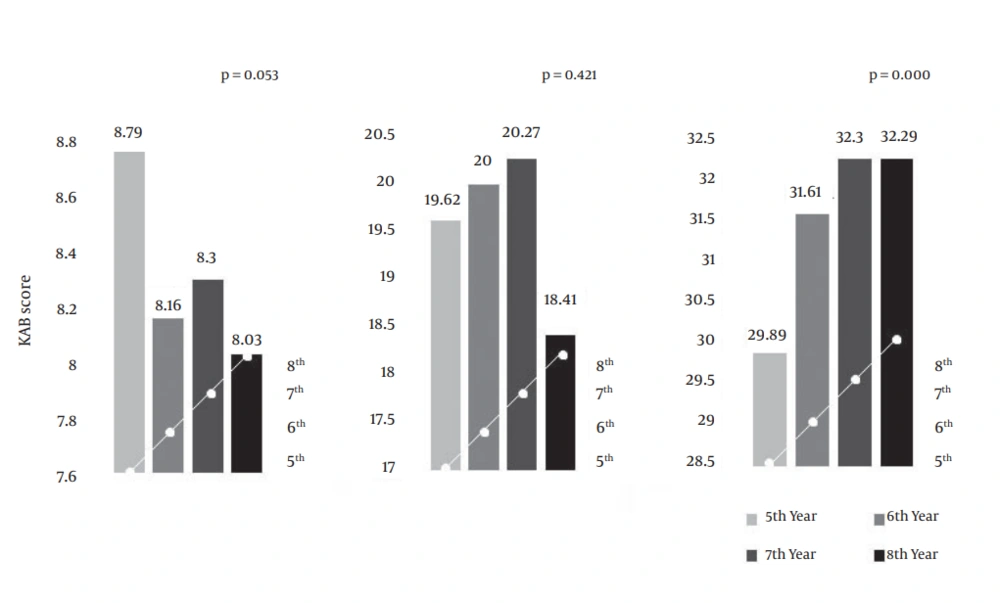
Figure 1.
Relationship Between KAB Score and Grades
5.2.2. Relationship Between KAB Score and Dental or Medical Internship
Interestingly, dental and medical interns had differences in all KAB scores. There were significant relationships between being a dental or medical intern and knowledge score (P = 2.2e-16), as well as attitudes score (P = 0.032) and behaviors score (P = 2.077e-7) (Figure 2).
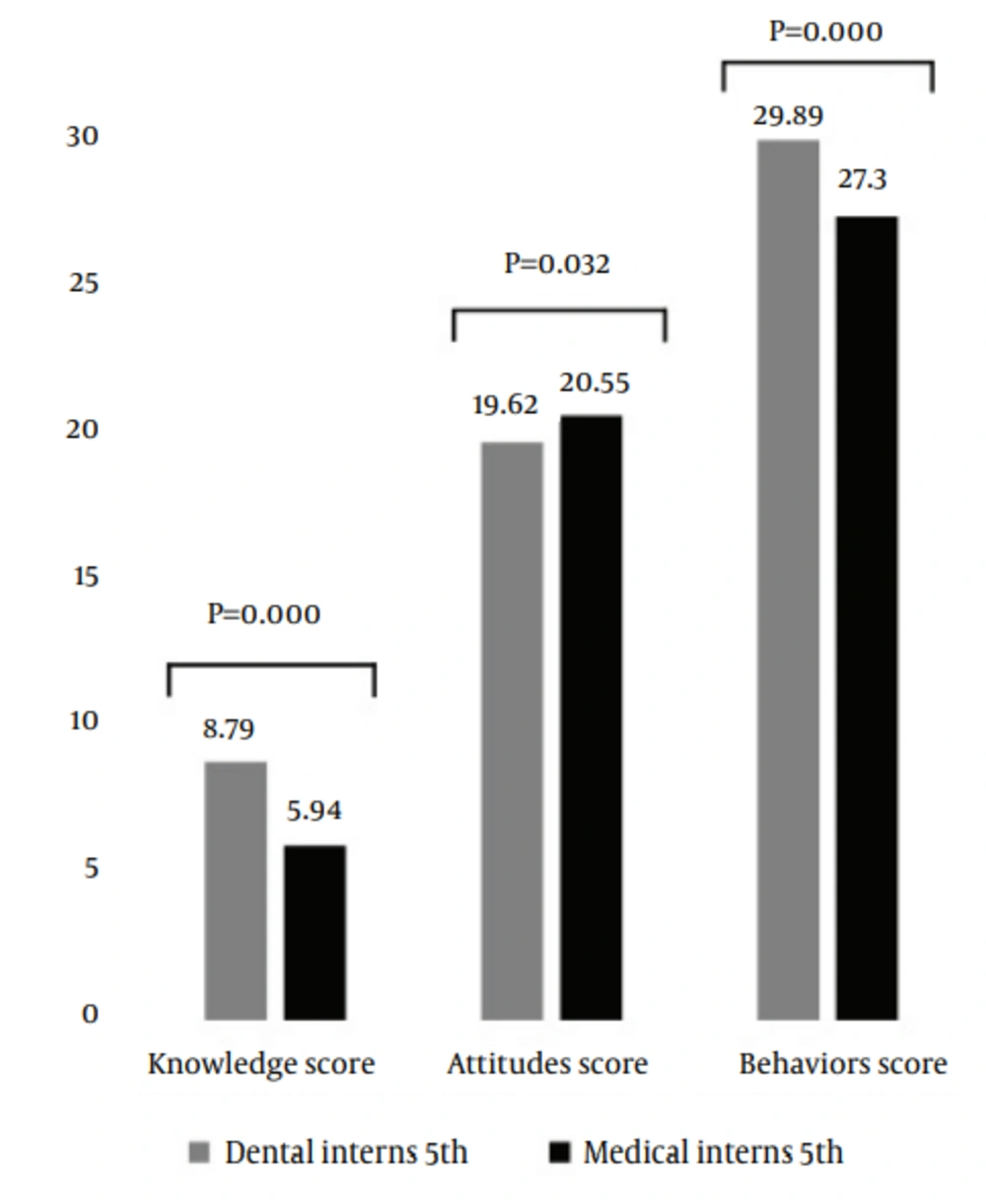
Figure 2.
Relationship Between KAB Score and being a dental or Medical Intern
5.3. KAB Phase
In this part authors evaluated which exact KAB phase respondents were in lack of knowledge or attitude change to give advice on providing more effective healthcare education, which is the core of the “K-A-B” model. First, based on the results of the study, it could be inferred that Chinese dental interns had a comparatively good level of knowledge about HBV-related issues, even better than Iranian students in some same questions, which was defined as a fairly acceptable knowledge level after being compared with lots of similar researches (6), 89.43% of undergraduates had good or excellent knowledge and no graduates in the seventh and eighth year had poor knowledge level, which is more convincing after being compared with those of the medical interns. Nonetheless, All of dental interns should pay more attention to active and artificial immunities against HBV, which is the major part of prevention knowledge they relatively lacked. In addition, they should review basic knowledge when accumulating clinical experience, therefore, they can combine theory and practice better, rather than applying methods without understanding the terms.
Second, regarding attitudes, dental interns were less willing to treat patients with HBV infection and had less positive attitude toward the control of HBV infection compared with medical interns and Taiwanese dental students with same questions (5). Interestingly, it was concluded that the more patients with HBV infection dental interns treat, the more positive attitude they will have. At last, behaviors of dental interns proved normal, 65.8% of dental undergraduates and 60% of dental graduates reported receiving all three required doses of vaccination or more. But compared with the fact that 61.2% of the dental students in Central India (9), and more than 50% and 93.8% of healthcare workers in Sudan and Uganda had not been vaccinated against Hepatitis B (10, 11), China got higher vaccination rates because of its policy of free HBV vaccination for children below 15 from June 2005, as well as the “2006 - 2010 National Guidelines for Hepatitis B Prevention and Treatment” developed by the Ministry of Health (12). However, the results of checking antibody titer status were not satisfactory, compared with 56.8% among Iranian surgeons (13). And the needle-stick injuries were less than expected, compared with German dental students (14). Moreover, the use of personal protective measures such as gloves was all similar to the Iranian dental students (6). Thus it was recommended that immunization program should be further strengthened to reach those remaining at higher risk such as dental interns (15).
Chinese dental interns were different from the subjects in the previous studies (9, 10, 13, 14, 16-18) who lacked basic knowledge of HBV. They had comparatively good knowledge, less positive attitude and ordinary behavior levels. As the positive linear correlations reaffirms that better knowledge can lead to positive attitudes and subsequently good behaviors (9, 16, 19), it is recommended that dental interns continue improving their knowledge level, gain more positive attitude by accumulating clinical experience, and pay more attention to ignored behaviors such as checking antibody titer status routinely. Authors believe that the current study will help the Chinese dental interns on theoretical studies and clinical practices about HBV; thus, dentists and dental staffs will create an environment, where infected patients can be treated easily and safely.