
1. Context
1.1. Rationale
Breast cancer is the most frequent cancer among women. The estimated five-year relative survival rate for 50 to 69-year-old women diagnosed with breast cancer between 2001 and 2013 is over 80% (1). Overall, well-being of patients after their cancer diagnosis and post-treatment period is a concern and can affect the breast cancer recurrence. Hence, related interventions by maintaining or enhancing lifestyle modifications can increase their overall-wellbeing (2). Furthermore, lifestyle modifications are highly recommended to patients with breast cancer during or after their treatments as an adjunct to standard breast cancer therapies in order to increase their quality of life (3, 4). Quality of life is an important factor for every human being, especially for patients, which is affected by the condition of disease and the length of patient’s life (5). The exact concept of quality of life is hard to describe and it mostly relies on the particular comprehension of disease and health; however, according to the phrase given by the World Health Organization (WHO), quality of life includes not only mental, physical, and social health but cognitive-behavioral working ability and life-long pleasure which can be measured via different validated scales (5). On the other hand, based on the Nature definition, lifestyle modifications not only altering diet and physical activity but also having new behavioral changes for a long time (6).
With regard to the dietary feature of lifestyle modifications, related principal aspects include energy intake, dietary fiber, dietary fat and carbohydrate intakes, micro-nutrients, and alcohol consumption (7). Considerable attention has subsequently been directed towards energy restriction programs that cause reductions in body weight. There are numerous evidence that shows losing weight is associated with decreased risk of breast cancer recurrence (8, 9) and improved quality of life and psychological wellbeing (10). As a consequence, the present study will mainly focus on dietary modifications related to weight loss that generally include reduced fat and simple carbohydrate intakes.
Similar to energy restriction, physical activity also causes higher quality of life. A previous systematic review reported that patients with higher physical activity levels were observed to experience a lower relative risk of cancer recurrence and had less intense adverse events compared with those who had less exercise (11). Further, a recent meta-analysis reported that exercise resulted in beneficial effects on quality of life and physical functions of patients with breast cancer who had different demographic or clinical characteristics during and following their treatments (12).
Meanwhile, the third substantial component of lifestyle modifications is cognitive-behavioral therapy which can be incorporated into breast cancer survivorship programs (13). In fact, recent comprehensive lifestyle modification programs consider cognitive-behavioral strategies as the combination factors between dietary and physical activity recommendations in order to improve patients’ adherence to a long-term treatment (14). Promising data have indicated that performing multidisciplinary lifestyle modifications would provide patients with comprehensive long-term management of their disease treatment (15, 16). Beneficial effects were found via cognitive-behavioral therapy; Lichtenthal et al. showed that cognitive-behavioral intervention led to improvements in health worries and interpretation biases in patients with breast cancer compared with the control arm (17). Further, cognitive-behavioral therapy has been shown to have additional benefits to patients’ mood and quality of life (18). However, in spite of such beneficial effects, insignificant or contrary findings were also reported (19).
As mentioned above, there are published clinical trial articles that assessed cognitive-behavioral therapy with either dietary intervention or physical activity as well as the simultaneous effects of three of them among patients with breast cancer and survivors (20-25). Meffered et al. (20) postulated that the combined intervention of the three lifestyle modifications aspects could decrease the recurrence rate and prevent the obesity risk in overweight breast cancer survivors. Sanft et al. (22) also found that the combination of cognitive-behavioral, physical, and dietary interventions led to a prevention of the disease recurrence compared with the control group.
With regard to the previous systematic review articles, there are published studies that separately reported the efficacies of dietary (26-29), physical (12, 30), and cognitive-behavioral intervention (31) on quality of life and disease recurrence of patients with breast cancer and survivors. Besides, compared to the present study protocol, there is only one systematic review protocol article that has been published in 2014 and included only dietary modification and physical activity features of quality of life and their relation with breast cancer recurrence, without considering articles that included cognitive-behavioral therapy along with the other two aspects; further, the results of this systematic review protocol has not yet been fully published (32). Consequently, there are no meta-analysis or systematic review articles that specifically report the effects of either dietary or physical activity interventions with cognitive-behavioral therapy or even three of them on quality of life and/or cancer recurrence among patients with breast cancer and survivors. Hence, performing the present meta-analysis in order to identify lifestyle related factors that can improve survival rate and quality of life of patients during or after the treatment process, would be of great value. The specific strengths of the present study would be as followed:
In comparison with similar publications, one of the aims of this article is to provide a more specific and precise assessment on the role of lifestyle modification in patients with breast cancer and the efficacy of its three important aspects including dietary, exercise, and psychological interventions on quality of life of patients with breast cancer and survivors.
As cognitive-behavioral therapy is a complementary therapy that has shown to have long-lasting effects on non-communicable diseases such as breast cancer, another aim of this study is to consider those trials that included the cognitive-behavioral therapy in the treatment process of breast cancer along with dietary or physical interventions.
This meta-analysis will provide beneficial guidance for healthcare providers and family members to augment the current perception of the function of all the lifestyle modifiable components on alleviating the important problems of lifestyle of patients with breast cancer.
The beneficial results will prolong the life of breast cancer survivors.
The primary objectives of the present study are assessing the simultaneous effects of dietary intervention or physical activity with cognitive-behavioral therapy, or three of them, as the main aspects of lifestyle modification on quality of life and the recurrence levels among patients with breast cancer/survivors. The secondary objectives include the assessment of the above-mentioned lifestyle modification factors on anthropometric factors, including weight, body mass index (BMI), waist-hip ratio, and/or body fat.
2. Evidence Acquisition
2.1. Design
This systematic review and meta-analysis protocol was prepared in accordance with the PRISMA-P checklist (Appendix 1 in Supplementary File) (33). With regard to the instructions, this protocol of a systematic review was registered according to the International Prospective Register of Systematic Reviews (PROSPERO) on 24 July 2018 and the last update was on 25 November 2019 (registration number: CRD42018100628). It will be conducted according to a format brought in the Cochrane handbook for systematic reviews of intervention (34) and the related data will be reported following the recommendations of PRISMA statement (35). Quantitative extracted data from included randomized clinical trials (RCTs) will be meta-analyzed.
2.2. Eligibility Criteria
2.2.1. Types of Studies
This review study will only include either full-scale or pilot randomized controlled trials that assessed the dietary or physical activity interventions with cognitive-behavioral therapy or the combination of three of them, compared to a control or usual care. Types of blinding of included articles will not be considered as the inclusion criteria and will only be assessed according to the quality assessment tools. The control group for every intervention part can be either a watchful-waitlist as passive control or groups that received other standard care management or placebo as active control. No limitations for sample size or sampling methods will be considered. Trials with before-after designs will be primarily excluded. We will exclude studies if they are animal or in-vitro models. Any records without full texts will also be excluded as well as the studies that are irrelevant to the context.
2.2.2. Types of Participants
Eligible participants will include patients aged 18 to 65 with breast cancer stage I to III who are undergoing treatment process as well as breast cancer survivors who have completed their treatments in the previous 10 years. No ethnicity limitation will be considered.
2.2.3. Types of Intervention
Intervention types of included RCTs will consist of lifestyle modification including three main aspects which are dietary interventions, physical activity, and cognitive-behavioral interventions. Dietary interventions will consist of dietary counseling and programs including particular diets for weight management such as a low-calorie diet, low-carbohydrate, and/or low-fat diets that are performed individually or through group meetings or those that are given by telephone calls or mail correspondence, particular for weight management. We will not consider other dietary modifications that include smoking cessation, alcohol consumption, or different supplement therapies. Physical activity intervention will consist of any type of exercise with different duration. Trials with cognitive-behavioral interventions will be included which have been given either via a face-to-face conversation or by online mode.
2.3. Information Sources
One reviewer (ER) will search electronic databases, including Scopus, ISI Web of Science, Pubmed, the Cochrane Central Register of Controlled Trials, CINAHL, and EMBASE for peer-reviewed literature. No time limitations will be considered and the search will be performed after the submission.
The search strategy will include related keywords of breast cancer which will be separately combined with the synonyms of either of the dietary intervention, cognitive-behavioral therapy, or physical activity (Appendix 2 in Supplementary File).
We will also perform Grey literature by the “GREY MATTERS” checklists which are from the Canadian Agency for Drugs and Technologies in Health (CADTH).
There will be no language restrictions and the searches will be re-conducted right before the final analysis. Translation tools will be used for articles in languages other than English.
2.4. Search Strategy
Related keywords that will be used in the search strategy will consist of selected keywords from the Medical Subject Headings (MeSH) database and the other non-MeSH terms. The MeSH terms will be made for sequential searches. Other synonyms of every three of the main components will also be searche’d separately. Final search results will be concatenated with BOOLEAN operators including “OR” for the synonyms and “AND” for every combination between the “breast cancer” component and each of the three intervention keywords.
2.5. Study Records
2.5.1. Data Management
Two researchers (AS and ER) will conduct the main management of the study. Data collection will be performed according to the PRISMA flow diagram for reporting systematic reviews and meta-analyses studies (36). Hence, all of the pooled records will be automatically duplicated. As finding duplicates via EndNote software (version 8.2, Thomson Reuters, Philadelphia, USA) are inadequate, further duplication will be performed via hand-searching.
2.5.2. Selection Process
Five reviewers (AS, ER, MZ, MB, and AM) will perform the screening of titles and abstracts of studies according to the mentioned inclusion and exclusion criteria. All reviewers will meet and compare their screening at least three times to compare and discuss the related results. If any doubt still exists, the full text of the related study will be checked for more precise assessment.
2.5.3. Data Collection Process
The five reviewers (AS, ER, MB, MZ, and AM) will review the full texts of articles and will perform data extraction independently for each study via a standardized form which is from the Cochrane Data Collection for Randomized Controlled trials (37). The data which will be extracted are as followed:
1) The basic characteristics of the study including the author names, publication year and the region of the published article as well as the methodological quality and the design of each study including randomized or non-randomized, pilot, or full trials.
2) Characteristics of trial participants including total participants, age, breast cancer stage, type of treatment, breast cancer biological subtype, and ethnicity.
3) Type of interventions including diet or exercise intervention with psychotherapy or three of them along with details of the interventions and durations versus the control groups.
4) Outcome measures and their definitions and units; the drop-out and completion rates, the measurement tools, and the final analysis with or without adjusted variables and the per-protocol or intention-to-treat analysis.
Data will be separately entered for studies that have more than one outcome measure in order to conduct individual analysis. We will calculate the mean differences of selected data in SPSS (version 20, IBM, Chicago IL, USA). Data type in the present meta-analysis will be means and standard deviations of continuous data among participants either in the intervention or control groups and if data present in forms other than means and standard deviations, they will be accordingly converted in order to conduct the pooled analysis. Two reviewers will revise the accuracy of the extracted data (AS and ER) and they will resolve any discrepancies or disagreement through group discussion by re-checking the extracted data and full texts of all articles.
2.6. Outcomes and Prioritization
The following primary and secondary outcome measurements will be evaluated and analyzed based on the reported data from every included trial:
2.6.1. Primary Outcomes Measure
Quality of life and disease recurrence rates.
2.6.2. Secondary Outcomes Measure
Anthropometric factors, including weight, BMI, waist-hip ratio, and/or body fat.
2.7. Quality Assessment
2.7.1. Risk of Bias Assessment
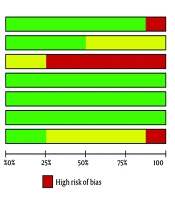
The risk of bias of all the included studies will be assessed one by one by the reviewers using the Cochrane collaboration’s risk of bias assessment tool (38, 39). There will be Six main domains of bias which will be assessed, including selection, attrition, detection, performance, reporting bias, and other biases, all of which will be evaluated through the Review Manager software and then will be classified as either “high-risk”, “low-risk” or “by some concern” (39). The disagreements will be checked through meetings in the Breast Cancer Research Center.
2.7.2. Quality of Evidence
We used the Grading of Recommendations Assessment, Development, and Evaluation (GRADE) approach to assess the quality of evidence for each outcome according to the following domains: risk of bias, publication bias, imprecision of results, heterogeneity, and indirectness of evidence (40). Finally, the quality of evidence will be categorized as very low, low, moderate, and high.
2.8. Data Synthesis
The STATA software (version 14.2, College Station, Texas, USA) will be used as the principal software for conducting meta-analysis. The random-effects model will be performed to take into account the between-study variations. For each outcome measure, means and standard deviations of continuous data of every included study, will be extracted and analyzed and finally, standardized mean difference (SMD) with their corresponding standard errors (SEs) will be calculated. The text and quantitative data will be checked by the two main reviewers (AS and ER). In case of incomplete or missing data presents, attempts will be made to communicate with the original authors of published articles to receive full texts of more clarifications.
2.8.1. Assessment of Heterogeneity and Publication Bias
The heterogeneity of studies will be assessed using the I-squared and Cochra’s Q-statistical tests (41). Heterogeneity will be considered important if the I-squared statistic will be more than 50%. Then, if the heterogeneity presents, sub-group analyses will be performed to identify the source of heterogeneity based on between-study differences of included studies.
2.8.2. Sensitivity Analysis
Sensitivity analysis will be conducted to assess the robustness of the measures and to understand the extent to which the conclusions depend whether upon a particular study or a group of studies. In fact, by using sensitivity analysis, the effect of included studies which have higher levels of missing data will also be evaluated in the overall assessment of treatment effect.
The levels of attrition will be noted for included studies. As far as possible, the analyses will be performed according to an intention-to-treat basis. Thus, participants will be analyzed regardless of whether they received the allocated intervention and only the group that they were allocated will be considered for the analysis.
3. Discussion
This meta-analysis includes a complete aspects of lifestyle modification and, when will be done, will provide beneficial guidance for healthcare providers and family members to better understand the role of modifiable lifestyle factors on alleviating their major problems which will prolong breast cancer survivors’ lives.
The limitations of the present study may be the heterogeneity from some trials.
3.1. Ethics, Knowledge Dissemination and Impact of Study
The ethics and feasibility of the present study is registered at Academic Center for Education, Culture and Research, ACECR, Department of Breast Cancer, Tehran, Iran (no.: IR.ACECR.IBCRC.REC.1397.102). The authors believe that this meta-analysis will provide critical evidence-based guidance for government or priority setters as well as healthcare stakeholders in determining whether lifestyle modification is a prior and preferred remedy for breast cancer-related outcomes among its patients and survivors.
All data in this study will be saved and managed electronically and password will be encrypted. In addition, backup of data will be made on USB flash drives.