
1. Context
Immune checkpoint inhibitors (ICIs) can cause immune-related adverse events (irAEs) affecting virtually any organ system. Although initial manifestations may be mild, some toxicities emerge or persist after treatment is discontinued (1, 2). Chimeric antigen receptor (CAR) T-cell therapies and T-cell-engaging bispecific antibodies present distinct but potentially overlapping safety challenges. Cytokine release syndrome (CRS) and immune effector cell-associated neurotoxicity syndrome (ICANS) may progress rapidly, sometimes within hours, particularly following infusion or step-up dosing (3-5). Consequently, continuous symptom surveillance between scheduled clinical assessments is essential for timely recognition and intervention.
Remote symptom monitoring has demonstrated clinical utility in oncology. Randomized controlled trials have reported improvements in symptom burden and patient experience (6-8), with some also demonstrating reductions in emergency department visits or delays in such visits. These benefits were generally supported by clinical response pathways in which nursing teams reviewed and acted on patient-reported alerts. A small feasibility study of remote monitoring during ICI treatment also demonstrated the potential acceptability and feasibility of this approach and suggested possible improvements in quality of life (9). However, its limited scope precluded conclusions regarding survival outcomes or acute care utilization. Collectively, these findings support the clinical value of structured monitoring and response pathways but do not establish that machine learning-based approaches improve triage performance or patient outcomes.
Multimodal monitoring systems offer the potential to integrate diverse data streams, including patient-reported symptoms, functional status, wearable-derived physiological measurements, laboratory trends, and clinical history. However, strong discriminatory performance alone is insufficient to establish clinical utility. Models may exhibit inadequate calibration, fail to provide sufficiently early warnings, or generate unreliable predictions in the presence of missing data. Furthermore, the clinical value of an alert depends on the availability of a timely and appropriate response. Accordingly, detection, prediction, and triage should be regarded as distinct but interrelated functions, each requiring separate evaluation.
Recent reviews have addressed individual components of this emerging field. One examined the application of artificial intelligence to ICI-related safety monitoring (10), whereas another evaluated remote symptom monitoring programs during ICI treatment (11). Two additional reviews assessed predictive models for CAR T-cell-related toxicities (12, 13), both of which highlighted substantial limitations in clinical validation and readiness for implementation. The present review brings these complementary areas together and extends the discussion to toxicity monitoring during bispecific antibody therapy. Particular emphasis is placed on clinically actionable decisions, multimodal data integration, and the requirements for translating predictive approaches into effective clinical monitoring and triage pathways.
This review addresses three central questions: (1) What evidence currently supports the use of remote monitoring and triage in patients receiving immune-based cancer therapies? (2) What safety limitations and implementation challenges remain unresolved? and (3) What methodological and clinical evaluation frameworks are needed to establish the safety, reliability, and clinical utility of future monitoring systems?
2. Evidence Acquisition
We conducted a literature search in PubMed covering all records indexed from database inception through 5 September 2026. Four reproducible search strategies were developed to capture the major treatment groups. The complete search strings and corresponding retrieval counts are provided in Supplementary Table S3. To identify additional relevant studies, we also screened the reference lists of included publications and examined forward citations. Primary publisher sources and official regulatory documents were consulted when necessary to verify specific findings and regulatory information (14-18).
Studies were considered eligible if they investigated the detection or prediction of treatment-related toxicities in human populations. Prospective studies evaluating remote monitoring following immune effector cell therapies were also included. Randomized trials of symptom monitoring in oncology were considered when their findings provided relevant evidence on alert generation, clinical response workflows, or related triage processes. Studies focusing exclusively on treatment-response prediction without assessing safety-related outcomes were excluded, as were preclinical investigations and technical models lacking a plausible application in clinical triage. Conference abstracts were considered only when no corresponding full-text publication was available. Evidence was classified into three tiers according to the level of clinical implementation and integration into decision-making. Tier 1 comprised studies evaluating prospective artificial intelligence-guided triage or clinical escalation. Tier 2 included studies investigating remote monitoring, feasibility, or toxicity prediction without an integrated AI-guided triage or escalation pathway. Tier 3 encompassed retrospective toxicity detection studies and indirect technical evidence with potential relevance to clinical monitoring. No identified study met the predefined Tier 1 criteria.
This review adopted a targeted narrative approach rather than a systematic or scoping review methodology. A single author conducted evidence selection and interpretation. No review protocol was registered, screening was not performed independently by multiple reviewers, and no PRISMA flow diagram was generated. These methodological features may have introduced selection and interpretation bias.
The included evidence was evaluated across several dimensions, including the clinical task addressed, outcome definition, timing of assessment, model calibration, validation strategy, handling of missing data, and clinical actionability. The SANRA (Scale for the Assessment of Narrative Review Articles) guidelines informed the reporting process (19). An unscored checklist based on these assessment domains is provided in Supplementary Table S2.
3. Results
3.1. The Clinical Comparator
Remote triage should be conceptualized as a clinical service rather than a stand-alone algorithm. In routine practice, patients typically contact their oncology clinic or an after-hours telephone service, where healthcare professionals obtain structured symptom information and apply clinical judgment to determine the appropriate level of care. A retrospective study of an oncology telephone hotline documented instances of potentially avoidable emergency referrals (20), highlighting opportunities to improve triage efficiency. Accordingly, future AI-enabled monitoring systems should be evaluated against a clearly defined nurse-led telephone triage pathway rather than against an absence of clinical support.
Detection identifies toxicity that is already present, whereas prediction estimates the likelihood of a future event within a predefined time horizon. Triage, in turn, translates current clinical findings or predicted risk into actionable decisions. Although retrospective text-based models have demonstrated potential for improving toxicity case identification (21-23), they may not provide sufficient lead time to prevent clinical deterioration. In contrast, a wearable-based monitoring study reported a median warning time of seven hours before an adverse event (24), suggesting that clinically meaningful early warning may be achievable even when predictive accuracy is modest. However, alert thresholds should be determined primarily by the clinical consequences of missed events, particularly the risk of delayed intervention for serious toxicities. The burden of false-positive alerts and the resulting demands on clinical teams must also be considered when optimizing these thresholds (25).
3.2. Electronic Patient-Reported Outcomes
Electronic patient-reported outcomes (ePROs) enable continuous symptom assessment between scheduled clinical visits, facilitating the early identification of worsening symptoms and timely clinical intervention. In the PRO-TECT trial, weekly electronic symptom surveys generated alerts for nursing staff when predefined symptom thresholds were exceeded (7). The final analysis demonstrated no significant overall survival benefit; however, emergency department visits were less frequent and occurred later in the intervention group. Patients also experienced delayed deterioration in physical function and health-related quality of life (8). Earlier randomized evidence had associated electronic symptom monitoring with improved survival outcomes (6). Taken together, these findings suggest that the clinical benefits of ePRO-based monitoring may extend beyond symptom detection to improved symptom management and healthcare utilization. Importantly, these interventions relied on designated clinical personnel to review alerts and initiate appropriate responses, underscoring the importance of an established clinical response pathway. Evidence supporting remote monitoring in immunotherapy remains limited. A review identified 16 multicomponent monitoring programs (11), with improvements in quality of life representing the most consistently reported benefit. The SOFIA pilot study demonstrated feasibility, although its small sample size limited the strength of its findings (9). A study involving 34 patients reported high discriminatory performance for adverse event detection (26); however, it lacked calibration assessment and external validation. Remote monitoring may also impose additional burdens on patients, as completing surveys, charging devices, and wearing sensors require time and effort. Importantly, nonresponse should never be interpreted as reassurance.
3.3. Multimodal Data
Each data source provides useful information but is also subject to potential limitations. The main trade-offs are summarized in Table 1.
Table 1.
Data Sources for Remote Immunotherapy Toxicity Monitoring a
| Data Sources | Examples | Possible Value | Main Limits | Evidence |
|---|---|---|---|---|
| Patient reports | Symptoms, function, medicines, free text | Captures patient experience | Survey burden, access, missing data | Tier 2: oncology trials (6 – 8); immunotherapy studies (9, 11, 26) |
| Wearable physiology | Heart rate, temperature, activity, sleep, SpO2 | Tracks change from baseline | Non-wear, motion, device error | Tier 2: review and feasibility studies (24, 27 – 30) |
| Routine laboratory data | Blood count, liver tests, creatinine, CRP, ferritin | Adds biologic context | Intermittent tests and slow results | Tier 2: composite scores and biomarkers (32, 33, 37) |
| Investigational sensors | Sweat CRP or cytokine signals | May provide continuous trends | No validated triage threshold | Tier 3: technical feasibility outside immunotherapy (34) |
| Clinical record | Treatment dates, comorbidity, medicines, notes | Adds timing and history | Documentation bias and delay | Tier 3: retrospective text detection (21 – 23) |
a Abbreviations: CRP, C-reactive protein; EHR, electronic health record; ICI, immune checkpoint inhibitor; SpO2, peripheral oxygen saturation.
Wearable devices can continuously monitor heart rate, temperature, physical activity, sleep, and oxygen saturation. Changes from individual baseline values may be particularly informative. A meta-analysis of hospital-based studies found no clear evidence of clinical benefit (27). Oncology studies have also reported device-related and workflow barriers (28). Telemedicine and wearable monitoring appear feasible following CAR T-cell therapy (29, 30). However, data collection may be interrupted by charging gaps, device nonwear, motion artifacts, or differences between devices. Furthermore, pulse oximetry may not accurately detect hypoxemia in some patient groups (31).
Routine laboratory tests can identify inflammation, organ injury, and cytopenias. EASIX-based scores have been associated with severe cytokine release syndrome (CRS) and immune effector cell-associated neurotoxicity syndrome (ICANS) (32, 33). However, thresholds may not be transferable across centers. Experimental sensors remain less mature. For example, a sweat-based patch has been developed to measure C-reactive protein (34), but it has not yet been used to guide home-based immunotherapy triage. Importantly, sensor failure should never prevent symptom-based clinical escalation.
Clinical records provide information on treatment timing, medications, laboratory trends, and clinical notes. Text-based models can identify severe events that may be missed by billing codes (21-23). However, most operate after an event has been documented in the medical record. They therefore support case identification rather than early prediction. Large language models may also generate unsupported information (35). Accordingly, a triage system should provide access to its source evidence and abstain from making recommendations when the available information is insufficient.
3.4. Therapy-Specific Evidence
Checkpoint inhibitor studies have primarily evaluated symptoms, imaging findings, or clinical text (10, 21-23, 26, 36). Among these approaches, symptom monitoring is the only one that directly supports surveillance between scheduled visits. No approach has demonstrated improved triage outcomes in a prospective comparative study. Models should specify the affected organ system and prediction time horizon because pneumonitis, colitis, myocarditis, hepatitis, endocrine toxicity, and skin toxicity represent distinct clinical events (1, 2).
CAR T-cell studies have focused primarily on cytokine release syndrome (CRS) and immune effector cell-associated neurotoxicity syndrome (ICANS). Studies using EASIX-based models have reported moderate to high discriminatory performance at selected time points (32, 33) (Table 2). A pediatric biomarker study initiated assessment at fever onset (37), whereas two conference reports evaluated early features for toxicity prediction (38, 39). A 2026 review identified 26 models across 29 studies (12). Only ten studies reported external validation, and only six reported calibration. All studies were judged to have a high risk of bias. A second review also found no consensus regarding the clinical applicability of these models (13).
Table 2.
Representative Clinical Studies a
| Studies | Therapy and Data | Task | Key Result | Why It Does Not Establish Triage |
|---|---|---|---|---|
| Iivanainen 2021 (26); 34 patients | ICI; electronic symptom reports | Current presence or onset of an irAE | AUC 0.99 and 0.93; no calibration | Small single-center cohort; no external validation |
| Rajeeve 2026 (24); 30 patients | CAR T-cell; wearable temperature and cytokines | Early inpatient CRS detection | 18 of 20 episodes detected; sensitivity 0.72; specificity 0.80; median warning 7 hours | Mostly grade 1 events; 67% adherence; no triage action |
| Dholaria 2025 (30); 25 enrolled | CAR T-cell; wearables and telemedicine | Outpatient feasibility | 20 treated; 19 admitted; grade 3 ICANS in 20% | Tests a care pathway, not an algorithm |
| Moreno-Castano 2026 (32); 119 patients | CAR T-cell; modified EASIX | Severe CRS or ICANS | AUC 0.71 at baseline and 0.73 after infusion; Brier score 0.122 | Small event count; partly diagnostic at symptom onset |
| Su 2024 (37); 95 development; 47 validation | CAR T-cell; lymphocyte and IL-2 model | Severe CRS at fever onset | Accuracy 85.1% and 74.5%; no calibration | Starts after fever; no independent-site test |
| Sun 2024 (21); 1,270 validation records | ICI; large language model and clinical notes | Detection after documentation | Sensitivity 98.1%; specificity 95.7% | Case finding, not future prediction or triage |
a Abbreviations: AUC, area under the receiver operating characteristic curve; CRS, cytokine release syndrome; ICANS, immune effector cell-associated neurotoxicity syndrome; ICI, immune checkpoint inhibitor; irAE, immune-related adverse event.
Bispecific antibodies require product-specific monitoring strategies. Clinical trials have reported differences in the incidence and timing of CRS across products (40-44). Events frequently cluster around step-up dosing and the first full dose. Outpatient guidance emphasizes patient education and rapid clinical escalation (4). Selected patients have received their first full epcoritamab dose in an outpatient setting (5).
3.5. A Therapy-Specific Safety Framework
The overall service architecture can be shared, whereas its clinical modules should remain therapy-specific. An immune checkpoint inhibitor (ICI) module may monitor symptoms over days or weeks. A CAR T-cell module may focus on vital signs and neurological changes over shorter time intervals, potentially within hours. A bispecific antibody module should account for the specific product, dose, and step-up dosing stage. Thresholds should not be transferred between modules without validation.
Figure 1 illustrates four safety functions. Layer 1 records each data input and its quality. Layer 2 generates a therapy-specific estimate or abstains when appropriate. Layer 3 applies independent red-flag rules that can override an otherwise reassuring model score. Layer 4 directs the resulting action to a staffed clinical service. This architecture adapts established safety principles (14-17) rather than proposing a new algorithm.
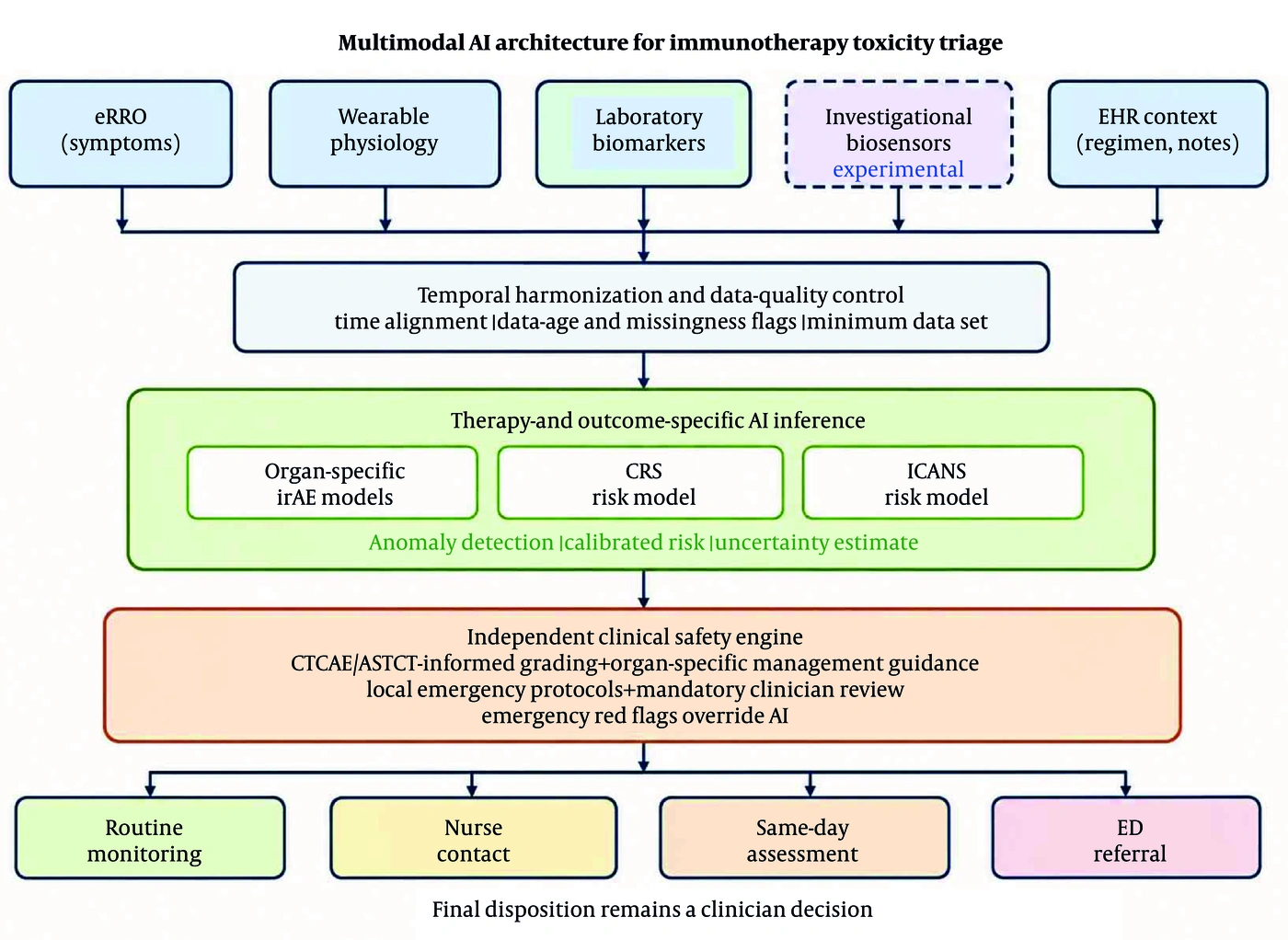
Figure 1.
Therapy-Specific Safety Framework for Remote Immunotherapy Toxicity Triage. The red-flag pathway remains active when model output is unavailable or indicates low risk. ChatGPT assisted in preparing the code used to draw this author-designed schematic. No generative image model was used.
The proposed framework has not undergone Delphi review or been tested by patients and clinicians, and no human-factors evaluation has been conducted. Accordingly, Table 3 describes candidate functions rather than establishing universal thresholds. Thresholds should be predefined within each clinical protocol before outcome assessment, with safety rules informed by current clinical guidance (2-4, 18).
Table 3.
Functions and Safety Conditions of the Proposed Framework a
| Layers | Function | Main Inputs | Required Output | Safety Condition |
|---|---|---|---|---|
| 1 | Reliable data capture | Symptoms; optional wearable, laboratory, and record data | Source, time, completeness, and quality | Red-flag questions remain active |
| 2 | Therapy-specific inference | Separate ICI, CAR T-cell, and product-specific bispecific inputs | Risk, uncertainty, horizon, or abstention | No transfer without validation |
| 3 | Independent safety rules | Current guidance, labels, local protocols, and model output | Rule fired, reason, conflict, and review need | Rules can override the model |
| 4 | Clinician-owned action | Reviewed output, urgency, capacity, and acknowledgment | Monitoring, contact, same-day review, or emergency referral | Backup queue, deadline, handover, and closure |
a Abbreviations: CRS, cytokine release syndrome; EHR, electronic health record; ICI, immune checkpoint inhibitor; ICANS, immune effector cell-associated neurotoxicity syndrome.
Existing standards address different aspects of this work. TRIPOD+AI and PROBAST+AI provide guidance on reporting and risk-of-bias assessment (48, 49). DECIDE-AI addresses early-stage clinical evaluation (50), whereas CONSORT-AI provides guidance for reporting randomized trials (51). Safety-assurance cases offer a structured approach to documenting hazards and corresponding controls (52). However, these standards do not constitute validation of the proposed framework.
3.6. Validation, Equity, and Implementation
Validation should begin with a clearly defined intended use. The protocol should specify the target population, therapy, clinical setting, intended user, outcome, prediction horizon, input variables, and resulting clinical action. Model performance reports should include calibration and discrimination using prespecified thresholds. Predictive values should reflect the prevalence of toxicity in the intended clinical setting. Studies should also report warning time, alert burden, response time, and completion of recommended actions.
Figure 2 illustrates a staged validation pathway. External validation should precede clinical implementation. Silent testing should assess calibration and clinical workload without influencing patient care. A supervised pilot should then evaluate usability, clinical overrides, and escalation procedures. A subsequent trial should compare the system with nurse-led telephone triage. Each stage should include prespecified stopping criteria.
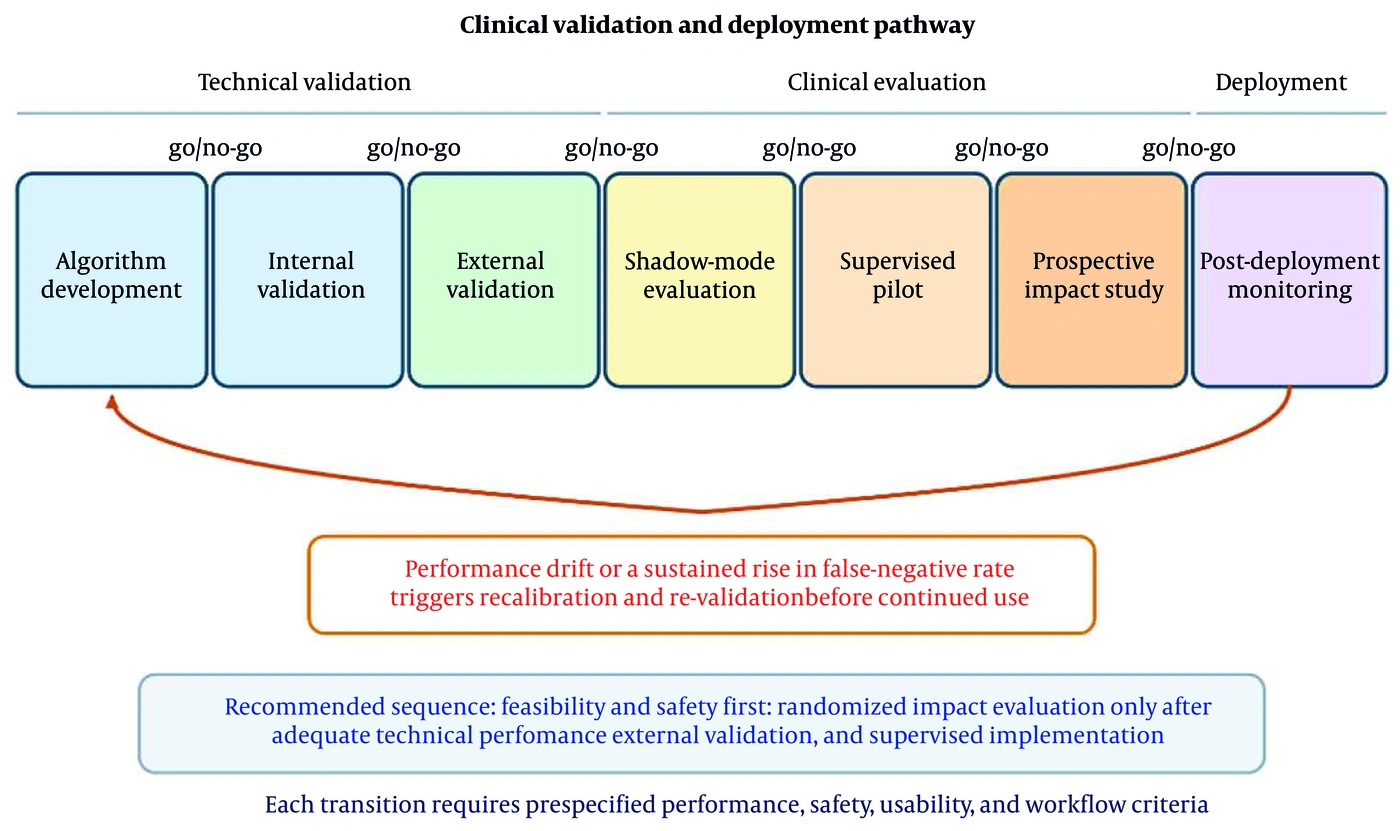
Figure 2.
Proposed Validation and Controlled Deployment Pathway. Failure to meet a predefined evaluation criterion should halt or reverse deployment. ChatGPT assisted in preparing the code used to draw this author-designed schematic. No generative image model was used.
Bias may arise before model training. Device access, survey completion, clinical documentation, and treatment selection can all influence the resulting datasets. A population-health algorithm underestimated the healthcare needs of Black patients because it used healthcare costs as a proxy for illness (53). Pulse oximetry may also underestimate hypoxemia unequally across patient groups (31). Subgroup analyses should therefore be prespecified. For smaller groups, uncertainty should be clearly reported, with access to human review.
Although remote care may reduce travel requirements, it may also widen existing disparities when access to phones, mobile data, electricity, or transportation is limited (54, 55). In resource-constrained settings, monitoring may begin with telephone- or text-based symptom reporting, while wearables and electronic health record integration remain optional. Nevertheless, red-flag rules and staffed clinical escalation pathways remain essential. Local calibration and silent testing are also necessary before implementation.
3.7. Limitations
This review may not have identified all relevant studies. Study selection and interpretation were performed by a single author, and formal risk-of-bias assessment tools were not applied to individual studies. The available evidence varied across therapies, outcomes, assessment time points, and data sources, making meta-analysis inappropriate. Some findings were available only in conference abstracts. Accordingly, the evidence presented in the tables is representative rather than exhaustive.
Feasibility does not establish triage benefit, and retrospective detection does not demonstrate early prediction. The proposed framework also remains unvalidated and requires further evaluation through consensus development, patient involvement, human-factors testing, external validation, and an impact trial.
4. Conclusions
This review identified no prospective comparative studies of artificial intelligence-guided remote triage. Current evidence supports structured symptom monitoring with clearly assigned clinical responsibility and limited outpatient monitoring following immune effector cell therapy. However, the available evidence does not support autonomous triage. Future systems require therapy-specific modules, calibrated risk estimates, clinically useful warning times, independent safety rules, and accountable clinical action. The proposed four-layer framework organizes these requirements but remains a design hypothesis.