
1. Introduction
Both in developing and developed countries, breast cancer is at the top of the list in women`s cancers. Breast cancer is increasing in developing countries, due to increased life expectancy, Western lifestyle and industrialization (1).
According to the International agency for research on cancer (IARC), 1.7 million new cases of breast cancer were identified in 2012, and 6.3 million patients were diagnosed since 5 years ago. Breast cancer is the first cause of cancer death in women (522000 deaths in 2012) and the most commonly diagnosed cancer among the women of 140 countries out of 184 countries around the world (2).
Of all deaths caused by breast cancer in the world, 21% have been attributed to alcohol consumption, overweightness, obesity, and lack of physical activity. In high-income countries, 27% have been attributed to obesity and overweightness as the most important risk factors. In middle and high-income countries, 18% have been attributed to overweightness, obesity, and physical activity, as the most important risk factor (10%) (3).
Most available studies and meta-analyses have considered BMI a marker of generalized obesity. They have also shown the increased risk of breast cancer in all ethnic groups of overweight or obese women during postmenopausal period (4-7).
In a study by Ghiasvand et al. (2011) on the risk factors of breast cancer in young women, no relation was observed among height, weight, BMI, and breast cancer (8). However, a study by Hajian et al. (2013) showed that obesity and overweightness significantly increase the risk of breast cancer in pre- and postmenopausal women (9).
A review by Cheraghi et al. in 2012 showed that the relation between high BMI and breast cancer was low (10). Another review by Namiranian et al. on the risk factors of breast cancer in the Eastern Mediterranean Region (EMRO) demonstrated that overweightness and obesity increase the risk of breast cancer and this association was statistically significant (11).
Due to the uncertainty of results of previous studies, high prevalence of obesity in women and increasing incidence of breast cancer, genetic and regional differences, and other risk factors, this review was conducted in Iranian population with its own characteristics.
Therefore, in this review, all observational studies including cohort, case-control, and cross-sectional studies on the relation between high BMI and breast cancer that were published in Persian or English from 2004 to 2014 were searched and investigated so that the overall effect of obesity and overweightness on breast cancer could be estimated and investigated in terms of heterogeneity.
2. Methods
2.1. Searching
This study was intended to determine all observational studies on the relation between BMI and breast cancer, including cohort, case-control and cross-sectional studies, that were published in Persian or English from 2004 to 2014. For identification of cancer synonyms, we used a search in MeSH. The following keywords were found:
Cancer, Tumor, Neoplasm, Neoplasia, Carcinoma, Malignancy, Malignant, Benign.
That combination with OR and added it to search field with AND to words such as Iran and breast was used as the search strategy.
The electronic databases of PubMed (search date11/05/2015), Web of Science (search date: 11/05/2015), Scopus (search date11/05/2015), and Google Scholar (search date: 19/04/2015) as well as the Iranian scientific electronic databases such as SID in English and Persian (search date: 14/04/2015) and Magiran in Persian (search date: 19/04/2015) were searched. To do further search, the references of the selected articles were also reviewed. Moreover, the summaries of the research presented at the international breast cancer congresses in Iran, annual breast cancer congresses and seminars in Iran were reviewed. Key journals were reviewed too. To find the texts of the articles from the congresses, seminars, and conferences, the corresponding authors were corresponded with.
2.2. Criteria for Including Studies
The observational studies (cohort, case-control and cross-sectional) on the relation between BMI and breast cancer that were published in Persian and English from 2004 to 2014 (1383 - 1393 Hijri) were searched in the study. The exposures were obesity (BMI ≥ 30) and overweightness (30 > BMI ≥ 25) according to the world health organization classification. The studies that were conducted only on patients were excluded. There were no limitations in terms of age and race, and no adjustment was made.
BMI is a criterion used to identify overweight or obese individuals. BMI is a person’s weight in kilograms divided by the square of height in meters. The desired outcome of this study is breast cancer, which has been confirmed by the pathology report. Therefore, all types of breast cancer, regardless of their pathological features and tumors’ stage, have been included in this study.
Two authors reviewed the obtained articles in terms of the inclusion criteria. The articles were not blind in terms of authors’ names, journal’s name, and results. Any disagreement between the two authors was reviewed by the third author.
2.3. Data Collection and Validity Assessment
Two authors extracted the data of the eligible articles. The extracted variables included publication year, author’s name, type of study, sample size, population age, BMI (including normal, overweight, and obese classifications) number of cases with breast cancer and number of healthy individuals (controls). The extracted data were entered into the software, and the author was corresponded in cases where we encountered lack of some data. The STROBE checklist was used for the quality assessment of studies. Two authors assessed the articles independently. Some of the criteria of the STROBE checklist that were used for the quality assessment of studies are as follows:
Methods: (setting, participants, variables, data sources/ measurement, bias), Results: (main results), Discussion: (limitations, generalizability)
2.4. Measures of Exposure Effect and Data Analysis
The OR was the selected effect size for report. The obtained studies were case-control and cross-sectional studies and there was not any cohort study. The OR means odds of the patient population that were exposed to the risk factor compared to odds of healthy population that were not exposed to the risk factor. A meta-analysis with a 95% confidence interval was used to obtain combined effect size. The analysis was performed using stata software and the results were reported using the random effects model.
2.5. Heterogeneity and Publication Bias
3. Results
3.1. Description of Studies
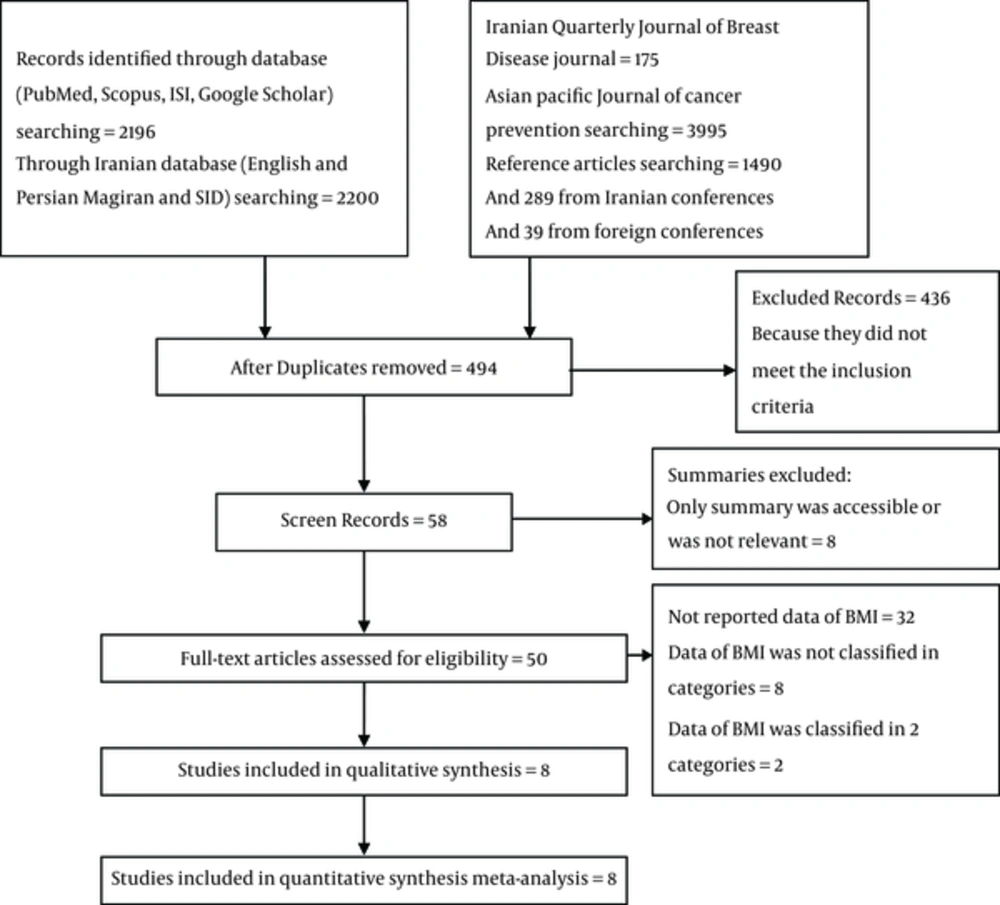
Figure 1.
Flow Chart of the Identification Process for the Selection of Articles in This Review
Data of BMI were not reported in 32 articles out of 50 full text articles, thus they were excluded. Reviewing the full texts of the articles showed that 18 articles examined BMI, among which 8 articles did not classify the data of BMI, which were excluded. Data of BMI in case and control groups were adjusted in 1 article (14) from these 8 articles. From 10 remained articles that reported to have classified data of BMI, 2 articles (15, 16) had presented their reports in two classifications (BMI < 25, BMI ≥ 25) and 8 articles reported their results in three classifications (normal BMI, overweight, and obesity).
3.2. Effect of Exposure
The effect of high BMI (overweightness and obesity) on breast cancer was assessed in selected studies using the OR. The results of analyzing studies using the random effects method showed that studies were heterogeneous. The risk of breast cancer was higher in obese (BMI ≥ 30) (Pooled OR = 2.456, 95%CI = 1.45 - 4.17) or overweight individuals (30 > BMI ≥ 25) (Pooled OR = 1.746, CI = 1.23 - 2.48). After determining statistical heterogeneity, one article was excluded (20). Therefore, 7 studies were again analyzed (for obesity or BMI ≥ 30: Pooled OR = 1.81, 95% CI = 1.24 - 2.64) (for overweightness or 30 > BMI ≥ 25: Pooled OR = 1.46, 95% CI = 1.13 - 1.89) (Tables 1 and 2) (Forest plot Figures 2 and 3). In other words, the odds are breast cancer is lower in women with normal BMI (BMI < 25) than obese or overweight women, and this relation was statistically significant.
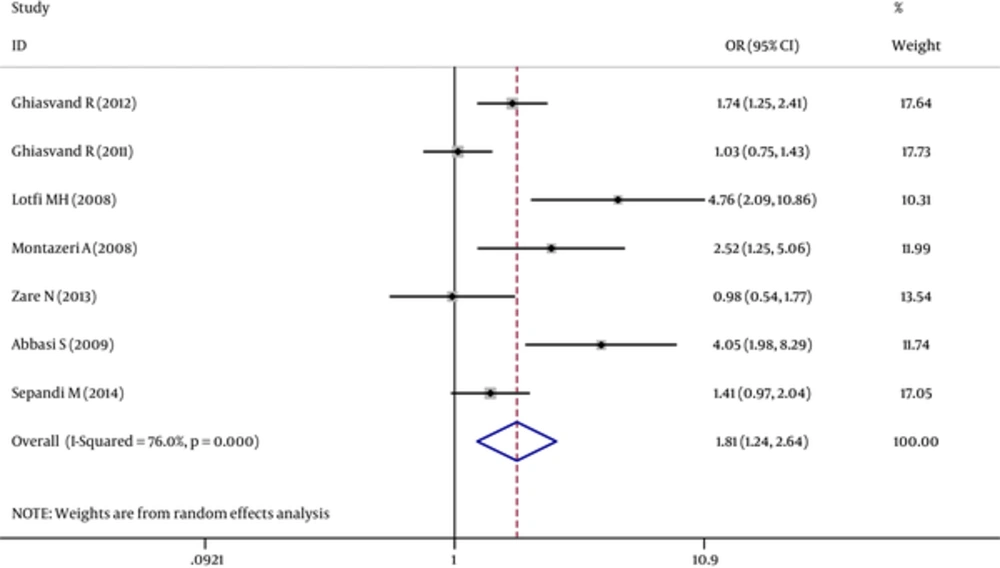
Figure 2.
Forest Plot of Odds Ratio Estimates of Breast Cancer by Obesity
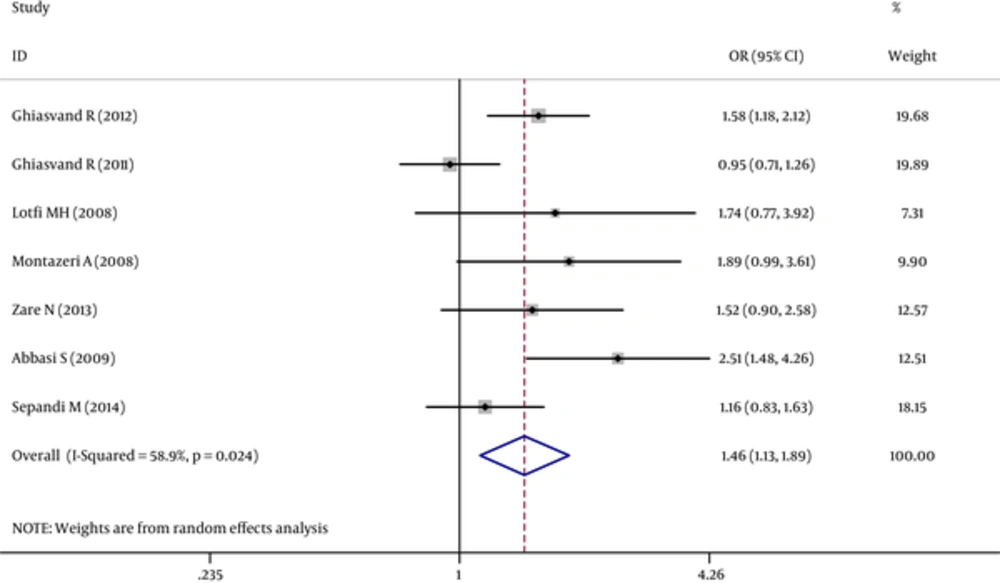
Figure 3.
Forest Plot of Odds Ratio Estimates of Breast Cancer by Overweight
Table 1.
Meta-Analysis Results of the Odds Ratio of Obesity in Breast Cancer Using the Random Effects Method
| Author | Year | Sample Size | OR | 95% Confidence Interval | Weight, %a | |
|---|---|---|---|---|---|---|
| Ghiasvand R (19) | 2012 | 588 | 1.737 | 1.25 | 2.414 | 17.64 |
| Ghiasvand R (8) | 2011 | 601 | 1.034 | 0.749 | 1.427 | 17.73 |
| Lotfi MH (21) | 2008 | 105 | 4.761 | 2.088 | 10.858 | 10.31 |
| Montazeri A (23) | 2008 | 134 | 2.519 | 1.253 | 5.061 | 11.99 |
| Zare N (18) | 2013 | 11873 | 0.978 | 0.541 | 1.769 | 13.54 |
| Abbasi S (22) | 2009 | 207 | 4.053 | 1.981 | 8.294 | 11.74 |
| Sepandi M (17) | 2014 | 6916 | 1.408 | 0.974 | 2.035 | 17.05 |
| Pooled OR | 1.812 | 1.243 | 2.641 | 100 | ||
aIn the meta-analysis each study was weighted by the inverse of its variance.
Table 2.
Meta-Analysis Results of the Odds Ratio of Overweight in Breast Cancer Using the Random Effects Method
| Author | Year | Sample Size | OR | 95% Confidence Interval | Weight, %a | |
|---|---|---|---|---|---|---|
| Ghiasvand R (19) | 2012 | 729 | 1.58 | 1.177 | 2.122 | 19.68 |
| Ghiasvand R (8) | 2011 | 744 | 0.945 | 0.708 | 1.261 | 19.89 |
| Lotfi MH (21) | 2008 | 100 | 1.742 | 0.774 | 3.921 | 7.31 |
| Montazeri A (23) | 2008 | 161 | 1.887 | 0.987 | 3.608 | 9.9 |
| Zare N (18) | 2013 | 12789 | 1.524 | 0.9 | 2.582 | 12.57 |
| Abbasi S (22) | 2009 | 251 | 2.509 | 1.478 | 4.261 | 12.51 |
| Sepandi M (17) | 2014 | 8964 | 1.16 | 0.826 | 1.63 | 18.15 |
| Pooled OR | 1.458 | 1.127 | 1.887 | 100 | ||
aIn the meta-analysis each study was weighted by the inverse of its variance.
The between-study heterogeneity was measured using the Chi2 and I2 tests. Examining the risk factor of obesity showed that Chi2 = 25.01, P < 0.001, l2 = 76%, and the difference among studies or Tau2 = 0.18. Therefore, the results of the present study were heterogeneous and the difference among studies or Tau2 = 0.18. From 7 analyzed studies, 3 studies showed no significant relation between obesity and breast cancer (8, 17, 18). Out of 7 analyzed studies, 5 studies reported no significant relation between overweightness and breast cancer in women (8, 17, 18, 21, 23).
Examining the risk of overweightness showed that Chi2 = 14.59, P < 0.02, l2 = 58.9%, and the difference among studies or Tau2 = 0.065.
In one article (8), overweightness was the protecting factor and 4 studies showed no significant relation between overweightness and breast cancer (17, 18, 21, 23).
Given the low number of studies in this field and lack of access to some studies despite contacting the authors of those studies through phone calls and emails, there is a possibility of publication bias.
4. Discussion
Meta-analysis results showed that BMI ≥ 30 significantly increases the odds of breast cancer in Iranian women, and this relation is statistically significant (Pooled OR = 1.81). Moreover, the odds of breast cancer were higher in overweight women (30 > BMI ≥ 25) than normal BMI (Pooled OR = 1.46). This relation was also statistically significant. Our review results were consistent with the results of other studies (6, 10, 24-27). The meta-analysis results of Namiranian et al. (2014) were also consistent with the results of the present study. Their results demonstrated the pooled OR for the overweight women (25 < BMI < 30) was 1.71 (95%CI = 1.09 - 2.68) and the risk of breast cancer in obese women (BMI > 30) was higher than women with normal BMI (pooled OR = 2.21, 95%CI = 1.71 - 2.36) (11).
The pooled OR in their review was higher than the current review due to increased number of articles and higher extent of the study area.
The results of Hosseinzadeh et al. (2014) in a case – control study demonstrated no association between high BMI and developing breast cancer (28). Low sample size, time of calculating of BMI, difference in diet and life style in area of research might be the causes of differences in results.
Some studies also showed that higher BMI increases the risk of breast cancer during menopause, but it decreases the risk of breast cancer during premenopausal period (10, 24). Suzuki et al. (2009) had reported an increased risk of breast cancer in overweight menopausal women (Pooled OR = 1.89, 95%CI = 1.52 - 2.36), while overweightness in women during premenopausal was a protective factor against breast cancer (7).
In this study, it was not feasible to investigate the effects of increased BMI on breast cancer during premenopausal and menopause periods because of insufficient data of articles.
Inappropriate data in some of studies, lack of access to data of summaries and not reported data of BMI according to menopause status were limitations of this review.
Review of seminars and congresses held in Iran and correspondence with Iranian universities of medical sciences to send data related to our study were strengths of current meta-analysis. More research in Iran is necessary for elucidating the association between BMI categories and developing breast cancer according to menopause status and geographical area.
4.1. Conclusion
The meta-analysis results of the present study showed that obesity and overweightness in Iranian women significantly increase the risk of breast cancer. Since data of 8 summaries were not accessible or were not appropriate, there is a possibility of publication bias. We recommend Iranian women to be aware of effect of weight on breast cancer and encourage them to decrease their weight via physical activity and diet control. These changes of life style can prevent breast cancer and decrease financial resources related to treatment and care.