
1. Background
Despite the therapeutic effect of cytotoxic drugs in cancer patients, these drugs could result in mutagenic and teratogenic effects in hospital staff (1, 2). Exposure to these drugs at pharmacies and health care settings mainly take place through breathing and skin (3, 4). Most cytotoxic drugs Cannot discriminate normal cells from cancer cells, such that they interfere with cell division by disrupting DNA and RNA syntheses which could lead to harmful effects such as carcinogenicity, genetic mutation, and teratogenicity (5). The national institute for occupational safety and health (NIOSH) recommended using a closed-system transfer device to reduce occupational exposure to cytotoxic drugs (6). Several guidelines have been published by agencies like the NIOSH and American Society of Health-System Pharmacists (ASHP) on the safe handling of these drugs (6, 7). The advantages of closed systems in minimizing cytotoxic drug surface contamination when compared to common preparation methods in the hospital setting have been shown in some studies (8-11).
Cyclophosphamide is one of the most common anti-neoplastic alkylating agents used to treat cancers and autoimmune diseases (12). Cyclophosphamide is a carcinogenic drug according the International Agency for research on cancer (IARC) (13). In order to assess dermal occupational exposure to cytotoxic drugs, surface sampling is used to determine the residual value of contamination on working areas, as well as the effectiveness of procedures of clearing the remaining contamination on treatment surfaces (14). In some studies of environmental surface contamination with cytotoxic drugs where surface sampling was used, the results demonstrated that the amount of contaminations were significant in some sectors such as drug preparation and administration (14, 15). Hon et al. showed that hospital pharmacy staff could be exposed to cytotoxic drugs because the detectable limits of drugs were found on the hands of some personnel (16). Contamination with cyclophosphamide has been detected in work environment at hospitals. Dermal and wipe samplings were reported to be used to monitor occupational exposure assessment of drugs and wipe sampling methods are used for quantification of dermal and surface contamination with cyclophosphamide (11, 17-21).
The routine techniques used for quantification of cytotoxic drugs, includes high-performance liquid chromatography coupled with an ultraviolet detector (HPLC-UV) (22), tandem mass spectrometry (HPLC-MS-MS) (17, 23), gas chromatography coupled with mass spectrometry (GC-MS) (24) and gas chromatography together with electron capture detector (GC-ECD) (25) and other devices (26). A new technique for analysis of cyclophosphamide was also introduced with GC-ECD recently (27).
2. Objectives
Considering the limitation of scientific information for occupational exposure level of dangerous cyclophosphamide drug, the aim of this study was to investigate the contamination of surfaces and hand skin of oncology staff with cyclophosphamide drug using GC-ECD at two major hospitals in the city of Tehran, Iran.
3. Methods
3.1. Preparation of Standard Solutions
Stock solution of cyclophosphamide was prepared at 0.1 mg/mL in sterilized water. Subsequently cyclophosphamide standards were diluted for production of surface densities (30, 60, 90, 120, 150, 180 ng/cm2) over defined area of 20 cm × 20 cm glass plane and Ifosphamide with surface density of 80 ng/cm2 was used for standards as internal standard.
3.2. Method Validation
The food and drug administration (FDA) guideline was used for the method development and validation of sampling and analysis of cyclophosphamide drug in spiked wipe samples (28). The validation processes included linear range surface densities, limit of detection (LOD), lower limit of quantification (LOQ), accuracy, precision, and stability of samples by analyzing the drug in spiked surface densities. Intra- and inter-day variations were calculated over afive-day period. Linear regression equation (y = 1.228x - 0.0708) for plotted points using microsoft excel software was obtained. The calibration curve was linear over six surface densities for cyclophosphamide with an R2 of 0.998.
The limit of detection (LOD) was defined as the lowest concentration level resulting in a peak area of 3 times the background peak. The limit of quantification (LOQ) was defined as the lowest concentration level resulting in a peak area of 10 times the background peak.
The intra-day and inter-day variability were evaluated to conduct precision test. Three surface densities (low, medium and high) of the cyclophosphamide standards were prepared for wipe sampling. Three replicates of the samples at each surface density were evaluated on the same day for intra-day precision, whereas repeated analyses at each surface density of the samples, three times per day over five successive days, were carried out for inter-day precision. The quantities of each wipe or skin sample were computed from the calibration curve. The relative standard deviation (R.S.D) was taken as a measure of precision.
The recovery experiments were carried out in order to check the accuracy of the method through three different cyclophosphamide spiked surface densities (low = 40, medium = 80 and high = 170 ng/cm2) over a defined area of 20 cm × 20 cm glass.
Stability of samples at low and high surface densities of 40 and 170 ng/cm2 were examined for the period of 1 to 13 days, while being kept in a refrigerator at -4°C.
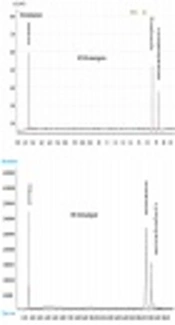
Chromatography confirmation of cyclophosphamide and Ifosfamide peaks obtained by GC-ECD in our study, were exercised using GC-MS (Agilent 5975c) by using the same chromatographic conditions and column, according to the procedure reported by Fred Feyerherm (28).
Wipe and dermal sampling were performed after method validation, according to Hedmer M procedure with some modification (17). Briefly, surface area of 400 cm2, specified by a plastic frame with internal size of 20 cm × 20 cm were sampled on working areas and floors. Sampling was carried out such that a swab was drawn twice from right to left and twice from up to down. All of wipe and dermal samples were collected by one person. Each wipes and dermal samplings were carried out by a new pair of gloves. Dermal sampling of personnel’s hand was performed after job tasks of cyclophosphamide preparation, injection and surface cleaning work with non-woven swab moistened with distilled water. Wipe and dermal samples were extracted with 20 mL distilled water and then liquid–liquid extraction was carried out with 20 mL of diethyl ether (twice) and the organic layers combined; remaining water was removed; samples were dried, dissolved in 100 µL of ethyl acetate and then the solvent was evaporated under a stream of nitrogen. 100 µL toluene analytical grade purchased from Merck Co. was added to the residue and finally 1 µL of the sample was injected to GC-ECD model No. 17A (Shimadzu, Japan).
3.3. Chromatographic Conditions
The GC (Shimadzu) with a capillary column (BP5 with 30 m) equipped with ECD detector was employed. The GC oven was initially kept at 80°C for 2 minutes and gradually increased (6°C per minute) to 160°C. After 1 minutes, the temperature was increased (8°C per minutes) to a final temperature of 230°C, with a total run time of 25 minutes. The carrier gas was nitrogen (99.9995 %) and the column flow was 1.8 mL/min.
3.4. Dermal and Wipe Sampling
This study was conducted in two hospitals in the city of Tehran, Iran from September 2014 until January 2016. The hospitals included 3 preparation rooms, 49 inpatient beds, and 10 outpatient beds. Environmental and personal monitoring for cyclophosphamide were performed after method validation by collecting wipe and dermal samples at two different times of handling of cytotoxic drugs or other job tasks such as cleaning benches and handling patients. Surface sampling was carried out using non-woven swabs of 10 cm × 10 cm size impregnated with 1 mL of buffer ammonium acetate (pH of 7.4) on surfaces that have the potential of being contaminated. Due to limited numbers of staff in oncology wards, the number of skin samples included all personnel and all their potentially contaminated work surface stations. Inclusion criteria were one-year work experience and working in the oncology ward. A total of 89 surface samples were collected from the floor, working areas and three biological hood cabinets within plastic frame of 20 cm × 20 cm. Skin samplings of personnel's hands were taken using non-woven swab impregnated with distilled water.
4. Results
Cyclophosphamide determination in wipe and dermal samples was performed after validating the method in the laboratory (Table 1). Cyclophosphamide and Ifosfamide peaks were examined by GC-MS, and they were confirmed at 95% confidence level.
Table 1.
Validation Parameters of Applied Method for Cyclophosphamide Quantification in Wipe Test by GC-ECD
| Parameter | Result |
|---|---|
| Limit of detection (LOD) | 12 ng/cm2 |
| Limit of quantification (LOQ) | 30.0 ng/cm2 |
| Linear range surface density | 30 - 180 ng/cm2 |
| Recovery | 95.1% |
| Precision (range of coefficient of variation) | Intra-day: 1.7 - 9.5% |
| Inter-day: 3.2 - 15% | |
| Prepared sample stability | 9 days at - 4°C |
As shown in Table 1, this method was linear for surface densities ranges of 30 - 180 ng/cm2 cyclophosphamide. Frozen spike wipe samples containing cyclophosphamide were analyzed over nine days and no considerable loss was observed. Cyclophosphamide was detected in some wipe and skin samples at two hospitals (Tables 2, 3 and 4).
Table 2.
Wipe Environmental Monitoring of Cyclophosphamide Drugs (ng/cm2) at Hospital A
| Hospital Units | Number of Samples (Positive) | Average Surface Density of Cyclophosphamide ± SD | Range Surface Density of Cyclophosphamide |
|---|---|---|---|
| Preparation room No. 1 | 9 (6) | 145.5 ± 37 | 95.75 - 174.5 |
| Preparation room No. 2 | 9 (5) | 138.5 ± 19.57 | 104.28 - 150.7 |
| Inpatient bed rooms | 12 (2) | 97 ± 3.8 | 94.25 - 99.75 |
| Outpatient bed rooms | 12 (3) | 85.25 ± 5.12 | 79.68 - 89.75 |
| Pharmacy | 10 (4) | 120.5 ± 17.11 | 102.54 - 139.5 |
| Office area | 8 (0) | Lower than LODa | Lower than LODa |
aLOD=12 ng/cm2.
Table 3.
Wipe Environmental Monitoring of Cyclophosphamide Drugs (ng/cm2) at Hospital B
| Hospital Units | Number of Samples (Positive) | Average Surface Density of Cyclophosphamide ±SD | Range Surface Density of Cyclophosphamide |
|---|---|---|---|
| Preparation room, Pharmacy | 10 (5) | 153.5 ± 16.81 | 132.29 - 173.25 |
| Inpatient bed rooms | 11 (2) | 101.74 ± 61.53 | 58.23 - 145.25 |
| Office area | 8 (0) | Lower than LODa | Lower than LODa |
aLOD=12 ng/cm2.
Table 4.
Dermal Sampling of Cyclophosphamide Drugs (ng/wipe) on Personnel Hands
| Hospital | Number of Samples (Positive) | Average of Cyclophosphamide ±SD | Range of Cyclophosphamide |
|---|---|---|---|
| A | 22 (4) | 118.12 ± 30.34 | 83.1 - 144.35 |
| B | 10 (2) | 104.02 ± 9.25 | 97.48 - 110.57 |
As shown in Tables 1 and 2, the highest average surface density of cyclophosphamide in wipe sample detected in the preparation room No. 1 at hospital A and no detectable surface density was found in office areas in either of the two hospitals.
27 out of 89 wipe samples (30.3%) and 6 samples out of 32 skin samples (18.7%) had higher density than LOD. Skin samples were taken from all personnel (N = 32) that participated in this study. The highest concentration of cyclophosphamide in dermal sample (144.35 ng/wipe) was detected on the hands of a staff who worked in the preparation room No. 1 at hospital A.
5. Discussion
Validation processes were used for the method of GC-ECD to analyze dermal and surface contamination by cyclophosphamide drug in the oncology wards of two hospitals. This method was linear for the surface density range of 30 - 180 ng/cm2. A comparable recovery and precision were found by Isarita Martins et al. in wipe samples for the cyclophosphamide analysis on the infusion bags (29) However, the applications of ECD detectors in our study resulted in increased parameters such as LOD and LOQ.
Occupational exposure of oncology staff can be different from one country to another because of differences in training level, work practices and regulatory requirements. However, this study confirmed the previous studies for the contamination of oncology wards’ surfaces with cyclophospamide (17, 21, 30). The result of this study and also confirmed previous studies suggest that improper cleaning procedures were used by oncology staff for cleaning contaminated surfaces with cyclophosphamide drug on surfaces (31, 32).
Similar to Hon, Chun-Yip and Wouter Fransman studies, results of this study show that oncology staff are exposed to cyclophosphamide dermally during performance of their daily routine tasks (16, 33). Although contamination levels on staff skin in the present study was higher than Hon, Chun-Yip study, this may be due to lack of personal training and improper use of personal protective equipment by staff in our study. Sessink, P. J. et al.’s study demonstrates that using a robotic system for cytotoxic drug preparation of cyclophosphamide with low amount of surface contamination and without appreciable measurable occupational exposure for the oncology staff (34).
The method was successfully applied to the analysis of low level dermal and surface contamination of cyclophosphamide in oncology wards at two hospitals, which is comparable with published methods by other authors (21, 29). According to the results of this and other recent studies (11, 21, 32, 35), safe work practice training for oncology staff is essential and environmental and biological monitoring of cytotoxic drugs should be periodically carried out as part of a comprehensive cytotoxic drug safe handling program and monitoring of effectiveness of preventive and protective measures.
In conclusion, the method used in this study for wipe and skin sampling and analysis was validated for low level cyclophosphamide contamination of oncology wards. According to results, few personnel and their stations were contaminated with cyclophosphamide. Periodic examination of oncology employees with developed procedure could enhance and promote their health.