
1. Introduction
Desmoid tumor or aggressive fibromatosis, defined as fibroblastic proliferation, arises in the deep soft tissue and is characterized by a tendency towards local recurrence (1, 2) in approximately 50 percent of patients but without the ability to metastasize (2). The risk of recurrence would be even higher than it would for women aged below 30 years. We report the case of a patient with desmoid tumor that we treated with triple therapy with doxorubicin, imatinib, and celexocib. Due to the extensiveness of the lesion and for maximum therapeutic response with minimal adverse side effects, a three-drug combination therapy was performed.
2. Case Presentation
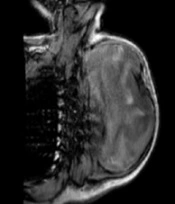
A 35-year-old woman with past medical history of aggressive fibromatosis in control. The primary diagnosis of the lesion was 4 years ago when the patient noticed a solid painless tumor above the right side shoulder and underwent surgical excision. The patient was advised not to become pregnant but she refused. Recurrence occurred in the last 2 months of pregnancy. The tumor gradually enlarged and after full term pregnancy, a hudge tender soft tissue mass on the posterolateral aspect of neck, the upper part of her left shoulder and chest wall were noticed and then she was referred to our clinic. At physical examination on palpation, a fibrously hard tumor, measuring 18 × 20 cm, was palpable (Figure 1). An enhanced CT SCAN imaging showed that the soft tissue bulk was located above her scapula and extended to right paraspinal and subscapulars, and extended to dorsal of clavicle. She underwent chemotherapy with doxorubicin 30 mg/m2 Q 21 day for 8 course, imatinib 100 mg 3 times a day and tamoxifen 2 times a day. After 2 courses of the therapy, the size of the tumor changed and seemed decreased. After end 8 course doxorubicin 30 mg/m2, 50 to 70 percent reduction in tumor size occurred (Figure 1). By the end of cardiotoxic dose, doxorubicin was stopped. The drug was withdrawn from the patient's medication list and celexocib 100 mg 2 times a day was added to the list of prescribed drugs. We were successfully able to reduce the size of the tumor and thereafter maintain the reduced size.
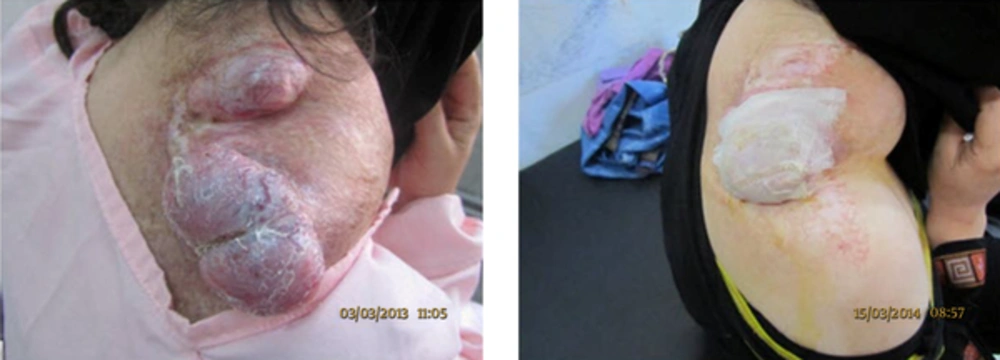
Figure 1.
A Hudge Tender Soft Tissue Mass (Deamoid Tumor) on the Posterolateral Aspect of Neck and the Upper Part of Shoulder (left) and After 6 Months Treatment (Right)
3. Discussion
Desmoids tumors are generally classified as intra- or extra-abdominal (2). The extra-abdominal tumors, which are usually sporadic and effectively treated with local therapy including wide excision with or without radiation therapy. Pregnancy-associated desmoids are almost exclusively located in the abdominal wall (3). In 10% of cases, they regress spontaneously (4). The standard treatment for desmoid tumor is wide excision and adjuvant radiotherapy if necessary. However, desmoids can often take a relapsing course and for those who have recurrence, if primary adequate local treatment is performed, it is the best to consider systemic therapy. Additional indications for systemic therapy include unresectable tumors, intra-abdominal desmoids and in patient with failure of primary treatment. In terms of relapse, it is better not to apply surgery, recurrence rates with surgical intervention may exceed. It is the most important reason to avoid surgery in this setting. Systemic treatment approaches comprise: antihormonal therapy, non-steroidal anti-inflammatory drugs, tyrosine kinase inhibitor and chemotherapy with highly variable results. When the tumor is unresectable because of its location or size, systemic therapy may be performed. Radiotherapy should be avoided if possible, because it can induce secondary sarcoma. Treatment with chemotherapy has been reported in combination with various agents. Chemotherapy in desmoid tumor patients is recommended in unresectable, rapidly growing and/or symptomatic and/or life threatening desmoid tumor. There is greater benefit in anthracycline (5). Based therapy regarding response rates. In the series of de Camargo, anthracyclines in combination with hormonal therapy demonstrated the greatest RECIST response rates (6). Endocrine and/or NSAID therapy is often considered first-line medical treatment for unresectable, advanced disease without clinical symptoms (7). Other systemic treatments have been reported in combination with doxorubicin such as antihormonal therapy. Estrogen receptor has been found to exist in desmoid tumors (8), and anti-estrogen therapy with tamoxifen has been reported to be effective in some patients in combination with other systemic therapy (8). Other systemic treatments are non-steroidal anti-inflammatory drugs, that is effective in combination with other treatment. It has been reported that combined pharmacotherapy with sulindac and tamoxifen is effective in 70 percent of patients with desmoid tumor. The last systemic treatment approaches is target therapy by tyrosine kinase inhibitors such as imatinib. Imatinib is active in the treatment of recurrent and progressive, aggressive fibromatosi, unresectable or difficult to resect desmoid tumors and whose prior therapy failed and offering long-term stable disease in a large proportion of patients. The study by N. Penely and et al 9 supports that imatinib may be effective as a choice in the treatment of recurrent aggressive fibromatosis and it is enough to give one year of imatinib (9). However, the following issues have to be considered in treatment decisions: cytotoxic agents have significant adverse effects especially cardiotoxicity and the selection of patients for treatment. Also, anti-estrogen agent is potentially hazardous in premenopausal patients. If NSAIDs are administered for a long period, they often cause peptic ulcers and renal disturbances. In our patient, the extra-abdominal desmoid tumour evidently grew rapidly, reaching its large dimensions due to hormonal stimulation during pregnancy. The giant tumor had no apparent adverse influence on the fetus; of course there has been significant growth in the last month. Finally, this protocol triple therapy in our patient resulted in complete response. The patient was recommended not to become pregnant again but she refused it, and she has planning for pregnancy a follow-up period of at least 2 years before planning a subsequent pregnancy advisable, due to the median time to desmoid recurrence after resection is approximately 1 to 2 years (10).
3.1. Conclusions
The use of combination chemotherapy in the treatment of aggressive fibromatosis should be considered for patients who suffer from recurrent, unresectable and advanced disease. For stabilization of disease, further targeted therapy with imatinib,tamoxifen and celexocib presents a valid option.