
1. Background
Any sort of swelling, observable, and palpable lump in thyroid refers to thyroid nodule (1). Thyroid nodule is a common disease and in physical examination, it is discovered among around 3% to 7% adults (2,3). Plethora of studies indicate this issue that half of the people in society, in case of being examined via sonography, will come up with thyroid nodule and this level increases by aging (4). These nodules may be single or multiple and with performance or without performance. The prevalence of these nodules is high in the iodine deficient regions among women and the elderly. The diameter of the majority of palpable nodules is more than 1 cm. However, the palpability of a nodule depends on its location inside the gland (superficial or deep), the patient’s neck anatomy, and the examiner’s adroitness (5).
Cases such as nodule growth, voice hoarseness, vocal cords paralysis, palpable neck lymph nodes, and nodule adhesion to the surrounding tissues suggest malignancy. In addition, the patients with the record of their whole body exposed to radiation due to bone marrow transplantation or the head and neck radiation exposure are at higher risk for malignancy (6). As the reports suggest, in 2014, totally 1,665,540 new cases of cancer infection and 585,720 cancer induced deaths occurred in the US. Also, TC affliction and its induced death rate have been reported as 62,980 and 1,890 individuals, respectively (7,8).
Based on a review conducted in Italy, the outbreak of TC is rising worldwide and it has been recognized as the most prevalent endocrine cancer (1% - 1.5%) annually in the US (9,10).
One of the most important specifications of survival analysis is censored data. The censoring of the survival studies is of different types. Interval censoring occurs when an event is not observable directly and happens in a random time range. In fact, it can be asserted that a person in the variable T is an interval censored if only we know that a < T < b. The interval censored data often occurs in longitudinal studies and clinical trials, which requires more follow-up (11). The prevalence of interval censored data is rising in medical studies given the biomarkers increase in a disease development. Interval censoring results from periodically monitoring a disease progress. Logistic regression is of applied techniques for classified data analysis. In binary logistic regression, the response variable has 2 modes. One of the methods to estimate the parameters is error least squares, in which the goal is to find the regression coefficients in order to minimize the error least squares. Another approach is maximum likelihood pursuing the goal behind the model likelihood maximization is to address the model parameters (12). The logistic regression model equals:
Because of such patients frequently referring, doing check-ups, sonography, recording the data in the files, the possibility of the thyroid nodules turning into cancer and concerning the thyroid gland performance being so vital in human body, in metabolism process and its impairment significant effect on other organs, we have decided to study this issue.
2. Objectives
The current research has been performed pursuing the goal to identify the most critical risk factors in the thyroid cancerous individuals with thyroid nodules in northern Iran during a decade.
3. Methods
The current research is of historical cohort type and targets to detect the most important factors influencing thyroid cancer in the patients with thyroid nodules, referring to Endocrinology and Metabolism diseases clinic from July 2003 to mid-March 2013. The statistical community consists of the patients with glands or symptoms like pain in nodule area or suffocation, hoarseness, swelling in the neck referring to the endocrinologist, introduced by another physician or referring due to other reasons such as diabetes. The question event in the research is thyroid cancer affliction in thyroid nodule patients. Out of 33,530 files surveyed, 1,817 files of the thyroid nodule sufferers have been recorded including 169 patients with different TCs. The data about the patients cover 70 variable types. Due to the missing data being massive in the study, expectation-maximization (EM) algorithm has been employed to compute the missing data. This study was approved by forth meeting of ethics committee of Research at Mazandaran University of Medical Sciences (July 8th, 2014).
When all the data are interval censored, one of the methods used is logistic regression. In data analysis with logistic regression, the time interval has been taken as 6 months and in case of the individual referring during the considered interval, 1 and otherwise 0 has been recorded. Under the following conditions, this is useful:
- Having the sufficient number of events in each range;
- The distribution determination f (t) not being important.
For instance, the logistic model with 3 indicator variables (defined for the intervals) and an explanatory variable is as it follows:
P (y = 1) equals the probability that the event occurs in a certain range provided that it did not occur in the prior intervals (13).
Applying univariate logistic regression, some meaningful variables have entered the final logistic regression model along with the variables having P < 0.3 and the final analyses have been performed. The patients' files have been examined fully confidentially and considering the obtained results in general, the patients’ privacy has been appreciated. The data have been analyzed with SPSS and Stata software at significance level 0.05.
4. Results
The following tables include the descriptive data about some of the most principal variables existing in the study (Table 1).
Table 1.
Descriptive Statistics of Some Variables in Patients with Thyroid Nodules
| Variable | No. (%) | Variable | No. (%) |
|---|---|---|---|
| Sex | T3 hormone | ||
| Female | 1594 (87.7) | Normal | 464 (25.5) |
| Male | 323 (12.3) | Abnormal | 204 (11.2) |
| Age | TSH hormone | ||
| < 30 | 448 (24.7) | Normal | 1193 (65.7) |
| 30 - 60 | 1202 (66.2) | Abnormal | 492 (27.1) |
| > 60 | 160 (8.8) | ||
| Marital status | Hemoglobin | ||
| Single | 1525 (84) | Normal | 678 (37.3) |
| Married | 153 (8.4) | Abnormal | 454 (25) |
| Hypothyroidism | Hb A1C | ||
| Yes | 196 (10.8) | Normal | 43 (2.4) |
| No | 1621 (89.2) | Abnormal | 71 (3.9) |
| Hyperthyroidism | Vitamin D | ||
| Yes | 93 (5.1) | Normal | 193 (10.6) |
| No | 1724 (94.9) | Abnormal | 144 (7.9) |
| Diabetes | Calcium | ||
| Yes | 69 (3.8) | Normal | 401 (22.1) |
| No | 1748 (96.2) | Abnormal | 34 (1.9) |
| Body Mass Iindex | Phosphorus | ||
| < 18.5 | 26 (4.1) | Normal | 366 (20.1) |
| 18.5 - 25 | 117 (6.4) | Abnormal | 18 (1) |
| 25 - 30 | 174 (9.6) | Thyroglobulin | |
| 30 - 35 | 136 (7.5) | Normal | 49 (2.7) |
| > 35 | 10 (0.6) | Abnormal | 34 (1.9) |
| Cholesterol | Thyroglobulin antibodies | ||
| Normal | 478 (26.3) | Normal | 33 (1.8) |
| Abnormal | 431 (23.7) | Abnormal | 10 (0.6) |
| HDL | Right lobe nodule | ||
| Normal | 313 (17.2) | Yes | 1130 (62.3) |
| Abnormal | 150 (8.3) | No | 687 (37.7) |
| LDL | Left lobe nodule | ||
| Normal | 320 (17.6) | Yes | 1000 (55) |
| Abnormal | 246 (13.5) | No | 617 (45) |
| Triglyceride | Bilateral nodules | ||
| Normal | 664 (36.5) | Yes | 618 (34) |
| Abnormal | 194 (10.7) | No | 1199 (66) |
| Fasting blood sugar | Multi nodular goiter | ||
| Normal | 983 (58.3) | Yes | 1102 (60.6) |
| Abnormal | 314 (17.3) | No | 715 (39.4) |
| Blood pressure | Sleeping disorder | ||
| Normal | 748 (41.2) | Yes | 86 (4.7) |
| Abnormal | 279 (15.4) | No | 1731 (95.3) |
| T4 hormone | Sore throat and irritation | ||
| Normal | 1486 (81.8) | Yes | 105 (5.8) |
| Abnormal | 164 (9) | No | 1702 (94.2) |
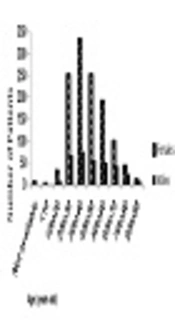
Out of the cancer sufferers, 141 (83.4%) were women and 28% (16.6%) were men. The patients' age, when referring, has been recorded quantitatively. The patients' mean age has been yielded as 41.07 ± 13.81. Moreover, the TC suffering patients' mean age has been 38.15 ± 13.52. Their mean education years number has been 10.96 ± 4.25. The graph below illustrates annual TC incidence in thyroid nodule patients by age separation (Figure 1):
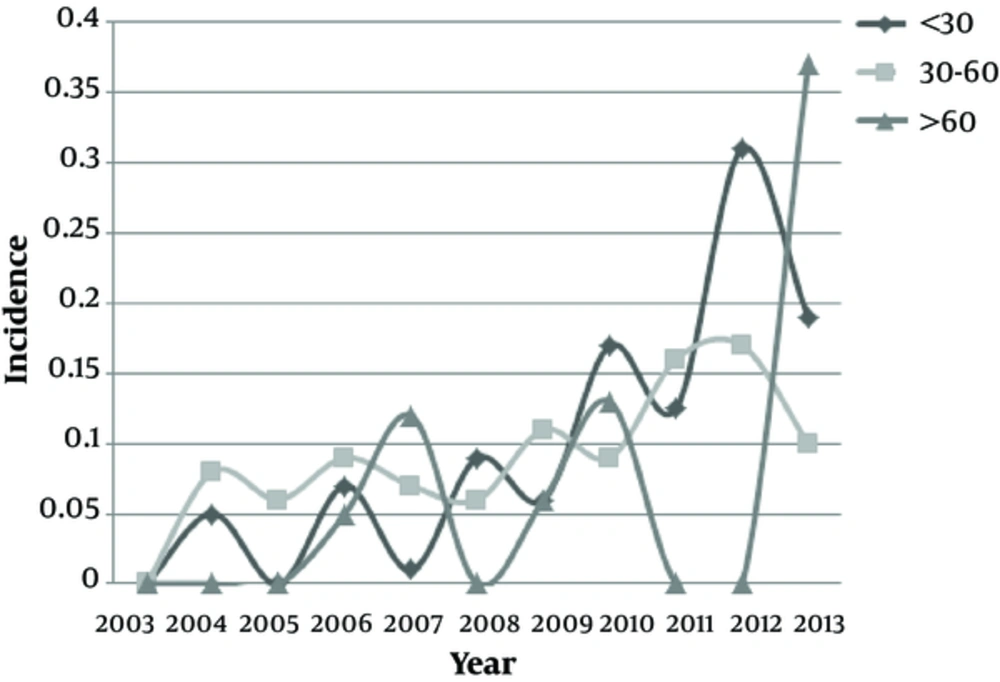
Figure 1.
Annual TC Incidence in Thyroid Nodule Patients by Age Separation
Twenty-two (22) 6-month time intervals have been defined in the research that in case of the patient referring at that time interval has been viewed as 1 and otherwise 0.These time intervals have been considered as independent variables along with other variables in the analysis. The results from the logistic regression model fitness have been given in the table below (merely the significant variables have been reported) (Table 2):
Table 2.
The Results From the Logistic Regression Model in Patients with Thyroid Nodules
| Variable | Odds Ratio | Parent Statistics | S.D | Sig. Level |
|---|---|---|---|---|
| 1nd half of 2005 | 0.53 | 5.98 | 0.225 | 0.014 |
| 2nd half of 2005 | 0.45 | 9.55 | 0.269 | 0.002 |
| 2nd half of 2007 | 0.64 | 5.07 | 0.194 | 0.024 |
| 2nd half of 2011 | 1.4 | 5.59 | 0.143 | 0.018 |
| 2nd half of 2012 | 1.36 | 4.51 | 0.144 | 0.034 |
| 2nd half of 2013 | 1.45 | 6.49 | 0.147 | 0.011 |
| Hyperthyroidism | 0.23 | 56.55 | 0.196 | < 0.001 |
| Hypothyroidism | 0.13 | 163.02 | 0.161 | < 0.001 |
| Diabetes | 0.26 | 26.62 | 0.267 | < 0.001 |
| Right lobe nodule | 0.065 | 179.2 | 0.205 | < 0.001 |
| Left lobe nodule | 0.24 | 96.93 | 0.146 | < 0.001 |
| Bilateral nodule | 2.38 | 8.95 | 0.348 | 0.003 |
| Multi Nodular goiter | 0.095 | 52.05 | 0.326 | < 0.001 |
| Cholesterol | 0.45 | 40.86 | 0.124 | < 0.001 |
| T4 | 1.29 | 4.49 | 0.12 | 0.034 |
| T3 | 0.43 | 12.94 | 0.237 | < 0.001 |
| TSH | 2.98 | 181.95 | 0.081 | < 0.001 |
| HbA1C | 0.33 | 6.11 | 0.45 | 0.013 |
| Calcium | 4.96 | 48.87 | 0.229 | < 0.001 |
| Phosphorus | 4.77 | 17.06 | 0.378 | < 0.001 |
| Vitamin D | 0.41 | 14.2 | 0.237 | < 0.001 |
| Thyroglobulin | 12.95 | 82.2 | 0.283 | < 0.001 |
| Sleep disorders | 0.044 | 9.49 | 1.02 | < 0.001 |
| Sore throat | 0.86 | 5.8 | 1.02 | 0.002 |
| Severely obese people | 1.34 | 11.79 | 0.086 | 0.016 |
According to the achieved results, the odds to get the cancer in the first half of 2005, if not happening in the prior intervals, equals 0.53. This odds is 0.45, 0.64, 1.4, 1.36, and 1 .45 in the second half of the years 2005, 2007, 2011, 2012, and 2013, respectively. Given the above tables, the odds ratio logarithm for the variables having bilateral nodules has been gained 2.38 so that it can be stated that the cancer infection odds in the bilateral thyroid nodules patients is 2.38 times than other sufferers. The cancer odds in the bilateral thyroid nodules with abnormal T4 hormone is 1.29 times than other sufferers .This odds has been obtained as 2.98, 4.96, 4.77, and 12.95 in the patients with abnormal TSH hormone, calcium, phosphorus, and thyroglobulin. Also, in the overweight individuals, based on the logistic regression model fitness, this odd has been gained as 1.34 times than the other patients. Other variables reported in the above table have odds ratio less than 1.
5. Discussion
In recent years, as diagnosing thyroid nodules increase, thyroid cancer incidence has been increasing across the world (14-16). The most common thyroid cancers are papillary and, then, follicular TCs that, as the studies indicate, include 85% to 90% and 10%to 15% of total TCs, respectively (17); they cover 94.1% and 3% of total cancers, respectively. As the studies in the US suggest, the raise of TCs outbreak in the US has been 6.6% in both genders from 1997 to 2009. In the present research, until 2006, the age bracket has been 30 to 60 years and in 2003, those over 60 years have had the highest TCs. According to a review paper by Pellegriti et al. in 2004 to 2008, in men, the highest TCs outbreak has been seen in the one over 65 years and in women, in 55 to 64 years (10). According to the results from the logistic regression finesse, it can be concluded that between 2011 and 2013, the patients have had the maximum TCs odds, which is true regarding the increasing trend of cancer thorough the world in recent years. TSH serves as an independent risk factor in predicting thyroid nodules malignancy (18). Various experiments on animals suggest the raise of iodine deficiency induced TCs as TSH goes up.
In the current study, the patients with high TSH will come up with 2.98% times further TC odds. The results extracted from several prospective studies display the increased risk of TC in obese individuals, consistent with this research derived results (10,19). In the present study, the TCs odds in severely obese individuals can be 1.34 times than others. The ones with multi-nodular and single nodules goiters face the same risk in thyroid malignancy; on the other hand, the prevalence of malignancy may be lower in the individuals with multi-nodular goiter, compatible with his study results (20,21). Having bilateral nodule has been identified of other risk factors behind thyroid cancers affliction, in line with the current research (5). According to the results of this study, the patients with bilateral nodules are exposed to 2.38 times more odds to get TCs than other ones.
Analyzing other variables has not been proved in TC malignancy so far. Of such variables gained as meaningful in the final fitted model and with the odds ratio higher than 1, we can mention calcium, phosphorus, thyroglobulin, and T4 hormone. It is hoped that through conducting more studies in this field in future, we access more fulfilling results on thyroid cancers risk factors in patients with thyroid nodules.
5.1. Conclusions
The incidence of TCs follows a rising trend; thus, in order to identify the risk factors in getting this disease, it is essential to identify the most critical factors. Of such factors identified in thyroid malignancy in thyroid nodules patients, severe obesity, bilateral nodules, abnormal TSH hormone, T4 hormone, calcium, phosphorus, and thyroglobulin can be pointed out.