
International Journal of Cancer Management

Image Credit:International Journal of Cancer Management

A Fatal Case of Bloodstream Infection by Fusarium Solani in a Patient with Adrenocortical Carcinoma From Isfahan, Iran

Author(s):
Alireza  RajabzadehAlireza Rajabzadeh1, Dariush  ShokriDariush ShokriDariush  Shokri ORCID2, Shima  AboutalebianShima Aboutalebian3, Hamid MorovatiHamid MorovatiHamid Morovati ORCID4, Abdolrasoul  MohammadiAbdolrasoul Mohammadi3, Reza  Eshraghi SamaniReza Eshraghi SamaniReza  Eshraghi Samani ORCID5, Rasoul MohammadiRasoul MohammadiRasoul Mohammadi ORCID6,*
1Infectious Diseases Specialist, Isfahan Milad Hospital, Isfahan, Iran
2Department of Microbiology, Faculty of Biological Sciences and Technology, Shahid Ashrafi Esfahani University, Isfahan, Iran
3Department of Medical Parasitology and Mycology, School of Medicine, Isfahan University of Medical Sciences, Isfahan, Iran
4Department of Medical Parasitology and Mycology, School of Medicine, Shiraz University of Medical Sciences, Shiraz, Iran
5Department of Surgery, Isfahan University of Medical Sciences, Isfahan, Iran
6Department of Medical Parasitology and Mycology, School of Medicine, Infectious Diseases and Tropical Medicine Research Center, Isfahan University of Medical Sciences, Isfahan, Iran

International Journal of Cancer Management:Vol. 13, issue 2; e98610
Published online:Feb 08, 2020
Article type:Case Report
Received:Oct 04, 2019
Accepted:Jan 11, 2020
How to Cite:Rajabzadeh A, Shokri D, Aboutalebian S, Morovati H, Mohammadi A, et al. A Fatal Case of Bloodstream Infection by Fusarium Solani in a Patient with Adrenocortical Carcinoma From Isfahan, Iran. Int J Cancer Manag. 2020;13(2):e98610. doi: https://doi.org/10.5812/ijcm.98610

Abstract

Introduction:

Fusarium species are hyaline saprophytic fungi that are frequently found in the soil, air, and water. They can cause severe systemic infections in immunocompromised patients. Clinical manifestations depend on the way of entry of the mold and host immune system status. The main ways of entrance are the airways, skin, and mucosal membranes. Disseminated fusariosis often occurs in patients with hematological disorders, patients with cancer, and solid organ transplant recipients.

Case Presentation:

Herein we report a case of Fusarium fungemia in a patient with adrenocortical carcinoma from Isfahan, Iran. The patient was a 41-year-old female with stage III adrenal cortical carcinoma. Despite antifungal therapy with liposomal amphotericin B, the patient passed away 6 days after admission. Internal transcribed spacer region sequencing applied for species identification and its sequence deposited in the GenBank (accession number: MK880379).

Conclusions:

Since the ideal strategies against invasive fungal infections remain uncertain and the mortality rate is high, we recommend primary prophylaxis with a broad-spectrum antifungal agent for vulnerable patients particularly those admitted to high-risk units such as oncology, hematology, and transplant units.

1. Introduction

Invasive fungal infections are on the rise and Fusarium species are important opportunistic filamentous fungi that cause a broad-spectrum of infections such as onychomycosis, fungal keratitis, superficial skin lesions, endophthalmitis, peritonitis, arthritis, and disseminated infections particularly in immunosuppressed patients (1). The clinical forms of Fusarium infections mainly depend on the way of entry for the fungus and host immune system status (2). Persistent fever and skin lesions are the main symptoms despite antibacterial therapy (3). Recent studies have shown that Fusarium species, mostly cause fungemia in immunosuppressed patients (4-6). Limited infections occur in both immunocompetent and immunocompromised hosts, however disseminated fusariosis regularly occur in patients with hematological disorders, cancer patients, and the solid organ transplant recipients (7). In the present study, we reported a case of fungemia wich caused by Fusarium solani; a rare filamentous fungi, in a patient with metastatic cancer from Isfahan, Iran.

2. Case Presentation

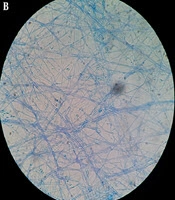
A 41-year-old female with stage III adrenal cortical carcinoma referred to the Seyed-al-Shohada Hospital, Isfahan University of Medical Sciences, Isfahan, Iran, in February 2018. She had cancer since December 2014 and underwent adrenalectomy and nephrectomy. Cancer chemotherapy was started with lysodren (mitotane) (4 g/day) and streptozotocin (STZ) (500 mg/m2/day by intravenous injection). After 16 months, metastatic lung tumors and involvement of abdominal lymph nodes were detected in 2016. After surgery, mitotane (4 g/day) was added to her regimen for 6 months. After 2 years, on 25-Feb-2018, the patient readmitted to the Department of Oncology in Seyed-al-Shohada Hospital due to febrile neutropenia (neutrophil count; 430/µL, temp; 39.5°C), malaise, and weight loss (3 kg). Gentamicin (3 × 80 mg IV/day) and vancomycin (2 × 750 mg IV/day) were started for probable bacteremia and blood culture was requested for her. After two days, she still had fever and got worse. On the third day, liposomal amphotericin B (5 mg/kg/day) was applied for suspected systemic fungal infection and two blood samples were taken on days 2 and 3. There was no lesion in the patient’s body and C-reactive protein (CRP) increased to 279 mg/L. The patient’s consciousness reduced and she passed away 6 days after admission. Five days after death, Fusarium spp. recovered from both blood samples (Figure 1).
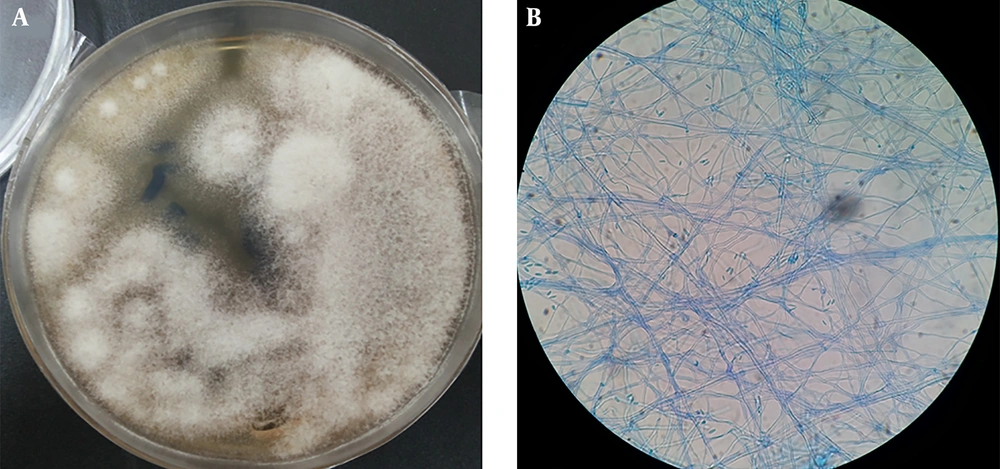
A, <i>Fusarium solani</i> on sabouraud dextrose agar (SDA) shows white and cottony hypha; B, microscopic examination with potassium hydroxide 10% reveals typical fusiform microconidia among hyaline hyphae.
Figure 1.

A, Fusarium solani on sabouraud dextrose agar (SDA) shows white and cottony hypha; B, microscopic examination with potassium hydroxide 10% reveals typical fusiform microconidia among hyaline hyphae.

For molecular identification, DNA extraction was performed by phenol-chloroform method (8) and ITS1-5. The 8S-ITS2 region was amplified using ITS1 (5’-TCC GTA GGT GAA CCT GCG G-3’) and ITS4 (5’-TCC TCC GCT TAT TGA TAT GC-3’) primers, and the amplicon was purified and sent for sequencing in forward direction (Bioneer, Korea). The sequencing product was analyzed using Chromas software version 2.3 (http://chromas.software.informer.com/2.4/) and with search in the basic local alignment search tool (BLAST) database at the National Center for Biotechnology (NCBI) about fungal sequences existing in DNA databases (http://blast.ncbi.nlm.nih.gov/Blast.cgi).
After molecular analysis, Fusarium solani was determined as the etiological agent of fungemia in above mentioned case and its sequence deposited in the GenBank (accession number: MK880379).
Due to the patient’s death, the informed consent form was completed and signed by her parents.

3. Discussion

Fusarium is a common saprophytic fungus that is found in the soil, air, and water. Although Fusarium species were first isolated as phytopathogens (plant pathogens), they can cause fixed (onychomycosis and fungal keratitis) and systemic infections in humans, especially in immunocompromised patients (4, 5, 9). These opportunistic fungi caused high morbidity and mortality rates among patients with malignancies, severe T cell immunodeficiency, and prolonged neutropenia. More than 120 Fusarium spp. has been identified in seven complexes: Fusarium solani, F. incarnatum-equiseti, F. oxysporum, F. dimerum, F. fujikuroi, F. sporotrichioides, and F. clamydosporum (10). Among these groups, Fusarium solani and Fusarium oxysporum complexes are responsible for about 65% and 30% of infections, respectively (11). The main entry ways of Fusarium species are the airways, skin, and mucosal membranes (12, 13). Macrophages and granulocytes play significant roles in the immune system against Fusarium species. Both macrophages and granulocytes inhibit the growth of hypha, while macrophages inhibit the germination of spores (2). Among patients with neutropenia, the most repeated clinical signs of infection are fever, cutaneous lesions, and positive blood culture (1, 13) however, cutaneous lesions were not observed in the patient in the present study. Therapeutic approaches to fusariosis cases are rare and response to the treatment depends on the fungal species and the patient’s immune status. In cancer patients, particularly those with prolonged neutropenia, fusariosis shows resistance to antifungal therapy. The mortality rate in patients with systemic fusariosis is apparently higher than those patients with localized infections specifically among patients with refractory neutropenia. Totally, amphotericin B lipid complex (ABLC) is suggested for the management of Fusarium infection, but the response is moderate among the neutropenic cancer patients (14). In the present case, the cause of death was not clear because the patient died 6 days after admission, probably was due to the invasive fungal infection or cancer recurrence. In 2004, Jensen et al. (15) reported 4 cases of fungemia due to Fusarium species in acute lymphoblastic leukaemia, chronic lymphatic leukaemia, acute myeloid leukaemia, and non-Hodgkin’s lymphoma patients from Denmark. The etiological agents were Fusarium spp., F. verticillioides (syn. F. moniliforme), F. verticillioides, and F. solani. Except for one patient, all patients died despite antifungal therapy with intravenous amphotericin B (AmBisome). In 2010, Jossi et al. (7) presented a patient with acute lymphoblastic leukemia that revealed prolonged fungemia. The patient also had multiple sclerosis and invasive breast carcinoma. Despite antifungal therapy with fluconazole (200 mg PO/day), voriconazole (2 × 300 mg IV/day), and liposomal amphotericin B (5 mg/kg/day IV), she died 16 days after infection. In 2016, Dabas et al. (5) reported two cases of systemic fusariosis in 17 and 65 years old patients with acute myeloid leukaemia and cutaneous T cell large anaplastic lymphoma erythroderma. Fusarium solani was isolated from two patients and both of them expired due to the severe sepsis and septic shock. In 2016, Narayanan and Nath (16) showed disseminated Fusarium fungemia in a 21-year-old woman with acute myeloid leukemia from India. Both legs of the patient had cellulitis and erythematous lesions with blackish center. In spite of antifungal therapy with amphotericin B and voriconazole, bronchopneumonia developed and the patient passed away. In 2017, Chiewchanvit et al. (17) presented a case of disseminated fusariosis in a 24-year-old female with acute leukemia from Thailand. Erythematous papules were distributed on the extremities and trunk. The patient was treated with itraconazole (100 mg/day), intravenous amphotericin B (40 mg/day or 1 mg/kg/day), and oral voriconazole (400 mg/day). Fusarium keratoplasticum was identified as the etiological agent of fusariosis using multilocus sequencing typing (MLST) method. Carlesse et al. (18) reported an outbreak of catheter-related fungemia among children with cancer in Sao Paulo, Brazil. In their study, Fusarium oxysporum was the causative agents of all cases. They survived after prompt catheter removal and antifungal therapy with oral voriconazole (7 mg/kg/dose). In 2019, Yasu et al. (19) from Japan, presented a case of fungemia after cord blood transplantation in a 65-year-old man. The patient died due to the fungemia on day 28 after treatment with fosfluconazole (F-FLCZ) (100 mg/day) and L-AMB (50 mg/day) or (0.72 mg/kg). Since, Fusarium solani is usually resistant to multiple antifungal agents, such as echinocandins and itraconazole (19), and the optimal dose of liposomal amphotericin B for Fusarium fungemia during neutropenia remains unclear, we highlight the use of wide spectrum antifungal agents, such as voriconazole and posaconazole as primary prophylaxis and combination therapies for vulnerable patients. Since identification of Fusarium spp. is controversy by phenotypic methods, we suggest a precise technique such as ITS-sequencing for identification of causative agent of fungemia. Since the mortality rate of fungemia due to the Fusarium spp. is high, we recommend primary prophylaxis with a broad-spectrum antifungal agent for vulnerable patients particularly those admitted to high-risk units such as oncology, hematology, and transplant units.
Acknowledgments

Footnotes

References

  • 1.
    Arnoni MV, Paula CR, Auler ME, Simoes CCN, Nakano S, Szeszs MW, et al. Infections caused by fusarium species in pediatric cancer patients and review of published literature. Mycopathologia. 2018;183(6):941-9. [PubMed ID: 29564632]. https://doi.org/10.1007/s11046-018-0257-6.
  • 2.
    Nucci M, Anaissie E. Fusarium infections in immunocompromised patients. Clin Microbiol Rev. 2007;20(4):695-704. [PubMed ID: 17934079]. [PubMed Central ID: PMC2176050]. https://doi.org/10.1128/CMR.00014-07.
  • 3.
    Nelson PE, Dignani MC, Anaissie EJ. Taxonomy, biology, and clinical aspects of Fusarium species. Clin Microbiol Rev. 1994;7(4):479-504. [PubMed ID: 7834602]. [PubMed Central ID: PMC358338]. https://doi.org/10.1128/cmr.7.4.479.
  • 4.
    Muhammed M, Anagnostou T, Desalermos A, Kourkoumpetis TK, Carneiro HA, Glavis-Bloom J, et al. Fusarium infection: report of 26 cases and review of 97 cases from the literature. Medicine (Baltimore). 2013;92(6):305-16. [PubMed ID: 24145697]. [PubMed Central ID: PMC4553992]. https://doi.org/10.1097/MD.0000000000000008.
  • 5.
    Dabas Y, Bakhshi S, Xess I. Fatal cases of bloodstream infection by fusarium solani and review of published literature. Mycopathologia. 2016;181(3-4):291-6. [PubMed ID: 26541869]. https://doi.org/10.1007/s11046-015-9960-8.
  • 6.
    Campo M, Lewis RE, Kontoyiannis DP. Invasive fusariosis in patients with hematologic malignancies at a cancer center: 1998-2009. J Infect. 2010;60(5):331-7. [PubMed ID: 20138081]. https://doi.org/10.1016/j.jinf.2010.01.010.
  • 7.
    Jossi M, Ambrosioni J, Macedo-Vinas M, Garbino J. Invasive fusariosis with prolonged fungemia in a patient with acute lymphoblastic leukemia: Case report and review of the literature. Int J Infect Dis. 2010;14(4):e354-6. [PubMed ID: 19665409]. https://doi.org/10.1016/j.ijid.2009.05.004.
  • 8.
    Kochl S, Niederstatter H, Parson W. DNA extraction and quantitation of forensic samples using the phenol-chloroform method and real-time PCR. Methods Mol Biol. 2005;297:13-30. [PubMed ID: 15570097]. https://doi.org/10.1385/1-59259-867-6:013.
  • 9.
    Konuma T, Takahashi S, Kiyuna T, Misawa Y, Suzuki M, Isobe M, et al. Fungemia due to Fusarium solani under low-dose liposomal amphotericin B in a patient after cord blood transplantation. J Infect Chemother. 2019;25(8):635-8. [PubMed ID: 30910505]. https://doi.org/10.1016/j.jiac.2019.02.020.
  • 10.
    van Diepeningen AD, Brankovics B, Iltes J, van der Lee TA, Waalwijk C. Diagnosis of Fusarium infections: Approaches to identification by the clinical mycology laboratory. Curr Fungal Infect Rep. 2015;9(3):135-43. [PubMed ID: 26301000]. [PubMed Central ID: PMC4537702]. https://doi.org/10.1007/s12281-015-0225-2.
  • 11.
    Guarro J. Fusariosis, a complex infection caused by a high diversity of fungal species refractory to treatment. Eur J Clin Microbiol Infect Dis. 2013;32(12):1491-500. [PubMed ID: 23934595]. https://doi.org/10.1007/s10096-013-1924-7.
  • 12.
    Sautour M, Edel-Hermann V, Steinberg C, Sixt N, Laurent J, Dalle F, et al. Fusarium species recovered from the water distribution system of a French University Hospital. Int J Hyg Environ Health. 2012;215(3):286-92. [PubMed ID: 22177529]. https://doi.org/10.1016/j.ijheh.2011.11.003.
  • 13.
    Litvinov N, da Silva MT, van der Heijden IM, Graca MG, Marques de Oliveira L, Fu L, et al. An outbreak of invasive fusariosis in a children's cancer hospital. Clin Microbiol Infect. 2015;21(3):268 e1-7. [PubMed ID: 25658562]. https://doi.org/10.1016/j.cmi.2014.09.004.
  • 14.
    Espinel-Ingroff A, Colombo AL, Cordoba S, Dufresne PJ, Fuller J, Ghannoum M, et al. International evaluation of MIC distributions and epidemiological cutoff value (ECV) Definitions for fusarium species identified by molecular methods for the CLSI broth microdilution method. Antimicrob Agents Chemother. 2016;60(2):1079-84. [PubMed ID: 26643334]. [PubMed Central ID: PMC4750715]. https://doi.org/10.1128/AAC.02456-15.
  • 15.
    Jensen TG, Gahrn-Hansen B, Arendrup M, Bruun B. Fusarium fungaemia in immunocompromised patients. Clin Microbiol Infect. 2004;10(6):499-501. [PubMed ID: 15191376]. https://doi.org/10.1111/j.1469-0691.2004.00859.x.
  • 16.
    Narayanan G, Nath SR. Disseminated Fusarium fungemia in a patient with acute myeloid leukemia. Mayo Clin Proc. 2016;91(4):542-3. [PubMed ID: 27046532]. https://doi.org/10.1016/j.mayocp.2015.11.006.
  • 17.
    Chiewchanvit S, Chongkae S, Mahanupab P, Nosanchuk JD, Pornsuwan S, Vanittanakom N, et al. Melanization of Fusarium keratoplasticum (F. solani species complex) during disseminated fusariosis in a patient with acute leukemia. Mycopathologia. 2017;182(9-10):879-85. [PubMed ID: 28616680]. https://doi.org/10.1007/s11046-017-0156-2.
  • 18.
    Carlesse F, Amaral AC, Goncalves SS, Xafranski H, Lee MM, Zecchin V, et al. Outbreak of Fusarium oxysporum infections in children with cancer: an experience with 7 episodes of catheter-related fungemia. Antimicrob Resist Infect Control. 2017;6:93. [PubMed ID: 28912948]. [PubMed Central ID: PMC5588724]. https://doi.org/10.1186/s13756-017-0247-3.
  • 19.
    Yasu T, Konuma T, Oiwa-Monna M, Kato S, Tanoue S, Isobe M, et al. Efficacy and safety of low-dose liposomal amphotericin B in adult patients undergoing unrelated cord blood transplantation. Antimicrob Agents Chemother. 2018;62(11). [PubMed ID: 30104271]. [PubMed Central ID: PMC6201127]. https://doi.org/10.1128/AAC.01205-18.

Similar Articles

8
Apr
2018
<i>In vitro</i> Antifungal Susceptibility Testing of Clinical and Environmental <i>Fusarium</i> Isolates in Iran

In vitro Antifungal Susceptibility Testing of Clinical and Environmental Fusarium Isolates in Iran

Hamed Aghaei,
Parivash Kordbacheh,
Reza Kachuei,
Shahram Mahmoudi,
Setareh Agha Kuchak Afshari,
Mahin Safara
,et al.

Aghaei H, Kordbacheh P, Kachuei R, Mahmoudi S, Agha Kuchak Afshari S, et al. In vitro Antifungal Susceptibility Testing of Clinical and Environmental Fusarium Isolates in Iran. Arch Clin Infect Dis. 2018;13(2):e58976. doi: https://doi.org/10.5812/archcid.58976

29
Sep
2025

Strategies for Preventing of Fusarium Species Infections in Burn Patients: A Systematic Review

Hossienali Danesh,
Abdolahad Nabiolahi,
Leila Keikha,
Fateme Koul,
Amirhossein Keikha,
Hossein Moein
,et al.

Danesh H, Nabiolahi A, Keikha L, Koul F, Keikha A, et al. Strategies for Preventing of Fusarium Species Infections in Burn Patients: A Systematic Review. Health Scope. 2026;15(1):e164217. doi: https://doi.org/10.5812/healthscope-164217

7
Aug
2016

Clinical Manifestation and Diagnosis of Invasive Fungal Sinusitis in Patients with Hematological Malignancy

Masoud Mardani,
Yazdanali Faghani,
Mahdi Tabarraee,
Sara Abolghasemi

Mardani M, Faghani Y, Tabarraee M, Abolghasemi S. Clinical Manifestation and Diagnosis of Invasive Fungal Sinusitis in Patients with Hematological Malignancy. Arch Clin Infect Dis. 2016;11(4):e36566. doi: https://doi.org/10.5812/archcid.36566

11
May
2024
Jundishapur J Microbiol

Invasive Fungal Infections Among Patients with Hematological Malignancies: A Two-Year Multicentric Study from Tehran, Iran

Davod Sheikh-Hoseini,
Saeed Soleiman-Meigooni,
Hassan Jalaeikhoo,
Jalil Rajabi,
Mohammad Hassan Kazemi-Galougahi,
Taher Azimi
,et al.

Sheikh-Hoseini D, Soleiman-Meigooni S, Jalaeikhoo H, Rajabi J, Kazemi-Galougahi MH, et al. Invasive Fungal Infections Among Patients with Hematological Malignancies: A Two-Year Multicentric Study from Tehran, Iran. Jundishapur J Microbiol. 2024;17(4):e144500. doi: https://doi.org/10.5812/jjm-144500

28
Aug
2021
Jundishapur J Microbiol

Molecular Identification and Antifungal Susceptibility Patterns of Candida Species Isolated from Candidemia Patients in Yasuj, Southwestern Iran

Shaghayegh Rostami Yasuj,
Maral Gharaghani,
Seyed Sajjad Khoramrooz,
Marjan Salahi,
Ali Keshtkari,
Jabar Taghavi
,et al.

Rostami Yasuj S, Gharaghani M, Khoramrooz SS, Salahi M, Keshtkari A, et al. Molecular Identification and Antifungal Susceptibility Patterns of Candida Species Isolated from Candidemia Patients in Yasuj, Southwestern Iran. Jundishapur J Microbiol. 2021;14(7):e117643. doi: https://doi.org/10.5812/jjm.117643


Crossmark
Crossmark
Checking
Share on
Cited by
Metrics

Ordering Reprints

Articles are published under the Creative Commons license stated on each article. No permission or royalty fee is required for uses permitted by that license. CCC handles optional bulk and customized reprint orders. Any quotation covers production and delivery services only, not copyright permission. > Request Reprints from CCC 

Search Relations

Author(s):

Related Articles